Employer of Record for Expats: Taxes, FEIE, and What to Know
Working abroad through an employer of record? EOR employees can claim FEIE but still owe FBAR and face home-state residency obligations. Here is what US expats need to know.

- EOR employees qualify for the Foreign Earned Income Exclusion (up to $132,900 in 2026) because EOR wages count as foreign earned income—the same rule applies to direct foreign employment
- EOR employees pay host-country income tax and social contributions withheld by the EOR, not US self-employment tax—saving roughly $14,000/year vs. contracting at a $100,000 salary
- Totalization agreements with ~30 countries (including Germany, France, Portugal, UK, and Australia) prevent double social security taxation for EOR employees abroad
- FBAR (FinCEN Form 114) is still required if personal foreign bank accounts exceed $10,000 aggregate—the EOR payroll account is not yours but your local checking account is
- EOR arrangements reduce permanent establishment risk for your US employer but do not eliminate it—employees in senior client-facing roles can still trigger a PE finding
- Home-state residency obligations do not dissolve automatically when you take an EOR role abroad—formally severing California, New York, or Virginia ties requires deliberate action before you leave
Disclosure: this article contains affiliate links. If you open an account through one of them, Cashflow Abroad may earn a referral commission at no extra cost to you.
An American product manager who relocated to Portugal in 2025 discovered that her US tech employer couldn't legally pay her there without first registering a Portuguese entity—a process that takes months and costs far more than her employer wanted to spend. The solution was an employer of record: a third-party company that hired her on her employer's behalf under Portuguese law. Her employer pays €599 per month for the arrangement. She pays Portuguese income tax and social contributions. She also files Form 2555 and excludes up to $132,900 of her salary from US federal income tax in 2026.
That combination is increasingly common as US employers hire globally without building foreign subsidiaries. But the arrangement carries complications that EOR providers rarely mention in their marketing: home-state residency obligations that do not dissolve automatically when you leave the US, FBAR requirements on personal foreign accounts, and a permanent establishment risk that shifts back to your employer if you take on a senior-enough role abroad.
What is an employer of record?
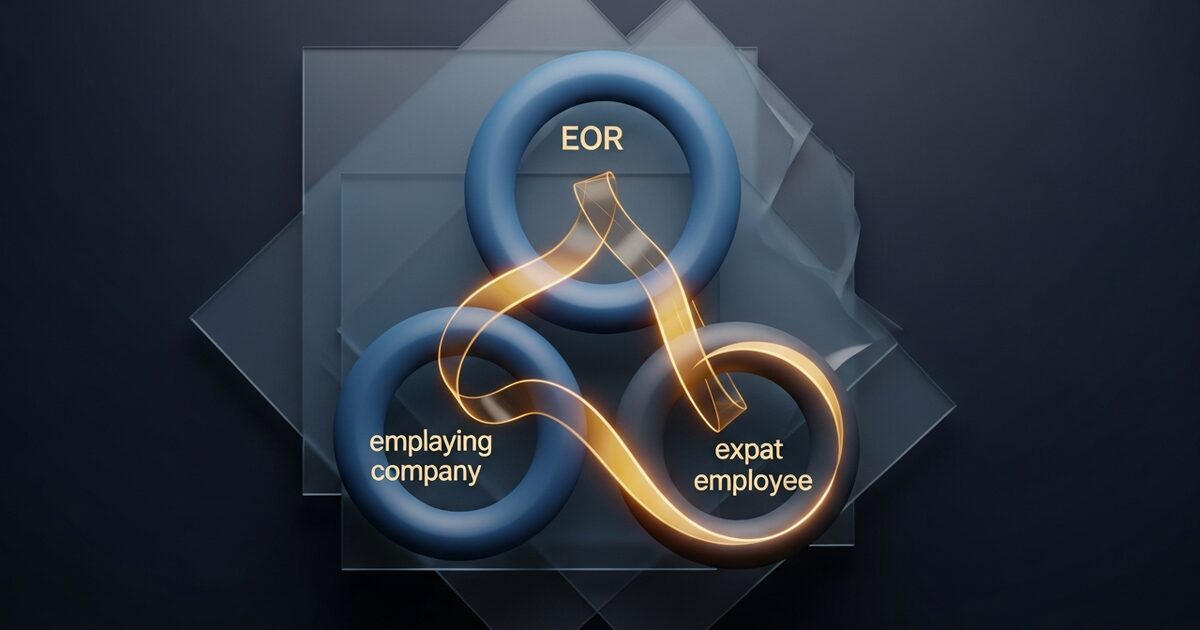
An employer of record is a third-party company that becomes your legal employer in a foreign country while your actual employer retains full operational control over your work. You still report to the same manager, work on the same projects, and receive the same salary. But on paper—and for payroll, tax, and labor law purposes—you are employed by the EOR's local entity in your host country.
The EOR handles:
- Drafting and signing a locally compliant employment contract
- Running local payroll and withholding host country income taxes
- Contributing and remitting local social security equivalents (employer and employee portions)
- Providing statutory benefits required by local law (paid leave, sick leave, severance)
- Registering you with the local tax authority
The EOR does not obtain your work visa or immigration authorization—that remains your responsibility. And the EOR service fee—typically $400 to $650 per month per employee—is charged to your employer, not deducted from your salary.
Can EOR employees claim the Foreign Earned Income Exclusion?
Yes. EOR employees can claim the Foreign Earned Income Exclusion (FEIE) if they satisfy the same tests as any US citizen working abroad. The IRS definition of "foreign earned income" is wages and compensation for personal services performed in a foreign country—the identity of your employer (US company vs. EOR entity) does not disqualify the income.
To qualify, you must meet all three criteria:
- Tax home in a foreign country: Your principal place of business or employment is in the foreign country, not the US.
- Foreign earned income: Your wages are for work physically performed abroad, not for work done remotely from the US.
- Residency test (either/or):
- Bona fide residence test: You are a genuine resident of a foreign country for an entire tax year (January 1 through December 31), or
- Physical presence test: You are physically outside the US for at least 330 full days in any 12-month period
The 2026 FEIE limit is $132,900 per qualifying taxpayer. A couple where both spouses work abroad and qualify can each exclude up to $132,900. Income above the exclusion is still subject to US federal tax at ordinary rates. And critically: the FEIE does not reduce self-employment tax—but EOR employees are not self-employed, so this trap is avoided by the arrangement.
What taxes does an EOR arrangement create?
Working through an EOR replaces US payroll tax withholding with host-country withholding—but your US worldwide reporting obligations remain exactly what they were.
Here is how the layers work:
Host-country income tax and social contributions
The EOR withholds income taxes and social contributions per local law. In Germany, that means income tax at progressive rates plus pension, health, unemployment, and nursing care insurance totaling roughly 40% of gross salary above certain thresholds. In Portugal, it means income tax at progressive rates plus 11% social security employee contribution. The exact numbers vary by country and income level.
The EOR's local entity pays the employer social contribution on top of your salary—typically another 15–35% depending on the country—which your employer factors into the total cost of employing you.
US payroll tax treatment
Once you are employed by a foreign EOR entity rather than directly by your US employer, FICA (Social Security and Medicare) withholding should stop from the US employer's side. You provide your employer a Form W-8BEN (Certificate of Foreign Status) indicating your work is being performed abroad by a foreign employer.
Whether US Social Security taxes apply depends on whether your host country has a Totalization Agreement with the US. Agreements exist with approximately 30 countries, including Germany, France, Portugal, the UK, and Australia. Under these agreements, you pay into only one social security system—typically the host country's—which prevents double coverage and double taxation. See the US totalization agreements guide for a country-by-country breakdown.
Using the Foreign Tax Credit
Host-country income taxes withheld through the EOR are creditable on your US return via the Foreign Tax Credit (Form 1116). If your host country's tax rate is higher than what you'd owe the US on the same income—which is common in Western Europe—you may end up with excess credits that reduce your US liability to zero on amounts above the FEIE limit.
EOR employee vs. independent contractor: the tax difference
The EOR arrangement versus going independent contractor is the most significant financial decision facing US expats who want to work abroad long-term. The wrong choice costs thousands annually.
| Tax Item | EOR Employee | Independent Contractor |
|---|---|---|
| FEIE eligibility | Yes, if residency tests met | Yes, if residency tests met |
| US self-employment tax (~15.3%) | No—employer/EOR covers payroll taxes | Yes, on net earnings above $400 |
| Host country social contributions | Yes, withheld by EOR | Varies; contractor may pay freelancer social taxes |
| Benefits (leave, sick pay) | Covered by EOR per local law | None unless negotiated |
| US Form received | Typically none; local employment docs | 1099-NEC (if US client and over $600) |
The self-employment tax trap is the most expensive difference. A US contractor earning $100,000 abroad and claiming FEIE to zero out income tax still owes the 15.3% self-employment tax on net earnings—roughly $14,130 on $100,000 before the deduction for half SE tax. An EOR employee earning the same amount owes no US self-employment tax. Over five years, that gap exceeds $60,000 before considering the host-country difference.
EOR employee claiming FEIE: $0 US federal income tax + $0 US SE tax = $0 US federal tax due on that $100,000 (assuming full exclusion). Contractor claiming FEIE: $0 income tax + $14,130 self-employment tax = $14,130 US tax due. The EOR employee saves roughly $14,000 per year in US taxes at this income level, offset by the employer's EOR fee cost and any difference in host-country social contributions.
Permanent establishment risk and what it means for you
Permanent establishment (PE) risk is primarily your employer's problem, not yours—but it becomes your problem if your employer faces a PE finding and restructures your arrangement as a result.
A permanent establishment exists when a foreign business has enough of a presence in a country to trigger corporate tax obligations there, even without a registered entity. An employee working in Portugal doesn't automatically create PE for a US company—but an employee who signs contracts on the company's behalf, manages significant client relationships in Portugal, or acts as a "country manager" might.
EOR services reduce PE risk by making the EOR (not your employer) the legal employing entity. But PE risk is not fully eliminated. If your title, scope of authority, and client-facing activities suggest your employer is conducting regular business in the host country through you, tax authorities can still pierce the EOR structure.
For you as the employee, the practical impact is: if your employer gets a PE finding in your host country, they may ask you to restructure as a contractor, relocate, or terminate the arrangement entirely. Knowing this risk exists is useful when negotiating employment terms for a remote international role.
FBAR for EOR employees
Your EOR arrangement doesn't change your FBAR (Foreign Bank Account Report) obligation—what matters is whether you personally hold or control foreign bank accounts with an aggregate value above $10,000 at any point in the year.
The FinCEN Form 114 (FBAR) is due April 15 each year with an automatic extension to October 15. You must file it if:
- You hold foreign personal bank accounts (local checking, savings) exceeding $10,000 aggregate
- You have signature authority over a foreign account you don't own, such as a company account, and the balance exceeds $10,000
The EOR payroll account is not your account—the EOR controls it. But if you open a local bank account in your host country for daily living expenses (which most EOR employees do, since you receive local payroll), that account is yours and must be reported if the balance exceeds the threshold.
FBAR is a reporting obligation, not a tax—but the penalties for non-compliance are severe: up to $10,000 per year for non-willful violations and potentially higher for willful ones. Report early and keep records.

What an EOR arrangement does not cover
An EOR handles host-country employment compliance but does not automatically end your US home-state income tax obligations. Aggressive home states (notably California and New York) continue to assert tax jurisdiction over former residents until formal residency severance steps are taken—regardless of your employment structure. If you were last registered in one of those states, complete the formal departure steps before you leave, not after. The expat home-state income tax guide covers the exact steps by state. A Charles Schwab international account helps here too: it gives you a US banking address without anchoring you to any specific state, and Schwab offers fee-free ATM access globally—useful when receiving local EOR payroll.
EOR providers and what they cost your employer
EOR pricing is typically a flat monthly fee per employee, billed to your employer—not a percentage of your salary. As of 2026, the range runs from about $400 to $650 per month per employee in straightforward markets, with higher-complexity countries (Brazil, France, Germany) sometimes adding surcharges.
| Provider | Approx. Monthly Cost | Notes |
|---|---|---|
| Multiplier | ~$400/employee | Lower-end entry-level option |
| Deel | ~$599/employee | Wide country coverage, add-ons available |
| Remote.com | ~$599/employee ($699 monthly billing) | Strong compliance track record |
| Papaya Global | $599–$770/employee | Enterprise analytics at higher tier |
Contractors managed through EOR platforms are usually cheaper for employers ($29–$40/month) because the employer has no payroll withholding obligation—but that shifts the self-employment tax burden to you.
Documentation checklist for your US tax return
Your EOR employer will issue you local payroll documentation (a Portuguese recibo de vencimento, a German Lohnabrechnung, etc.—not a US W-2). You will need these to claim your Foreign Tax Credit and prove the income qualifies for FEIE.
- All local payroll statements showing gross income, host-country income tax withheld, and social contributions withheld
- Your employment contract with the EOR entity (to document foreign employment status)
- Proof of physical presence or bona fide residence (passport stamps, lease agreements, utility bills)
- Foreign tax receipts or statements from the host country's tax authority confirming taxes paid
- FBAR records: account numbers, maximum balances, institution names for all foreign accounts held
- Evidence of formal US home-state departure (new driver's license in a no-income-tax state or abroad, voter registration update, lease termination)
- Totalization agreement certificate (if applicable) showing which country's social system covers you
Keep all of the above for at least six years. The IRS has a six-year statute of limitations when substantial income is omitted, and some state revenue agencies can look back further on home-state residency disputes.
Should you go EOR or contractor?
For US expats who want to stay employed by their current US company while living abroad legally, the EOR is the cleanest path—it handles local compliance, makes you FEIE-eligible, and avoids the self-employment tax that hits contractors. The tradeoff is that your employer pays a $400–$650 monthly service fee, which may affect how they think about long-term remote arrangements in high-cost EOR markets.
For expats who are willing to go independent—set up a US LLC, invoice their clients, and manage their own foreign tax obligations—the contractor path offers more flexibility and potentially lower overall costs once the business is structured correctly. That route is covered in depth in the self-employment tax guide for expat freelancers.
Either way, FEIE does the heavy lifting on US federal tax—but only if you have the residency documentation, the compliance records, and the home-state residency paperwork completed before you file.
Disclaimer: This article is general educational information, not legal or tax advice. EOR arrangements vary by country and provider. Consult a qualified international tax professional before restructuring your employment arrangement while living abroad.
Sources checked: IRS Foreign Earned Income Exclusion (irs.gov); FinCEN FBAR Report (fincen.gov); EOR provider pricing from Multiplier, Deel, Remote.com, and Papaya Global public pricing pages. FEIE limit verified from IRS inflation adjustment guidance. Checked June 2026.
Frequently asked questions
Can I claim the Foreign Earned Income Exclusion if I am employed by an EOR abroad?
Yes. EOR wages qualify as foreign earned income under IRS rules because the work is performed abroad. You must still pass the bona fide residence or physical presence test. The 2026 FEIE limit is $132,900 per qualifying taxpayer.
Do EOR employees pay US self-employment tax?
No. EOR employees are employed by a foreign entity, so US self-employment tax does not apply. Self-employment tax (15.3%) applies only to self-employed individuals and independent contractors. This is one of the main financial advantages of EOR over contractor status.
Does working through an EOR trigger FBAR reporting?
FBAR is triggered by personal foreign bank accounts over $10,000 in aggregate, not by the EOR arrangement itself. If you open a local bank account to receive your EOR payroll, that account must be reported on FinCEN Form 114 if the balance exceeds $10,000 at any point in the year.
What is the difference between an EOR and an independent contractor arrangement for a US expat?
EOR employees have host-country taxes withheld by the EOR and pay no US self-employment tax. Independent contractors receive full payment and must self-pay both host-country taxes and US self-employment tax on net earnings above $400. At $100,000 in earnings, this difference exceeds $14,000 per year in US taxes alone.
How much does an EOR service cost?
EOR service fees are paid by your employer, not deducted from your salary. As of 2026, major providers charge roughly $400 to $650 per employee per month depending on the provider and host country. Multiplier starts around $400/month; Deel, Remote.com, and Papaya Global typically charge $599 to $650/month per employee.
This guide is general information, not personalized tax, legal, or investment advice. Rules change; verify current thresholds with official sources or a qualified professional before acting.
Related guides
 Expat Tax & FinanceMay 29, 2026
Self-Employment Tax: The Expat Freelancer’s Hidden Bill
FEIE zeroes your income tax abroad—but SE tax still applies. See the exact numbers and legal ways to reduce your bill as a US expat freelancer.
 Expat Tax & FinanceMay 11, 2026
The FEIE Self-Employment Tax Trap for Expat Freelancers
FEIE won't save expat freelancers from SE tax. Learn what you actually owe, which countries offer exemptions, and 3 strategies to reduce the bill.
 Expat Tax & FinanceSeptember 6, 2026
Why 330 Days Abroad Can Still Fail FEIE
Pass the IRS tax home and abode tests before you file Form 2555. A 330-day count without a foreign tax home can wipe out the $130,000 FEIE.