US Totalization Agreements: The $14K Tax Break Expats Miss
If you're self-employed and living in one of 30 specific countries, you may be overpaying the US government by $7,000 to $20,000 every single year.
If you're self-employed and living in one of 30 specific countries, you may be overpaying the US government by $7,000 to $20,000 every single year.
Disclosure: this article contains affiliate links. If you open an account through one of them, Cashflow Abroad may earn a referral commission at no extra cost to you.
The IRS collected an estimated $2.1 billion in duplicate Social Security contributions from Americans abroad in recent years — and most of those people had no idea they were entitled to an exemption. If you're self-employed and living in one of 30 specific countries, you may be overpaying the US government by $7,000 to $20,000 every single year. That exemption has a name almost no one knows: the US Totalization Agreement.
Here's what makes this particularly galling: the exemption exists specifically to prevent double taxation. Congress knew this was a problem and negotiated bilateral agreements to fix it. The problem is that nobody tells you about them — not your bank, not your employer's HR department, and usually not even your accountant unless they specialize in expat taxes.
What Is a Totalization Agreement?
A totalization agreement is a bilateral treaty between the United States and another country that solves two problems simultaneously. First, it determines which country's social security system covers a given worker — so you pay into one system, not both. Second, it allows workers to combine ("totalize") their credits from both countries when calculating benefit eligibility.
Without such an agreement, an American freelancer living in Germany owes the IRS 15.3% of net self-employment income (12.4% Social Security + 2.9% Medicare) and could owe Germany's pension insurance at 18.7% — for the same period of work, protecting the same retirement risk. That's a combined rate exceeding 30% before you've paid a euro in income tax.
The agreement resolves this cleanly: pick one system, pay only that one. For most self-employed Americans who have genuinely relocated to a covered country, this means opting out of US Social Security entirely while abroad — and the savings are substantial.
The Dollar Math
Self-employment tax in the US is calculated on 92.35% of net earnings. Here's what eliminating it saves annually:
| Net Self-Employment Income | Annual SE Tax (15.3%) | Annual Savings With Totalization |
|---|---|---|
| $50,000 | $7,065 | $7,065 |
| $75,000 | $10,598 | $10,598 |
| $100,000 | $14,130 | $14,130 |
| $130,000 | $17,948 | $17,948 |
| $160,200 (2025 SS wage base) | $19,864 | $19,864 |
These aren't deductions — they're full eliminations of the tax line. A freelance developer earning $120,000 in Lisbon who correctly invokes the US-Portugal totalization agreement saves roughly $16,500 per year. Over a 10-year stint abroad, that's $165,000 that never leaves your bank account.
Note: the Social Security portion only applies up to the annual wage base ($176,100 in 2025). Medicare (2.9%) has no cap. In most totalization scenarios, you escape both components entirely.
The 30 Countries With Active Agreements
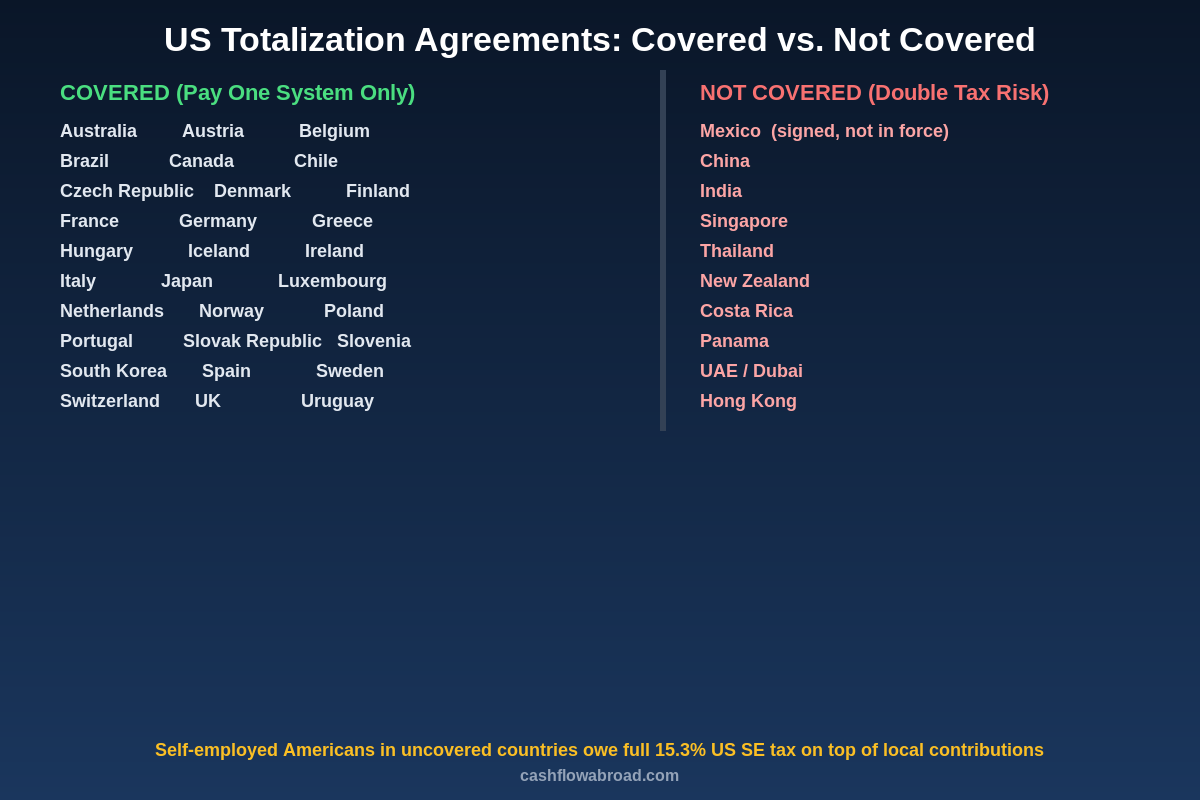
The US currently has active totalization agreements with 30 countries. The SSA maintains the official list, but here it is in full:
| Region | Countries |
|---|---|
| Western Europe | Austria, Belgium, Denmark, Finland, France, Germany, Greece, Iceland, Ireland, Italy, Luxembourg, Netherlands, Norway, Portugal, Spain, Sweden, Switzerland, United Kingdom |
| Eastern Europe | Czech Republic, Hungary, Poland, Slovak Republic, Slovenia |
| Asia-Pacific | Australia, Japan, South Korea |
| Americas | Brazil, Canada, Chile, Uruguay |
That's a heavily European list — 18 of the 30 are EU or EEA countries. If you're in Lisbon, Amsterdam, or Berlin, you're covered. If you're in Bangkok, Singapore, or Mexico City, you're not.
The Coverage Gaps That Will Burn You
The missing countries are where a huge share of the world's digital nomads and geographic arbitrage expats actually live. This is where the list gets painful:
- Mexico — an agreement was signed, but it is NOT in force. It has sat in legal limbo for years over verification and immigration concerns, with no implementation timeline from SSA as of early 2026.
- China, India — enormous gaps for expats working with multinationals
- Singapore, Thailand, Indonesia — three of the top digital nomad hubs in Asia, all uncovered
- New Zealand — surprising gap given Australia is covered
- Costa Rica, Panama — two of the most popular retirement destinations for Americans
- UAE / Dubai — no bilateral agreement
- Colombia — popular geographic arbitrage destination, zero coverage
What this means in practice: if you're a self-employed American freelancing from Chiang Mai, Medellín, or Dubai, you owe the full 15.3% US self-employment tax on all net income. Every year. There is no agreement to invoke. Your only legal paths to reduce that bill are the FEIE (which eliminates income tax but explicitly does not eliminate self-employment tax) or entity-level restructuring — which is a different strategy covered in our FEIE guide.
How Benefit Crediting Works: The Retirement Angle
The second function of these agreements catches long-term expats completely off guard.
To collect US Social Security retirement benefits, you normally need 40 quarters (10 years) of US-covered work. If you left the US at 35 with 32 quarters and spent the next 25 years working in Switzerland, you'd have 32 quarters — 8 short of the threshold. Without totalization, you'd collect nothing from the US system.
With the US-Switzerland agreement, SSA counts your Swiss pension credits to push you over the 40-quarter threshold — but only if you have at least 6 US quarters. Once you qualify, the benefit is calculated on a pro-rata basis: SSA figures what you'd receive if all those years were US-covered, then pays you the fraction reflecting your actual US work record.
In the example above: 32 US quarters out of a hypothetical combined total of 32 + Swiss equivalent quarters. You get your proportionate US share. Switzerland pays its proportionate share separately. You're not double-collecting — you're getting the right fraction from each system.
The minimum 6-quarter threshold is critical. Americans who started working abroad at 22 with only 4 quarters of US covered work are completely locked out of the totalization benefit crediting. This is a common gap for younger expats.
The 5-Year Detached Worker Rule for Employees
If you're an employee (not self-employed) assigned abroad by a US company, there's a separate provision: the detached worker rule. Under most totalization agreements, a US employer can send you abroad and keep you covered under the US Social Security system for up to 5 years — meaning you keep paying US Social Security, and the foreign country exempts you from its system entirely.
US companies use this constantly for international assignments. With a Certificate of Coverage confirming US coverage, both employer and employee continue US Social Security contributions, and German or French social insurance is irrelevant for the duration.
After 5 years, most agreements require switching to the foreign country's system. Extensions exist but require bilateral approval and aren't guaranteed — plan your assignment structure accordingly.
The Certificate of Coverage: The Document That Makes It Real
Knowing about the agreement and actually claiming the exemption are two different things. The operational tool is the Certificate of Coverage (CoC) — an official document from the SSA (if you're claiming US coverage) or the foreign country's agency (if you're claiming coverage under their system) confirming which system has jurisdiction.
Without this document, neither country has documented proof of the other's coverage. A German pension office may still assess contributions. The IRS will still expect Schedule SE with your full self-employment tax. Awareness alone does nothing — the CoC is the trigger that activates the agreement.
How to get a US Certificate of Coverage:
- Online: opts.ssa.gov (the SSA's online CoC application portal)
- Fax: (410) 966-1861
- Phone: (410) 965-7306
- Processing time: typically 4–8 weeks — apply before you move, not after the fact
What to do when filing taxes: Self-employed expats should attach the CoC to Schedule SE and write "Exempt — US-[Country] Totalization Agreement" on the self-employment tax line. Some tax software doesn't handle this well — if yours doesn't, paper filing or a specialized expat CPA is the cleaner path.
One practical necessity for managing all of this from abroad: a US mailing address for IRS correspondence, SSA notices, and financial institutions. Many expats use a virtual mailbox like Traveling Mailbox — a real US street address in 50+ cities, with mail scanning and forwarding, for $15/month. Anything SSA or IRS sends you goes there. See our virtual mailbox guide for the full setup logic.

The WEP Repeal: The Biggest Social Security Change in Decades
January 5, 2025 was a landmark date for anyone who spent significant time working under a foreign pension system. The Social Security Fairness Act was signed into law, repealing both the Windfall Elimination Provision (WEP) and the Government Pension Offset (GPO).
The WEP was a formula that permanently reduced US Social Security retirement benefits for people who also received a pension from work not covered by US Social Security — which explicitly included foreign pension systems under totalization agreements. The maximum WEP reduction in 2024 was $587 per month. For someone with 20 years of retirement ahead of them, that was $140,880 in lifetime benefits permanently withheld.
The repeal was retroactive to January 2024. By July 7, 2025, SSA had sent retroactive lump-sum payments to 3.1 million people totaling $17 billion. The average monthly benefit increase was $360/month — not a one-time windfall, a permanent monthly increase for life.
If you or a family member spent years working in a covered country and are now receiving (or approaching) US Social Security benefits, verify your current benefit statement. Log into my.ssa.gov and check whether your amount has been updated post-repeal. SSA processing has had backlogs; not everyone has received their corrected benefit amount automatically. A phone call to confirm takes 20 minutes and could be worth hundreds of dollars per month indefinitely.
How This Interacts With FEIE and the Foreign Tax Credit
A common and expensive misconception: the Foreign Earned Income Exclusion (FEIE) does not eliminate self-employment tax. The FEIE excludes up to $126,500 (2024) of foreign earned income from federal income tax — but Schedule SE is calculated separately on a completely different part of the tax return.
You can have zero federal income tax liability through FEIE and still owe $14,000+ in self-employment tax on the same income. Many expats discover this after their first year abroad, when their accountant presents a bill they didn't expect.
A totalization agreement, properly invoked, eliminates the Schedule SE line entirely. These aren't competing strategies — they work together. An expat in Portugal could use FEIE to eliminate income tax while using the US-Portugal totalization agreement to eliminate self-employment tax. Two separate legal mechanisms, each handling a different layer of the tax stack.
The full picture — FBAR, FATCA, FEIE, Foreign Tax Credit, and SE tax — is genuinely complex. Anyone earning self-employment income above $50,000 abroad should work with a specialized expat CPA for at least the first year. The consultation cost pays for itself many times over in avoided structural mistakes.
Banking and Financial Infrastructure for Covered Countries
If you've relocated to a totalization agreement country, your financial infrastructure matters as much as your tax structure. A few tools worth knowing about:
Charles Schwab's international brokerage and bank account remains the benchmark for US expats. No foreign transaction fees, ATM reimbursements worldwide, and the account stays open when you have a foreign address — unlike Fidelity and Vanguard, which quietly close expat accounts once they detect you've moved abroad. (We've covered this in detail in the geographic arbitrage playbook.)
For US business banking while running a remote operation from a covered country, Mercury is built for this exact use case — free US business banking, fast wires, no minimums, and no friction about the account holder being based in Lisbon or Amsterdam.
On the investing side, the expat investing landscape has specific landmines — PFICs being the biggest — that are worth understanding before you open brokerage accounts in your country of residence.
Action Steps: Making the Exemption Work
- Confirm your country is covered. Check ssa.gov/international for the current active list. Mexico, despite years of rumors, is not in force as of early 2026.
- Determine which system covers you. If you're a US employee temporarily abroad (under 5 years): US coverage continues. If you're self-employed and have genuinely relocated: the foreign country's system typically covers you after establishing residence.
- Apply for your Certificate of Coverage before you move — or as soon as possible after. Retroactive applications are processed but slower, and late applications create documentation headaches with foreign authorities.
- Note it on Schedule SE. Write the exemption language directly on the form and attach the CoC. Make sure your tax preparer understands totalization agreements — not all generalist CPAs do.
- Verify your Social Security statement post-WEP repeal. Log into my.ssa.gov. If WEP was previously applied to your benefit estimates, those figures should have been corrected and you may be owed retroactive payments from January 2024 forward.
- Have a plan if you're in a gap country. Moving to Singapore or Medellín? Explore S-Corp election or other entity structures as ways to reduce (not eliminate) SE tax. These strategies have their own costs and requirements — don't implement them without professional guidance.
The Bottom Line
Totalization agreements are one of the highest-value, lowest-effort tax tools available to self-employed US expats — and they're almost invisible. The IRS doesn't remind you they exist. Your bank doesn't mention them. Most generic tax software doesn't prompt you. You have to know to look.
If you're earning $100,000+ as a self-employed expat in a covered country and you're not invoking this agreement, you're leaving $14,000+ on the table every single year. Over a decade abroad, that's a down payment on a house, a fully funded retirement account, or financial independence years earlier than you'd otherwise reach it.
The actual paperwork is a Certificate of Coverage request and a note on Schedule SE. That's it. The 10-year ROI on that one afternoon of paperwork is extraordinary — and the WEP repeal has now restored lifetime benefit value on top of that for anyone who spent years working under a foreign pension system.
For more on the full US expat tax picture, see our complete expat banking and tax guide. If you're thinking through the retirement implications specifically, the Social Security abroad guide covers how to maximize what you'll eventually collect regardless of where you've lived.
Financial Disclaimer: This article is for informational purposes only and does not constitute tax, legal, or financial advice. Tax laws and international agreements change frequently. Consult a qualified CPA or tax attorney who specializes in US expat taxation before making decisions based on this information. The interaction between totalization agreements, FEIE, and self-employment tax is complex — individual circumstances vary significantly.
This guide is general information, not personalized tax, legal, or investment advice. Rules change; verify current thresholds with official sources or a qualified professional before acting.
Related guides
 Expat Tax & FinanceSeptember 29, 2026
Sales Tax Nexus When You Sell From Abroad
Compare the $100,000 and $500,000 state tests before you invoice US customers from abroad, including Illinois's 15% missing-address rule.
 Expat Tax & FinanceSeptember 19, 2026
IRS Interest Starts April 15 for Expats
Pay the IRS by April 15 even if you live abroad. Daily interest still runs, and the 0.5% monthly failure-to-pay penalty is a separate meter.
 Expat Tax & FinanceSeptember 16, 2026
Keep a US 529 After You Move to Canada
CRA bills 529 growth that the IRS leaves untouched. Compare keep, gift, Roth rollover, and RESP options before you take up Canadian residence.