Argentina for US Expats: Costs, Visas, Banking
US dollar earners can live comfortably in Buenos Aires for $1,500/month. Complete guide to Argentina visas, banking, taxes, and healthcare for American expats.
US dollar earners can live comfortably in Buenos Aires for $1,500/month. Complete guide to Argentina visas, banking, taxes, and healthcare for US expats.
Disclosure: this article contains affiliate links. If you open an account through one of them, Cashflow Abroad may earn a referral commission at no extra cost to you.
When Argentine annual inflation hit 211% in late 2023, conventional wisdom said stay away. Meanwhile, the dollar earners already living in Buenos Aires were quietly watching their $2,000 monthly salary cover rent in Palermo, nightly steak dinners, and private health insurance — with money left over.
They weren't wrong to stay. And you're not wrong to look now.
Javier Milei's shock-therapy reforms have driven annual inflation from 211% down to 31.8% as of November 2025 — the lowest in seven years — with projections for 18–20% in 2026. The government lifted nearly all currency controls in April 2025, backed by a $20 billion IMF deal. The notorious "blue dollar" gap that once let black-market exchangers pocket a 100%+ premium has collapsed to roughly 2–3%. Exchange rates have effectively converged at around 1,460 pesos per dollar.
What hasn't changed: Argentina is still one of the cheapest countries on earth for anyone earning in dollars. That gap between what you earn and what things cost is the definition of geographic arbitrage — and Buenos Aires delivers it at world-class-city quality.
What It Actually Costs to Live in Argentina
Buenos Aires has neighborhoods ranging from grunge-chic La Boca to polished Recoleta. Most expats land in Palermo, San Telmo, or Villa Crespo — walkable, transit-connected, and dense with independent coffee shops. Here's what a realistic monthly budget looks like in USD:
| Expense | Budget Tier (USD/mo) | Comfortable Tier (USD/mo) |
|---|---|---|
| Rent (1BR furnished, central) | $400–$550 | $650–$900 |
| Groceries | $150–$200 | $200–$270 |
| Dining out | $100–$150 | $200–$350 |
| Public transport (Subte + bus) | $15–$18 | $15–$18 |
| Private health insurance (Prepaga) | $83–$120 | $120–$208 |
| Utilities + high-speed internet | $40–$60 | $60–$90 |
| Misc (gym, entertainment, personal) | $80–$120 | $150–$250 |
| Monthly Total | $868–$1,218 | $1,395–$2,086 |
That mid-range dinner for two at a Buenos Aires restaurant runs about $60. A cortado and medialunas at a Palermo café: under $3. A gym membership at a decent facility: $25–$40/month. A 45-minute Uber across the city: $3–$5. The math is genuinely absurd compared to any major Western city.
Outside Buenos Aires, costs fall another 20–35%. Mendoza, nestled in wine country at the foot of the Andes, runs around $1,000–$1,400/month comfortably. Córdoba — Argentina's second city and home to a massive university — is even cheaper. Bariloche delivers Patagonian scenery for a modest premium on housing.
One honest caveat: grocery prices have crept toward Western levels as the peso stabilized and import restrictions eased. Imported goods — electronics, certain brands — cost closer to international prices. Where Argentina wins hardest is in locally-produced food, services, rent, and anything priced in pesos by Argentines for Argentines.
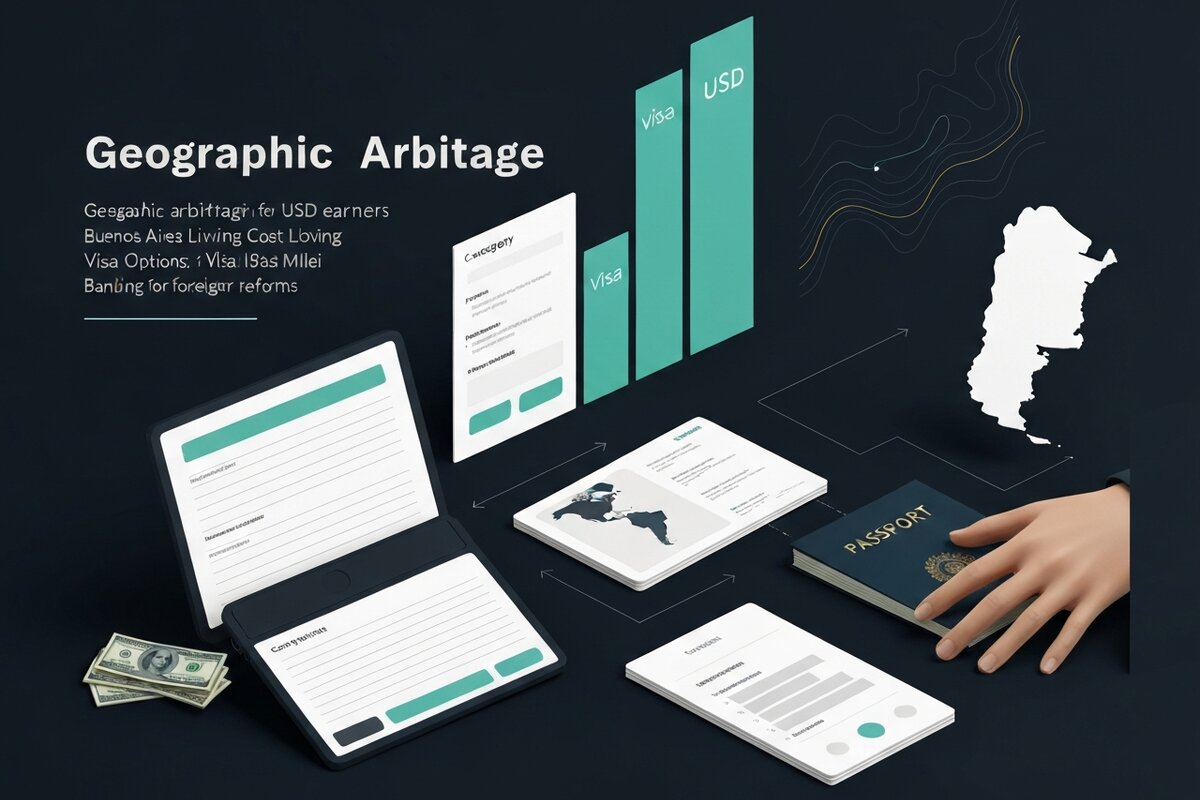
Your Visa Roadmap: Tourist to Residency
Americans enter Argentina visa-free for 90 days. You can extend once at a local Migraciones office for another 90 days — 180 total. After that, a border hop to Uruguay or Chile resets the clock. Many short-stay expats live on this rhythm indefinitely, though it creates a grey zone legally.
For anything longer and more structured, Argentina offers three main paths:
| Visa Type | Duration | Income Requirement | Fee | Best For |
|---|---|---|---|---|
| Digital Nomad Visa | 180 days (extendable to 360) | ~$1,500/month from foreign sources | $117–$200 | Remote workers, freelancers |
| Rentista Visa | 1 year (renewable) | ~$2,000/month passive income | ~$250 | Investors, passive-income earners |
| Pensionado Visa | 1 year (renewable) | ~$2,000/month pension income | ~$250 | US Social Security recipients, retirees |
Argentina introduced its Digital Nomad Visa in 2022. Processing takes 10–45 business days. There's no fixed income floor in the law, but consulates look for stable monthly foreign income — $1,500 is the informal minimum. You'll need contracts, invoices, or bank statements to show it.
The Rentista and Pensionado routes lead to temporary residency and eventually permanent status. After two years of continuous temporary residency, you can apply for permanent. After three years as a permanent resident, you're eligible for Argentine citizenship — and an Argentine passport grants Mercosur travel rights across South America.
Under Milei-era Decree 366/2025, temporary visa holders must hold private health insurance for the duration of their stay. Prepaga plans start at $83/month for basic adult coverage — a reasonable mandatory cost baked into the budget anyway.
Banking in Argentina as a Foreigner
This is where most expat guides get deliberately vague. Here's the actual situation.
To open a traditional Argentine bank account, you need a CUIL or CUIT — Argentina's tax identification number. Tourists don't have one. Once you're on a residency visa and have applied for a DNI (National Identity Document), you can get a CUIL through ANSES relatively quickly. Without it, most brick-and-mortar banks will decline you.
Before you have local residency documentation, your toolkit is:
- Charles Schwab International Checking — The single best expat banking tool in Argentina. Schwab reimburses all ATM fees worldwide, gives you the real interbank exchange rate, and charges zero foreign transaction fees. Withdraw pesos from Argentine ATMs at the now-unified official rate. This is your primary day-to-day spending mechanism for the first several months.
- Brubank — A fully digital Argentine bank that's significantly more foreigner-friendly than traditional institutions. Brubank supports USD-denominated accounts — useful for anyone who wants local banking but doesn't want peso exposure on their savings.
- Mercado Pago / Ualá — Digital wallets accepted nearly everywhere in Argentina (roughly 60% of Argentine transactions run through Mercado Pago). Neither requires a CUIL to get started and both work immediately for everyday payments while your formal documentation processes.
- ARQ Finance — A stablecoin-powered fintech that holds balances in USDc or EURc, swaps to ARS (and other LATAM currencies) at competitive rates, and includes a cashback Mastercard. ARQ supports USDC/USDT deposits from external wallets and earns up to 4% on dollar balances. Available in Argentina, Mexico, Colombia, and Brazil — useful if you're building a regional lifestyle.
For sending money from the US, Remitly offers transparent rates to Argentine bank accounts with fees disclosed upfront. Now that Argentina's exchange rates have unified, the complexity of the old multi-rate system is largely gone — you get a clear, fair conversion. For a deeper look at hidden transfer fees, see our money transfer guide.
One non-negotiable: maintain a US banking address while abroad. A virtual mailbox through Traveling Mailbox ($15/month) gives you a real US street address for banking, IRS correspondence, and state domicile — preventing the account closures that blindside expats who forget to update their address before moving.

What You Owe the IRS (and Argentina)
The US and Argentina have no tax treaty. That's the first thing to internalize. There's no special bilateral protection against double taxation — you rely instead on the standard tools available to all US citizens abroad.
Your US filing obligation doesn't end when you move. Every citizen files every year. The levers available to minimize US tax:
- Foreign Earned Income Exclusion (FEIE) — Excludes up to $130,000 (2025 tax year, filed in 2026) of foreign-earned income from US federal income tax. You qualify via the bona fide residence test (legal resident of Argentina) or physical presence test (330+ days outside the US in a 12-month period). Most expats in Argentina qualify on both. See our complete FEIE guide for how to structure this correctly.
- Foreign Tax Credit (FTC) — Offsets US tax dollar-for-dollar against Argentine taxes paid. If Argentina taxes you at 18% and your marginal US rate on that income would be 22%, the FTC absorbs most of the gap. No double taxation in practice, even without a treaty.
Argentina's own tax system is progressive at 5–35% on income. The trigger for becoming an Argentine tax resident: living there 12+ months, or obtaining permanent residency. During your first 12 months in Argentina, foreign-source income is generally exempt from Argentine income tax — a useful honeymoon window to establish yourself before full resident obligations kick in.
FBAR (FinCEN 114) is required if any foreign accounts — including Argentine bank accounts — exceed $10,000 at any point during the year. This is a disclosure form, not a tax payment, but penalties for missing it are severe. PFIC rules may apply if you purchase Argentine mutual funds or local ETFs; keeping your investment portfolio in US-domiciled funds avoids this trap. See our expat investing guide for the PFIC explanation.
Healthcare: Prepaga or International Insurance
Argentina has a functioning public healthcare system, and legal residents can access it. The quality varies significantly by facility and province, and wait times at public hospitals can be long. Most expats go private — and private healthcare in Argentina is genuinely good, particularly in Buenos Aires.
Private plans called prepagas are the standard for Argentina's middle class. Monthly costs per adult as of May 2026 range from roughly $83 (entry-level plans) to $208 (mid-tier OSDE-style coverage). Major providers include OSDE, Swiss Medical, Galeno, and Medifé — all with real hospital networks and legitimate specialist access.
Prepaga costs are peso-denominated. They've risen about 30% year-over-year in peso terms as providers adjust for inflation. But because the peso is now more stable and your income is in dollars, the USD cost has actually declined from the peak chaos years. An OSDE 310 plan for a 35-year-old runs $120–$140/month — real coverage, not a tourist shell product.
If you're arriving on a tourist or Digital Nomad Visa and can't yet access prepagas, SafetyWing Nomad Insurance ($56–$100/month depending on age) is designed for exactly this window. You can activate it from anywhere, instantly, with no waiting periods for illness. Once you have local residency and CUIL, transition to a prepaga for local GP access — and keep SafetyWing for international travel coverage. For the full breakdown on building an expat health stack, see our expat health insurance guide.
Where to Base Yourself
Argentina's geography spans 2.8 million square kilometers. Your base matters.
Buenos Aires is the default — a proper global city with Michelin-caliber restaurants, active nightlife, tango culture, fiber-optic internet, and a large English-speaking expat community. Palermo Soho and Hollywood are the nomad hubs. Recoleta is quieter and more upscale. San Telmo has cobblestoned atmosphere. Coworking spaces run $80–$150/month for a dedicated desk at serious facilities.
Mendoza costs 20–30% less than Buenos Aires and sits at the foot of the Andes with day-trip access to ski resorts and world-class wine regions. Small enough to feel manageable, big enough to have a real food scene and consistent high-speed internet. Growing remote-work community, especially among outdoor-oriented expats.
Córdoba is Argentina's second-largest city — younger, cheaper, and increasingly connected. Driven by a massive university population, it has active culture and very low cost of living. Less international polish than Buenos Aires, but excellent value.
Bariloche offers Patagonia at its most spectacular: mountain scenery, skiing in winter, world-class trekking in summer, and a quirky alpine-Germanic town aesthetic. The tradeoff is geographic isolation — flights are limited and relatively expensive, and the town is small. Best for those who genuinely prioritize outdoor access over urban connectivity.
The Realistic Assessment
Argentina is not a frictionless destination. The banking setup takes real effort — expect weeks, not days. The absence of a US tax treaty means your tax planning has no structural backstop beyond FEIE and FTC (which are robust, but require competent preparation). The political and economic environment, while dramatically improved, remains higher-variance than Western European alternatives.
But for the right profile — a dollar earner with $2,500–$5,000/month in remote income who wants genuine urban quality of life at a fraction of its cost elsewhere — Buenos Aires is one of the most compelling geographic arbitrage plays operating right now. A lifestyle that would require $6,000–$8,000/month in New York or San Francisco runs $1,500–$2,500 here. The visa framework is legal and accessible. The food and culture are legitimately world-class. The people are warm and cosmopolitan.
The expats who stayed through Argentina's worst years made money and memories. The ones arriving now get a more stable version of the same asymmetric deal.
Financial Disclaimer: This article is for informational purposes only and does not constitute tax, legal, immigration, or financial advice. Tax rules, visa requirements, and cost-of-living figures change frequently and vary based on individual circumstances. Consult a qualified international tax professional and immigration attorney before making relocation or financial decisions. ARQ Finance and other services mentioned are not investment advisors. All investing involves risk, including possible loss of principal. Exchange rates and prices referenced reflect conditions as of the date of publication.
This guide is general information, not personalized tax, legal, or investment advice. Rules change; verify current thresholds with official sources or a qualified professional before acting.
Next step
Run Argentina through the country filter
Argentina can be compelling for dollar earners, but currency rules, tax residence, healthcare, and banking need a full-stack comparison.
Related guides
 Geographic ArbitrageMay 15, 2026
Argentina Expat Guide: Why Dollars Go Further in Buenos Aires
US expats can live well in Buenos Aires for $1,200–$1,600/month. Visa options, tax rules, banking, and neighborhoods explained.
 Geographic ArbitrageApril 30, 2026
Argentina Expat Guide: Dollar Income, Peso Prices
Live comfortably in Buenos Aires for $1,500/month. Full guide to cost of living, tax rules, residency visas, and banking after Milei's 2025 reforms.
 Geographic ArbitrageMay 24, 2026
Costa Rica Expat Guide: $2,100/Month, 0% Foreign Tax
Costa Rica taxes zero on foreign income. Live on $2,100/month and qualify with $1k/month SS. Complete visa, tax, banking, and cost of living guide.