US Company EU VAT Number: When You Need One
Learn when a US company selling to EU customers needs VAT registration, OSS, IOSS, reverse charge, or marketplace handling.

- B2B services to VAT-registered EU companies often use reverse charge, so the buyer accounts for VAT in their country.
- The Non-Union OSS lets non-EU businesses register in one EU country for covered services sold to EU consumers.
- IOSS applies to distance sales of imported goods from outside the EU in orders up to EUR 150 per order.
- From July 1, 2026, the EU adds a temporary EUR 3 customs duty on many low-value parcels worth up to EUR 150.
- VAT collected from EU customers is a payable, not revenue, so it should be separated before cash-flow decisions.
A $49 digital template sold to a customer in Germany can create a VAT question for a US company with no office, employee, or bank account in Europe. The mistake is assuming “US LLC” means “US tax only.” EU VAT follows the transaction, the customer type, and the place-of-supply rules.
This guide is for US founders, freelancers, ecommerce operators, and expats running a US company from abroad. It is practical, not encyclopedic: decide whether you are selling B2B services, B2C services, digital products, physical goods, or marketplace-handled sales, then choose the right registration path. For broader operating context, see running a US business while living abroad and the Expat Business & Remote Work hub.
When a US Company Needs EU VAT
A US company may need EU VAT handling when it sells to EU consumers, imports low-value goods to EU customers, stores goods in Europe, or supplies services where EU place-of-taxation rules put the sale in a Member State. It may not need to charge VAT on many B2B services if the EU business customer accounts for VAT under reverse charge.
VAT number vs. VAT obligation
An EU VAT number is an identifier used for VAT registration and reporting. The real question is not “Can I get a VAT number?” It is “Who is responsible for charging, reporting, and paying VAT on this transaction?” Sometimes the seller handles it. Sometimes the buyer handles it. Sometimes a marketplace is treated as the seller for VAT purposes.
B2B Services: Often Reverse Charge
If a US company sells many services to a VAT-registered EU business, the EU customer may account for VAT under the reverse charge procedure. The European Union's business VAT guidance says that when selling services to businesses in another EU country, you usually do not need to charge your customers VAT; the customer pays VAT on the services received at the rate in their country using reverse charge.
What to collect from business customers
For B2B sales, collect the legal business name, billing country, VAT ID where applicable, contract entity, and evidence that the buyer is acting as a business. Your invoice should be consistent with the reverse-charge treatment your tax adviser approves for that service type.
Do not assume every “business-looking” buyer is a business for VAT. A solo buyer using a personal email, a non-taxable organization, or a customer who cannot provide valid business details may fall into a consumer workflow instead.
100 EU B2B software setup calls at $300 each can be $30,000 of revenue, but the VAT workflow depends on customer status, not revenue alone.
B2C Services and Digital Products
B2C is where many US operators need to slow down. EU guidance says telecommunications, broadcasting, and electronic services are taxed in the customer's country. The One Stop Shop system lets non-EU businesses use the Non-Union scheme for services supplied to EU consumers.

Non-Union OSS
The EU One Stop Shop guidance says the Non-Union scheme is for businesses established outside the EU with no EU fixed establishment, and it covers services supplied to EU consumers. A non-EU business can choose one EU country for OSS registration and submit a quarterly return through that country.
This can matter for paid communities, downloadable templates, courses, SaaS, membership content, apps, and some remote professional services. The boundary is not always intuitive, so classify the offer before launching EU checkout.
| Sale type | Typical VAT route | Useful evidence | Common mistake |
|---|---|---|---|
| B2B consulting to EU company | Reverse charge often applies | VAT ID, contract entity, billing address, business use | Charging consumer VAT without checking buyer status |
| B2C digital product | Non-Union OSS may be needed | Customer country evidence and VAT rate by destination | Using one flat global price and ignoring EU destination VAT |
| Imported goods up to EUR 150 | IOSS can simplify import VAT | Order value, customs data, customer country, IOSS number if used | Letting customers discover VAT and fees only at delivery |
| Marketplace-facilitated sale | Marketplace may be deemed supplier in certain cases | Marketplace tax reports and seller settings | Assuming the platform covers every country and product type |
| Goods stored inside the EU | Local VAT registration may be required | Inventory location, fulfillment records, local tax registration | Using OSS language for inventory that creates local obligations |
Physical Goods: IOSS, Marketplaces, and Customs
Physical goods are different from services because import VAT and customs rules enter the picture. The EU's Import One Stop Shop, or IOSS, is designed for distance sales of imported goods from outside the EU in orders up to EUR 150.
The EUR 150 line
The EU OSS page says the Import scheme applies to imported low-value goods up to EUR 150 per order and lets VAT be collected at payment, which avoids the customer having to pay VAT on delivery. The European Commission's customs page also describes low-value consignments as goods worth less than EUR 150.
As of July 2026, there is another cost to watch. The European Commission announced that from July 1, 2026, the EU introduces a temporary EUR 3 customs duty on low-value parcels imported from outside the EU, mainly through ecommerce, for goods worth up to EUR 150. That duty is separate from VAT and can affect pricing, landed cost, and customer experience.

Registration Paths for US Operators
A US company usually has four practical paths: no VAT registration because the buyer accounts for VAT, Non-Union OSS for B2C services, IOSS for low-value imported goods, or local VAT registration when inventory, local operations, or special rules require it. Marketplace sellers need a fifth check: whether the platform is deemed to collect and remit VAT for the transaction.
One registration is not always enough
The OSS reduces multiple registrations for covered sales, but it is not a magic EU tax shield. The EU OSS guidance says non-EU established businesses cannot use the Union scheme to declare and pay VAT due on supplies of services; instead, they can use the Non-Union scheme for services to EU consumers. For imported goods, IOSS is its own scheme and monthly return system.
Local registration can still come up if you store inventory in an EU country, use local fulfillment arrangements, sell excise goods, make excluded supplies, or cross into country-specific obligations. A remote founder living in Mexico or Colombia can still create EU VAT obligations through a US company if the transaction chain points to EU customers.
Edge Cases That Change the Answer
Several facts can change the VAT route even when the headline sale looks simple. The most common are mixed bundles, subscriptions with both digital and human service elements, local fulfillment, marketplace overlap, and customers who shift from business to consumer status during checkout.
Bundles and mixed offers
A course plus live coaching call is not always the same VAT analysis as a downloadable course alone. A physical product plus a paid setup service may need separate lines in the pricing file. If the invoice combines goods, digital access, support, and shipping into one price, ask whether each component follows the same place-of-supply rule before you automate tax collection.
Subscription businesses should also watch customer evidence over time. A buyer may start with a valid VAT ID, then change billing details, move countries, cancel a business registration, or add consumer users. Store enough history to explain why a transaction was treated as B2B, B2C, marketplace-collected, or outside scope at the time it happened.
A Workflow Before You Sell to the EU
Build this workflow before your first EU checkout page goes live. Retrofitting VAT after the first hundred orders is usually more expensive than adding the right fields and logic upfront.
- Map the offer. Separate services, digital products, physical goods, subscriptions, and marketplace listings.
- Classify the customer. Determine whether the buyer is a business, consumer, non-taxable organization, or marketplace-handled customer.
- Capture country evidence. Keep billing country, IP or payment evidence where appropriate, shipping country, and VAT ID where applicable.
- Choose the VAT route. Reverse charge, Non-Union OSS, IOSS, marketplace collection, or local VAT registration.
- Price the landed cost. Add VAT, platform fees, shipping, customs duty, returns, and refund risk before setting public prices.
- Configure checkout. Show taxes, collect location data, validate VAT IDs, and store invoices consistently.
- Reconcile monthly or quarterly. Match payment processor exports, platform reports, refunds, and VAT returns.
- Review before scaling ads. Do not scale EU acquisition until the tax workflow has survived refunds, failed payments, and country mix changes.
Tool Stack and Cash Flow
For a lean remote business, the stack can be simple: a checkout system that handles tax logic, a payment processor, accounting software, a VAT evidence folder, and a monthly reconciliation routine. The hidden cost is not only VAT paid; it is admin time, adviser time, refunds, and blocked shipments.
Cash-flow timing
VAT collected from a customer is not revenue. Treat it as a payable from the first day it hits your account. If your checkout deposits gross receipts and your accounting file treats everything as sales, you can overstate cash flow and spend money that belongs in the next VAT return.
For a broader portable-income frame, compare this with building a $100K online business from anywhere. The point is not to avoid Europe; it is to make EU revenue predictable enough that compliance does not eat the margin.
Conclusion
A US company does not need an EU VAT number for every EU sale, but it does need a VAT decision for every EU sales model. B2B services, consumer digital products, imported goods, marketplace sales, and EU-stored inventory follow different paths.
The practical move is to classify the transaction before you optimize the business. If you know who the customer is, what you sold, where it is consumed or delivered, and who is responsible for VAT, the registration question becomes much easier.
Data Notes / Sources Checked
Sources checked in July 2026: EU One Stop Shop guidance, EU cross-border VAT guidance, European Commission goods bought online, European Commission EUR 3 customs duty announcement, European Commission low-value consignment formalities, and European Commission place of taxation guidance.
Frequently asked questions
Does a US company need an EU VAT number to sell services?
Sometimes. B2B services often use reverse charge, while B2C services or digital products may require Non-Union OSS or another VAT route.
What is the EU Non-Union OSS scheme?
It is an EU VAT scheme for businesses established outside the EU with no EU fixed establishment that supply covered services to EU consumers.
When does IOSS apply to US ecommerce sellers?
IOSS can apply when a seller imports low-value goods from outside the EU to EU consumers in orders up to EUR 150 and collects VAT at checkout.
Can a marketplace handle EU VAT for a US seller?
In some cases a marketplace may be deemed the supplier for VAT and handle collection, but sellers still need reports and should verify product and country coverage.
This guide is general information, not personalized tax, legal, or investment advice. Rules change; verify current thresholds with official sources or a qualified professional before acting.
Related guides
 Expat Business & Remote WorkJuly 10, 2026
EU VAT for US Digital Sellers: A Practical Guide
US expats selling digital products to EU consumers owe VAT once sales top €10,000/year. How OSS registration, B2B reverse charge, and platform
 Expat Business & Remote WorkAugust 7, 2026
US LLC Annual Reports While Abroad
Track state LLC annual reports, franchise taxes, statutory contacts, and good-standing proof while running a US company abroad.
 Expat Business & Remote WorkMarch 31, 2026
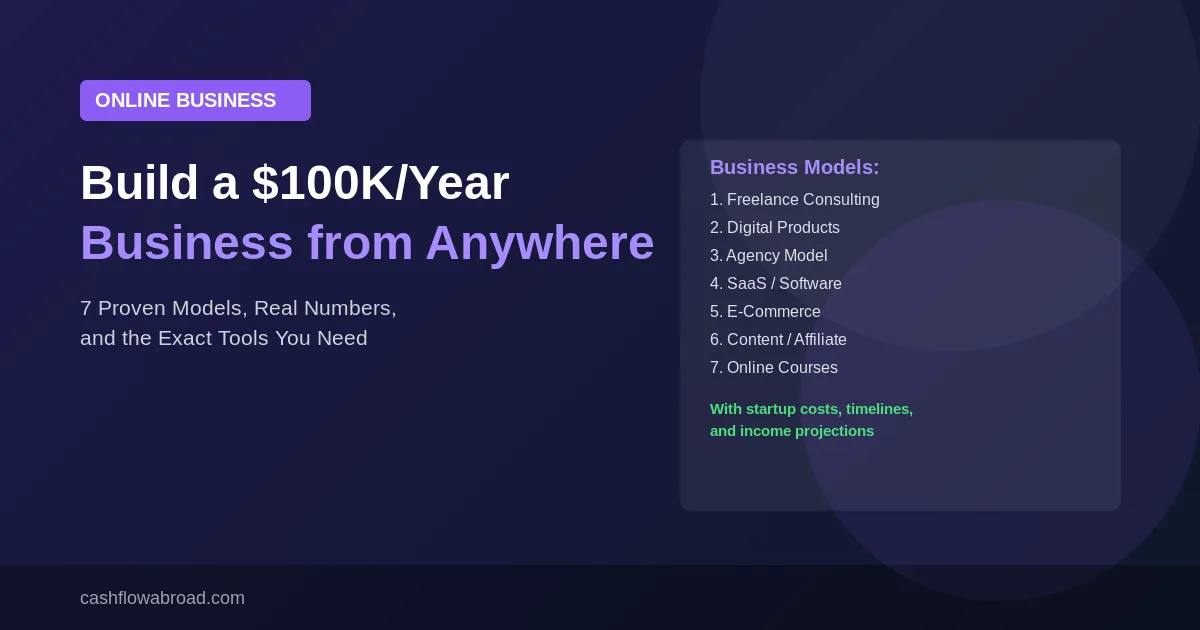
How to Build a $100K/Year Online Business You Can Run from Anywhere
You don't need a brilliant idea, VC funding, or a Silicon Valley address to build a six-figure business. Full LLC setup walkthrough here.