Paraguay Tax Residency: Zero Foreign Tax, Zero Days Required
9 min read · 2,282 words
The most powerful territorial tax residency in the Western Hemisphere requires no investment, no bank deposit, and — remarkably — zero days per year of physical presence. Paraguay has quietly become the go-to second residency for digital nomads, crypto traders, and early retirees who want a legitimate low-tax legal structure without the six-figure price tags that Panama and Uruguay now demand. Yet it barely makes the mainstream expat conversation.
That’s changing fast. In 2025 and 2026, Paraguay residency inquiries from North Americans and Europeans surged as Panama raised its Friendly Nations threshold to $200,000 and Uruguay began requiring $130,000 in local assets. Paraguay meanwhile kept its doors open — no investment required, government fees under $1,200, and a cost of living so low that $700/month covers a comfortable lifestyle in the capital.
Here’s what makes this interesting: Paraguay taxes zero percent on all foreign-sourced income. No capital gains on overseas investments. No tax on remote work income earned from foreign clients. No tax on dividends from foreign companies. The only income Paraguay wants a piece of is money you earn inside its borders — and most expats earn nothing there.
How Paraguay’s Territorial Tax System Actually Works
Most countries tax residents on their worldwide income — the US, UK, Germany, Australia. A handful use territorial taxation, meaning they only tax income generated within their borders. Paraguay runs the most extreme and accessible version of this system available today.
Under Paraguay’s current tax code, the Personal Income Tax (Impuesto a la Renta Personal, or IRP) applies only to income with a Paraguayan source. Foreign-sourced income — dividends from US ETFs, freelance income paid by foreign clients, rental income from property abroad, crypto gains on foreign exchanges — is taxed at exactly 0%.
For income that is sourced in Paraguay, the flat rate is 10%. Corporate tax (IRE) is also capped at 10% flat. These are among the lowest flat rates in the entire region, competitive with Georgia and Bulgaria.
What counts as “Paraguayan-sourced”? Income from Paraguayan businesses, Paraguayan real estate, Paraguayan clients paying for services rendered inside the country. The moment the economic activity crosses the border, it exits Paraguay’s tax net entirely. A US remote worker paid by a US company, billing from a laptop in Asunción, earns foreign-sourced income. Paraguay sees none of it.
The US Citizen Reality Check
One non-negotiable fact before you start browsing Asunción apartments: the US taxes its citizens on worldwide income regardless of where they live. Moving to Paraguay doesn’t eliminate your IRS obligation. Paraguay’s 0% is real, but it runs parallel to US taxation rather than replacing it.
That said, US expats have powerful tools to dramatically reduce or eliminate the American tax bill:
- Foreign Earned Income Exclusion (FEIE): Excludes up to $130,000+ of foreign earned income from US taxation (2026 figures) if you pass the physical presence or bona fide residence test. See the full breakdown in the FEIE guide.
- Foreign Tax Credit (FTC): Since Paraguay taxes so little, FTC benefit is minimal — but it exists for the 10% you pay on any local income.
- Foreign Housing Exclusion: Stacks on top of the FEIE for housing costs abroad, adding $14,000–$35,000+ in additional deductions.
The practical result for a typical digital nomad earning $80,000 remotely: FEIE covers the full amount, IRS bill approaches $0. For passive income investors — dividends, capital gains, rental income abroad — the math is more complex and depends on your portfolio structure. That’s a conversation for a qualified expat CPA.
One gap to know: Paraguay has no tax treaty with the United States. No treaty-based mechanisms to reduce double taxation, no special treaty rates on dividends or royalties. For most expats earning active income, this doesn’t matter much. For complex investment structures, it’s worth factoring in. The complete expat banking and tax guide covers the full interaction.
What It Actually Costs to Get Paraguayan Residency
Paraguay has two primary residency routes. Both lead to permanent residency and eventual citizenship eligibility.
Route 1: Standard Temporary Residency
This is what most expats pursue. You apply for temporary residency, valid for one year and renewable indefinitely. After 21–24 months of temporary status, you become eligible to convert to permanent residency. After three years of permanent residency, you can apply for citizenship — and Paraguay is one of only a handful of countries where you can hold dual citizenship alongside a US passport.
No investment required. The $5,000 bank deposit that used to be mandatory was eliminated in 2022. You need to demonstrate you have income — a foreign pension, remote work income, investment returns — but there’s no specific minimum amount mandated in the temporary residency rules.
| Item | Cost (USD) |
|---|---|
| Government application fees | $800 – $1,200 |
| Document apostille & certified translation | $300 – $600 |
| Attorney / immigration agency fees | $1,500 – $5,000 |
| FBI background check (apostilled) | $50 – $150 |
| Medical certificate (Paraguay) | $50 – $100 |
| Total estimated range | $2,700 – $7,050 |
Processing typically takes 4–12 weeks with a reputable local attorney. You need to be physically present in Asunción for roughly 2–5 days to submit documents and complete biometrics — after that, the process continues remotely until your cedula (national ID card) is ready for pickup.
Route 2: SUACE Investor Residency
For those wanting to formalize a Paraguayan business structure, the SUACE program accepts a business plan projecting $70,000 in local economic activity over 10 years — roughly $7,000/year. This isn’t a single upfront payment; it’s a commitment verified through a business plan and annual reporting. The residency granted through SUACE skips the temporary stage and goes directly to permanent status.
Most digital nomads skip SUACE unless they plan to run a Paraguay-based business. The standard route is simpler and cheaper.
Cost of Living in Asunción: The Numbers
Paraguay is genuinely cheap — not “cheaper than NYC” cheap, but “a developed-country monthly salary covers everything” cheap. Asunción consistently ranks among the most affordable capitals in Latin America, in the same range as La Paz and Quito rather than Bogotá or Lima.
| Expense | Monthly Cost (USD) |
|---|---|
| 1-bedroom apartment, city center | $350 – $500 |
| 3-bedroom apartment, city center | $650 – $900 |
| Groceries (single person) | $150 – $200 |
| Restaurant meal (mid-range) | $6 – $12 |
| Monthly transit pass | $20 – $30 |
| Utilities (electricity, water, internet) | $80 – $130 |
| Local private health insurance | $60 – $150 |
| Comfortable single-person total | $700 – $1,100/month |
The Guaraní (PYG) has been relatively stable against the dollar. If you’re earning in USD or EUR and spending in Paraguay, the geographic arbitrage is real — roughly 50–65% savings compared to a mid-tier US city. Someone earning $5,000/month remotely and spending $900/month in Asunción is banking $4,100 before touching any investment returns.
For moving money in and out of Paraguay, Remitly covers USD → PYG corridors with competitive rates and fast delivery. Most expats also open a local Paraguayan bank account after receiving residency for day-to-day expenses.
For maintaining US banking infrastructure while abroad — receiving dollar income, keeping credit history alive, managing US investments — Mercury works well for US business banking, and Charles Schwab International remains the gold standard for personal banking and brokerage (zero ATM fees worldwide, no foreign transaction fees, strong IRA/investment account support).
The Crypto Angle: Why Bitcoin Holders Are Paying Attention
Paraguay’s combination of territorial taxation and non-CARF status has made it one of the most discussed jurisdictions in crypto-heavy expat circles. The logic is straightforward:
Under territorial taxation, crypto gains from foreign exchanges are not taxable in Paraguay. If you hold Bitcoin on Coinbase, trade on Kraken, or DCA into ETH through any foreign platform, those gains are foreign-sourced and outside Paraguay’s tax net. Capital gains, trading profits, staking rewards — if the economic activity happens outside Paraguay’s borders, Paraguay doesn’t touch it.
The 2026 update: Paraguay’s tax authority (DNIT) issued Resolution 47 in March 2026, requiring residents to report crypto holdings and transactions above $5,000 through the Marangatu system — wallet addresses, transaction hashes, flow amounts. This is a reporting obligation, not a new tax. The territorial principle remains intact. The government wants visibility; they’re not taking a cut of your foreign gains.
The CARF factor: Paraguay is not a signatory to the OECD’s Crypto-Asset Reporting Framework (CARF), meaning it does not automatically share crypto financial data with foreign tax authorities under that framework. Paraguay has signed some CRS agreements, so it’s not a total data black hole — but it has less automatic reporting exposure than EU or G20 members. For US citizens, the IRS still expects full crypto reporting on your US return regardless of where you live. CoinTracking handles portfolio tracking and tax-lot accounting for complex crypto situations. The full US expat crypto framework is covered in the expat crypto tax guide.

Paraguay vs. The Competition
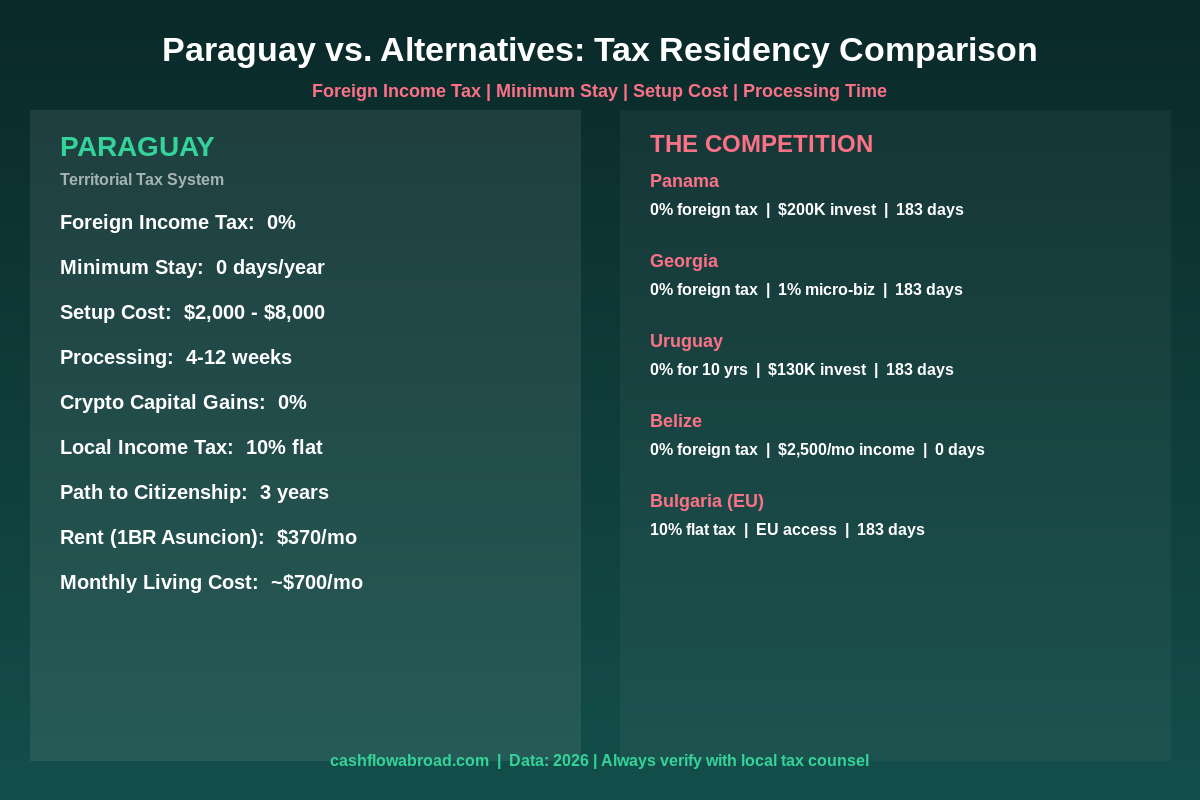
Here’s how Paraguay stacks up against the other popular low-tax territorial residency plays in 2026:
| Country | Foreign Income Tax | Minimum Stay | Setup Cost | Processing |
|---|---|---|---|---|
| Paraguay | 0% | 0 days | $2,700 – $7,050 | 4–12 weeks |
| Panama | 0% | 183 days (for tax cert) | $200,000+ invest | 6–12 months |
| Georgia | 0% (territorial) | 183 days | $1,500 – $3,000 | 2–4 weeks |
| Uruguay | 0% for 10 years | 183 days | $130,000+ assets | 3–6 months |
| Belize | 0% | 0 days (QRP) | $25,000 bond | 2–4 months |
| Malaysia (MM2H) | 0% | 90 days/year | $100,000+ deposit | 6–12 months |
Georgia comes closest on cost and speed, but requires 183 days in-country to establish tax residency — a dealbreaker for anyone splitting time across multiple countries. Panama used to be the benchmark; the $200,000 investment requirement now prices out most nomads and early retirees. See the geographic arbitrage playbook for the broader multi-country strategy framework.
Paraguay’s zero-day requirement is the decisive differentiator. You can hold Paraguayan residency as your official tax domicile and spend your year in Thailand, Portugal, or hopping between Airbnbs — as long as you maintain your cedula and don’t inadvertently establish tax residency in a country that taxes foreign income.
The Residency Process: Step by Step
Here’s how the standard temporary residency application flows in 2026:
- Hire a Paraguayan immigration attorney. Do not DIY this. Local attorneys handle bureaucratic follow-up, translate documents correctly, and can dramatically reduce processing time. Budget $1,500–$4,000 for attorney fees depending on complexity.
- Gather your documents: FBI criminal background check (apostilled at the US State Department or authorized agent), birth certificate (apostilled), passport copy, proof of income (bank statements, tax returns, or pay stubs), and passport-style photos. Every document needs certified Spanish translation.
- Fly to Asunción for 3–5 days. You appear in person at the Department of Immigration (DGME), submit documents, and complete biometric enrollment. Your attorney handles everything else.
- Wait for processing — typically 4–12 weeks. You can be anywhere in the world. Your attorney manages follow-up.
- Return to collect your cedula (national ID). This is your proof of residency and the document you’ll use to open Paraguayan bank accounts.
- After 21–24 months, apply to convert to permanent residency. After that, you only need to visit Paraguay once every three years to maintain your status. Total time in Paraguay across the entire process: roughly 6–10 days across two trips.
Keeping Your US Financial Infrastructure Intact
One thing expats consistently underestimate: a valid US mailing address is critical for maintaining US bank accounts, brokerage accounts, and IRS correspondence after you move abroad. A virtual mailbox with a real US street address covers all of this. Traveling Mailbox provides a real street address in 50+ US cities, mail scanning on demand, and check deposit capability for around $15/month. It’s the cleanest solution for staying compliant with US financial institutions while living full-time abroad — we covered the full setup in the virtual mailbox guide for expats.
For international health coverage, SafetyWing Nomad Insurance starts at ~$45/month and covers emergency care in 185+ countries — solid for nomads who aren’t staying in Paraguay full-time. Local Paraguayan private insurance runs $60–$150/month for those who want domestic coverage. Full comparison at the expat health insurance guide.
Who Paraguay Works For — and Who It Doesn’t
Paraguay is the right move for a specific type of person. It’s not universally correct.
Paraguay makes sense if you:
- Earn most of your income from sources outside South America (remote work, foreign investments, crypto trading)
- Want a legitimate territorial tax residency without tying up capital in an investment
- Plan to travel extensively and can’t commit to 183 days in any single country
- Hold significant crypto positions and want a non-CARF tax domicile
- Are playing a long game toward a non-US backup citizenship (3-year path)
- Want the simplest, cheapest residency process in the Western Hemisphere
Paraguay is probably not right if you:
- Earn substantial US-sourced income the FEIE doesn’t cover (Paraguay residency doesn’t reduce your IRS bill on US-source income)
- Want EU travel privileges, Schengen access, or an EU-member tax base
- Prefer established expat hubs with large English-speaking communities and robust infrastructure
- Have complex passive income structures that require careful tax treaty analysis
For investors with significant foreign portfolios, the interaction between Paraguay residency, the FEIE, and PFIC rules on foreign mutual funds is worth reviewing carefully before restructuring anything — see the expat investing playbook. And if you’re weighing retirement abroad more broadly, the retirement abroad guide covers how Social Security income plays into the equation.
Bottom Line
Paraguay has engineered one of the most accessible territorial tax residency structures in the world: 0% on foreign income, zero minimum stay, no investment required, and a cost of living around $700/month in the capital. For the right person — a digital nomad, a crypto investor, a remote worker who wants a legitimate low-tax domicile without tying up capital — it’s an almost unfair advantage.
The trade-off is real: Asunción isn’t Singapore or Lisbon. It’s a developing city with infrastructure gaps, a smaller English-speaking expat community, and a Spanish/Guaraní language environment. But for what it delivers on the residency and tax side, nothing in the Western Hemisphere comes close at this price point.
The window is open now. Paraguay’s requirements have remained stable since 2022, but the country is not immune to the global trend toward tighter residency rules — Panama’s trajectory should serve as a warning. Early movers are glad they moved fast. The same logic applies here.
This article is for informational purposes only and does not constitute tax, legal, or financial advice. US tax obligations apply regardless of foreign residency status — US citizens remain taxable on worldwide income. Consult a qualified expat tax professional and licensed immigration attorney before making any residency or tax structure decisions. All fees, thresholds, and regulations cited reflect 2026 information and are subject to change.
Liked this article?
Get the next one delivered straight to your inbox — plus a free Expat Tax Cheat Sheet.
Join our subscribers. No spam — just expat finance intel and new post notifications.