Panama’s Friendly Nations Visa: The $5,000 Residency Play
8 min read · 2,106 words
Ninety-four percent of expats living in Panama say they have a good life there. Not “it’s fine.” Not “better than expected.” A good life — the highest satisfaction rate of any expat destination on earth, according to InterNations’ 2025 global survey. And yet, most Americans planning their escape abroad never even put Panama on the shortlist.
They obsess over Portugal (NHR is dead), Georgia (1% tax but banking is a nightmare for Americans), or Paraguay (zero tax but genuinely middle-of-nowhere). Meanwhile, Panama offers something most of those countries can’t match: a territorial tax system that exempts all foreign income, a clear residency pathway for about $3,200 in fees, a US-dollar economy with no currency risk, and a cost of living 36% lower than the United States. It ranked #1 in the world for expats for the second consecutive year in 2025. And most people still aren’t paying attention.
Here’s exactly how the Panama Friendly Nations Visa works, what it costs, and whether it actually delivers on the zero-tax promise for US citizens.
What Is the Friendly Nations Visa?
The Friendly Nations Visa is Panama’s residency program for citizens of 50 countries that Panama considers to have strong economic and diplomatic ties with the country. The US, Canada, UK, Australia, and all EU member states qualify — as do Argentina, Brazil, Israel, Japan, Singapore, and South Korea.
The program is designed to attract productive foreign residents: people who invest, work, or bring economic activity. In practice, it’s the most straightforward residency path for most English-speaking expats, and it comes with a clear pathway to permanent residency and eventually citizenship — without requiring you to surrender your US passport.
Three Ways to Qualify
- Employment: Work for a Panamanian company with at least 10 Panamanian employees on payroll. Least common for foreign applicants.
- Real estate investment: Purchase Panamanian property worth at least $200,000. The property can be financed — a purchase agreement or title suffices.
- Fixed-term bank deposit: Deposit $200,000 in a Panamanian bank for a minimum of three years. You’re not spending it — it sits in your account. If you’re moving capital abroad anyway, this option does double duty.
The bank deposit route is the one most people overlook. You retain ownership of the $200,000 throughout. It’s essentially a residency fee paid with an opportunity cost rather than cash out of pocket.
The Real Costs: What You’ll Actually Pay
Government and legal fees for the primary applicant run about $3,200 total:
| Fee Type | Cost (USD) |
|---|---|
| Government immigration fees | ~$1,400 |
| Attorney / legal fees | ~$1,800 |
| Dependent spouse | ~$2,000 additional |
| Children under 12 | ~$1,200 per child |
| Children ages 12–25 | ~$2,000 per child |
| Background check + apostille | $50–$200 |
| Health certificate | $50–$150 |
For comparison: Portugal’s D7 visa requires proving at least €760/month in passive income and costs €2,000–€4,000 just to get started — before you factor in the 183-day-minimum residency requirement that will trigger Portuguese tax residency and potentially wreck whatever tax structure you were trying to build. Panama’s process is more predictable and significantly less administratively painful.
The Timeline: What to Expect
Panama updated the program in January 2025, cutting the temporary residence permit from 12 months to 6 months. The process from start to permanent residency:
- Document preparation (2–4 weeks): Criminal background check (valid 6 months), health certificate (valid 3 months), passport copies, power of attorney for your Panamanian attorney, and proof of your qualifying investment or employment.
- Physical arrival required: You must be in Panama when you submit — remote applications aren’t accepted.
- Temporary residence permit (1–2 days): Issued almost immediately after submission. Valid for 6 months.
- Full processing (4–6 months): Panama City offices move faster than regional ones (5–7 months).
- Provisional residency (2 years): Your status after approval.
- Permanent residency: Apply after 2 years of provisional status. Processing takes up to 6 more months.
Total: roughly 2.5–3 years from first arriving to permanent residency. Citizenship is available after 5 years of permanent residency. Panama allows dual citizenship — you keep your US passport.
Panama’s Territorial Tax System: What It Means for Americans
Panama uses a pure territorial tax system: only income earned from activities performed within Panama is taxable. Income from sources outside Panama — a US freelance client, dividends from a Fidelity account, rental income from a Georgia property — is 100% exempt from Panamanian income tax. No cap. No reporting form to Panama. Just zero.
Panama’s domestic tax rates on Panama-source income:
| Panama-Source Income | Tax Rate |
|---|---|
| First $11,000 | 0% |
| $11,001 – $50,000 | 15% |
| Over $50,000 | 25% |
A freelancer billing US clients from Panama owes $0 to Panama’s tax authority (DGI). A retiree drawing Social Security and investment dividends owes $0 to Panama. Unlike Singapore’s territorial system (which taxes foreign income when remitted locally) or Cyprus’s SDC, Panama’s exemption is clean and unconditional on the source side.
The American Catch (There’s Always One)
US citizenship-based taxation doesn’t disappear when you move to Panama. There’s no US–Panama tax treaty, which means no treaty protection to reduce double taxation. What saves most American expats is the Foreign Earned Income Exclusion (FEIE): up to $130,000 of foreign-earned income excluded from US federal tax in 2025, provided you qualify via the physical presence test (330 days outside the US in a 12-month period) or bona fide residence test.
Stack the Foreign Housing Exclusion on top of that — up to $39,000 total for Panama, with a base amount of $15,750 — and a freelancer earning $150,000 could eliminate most US federal tax liability. The FEIE doesn’t apply to passive income like dividends and Social Security, but Panama’s territorial system means that income faces no Panamanian tax either. You’re only paying US federal rates on it, and often in lower brackets after the standard deduction.
You still file FBAR (FinCEN 114) if your Panamanian accounts exceed $10,000 at any point in the year, and FATCA reporting applies above $200,000. The paperwork overhead is real — but it’s paperwork, not a tax bill.
Full guide to FBAR, FATCA, and FEIE for US expats →
Cost of Living: The Real Numbers
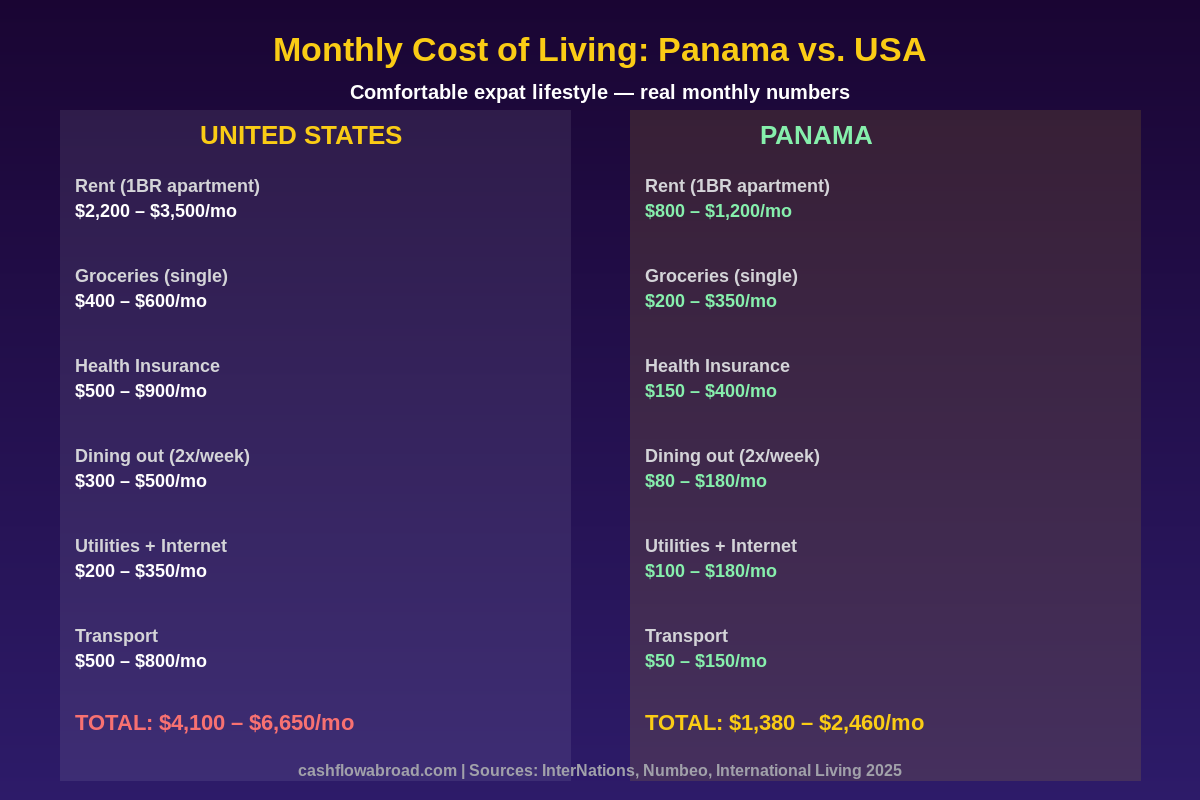
Panama City is the most expensive part of Panama — and it still runs 36% cheaper than the US average (Numbeo, 2025). Housing costs 49.5% less than comparable US apartments. Here’s what a comfortable lifestyle actually costs in the main expat areas:
Panama City (neighborhoods: Costa del Este, San Francisco, Punta Pacifica, Casco Viejo):
- 1–2 bedroom apartment: $800–$1,500/month
- Groceries (single person): $200–$400/month
- Private health insurance: $150–$400/month
- Local restaurant meal: $4–$8
- Mid-range dinner for two: $40–$70
- High-speed internet (100 Mbps): $40–$60/month
- Uber across the city: $5–$12
Boquete (mountain town, consistently rated best retirement spot): 2-bedroom homes $800–$1,200/month. Year-round temperatures of 65–75°F. The InterNations 2025 survey cited it explicitly as one of the best places in the world for expat retirees — not just in Panama, globally.
Coronado / Nuevo Gorgona (Pacific Coast beach towns): Ocean-view 2-bedroom apartments start at $1,000/month. These towns are 1–1.5 hours from Panama City — enough distance to escape urban congestion without losing access to international flights.
A comfortable single person spends $2,000–$2,500/month in Panama City. A couple with private insurance, regular dining out, and a nice apartment lands at $3,000–$3,500. InterNations found that 35% of expats in Panama are retired — versus 11% globally — suggesting the numbers work particularly well for people on fixed income.
Banking Reality: The Friction Points for Americans
FATCA has made Panamanian banks reluctant to open accounts for American non-residents. The compliance burden is real, and many mid-tier Panamanian banks have quietly stopped accepting new US clients. As a non-resident American, the minimum deposit at reputable banks typically runs $250,000.
Once you have Panamanian residency, that threshold drops to $500–$5,000 — what any local would face. This is an underappreciated reason to pursue the visa quickly: your banking access improves substantially the moment you have a carnet (resident ID). Banks that work well with American residents include Banistmo (Scotiabank subsidiary), BAC Credomatic, and Multibank.
Documentation to open an account as a resident:
- Passport + secondary ID
- Proof of address (rental agreement or utility bill)
- Bank reference letter from your US bank
- Personal or business reference from a Panama contact
- Proof of income (pay stubs, tax return, or investment statement)
- W-9 form (confirms your US taxpayer status for FATCA)
For maintaining your US financial infrastructure while living in Panama, you need a real US street address — not a PO Box, which most banks won’t accept. A virtual mailbox like Traveling Mailbox provides a real address in 50+ US cities, scans your mail digitally, and handles check deposits — for around $15/month. It’s what keeps your US brokerage accounts, banking relationships, and IRS correspondence intact from abroad.
For moving money between US and Panamanian accounts, Remitly handles USD transfers with transparent rates — useful before you have a local account fully operational. The full money transfer guide has a breakdown of all the options.
The Expat Brokerage Stack That Won’t Close on You
Charles Schwab International is the standard recommendation for expat brokerage accounts. It reimburses all ATM fees worldwide (including Panamanian ATMs), charges no foreign transaction fees, and has a track record of not closing accounts simply because the holder lives abroad. The brokerage side lets you hold US ETFs and stocks without the PFIC complications that come with foreign-domiciled funds.
The expat investing playbook has a complete breakdown of which US brokerages stay open for expats and which ones silently close accounts when they detect a foreign address.
The Pensionado Alternative: Retire to Panama for Less
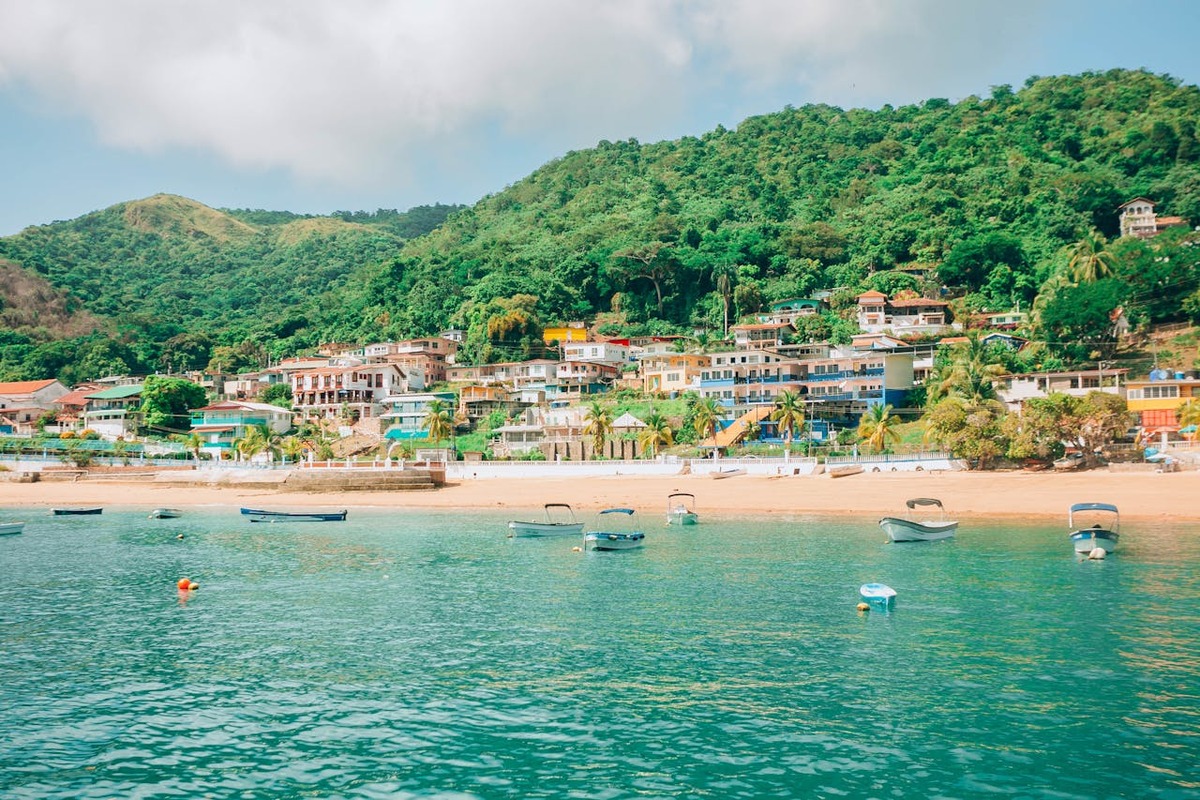
If you’re retired with a pension or Social Security, Panama has a separate track: the Pensionado Visa. Requirements are simple:
- Prove lifetime pension income of at least $1,000/month ($1,250 with dependents)
- US Social Security counts — as do pension distributions, annuity payments, or any qualifying lifetime income
- No $200,000 investment required
The Pensionado Visa also comes with legally mandated discounts baked into Panamanian law: 50% off movie tickets and sporting events, 30% off bus and ferry fares, 25% off restaurant meals and domestic airline tickets, 15% off hospital bills, and 20% off doctor and dental visits. These aren’t loyalty perks — they’re law. Panama subsidizes retirement in a way almost no other country does.
For anyone collecting more than $1,000/month in Social Security, the Pensionado path is cheaper and faster than the Friendly Nations Visa. The Social Security abroad guide covers how those payments hold up across the best retirement destinations.
Panama vs. Other Territorial Tax Countries
| Country | Tax on Foreign Income | Residency Investment Required | USD Economy | Banking for Americans |
|---|---|---|---|---|
| Panama | 0% | $200K property or deposit | Yes (official) | Moderate |
| Paraguay | 0% | None (presence only) | No | Difficult |
| Georgia | 1% (small business) | None formally | No | Increasingly difficult |
| Costa Rica | 0% | $1,000/mo income proof | No | Moderate |
| Singapore | 0% (unless remitted) | High investment thresholds | No | Excellent |
Panama’s singular advantage is the US dollar economy. Currency risk is zero. You earn in dollars, spend in dollars, bank in dollars. Paraguay’s zero-tax residency is more accessible financially, but operating in Guaraní with Paraguayan banking systems creates friction that Panama simply doesn’t have. If you don’t have $200,000 to deploy, Paraguay’s setup is worth examining — but if you do, Panama is the cleaner play.
Next Steps if You’re Serious
- Visit for 2–4 weeks first. Panama City, Boquete, and at least one beach town. What looks like a blog post data point looks different from inside the country.
- Decide: real estate or bank deposit? Both require $200K. Bank deposit keeps capital liquid (but locked). Property builds equity and gives you a place to live. Run the numbers for your specific financial situation.
- Hire a Panamanian immigration attorney. The ~$1,800 legal fee is not optional. Document errors delay the process by months. Apostilles, immigration office communication, and paper chasing require someone who does this daily.
- Apostille your US documents before leaving. Criminal background check and other US-issued documents need apostille certification. Federal documents go through the US State Department; state-issued documents go through your state’s Secretary of State office.
- Set up US financial infrastructure before the move. Get a virtual mailbox for a real US street address, confirm your brokerage accounts won’t close, update your IRS address. Do this before you leave — fixing it from abroad is significantly more complicated.
Bottom Line
Panama’s Friendly Nations Visa isn’t the cheapest residency program available. Paraguay has no minimum investment requirement. Georgia’s setup costs less to enter. But Panama offers something those countries don’t: a territorial tax system running on US dollars, an infrastructure that actually works, direct flights back to the US in 3–5 hours, and an expat satisfaction rate that isn’t marketing — it’s what people who moved there actually reported in 2025. The 94% satisfaction figure is the highest of any country measured. That number should move your priors.
If you can deploy $200,000 into Panamanian real estate or a bank account, you’re not spending that money — you’re repositioning it into a jurisdiction that charges you nothing on foreign income and subsidizes your retirement by law. The $3,200 in fees is the actual cost of the visa. Everything else is just asset allocation.
Financial disclaimer: This post is for informational purposes only and does not constitute tax, legal, or investment advice. US expat tax law is complex and changes frequently. Consult a licensed US expat tax professional and a Panamanian immigration attorney before making residency or financial decisions. All figures reflect publicly available 2025 data and may change.
Liked this article?
Get the next one delivered straight to your inbox — plus a free Expat Tax Cheat Sheet.
Join our subscribers. No spam — just expat finance intel and new post notifications.