
Most expats doing geographic arbitrage talk about Portugal, Panama, and Thailand. Meanwhile, a small but growing crowd quietly relocated to Paraguay, legally paying 0% tax on every dollar they earn outside the country — and they got legal residency for under $5,000. Nobody's making YouTube videos about Asunción. That's the point.
Paraguay operates one of the purest territorial tax systems on the planet. Foreign-sourced income — freelance clients abroad, US dividends, rental income from American property, crypto gains on foreign exchanges, remote work revenue — is taxed at exactly zero percent. Not 0% with an asterisk, not 0% until you hire the wrong accountant. Just zero, by statute. The country explicitly does not claim income generated beyond its borders.
It's also the cheapest country in South America to live in — 57.4% cheaper than the US overall, with rent running 74.8% below American prices (Numbeo, March 2026). A single person can live comfortably in Asunción, the capital, for $1,200–$1,500 per month. That number includes a one-bedroom apartment in a decent neighborhood, eating out several times a week, private health insurance, and reliable fiber internet fast enough to run a remote business.
This post covers everything: the three residency routes, exact documents and costs, how the tax system actually works, banking realities, and the honest tradeoffs the Paraguay promotional circuit tends to skip.
Why Paraguay Is Quietly Winning the Expat Arbitrage Game
The combination that makes Paraguay unusual: it's cheap, it has a territorial tax system, residency is genuinely attainable, and citizenship is available after just three years of legal residency. Compare that to Panama (five years), Uruguay (three to five depending on path), Portugal (five years), and most EU options (ten years minimum). For anyone playing the long game on a second passport, Paraguay has the shortest runway for the lowest price anywhere in the western hemisphere.
The country comparisons hold up across every metric that matters. Panama also runs a territorial system, but residency costs $5,000–$7,000 and a comfortable life in Panama City runs $2,200+ per month — the city's dollar economy is a genuine convenience but also a genuine price inflator. Dubai has zero income tax, but setting up life there costs $15,000–$30,000 before you've had a single dinner. Portugal's NHR replacement program has grown more complex, requires longer stays, and Lisbon now costs upwards of $3,200/month for a comparable lifestyle.
Paraguay is not a lifestyle-prestige destination. It's not a party hub or an Instagram backdrop. But if your goals are legally minimizing taxes, reducing your cost base, and eventually holding a second passport, the arithmetic is difficult to argue with.
The Three Residency Routes: Costs, Timelines, Requirements
There isn't a single "Paraguay residency" — there are three distinct paths with meaningfully different costs and timelines. The right one depends on your income structure and how quickly you need legal status.
Route 1: Temporary Residency (The Standard Path)
Temporary residency runs two years, is renewable, and requires you to enter Paraguay at least once per year. Government fees run approximately $350. The real cost is documentation, apostilling, and professional translation — if you hire a local immigration attorney or agency, total cost lands at $3,000–$5,000. People who are fluent in Spanish and willing to navigate the process themselves report DIY costs of $1,200–$1,400.
Processing time with an experienced agency: 35–45 days. Going without representation: 95–105 days, assuming no document errors. After 21 months of temporary residency, you're eligible to apply for permanent status. Total path from nothing to permanent residency card: roughly two and a half years.
Route 2: SUACE Investment Program (Fast-Track Permanent)
The SUACE program skips the temporary phase entirely and grants permanent residency directly — but requires a minimum $70,000 investment in Paraguay, spread over ten years ($7,000/year). Legal fees run $10,000–$14,000 on top of government fees of ~$340. The permanent card is valid for ten years. This isn't the budget route, but if you're capitalized and want residency resolved quickly without the two-year wait, it's clean and fast.
Route 3: Passive Income / Retirement Residency
This is the route most online guides miss entirely. Paraguay grants residency to anyone who can demonstrate passive income of at least 100 Paraguayan minimum wages per month — roughly $1,300 USD. Eligible sources include Social Security, pensions, dividends, rental income, mutual fund distributions, and investment interest. If you're already pulling $1,300/month from investments or retirement accounts, this may be your cleanest path, and it comes with import tariff exemptions on personal effects.
The Document Checklist (And Where 40% of Applications Fail)
Document errors cause 40% of application rejections. Paraguay requires all foreign documents to be apostilled under the Hague Convention and translated into Spanish by a licensed Paraguayan public translator — not just any translator, not a bilingual friend, not an online service. A licensed Paraguayan public translator specifically.
Required documents for all routes:
- Valid passport
- Apostilled criminal background check from your country of residence for the last three years
- Apostilled birth certificate (original)
- Apostilled marital status certificate
- Interpol clean record certificate and certificate of personal data
- Proof of financial solvency — any one of: bank statement showing at least $5,000, apostilled university degree, employment contract in Paraguay, RUC (Paraguayan tax ID), company partnership documents, pension documentation, or stock ownership documentation
The $5,000 bank statement is the most common solvency proof. It's a low bar globally — Panama requires the same amount plus $2,000 per dependent. The apostilling process typically takes 3–6 weeks depending on your home country. Build this into your timeline before booking flights.
One timing note: in September 2024, Paraguay rolled out a new biometric ID card format with a microchip, electronic fingerprints, and digital signature. Processing infrastructure is still catching up in some offices, occasionally causing delays for first-time applicants. Working with an agency that has an established relationship with the migration office (DGME) saves real headaches here.
Cost of Living in Asunción: The Real Numbers
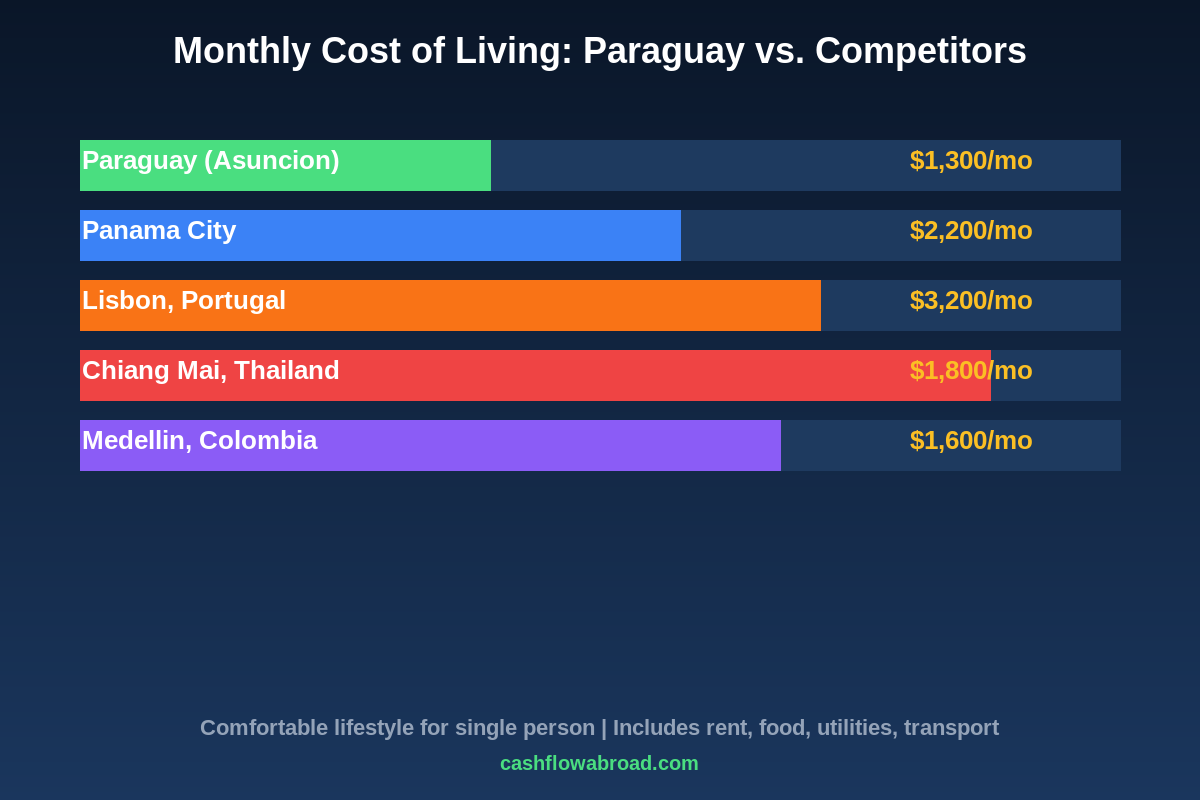
Asunción is a mid-sized Latin American capital — functional, affordable, and still far enough off the expat radar that prices haven't been inflated by foreign demand the way Medellín and Lisbon have in recent years. The neighborhoods most established expats settle in are Villa Morra and Carmelitas, which have better infrastructure than the city center.
| Expense | Budget | Mid-Range |
|---|---|---|
| 1BR Apartment (decent neighborhood) | $250–$350/mo | $440–$650/mo |
| Groceries (1 person) | $200–$300/mo | $300–$400/mo |
| Local restaurant meal | $3.50–$5.00 | $8–$15 |
| Electricity + water | ~$42/mo | |
| Internet (60+ Mbps fiber) | $18/mo | |
| Mobile plan (10GB data) | $14/mo | |
| Private health insurance | $50/mo | $150/mo |
| Doctor visit (no insurance) | $20–$40 | |
| Specialist consultation | $40–$80 | |
| Gym membership | $30/mo | |
| Uber/rideshare (5km) | $2.60 | |
| Total comfortable lifestyle | $1,200–$1,500/mo | |
Healthcare deserves specific mention. Prescription medications run 50–70% cheaper than US prices, and specialist consultations cost $40–$80 without insurance. For expats who've been ground down by US healthcare costs, this matters more than the rent savings. See the full expat health insurance guide for international coverage options — SafetyWing's Nomad Insurance is one of the most affordable options for expats under 60 who want global coverage without the $400/month price tag.
One honest downside on cost of living: Paraguay uses the Paraguayan Guaraní (PYG), which has historically been volatile against the dollar. Your rent is quoted in Guaraní; when the PYG depreciates (the more common direction), your dollar-denominated income wins. When it appreciates, your buying power shrinks. Most expats earning in USD treat this as a net positive over time — but it's not the fixed-rate stability of Panama, which runs on USD directly.
How the 0% Tax Actually Works

Paraguay taxes income on a strictly territorial basis. The legal principle: if the economic activity generating the income occurred outside Paraguay, Paraguay has no claim on it. In practice, this means:
- Remote work income from foreign clients: 0% Paraguayan tax
- Dividends from US or foreign stocks: 0%
- Rental income from property in other countries: 0%
- Crypto gains on foreign exchanges: 0%
- Online business revenue from non-Paraguayan customers: 0%
What Paraguay does tax: income earned within Paraguay's borders. Corporate income (IRE) is taxed at a flat 10% — the lowest rate in the Americas. Personal income from Paraguayan sources (IRP) runs 8–10% progressively. Local VAT is 10%. If you're running a purely internationally-focused business or remote career, your effective Paraguayan tax rate on that income is zero.
| Country | Tax on Foreign Income | Corporate Tax | Residency Cost (Total) | Path to Citizenship |
|---|---|---|---|---|
| Paraguay | 0% (Territorial) | 10% flat | $3K–$5K | 3 years |
| Panama | 0% (Territorial) | 25% flat | $5K–$7K | 5 years |
| UAE / Dubai | 0% (No income tax) | 9% | $15K–$30K | 30 years (effectively) |
| Georgia (Country) | 0% (Virtual Zone) | 15% | $2K–$4K | Not straightforward |
| Colombia | Up to 39% (Worldwide after 183 days) | 35% | Variable | 5 years |
| United States | Up to 37% (Worldwide) | 21% | Home country | N/A |
What You Actually Need to Do to Access 0% Status
Getting the residency card is step one. What most promotional content skips is step two. To properly establish Paraguay as your tax domicile:
- Obtain your Cédula (national ID card) — issued with residency approval
- Register for RUC (Paraguay's tax ID) — required even if declaring zero local income
- File annual tax returns — even a zero-income filing establishes your compliance record
- Maintain a local bank account and physical address in Paraguay
- Break tax residency in your home country — if you're American, this is more complicated
The US Citizen Tax Caveat
If you hold a US passport, Paraguay's 0% rate does not eliminate your US tax obligation. The United States taxes citizens on worldwide income regardless of where they live — it's one of only two countries in the world that does this, the other being Eritrea. Paraguay residency doesn't change that fundamental reality.
What changes: your ability to use the Foreign Earned Income Exclusion (FEIE), which lets you exclude up to $126,500 in foreign earned income from US taxes (2024, indexed annually). The combination of FEIE plus Paraguay's territorial system can get many US expats to a very low effective global rate on earned income — but it requires proper planning, and passive income (dividends, interest, capital gains) doesn't qualify for FEIE and remains fully taxable by the US. See our full FEIE guide and the complete expat banking and tax guide for how the mechanics work in practice.
Non-US citizens from countries that tax based on residency rather than citizenship — which is nearly every other country on earth — get a much cleaner deal: Paraguay residency genuinely means 0% on all foreign income, full stop, the moment you break tax residency in your home country.
Banking in Paraguay: The Bottleneck Nobody Warns You About
The banking situation is the most practically frustrating part of Paraguay residency, and it's almost never discussed honestly in the promotional content.
You cannot open a meaningful Paraguayan bank account without your Cédula. Some banks offer tourist-tier accounts, but they're capped at low balances and guaraní-only. The Cédula comes with your residency approval — meaning you're 60–90+ days into the process before you can even start banking setup.
Once you have your Cédula, the options:
- Banco Familiar: Most accessible for new residents. Extensive branch network. Spanish-only service. Simplified expat requirements for account opening.
- Ueno Bank: Digital-first, specifically targeting expats and digital nomads. English-speaking staff, more flexible onboarding. Best starting point for most foreign arrivals.
- Larger institutions (Itaú, Continental): Stricter compliance, harder for foreigners without established local history. Use these once you have six months of RUC activity and a track record.
As of January 2026, Paraguayan banks now require Source of Wealth documentation for all new accounts due to increased GAFILAT (the Latin American anti-money laundering body) oversight. Come prepared with wire records, tax returns, business invoices, or brokerage statements explaining where your money originates. The era of walking in with cash and minimal questions is over.
For US banking while abroad: Mercury is the best option for remote business operators — free US business banking, wire transfers, no foreign transaction fees, no minimum balance. For personal banking, Charles Schwab International remains the gold standard for expats: free ATM withdrawals worldwide, no foreign transaction fees, and they don't close accounts because you live abroad (unlike Fidelity and Vanguard, which do). See the geographic arbitrage playbook for the full banking stack setup before you relocate.
One more thing US citizens can't skip: maintaining a US address. The IRS, Social Security Administration, and most US financial institutions require one. A Traveling Mailbox gives you a real US street address in 50+ cities for $15/month — mail scanning, check deposits, and a physical address that keeps your US banking infrastructure intact while you're in Asunción. Without this, US accounts start closing within 12–18 months of an address going stale. See our virtual mailbox guide for the full setup process.
The Citizenship Angle: Three Years to a Second Passport
Paraguay's citizenship timeline is one of the most compelling aspects for serious internationalization-focused expats. After three years of legal residency, you're eligible to naturalize. What that gets you:
- A Paraguayan passport with visa-free access to 144 countries
- The right to live and work in Paraguay indefinitely
- Mercosur freedom of movement (Argentina, Brazil, Uruguay, Bolivia, Chile)
- A second citizenship that is globally recognized and carries no significant geopolitical baggage
The three-year timeline is real but not automatic. Paraguay does not grant citizenship to residents who spent three years in Medellín while maintaining a Paraguayan address on paper. You need to demonstrate genuine ties: property or lease agreements, local bank accounts, RUC filings, and physical presence records that hold up to scrutiny. The standard isn't onerous, but it requires actually living there.
For anyone looking to hold a true geographic arbitrage setup long-term — second passport, low-tax legal structure, and global optionality — Paraguay is the most cost-efficient path in the western hemisphere right now.
The Honest Tradeoffs
Any post that ends with "Paraguay is perfect for everyone" is selling you something. Here's what the promo content skips:
Language: Paraguay is Spanish-dominant, with Guaraní as a co-official language. English is uncommon outside international business circles. Functional Spanish is required to navigate banking, government offices, and daily life. If you don't have it, budget for intensive lessons before arrival.
Infrastructure: Asunción works but isn't impressive. Roads are inconsistent. Power outages happen. Internet reliability varies significantly by neighborhood — research fiber availability before committing to an apartment. Villa Morra and Carmelitas have substantially better infrastructure than the historic center.
Social scene: The expat community is small and growing, but Paraguay is not yet the saturated hub that Medellín or Lisbon have become. That's a feature for some, a bug for others. If you need a large English-speaking social network on day one, you'll find it thinner here than in the more established destinations.
Currency volatility: Unlike Panama, which runs on USD, Paraguay uses the Guaraní. Rent and large transactions can often be negotiated in USD, but you'll be exchanging currency regularly. The informal exchange rate is typically better than official bank rates — a well-known local reality that expats navigate openly.
Banking compliance creep: The January 2026 Source of Wealth requirement is directionally significant. Paraguay remains more private than EU banking jurisdictions, but GAFILAT pressure is tightening compliance standards. Don't plan your financial life around Paraguay's historical laxity staying constant.
Who Paraguay Actually Makes Sense For
The sweet spot is specific. Paraguay works if you:
- Earn primarily from foreign clients, remote work, or foreign investments
- Want to legally minimize taxes without the cost of UAE or the complexity of EU programs
- Are targeting a second passport within a three-to-five-year horizon
- Can operate in Spanish or are committed to learning
- Value a low cost base over lifestyle prestige or a strong expat social scene
It's a poor fit if you need the dollar economy of Panama, the European infrastructure of Lisbon, or the established community network of Medellín. Those are legitimate priorities — just different tradeoffs from what Paraguay offers.
How to Get Started: The Practical Sequence
- Visit first. Spend at least two weeks in Asunción before committing. The city is not what most people expect from South American capitals, and "visiting" and "living" are genuinely different. Book accommodation in Villa Morra or Carmelitas — the neighborhoods most established expats land in.
- Start the apostille process early. Criminal background checks, birth certificates, and marital status certificates take time. Processing in your home country may take 4–8 weeks before you even get to the Paraguayan translation step. Start before you've booked a one-way flight.
- Hire a Paraguayan immigration attorney. The $3,000–$5,000 total cost includes their fees and is worth it. Document errors cause 40% of rejections, and the cost of a second application exceeds the cost of doing it right the first time.
- Set up your US infrastructure before you leave. Virtual mailbox, the right US bank accounts, and a cross-border CPA who understands both US expat tax law and Paraguayan territorial taxation.
- Register for RUC and file tax returns from year one. Clean compliance records make everything easier — banking, future citizenship applications, and demonstrating genuine residency. Don't wait to "see how it goes."
Bottom Line
Paraguay doesn't appear on most "best expat destinations" lists because it isn't photogenic and the city lacks glamour by regional standards. That's precisely why the numbers still work. The places that get famous get expensive and administratively complicated — Paraguay hasn't hit that inflection point yet.
For anyone willing to do the paperwork, learn some Spanish, and genuinely live there: legal residency in 60–90 days, 0% tax on all foreign income, a comfortable life for $1,300–$1,500/month, and a second passport in three years. That combination, at under $5,000 in total setup cost, is genuinely hard to beat anywhere in the western hemisphere right now.
Financial disclaimer: This article is for informational purposes only and does not constitute tax, legal, or financial advice. Tax laws change, and the interaction between Paraguayan territorial taxation and US worldwide taxation is complex for American citizens specifically. Consult a qualified cross-border tax professional before making any residency or tax planning decisions. All costs and figures are sourced from third-party research (Numbeo, PwC Tax Summaries, Global Citizen Solutions, Paraguay Pathways, MoveToParaguay.com) and may have changed since publication.