Serbia for US Expats: 10% Flat Tax and $900/Month Living
10 min read · 2,417 words
Belgrade is 63% cheaper than New York City. Its income tax rate is 10% — flat, no brackets, no phase-outs. And in November 2025, Serbia quietly joined the SEPA payment zone, eliminating the slow, expensive international wire bottleneck that made banking there a headache for years. Yet walk into any expat forum and you’ll find four threads about Portugal for every one about Serbia.
That gap is closing fast. Belgrade’s digital nomad population has roughly doubled since 2022, and a handful of US expats who landed there early are sitting on a genuinely unusual setup: Western-style infrastructure, sub-$1,000/month living costs, and a tax bill that makes most EU countries look extortionate. This guide covers everything a US expat needs to evaluate — and potentially execute — a Serbia move.
Why Serbia Keeps Getting Overlooked
Serbia isn’t in the EU. That’s the first thing most Americans hear, and it kills the conversation before it starts. But EU membership cuts both ways. Non-EU countries can set their own tax rates without Brussels looking over their shoulder, which is exactly why Serbia’s personal income tax sits at 10% while Germany’s tops out at 45%.
The second misconception is stability. Serbia has been politically stable for over two decades, operates with a freely convertible currency (the dinar), and has bilateral investment treaties with over 60 countries. The World Bank ranks it among the top countries for ease of starting a business in the Western Balkans region. It’s an EU candidate, meaning it’s been aligning its legal and financial infrastructure with EU standards — without yet being bound by all of them.
Belgrade itself is a proper capital city: two international airports (Nikola Tesla handles most traffic), excellent public transit, fast fiber internet averaging 200+ Mbps, and a functioning healthcare system with both public and private hospitals. The food scene punches well above its price tag.
Serbia’s Tax System: The 10% Flat Rate Explained
Personal income tax in Serbia runs at a flat 10% on most employment and self-employment income. There’s a surtax that kicks in above approximately €42,000 in annual earnings — at that point the marginal rate climbs to 20% on income above that threshold — but for most remote workers and freelancers earning under that figure, the effective rate stays at 10%.
What almost nobody mentions outside specialized expat-tax circles is the 70% tax base reduction for newly settled foreign workers. Under Serbia’s talent attraction incentive, expats who relocate and meet certain criteria (typically a degree plus a salary above a defined threshold) can have their taxable income reduced by 70% for up to five years. A qualifying expat earning €60,000 gets taxed on only €18,000 of it — pushing the effective rate well under 5% on total income for those first five years.
Not everyone qualifies, and the rules have nuance. But the base 10% rate alone already beats Belgium (50%), France (45%), Spain’s standard bracket (47%), and even Portugal’s NHR replacement program.
Capital Gains and Investment Income
Capital gains in Serbia are taxed at 15%. Dividends from Serbian companies are also 15%. Interest income is taxed at 15% as well. These rates apply to income earned within Serbia — your US-source investment income is still subject to US tax rules regardless of where you live, since the US taxes citizens on worldwide income.
Serbia and the US do not have a bilateral tax treaty. That matters: you can’t use treaty provisions to eliminate or reduce double taxation the way you can in, say, Germany or the UK. Your primary tools remain the Foreign Earned Income Exclusion (FEIE) and the Foreign Tax Credit (FTC). For most US expats in Serbia, the FTC is more advantageous — Serbia’s 10% rate leaves a credit that partially offsets your US liability, and FEIE only covers earned income, not investment income.
Cost of Living in Belgrade: Real Numbers
Numbeo’s April 2026 data puts Belgrade 63% cheaper than New York City on a consumer price index basis. Here’s what that looks like in actual monthly expenses:
| Expense Category | Budget Level (~$900/mo) | Comfortable (~$1,500/mo) |
|---|---|---|
| Rent (1BR) | €350–€420 (outskirts) | €500–€650 (city center) |
| Utilities (electric, gas, internet) | €80–€100 | €100–€130 |
| Groceries | €150–€200 | €200–€280 |
| Eating out (3–5x/week) | €80–€120 | €150–€250 |
| Transport (metro/bus or taxi) | €30–€50 | €50–€100 |
| Health insurance (private) | €30–€60 | €60–€150 |
| Entertainment/misc | €80–€120 | €150–€250 |
| Total | ~€800–€1,070 | ~€1,210–€1,810 |
A sit-down lunch with a beer runs €7–€12 at a good local restaurant. Coffee is €1–€2. A monthly public transit pass is €25. Bread that costs €1 in Serbia costs up to €3 in the EU. These aren’t padded estimates — they come from current Expatistan and Numbeo data cross-referenced with community reports from expats actually living there.
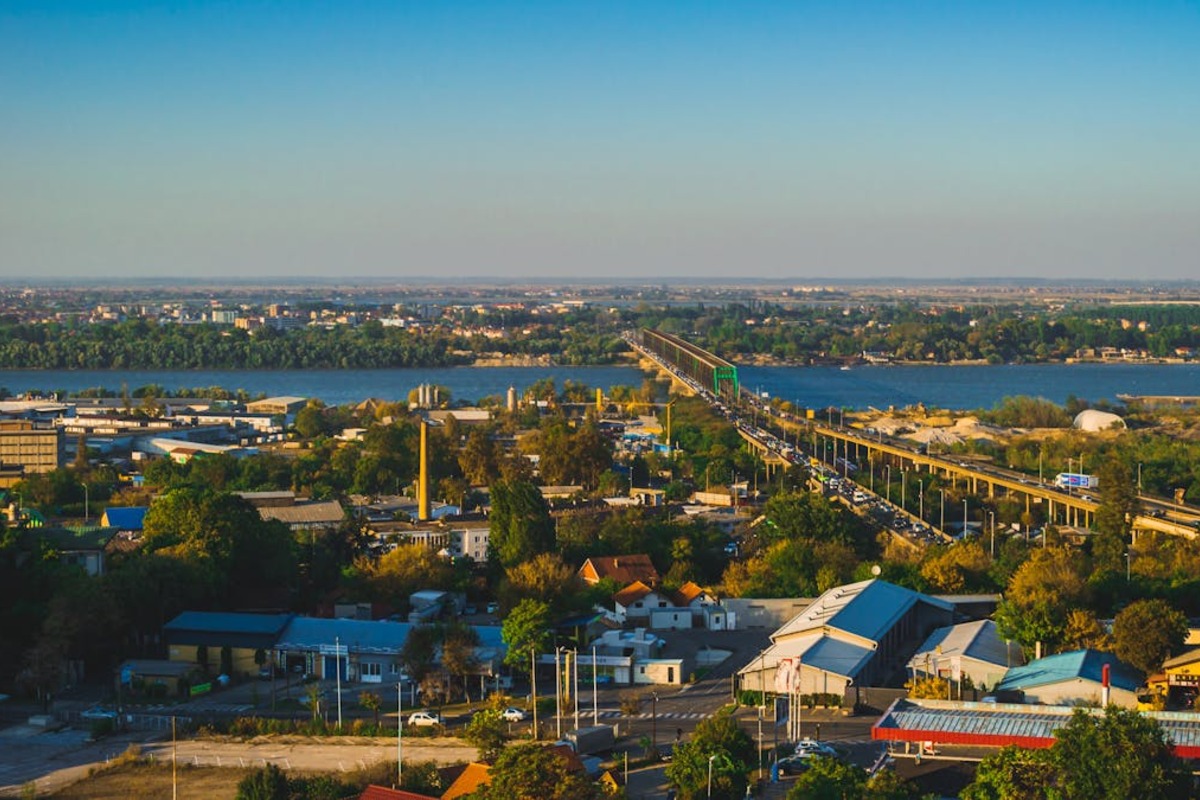
Novi Sad, Serbia’s second city about 90km north of Belgrade, runs roughly 15–20% cheaper than the capital with a surprisingly active expat and student community. For those who want a slower pace without sacrificing infrastructure, it’s worth a serious look.
Visas and Residency: What US Citizens Actually Do
US passport holders enter Serbia visa-free for up to 90 days in any 180-day period. That’s enough time to test the city, find an apartment, and begin the residency paperwork if you decide to stay.
Serbia doesn’t have a formal digital nomad visa. What it does have is a self-employment-based Temporary Residence Permit — and most long-term expat freelancers take this route. The process:
- Register as a sole proprietor (preduzetnik) with the Serbian Business Registers Agency (APR). Done online, takes 24–48 hours.
- Apply for a Temporary Residence Permit at the local police station (MUP). Required documents: passport, white card (proof of address registration), APR registration certificate, proof of income or bank balance.
- Permits are issued for one to three years and are renewable.
- After five years of continuous residence, permanent residency becomes available.
For non-freelancers, a long-stay Visa D (applied for at a Serbian embassy before arrival) works as an entry pathway for self-employment purposes. Serbia also allows a single-person LLC (d.o.o.) with a founding capital of one dinar — effectively zero. This corporate wrapper can be more tax-efficient depending on how your income is structured.
The 183-Day Tax Residency Trigger
You become a Serbian tax resident once you’ve spent 183 days in the country within a 12-month period. Before that threshold, Serbian tax only applies to your Serbia-source income. After it, your worldwide income is theoretically in scope — but without a US-Serbia tax treaty, you’re managing two tax systems simultaneously, not one clean territorial setup.
Some expats stay under 183 days in Serbia and maintain tax residency elsewhere. That strategy requires real substance in another jurisdiction, not just a hotel receipt.
Banking in Serbia: The SEPA Milestone Changes Everything
Serbia joined the SEPA (Single Euro Payments Area) zone in November 2025, with banks operationally ready for SEPA transactions by May 2026. For expats, this is a genuine inflection point. Before SEPA, moving euros to or from a Serbian bank account meant correspondent banking fees, multi-day delays, and occasional rejections from major EU banks that didn’t recognize Serbian IBANs. That bottleneck is now functionally gone.
Major banks operating in Serbia and accepting foreign clients:
- Raiffeisen Bank Serbia — most popular with expats, English-speaking staff in major branches, solid online banking
- UniCredit Bank Serbia — strong for business accounts, clean SEPA integration
- Intesa Banka Serbia — large retail network, competitive fees
- OTP Banka Serbia — Hungarian parent, widely accepted
- Erste Bank Serbia — good for those coming from Central/Eastern Europe
Opening an account as a new resident requires your passport, a white card (proof of address registration), and a Tax Identification Number (PIB). Process takes one to three business days. Deposits are insured up to €50,000 by the State Deposit Insurance Agency.
For your US banking anchor, Charles Schwab International remains the gold standard — no foreign transaction fees, unlimited ATM fee reimbursements worldwide including Serbian ATMs, and no minimum balance. Pair it with a Serbian local account for day-to-day dinar spending and you have a clean two-account stack. Mercury works well for business banking if you’re running an LLC or online operation from Serbia.
For USD-to-EUR transfers into your Serbian account, Remitly offers competitive rates with transparent fees and fast delivery — useful until you’ve established a regular banking routine.
US Tax Obligations You Can’t Escape
Moving to Serbia doesn’t change your US tax filing obligations. The US taxes citizens on worldwide income regardless of residence. The key requirements:
- FBAR (FinCEN 114): Required if your foreign bank accounts (combined) exceed $10,000 at any point during the year. File through BSA E-Filing — free. Penalties for willful non-filing start at $10,000 per violation.
- Form 8938 (FATCA): Required for single filers with foreign financial assets above $200,000 at year-end or $300,000 at any point. Thresholds double for married filing jointly.
- FEIE: If you qualify (bona fide residence or physical presence), you can exclude up to $130,000 of foreign earned income from US tax (2025 figure, indexed annually).
- Foreign Tax Credit: You can claim a credit for Serbian taxes paid on income also subject to US tax. Serbia’s 10% rate offsets some but not all of a higher US marginal rate.
The no-treaty situation catches people off guard. Countries with US tax treaties (Germany, UK, Netherlands) have provisions that prevent certain income types from being taxed twice in practice. Serbia has no such provision. Work through the FTC math carefully with an expat-specialist CPA before you file your first year.
For the full breakdown of FBAR, FATCA, and FEIE mechanics, the US Expat Banking & Taxes guide covers it in depth. For FEIE vs. FTC strategy, see Zero Federal Income Tax as a US Expat.
Healthcare in Serbia
Serbia has a public healthcare system, and residents with Serbian employment or self-employment registration can access it after paying social contributions. Quality is uneven — state hospitals in Belgrade are functional but crowded, and English proficiency among medical staff is inconsistent outside major private clinics.
Private clinics are inexpensive by Western standards. A GP visit runs €20–€40. Private health insurance from a local provider costs €30–€80/month for basic coverage. For major procedures or emergencies, medical tourism to neighboring EU countries (Hungary, Austria) is a practical option many expats use.
For international coverage — particularly if you travel frequently or want reliable English-speaking care across multiple countries — SafetyWing’s Nomad Insurance starts at around $56/month and covers you in Serbia and most other countries. For a full comparison of expat health plans, see the Expat Health Insurance guide.
Where to Live in Belgrade
Belgrade has distinct neighborhoods with meaningfully different vibes and price points:
- Vracar: The expat and young professional sweet spot. Dense with cafés, co-working spaces, restaurants. 1BR runs €500–€700/month. Walkable, central, safe.
- Zemun: Across the river, quieter and more residential. 15–20 minutes to the center. Rent is 20–30% lower than Vracar. Large Hungarian heritage community.
- Novi Beograd: The glass-and-concrete commercial district. Many tech companies and multinationals are based here. Modern apartments, €450–€600/month for a 1BR. Convenient but sterile.
- Savamala: Belgrade’s arts and nightlife district along the riverfront. Great energy, noisy on weekends, gentrifying fast.
- Dedinje: Belgrade’s most upscale residential area, favored by diplomats. Quiet, suburban. Rent jumps to €800–€1,500+ for a 1BR.
For most digital nomads and remote workers, Vracar is the obvious first base. It has the density of amenities that makes daily life easy, an active co-working scene, and it’s not so expensive that it undermines Serbia’s cost advantage.
Serbia vs. the Alternatives
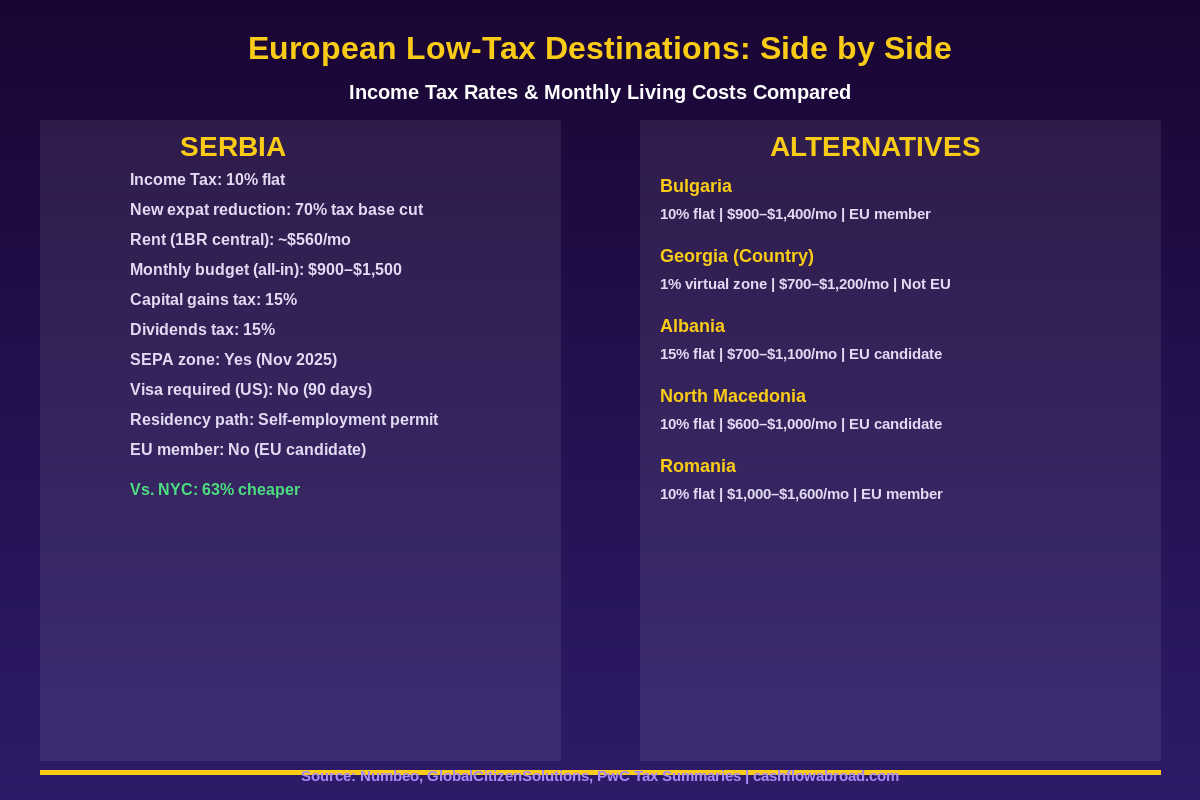
| Country | Income Tax | Monthly Budget | EU Member | SEPA | US Tax Treaty |
|---|---|---|---|---|---|
| Serbia | 10% flat | $900–$1,500 | No (candidate) | Yes (Nov 2025) | No |
| Bulgaria | 10% flat | $900–$1,400 | Yes | Yes | No |
| Georgia (Country) | 1% virtual zone | $700–$1,200 | No | No | No |
| Albania | 15% flat | $700–$1,100 | No (candidate) | No | No |
| Romania | 10% flat | $1,000–$1,600 | Yes | Yes | Yes |
| Portugal (NHR 2.0) | 20% flat (special) | $2,200–$3,500 | Yes | Yes | Yes |
The Serbia vs. Bulgaria comparison is the most instructive. Both have 10% flat rates, both have SEPA access, and both are in the broader European orbit. Bulgaria edges Serbia on EU membership — which matters if you eventually want full EU freedom of movement. Serbia edges Bulgaria on raw cost of living: Belgrade is meaningfully cheaper than Sofia on rent and daily expenses. If EU citizenship is a goal, Bulgaria wins. If you want to stretch dollars harder right now, Serbia wins.
Georgia at 1% virtual zone tax is compelling for pure tax optimization, but it requires setting up an IT company, operating without SEPA, and banking outside the Western financial infrastructure Serbia now offers. The gap between Georgia’s rate and Serbia’s has to be weighed against that friction.
Connectivity and Co-Working
Serbia’s internet infrastructure is solid. Average fixed broadband speeds in Belgrade run above 200 Mbps per Ookla’s Speedtest data. 4G LTE coverage is near-universal in urban areas; 5G rollout is active in Belgrade and Novi Sad.
The co-working scene has matured. Impact Hub Belgrade, Startit Centre, and several independent options in Vracar run €100–€200/month for a dedicated desk. Day passes are available.
If you’re traveling regionally while based in Serbia, a Saily eSIM covers 150+ countries and keeps you connected across borders without juggling physical SIMs.
Maintaining Your US Presence
Moving to Serbia doesn’t mean burning your US financial infrastructure. You still need a US address for IRS filings, brokerage accounts, and banking relationships. A physical address in a no-income-tax state (South Dakota, Wyoming, Florida, Nevada) is the standard approach for expats who want to eliminate state tax obligations entirely.
Traveling Mailbox gives you a real US street address in 50+ cities — not a PO box — with mail scanning and check deposit capability for $15/month. It’s what most serious long-term expats use to maintain their US banking stack, preserve their IRS-compliant address, and manage their state domicile situation. The virtual mailbox guide covers which state to anchor to and why.
The Bottom Line on Serbia
Serbia is a legitimate option — not a theoretical one, not a compromise. For US expats who don’t need EU citizenship or a US tax treaty, who earn under €42,000 and want a flat 10% rate, and who want a full-featured capital city at 63% less than New York’s cost, Belgrade is one of the stronger geographic arbitrage plays in Europe right now.
The SEPA addition removed the biggest practical friction point. The self-employment residency pathway is well-worn. The city works — internet, healthcare, food, transport. The main trade-off is the absence of a US tax treaty, which demands careful tax planning, and the non-EU status, which limits Schengen mobility to 90-day tourist windows unless you have another EU visa or citizenship.
For the framework on how to pick a base and structure your finances across borders, the Geographic Arbitrage Playbook is the place to start. If you’re still working through expat investing structures, the Expat Investor’s Playbook covers the PFIC trap and how to keep a compliant US brokerage account abroad.
Financial disclaimer: This article is for informational purposes only and does not constitute tax, legal, or financial advice. US tax obligations vary by individual circumstance. Consult a qualified CPA or tax attorney familiar with US expat law before making relocation or tax structure decisions. Tax laws in both the US and Serbia are subject to change; verify current rates with official sources before acting.
Liked this article?
Get the next one delivered straight to your inbox — plus a free Expat Tax Cheat Sheet.
Join our subscribers. No spam — just expat finance intel and new post notifications.