Buenos Aires for Expats: Living Large on $1,500/Month
9 min read · 2,131 words
Here’s a number that should stop you mid-scroll: a furnished one-bedroom apartment in Buenos Aires’s most fashionable neighborhood — tree-lined streets, European architecture, world-class steakhouses on the corner — costs around $700–$900/month USD. Utilities and internet add another $100. A dinner for two at a proper parrilla runs $12. The same lifestyle in New York, London, or Sydney? Call it $6,000–$8,000 a month and climbing.
Argentina has always attracted expats chasing the dollar gap. What’s different now is the stability. President Javier Milei’s shock-therapy reforms — chainsaw spending cuts, subsidy slashes, labor deregulation — drove Argentina’s annual inflation from a catastrophic 211% in late 2023 down to 31.8% by November 2025, the lowest in over seven years. The peso has largely stabilized. The chaos is receding. And the dollar still buys three to four times what it does anywhere else in the Americas.
This guide covers what you actually need to know: real monthly budgets, the visa options, how US tax obligations work here, and the banking workarounds that make Argentine life functional rather than just affordable.
Why Argentina, Why Now
The case for Buenos Aires has always been the lifestyle-to-cost ratio. Culturally, it punches at a European level — world-class theater, opera, museums, a serious food scene, and neighborhoods that feel like Madrid or Paris. Practically, you live on a US remote income that makes you wealthy by local standards.
What kept serious expats away for years was the chaos: multiple exchange rates, capital controls, 100%+ annual inflation, and a banking system that made moving money feel like a dice roll. Milei’s administration has addressed most of this. Capital controls have eased significantly. The exchange rate regime moved to a managed float band system in early 2026. Inflation, while still elevated at an estimated 20–25% for 2026, is no longer in hyperinflation territory.
For dollar earners, this creates a window: Argentine prices haven’t fully caught up to international levels, services remain dramatically cheaper than the US, and the country is functional enough that you’re not dealing with daily emergencies. Buenos Aires rent is still 65% cheaper than New York City and 45% cheaper than London for comparable apartments, according to Numbeo’s April 2026 data.
Cost of Living: The Real Numbers
The honest range for living comfortably in Buenos Aires as a dollar earner is $1,000–$2,500/month, depending almost entirely on rent and lifestyle choices. Here’s how that breaks down across three tiers:
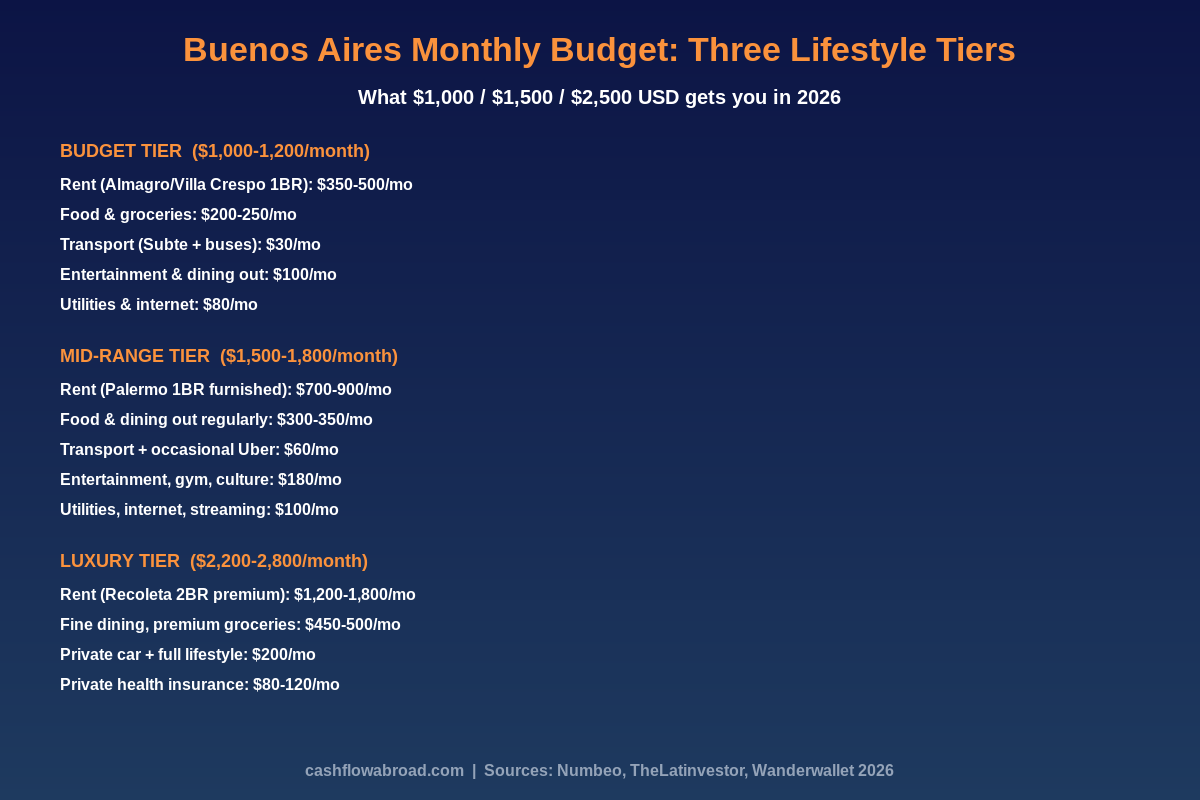
| Expense Category | Budget ($1,000-1,200) | Mid-Range ($1,500-1,800) | Luxury ($2,200-2,800) |
|---|---|---|---|
| Rent (1BR) | $350–500 | $700–900 | $1,200–1,800 |
| Food & groceries | $200–250 | $300–350 | $450–500 |
| Transport | $30 | $60 | $200 |
| Entertainment | $100 | $180 | $250 |
| Utilities & internet | $80 | $100 | $120 |
| Health insurance | $40–60 | $80–100 | $100–150 |
| Monthly Total | $800–1,020 | $1,420–1,690 | $2,320–3,020 |
Groceries deserve special mention. A full week’s shopping — actual cooking, not just snacks — runs $50–70 USD at a decent supermarket in Palermo. A steak dinner for two with wine at a mid-tier parrilla: $25–35. Espresso: $1. The peso hasn’t parity’d with the dollar on food yet, and that’s where the daily advantage shows up.
Neighborhoods Worth Knowing
Palermo (Soho/Hollywood sub-districts) is the default expat zone — cafés, coworking spaces, restaurants, parks, and a critical mass of English speakers. Expect to pay $700–$1,200/month for a furnished 1BR. It’s Buenos Aires’s Brooklyn, priced accordingly.
Recoleta runs more formal and European, with tree-lined boulevards, museums, and old-money architecture. Furnished 1BR apartments run $1,000–$1,800/month — premium, but genuinely beautiful.
Belgrano is where many long-term expats land: quieter, family-friendly, excellent infrastructure, $600–$900/month for a decent 1BR. Better value than Palermo, marginally less hip.
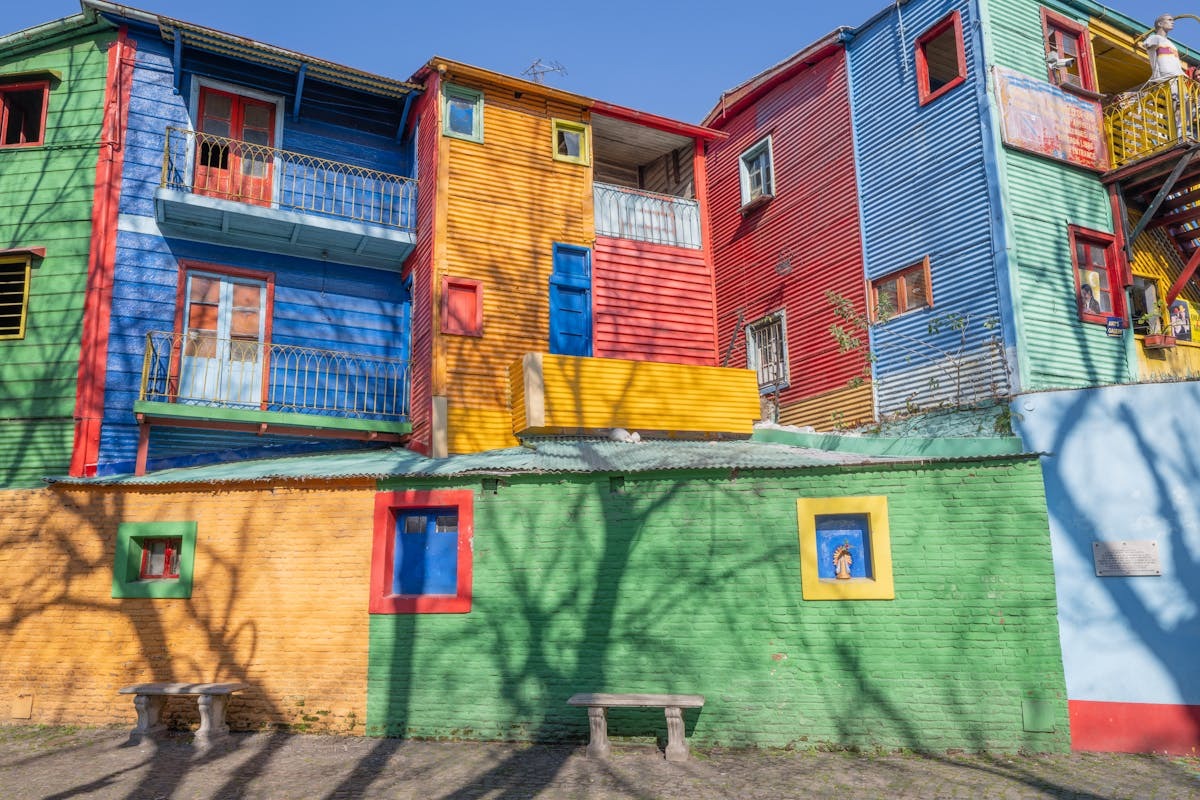
San Telmo and La Boca offer the cheapest rents in the central areas ($350–600/month) and the most authentic city texture — cobblestone streets, tango, open-air markets. San Telmo has gentrified considerably; La Boca requires more selective neighborhood navigation.
Almagro and Villa Crespo are the true budget picks for expats who want central access without tourist-area pricing. Furnished 1BRs start around $400/month and the neighborhoods are increasingly popular with younger digital nomads.
Visas and Residency Options
Argentina’s entry rules are comparatively relaxed for US citizens. You can enter visa-free for up to 90 days, renewable once for another 90 days (a simple border hop to Uruguay works). For longer stays, here are the structured options:
Digital Nomad Visa (Temporary Residency for Remote Workers)
Formalized via Decree 366/2025, Argentina’s remote worker visa allows stays of up to 180 days, extendable to 360 days total. Requirements:
- Valid passport (minimum 6 months validity)
- Proof of remote income: salary slips, employment contract, or invoices showing at least $1,500/month USD from a foreign employer or clients
- International health insurance coverage for the duration of stay
- Accommodation details
- Application fee: approximately $150 USD
This is a “transitory” category — it does not accumulate toward permanent residency. If you’re aiming to stay long-term, you’ll need to convert to a different visa category.
Rentista Visa
For those with passive income sources — dividends, rental income, pensions — the Rentista visa requires demonstrating regular monthly income from abroad. Processing time runs 2–4 months through the Argentine consulate. This route does accumulate toward permanent residency after 2 years of continuous residence.
Temporary Residency (Work or Investment)
The more formal permanent track: establish a business, get sponsored employment in Argentina, or qualify under the investment visa category. After 2 years of legal temporary residence, permanent residency becomes available. After 2 more years, citizenship is theoretically accessible — one of the faster timelines in the region.
US Taxes When You’re Based in Argentina
The critical context: Argentina and the US have no tax treaty. That removes one layer of protection, but the tools that matter — FEIE and the Foreign Tax Credit — still apply.
Foreign Earned Income Exclusion
If you meet the physical presence test (330 days outside the US in a 12-month period) or bona fide residence test, the FEIE lets you exclude up to ~$126,500 of foreign earned income from US federal taxes. This covers wages, freelance income, and self-employment earnings. It does not cover passive income like dividends or capital gains.
Argentine Income Tax
If you’re working remotely for clients and companies entirely outside Argentina, Argentine tax authorities generally do not consider you to have Argentine-source income — meaning you likely won’t owe Argentine income tax at all. This is the standard interpretation for most digital nomads and remote workers on the digital nomad visa.
If you do earn Argentine-source income (local clients, Argentine employer), the rates run from 5% to 35% on a progressive scale. Any Argentine taxes paid can be claimed as a Foreign Tax Credit on your US return, preventing double taxation on the same income. See the full strategy breakdown in our US Expat Banking & Taxes guide.
FBAR and FATCA Still Apply
Holding more than $10,000 in Argentine bank accounts at any point during the year triggers FBAR reporting. FATCA applies to foreign financial accounts over $200,000 (single filer). Most expats in Argentina keep minimal balances in local accounts and hold the bulk of their assets in US-based accounts — which sidesteps most of the reporting complexity. A Traveling Mailbox gives you a permanent US street address to maintain your US banking relationships, credit card accounts, and IRS domicile while you’re based in BA — essential if you’re planning to stay more than a year.
Banking and Moving Money
This is where Argentina still requires strategy. The official peso exchange rate and the informal “blue dollar” rate have converged significantly under Milei’s managed float system, but navigating the currency requires a plan. Opening a local Argentine bank account as a foreigner is bureaucratic — you’ll need a CUIL (tax ID equivalent), a local address, and significant patience.
For most expats, the practical approach:
- Keep your US banking intact. Mercury works well for dollar banking with no foreign transaction fees and easy wire capabilities. Charles Schwab International reimburses all ATM fees globally — genuinely useful in Argentina where ATM withdrawal fees compound fast.
- Use stablecoins for local spending. ARQ Finance lets you hold USDC/USDT balances and swap directly to ARS at near-official rates, plus offers a Mastercard with cashback and the ability to earn up to 4% on dollar balances. For expats in Argentina, this solves the peso access problem without the bureaucracy of a local bank account. Available for users in Argentina, Mexico, Colombia, and Brazil.
- Send transfers via Remitly. For larger USD-to-ARS conversions, Remitly consistently offers competitive rates with transparent fees — far better than standard wire options.
For more on the mechanics of moving money across borders without getting eaten by fees, see our Expat Money Transfer guide.
Healthcare: Better Than Expected, Cheaper Than Home
Argentina’s public healthcare is technically available to legal residents, but quality is inconsistent and wait times are long. The private system — obras sociales and private clinics — operates at a level that regularly surprises expats. Buenos Aires has several world-class hospitals and a large concentration of English-speaking physicians trained abroad.
Private health insurance in Argentina costs $80–$150/month USD through local providers like Medicus or Galeno, covering hospitalizations, specialist visits, and most outpatient care. Dental is excellent and dramatically cheaper than the US — expect to pay $30–60 for cleanings, $150–300 for procedures that would run $800+ Stateside.
For international coverage that follows you regardless of where you roam, SafetyWing’s Nomad Insurance starts at around $45–56/month and covers you in Argentina and across 180+ countries — useful if you’re splitting time between Argentina and other locations. Full comparison of expat health options in our Expat Health Insurance guide.
Connectivity and Practical Setup
Buenos Aires has solid internet infrastructure. Fiber connections run $20–40/month for 100–300 Mbps speeds in most central neighborhoods. Coworking spaces like Areatres, Urban Station, and Córdoba Club offer day passes ($8–15) and monthly memberships ($80–150) with reliable connections, printing, and coffee.
For connectivity before you land or while moving between countries, a Saily eSIM keeps you connected without hunting for local SIMs at the airport. Once settled in BA, local SIMs from Claro or Personal run $10–15/month for a generous data plan.
A NordVPN subscription is worth having — geo-blocked content from US streaming services, plus added privacy on local networks. At $4–5/month, it pays for itself the first time you want to watch something from a US library.
Argentina vs. the Regional Alternatives
If you’re deciding between South American expat destinations, here’s the honest comparison:
| Factor | Buenos Aires | Medellín, Colombia | Lima, Peru |
|---|---|---|---|
| Monthly budget (mid-range) | $1,500–1,800 | $1,200–1,600 | $1,300–1,700 |
| Digital nomad visa | 180 days, $1,500/mo income req | Digital nomad + investor visas | No specific DN visa |
| Tax on foreign income | Generally untaxed if truly foreign-sourced | Taxed globally after 183 days | Territorial after 3rd year |
| USD stability | Improving, managed float | Stable, USD widely accepted | Stable (official dollar economy) |
| Cultural capital | Very high (European-influenced) | High (Latin energy, transformation story) | High (history, food scene) |
Colombia, particularly Medellín, competes directly with Buenos Aires for the “Latin America expat base” title — stronger overall safety statistics in the city center and a growing remote-work infrastructure. If Colombia interests you as an alternative or complement, ColombiaMove.com covers the full picture on visas, banking, and neighborhoods. The Geographic Arbitrage Playbook covers how to rank countries systematically before committing.
What Actually Makes Buenos Aires Different
Numbers tell part of the story. What they miss: Buenos Aires has cultural depth that’s rare in “cheap” expat destinations. This is a city with over 200 live theater venues — more per capita than any city except New York — a tango tradition that’s genuinely lived rather than performed for tourists, a food scene built around one of the world’s great beef traditions, and an intellectual culture that produces serious literature, art, and conversation.
The pace is specifically Argentine — late dinners (9pm is early), extended social rituals, a deliberate resistance to the Northern Hemisphere’s productivity worship. Some expats hate it. Most, over time, find it recalibrating.
The tradeoffs are real: inflation psychology is baked into daily life even as rates improve, bureaucracy can be genuinely maddening, and periodic political volatility reminds you this isn’t Switzerland. But for a remote worker earning USD, the equation remains unusually favorable: a genuinely world-class lifestyle at a fraction of Western costs, with improving stability and a visa framework now structured enough to plan around.
Bottom Line
Buenos Aires rewards the prepared expat. The dollar advantage is real and persistent — you’re not just saving money, you’re accessing a cultural capital that most travelers only visit. With Milei’s reforms taking hold, the worst economic volatility has subsided. The digital nomad visa provides a legitimate 6–12 month framework. And $1,500/month buys a lifestyle that would cost $5,000+ in any comparable Western city.
The keys: maintain your US financial infrastructure (Schwab International for ATMs, a US banking address via Traveling Mailbox, Mercury for dollar operations), use stablecoin-backed tools like ARQ Finance for local ARS access, and get proper international health coverage in place before you land. The rest is mostly logistics.
If geographic arbitrage is your goal, Argentina is still one of the highest-leverage plays in the Western Hemisphere — and it’s more stable than it’s been in a decade.
Financial disclaimer: This article is for informational purposes only and does not constitute financial, tax, or legal advice. Tax laws and residency regulations change frequently. Consult a qualified expat tax professional and immigration attorney before making decisions about living or investing abroad. Affiliate links in this article may earn a commission at no additional cost to you.
Liked this article?
Get the next one delivered straight to your inbox — plus a free Expat Tax Cheat Sheet.
Join our subscribers. No spam — just expat finance intel and new post notifications.