Morocco for US Expats: Taxes, Visas & the $1,200/Month Life
11 min read · 2,772 words
Morocco sits 14 kilometers from Spain across the Strait of Gibraltar. On clear days you can see the Spanish coastline from Tangier’s waterfront. You can live in this country on $1,200 a month, apply the Foreign Earned Income Exclusion to eliminate most US federal income tax on earned income, and fly to a dozen European capitals for under $60. Fewer than 25,000 Americans have figured this out. That window won’t stay open forever.
Morocco isn’t the flashiest expat destination. It doesn’t have the UAE’s 0% corporate tax or Uruguay’s 11-year foreign income exemption. What it has is something rarer: genuine affordability inside a stable, modern country with fast internet, a functional legal system, a US tax treaty, and direct flights to America. For retirees, remote workers, and freelancers who want Europe’s proximity at Southeast Asia’s prices, it’s quietly one of the most underrated plays on the board.
What It Actually Costs to Live in Morocco
The exchange rate does most of the heavy lifting. At roughly 10 Moroccan dirhams to the dollar, everything denominated in MAD looks extraordinary to American eyes. A full meal at a local Moroccan restaurant runs 40–80 MAD ($4–8). A kilo of tomatoes costs 5 MAD. A domestic flight from Casablanca to Marrakech runs under 300 MAD ($30). A beer in a bar (the few that serve alcohol) is 40 MAD. Even the local hammam costs 20 MAD for a full steam session.
Rent is where the arbitrage is sharpest. A one-bedroom apartment in Marrakech’s residential neighborhoods rents for 3,000–4,500 MAD ($300–$450) per month. In Casablanca’s Maarif or Racine districts, expect 5,000–7,500 MAD ($500–$750). In Fes or Meknes, a spacious apartment in a traditional neighborhood rents for 2,500–3,500 MAD ($250–$350). Even in Casablanca’s premium neighborhoods, you won’t touch $1,500/month for a fully furnished flat.
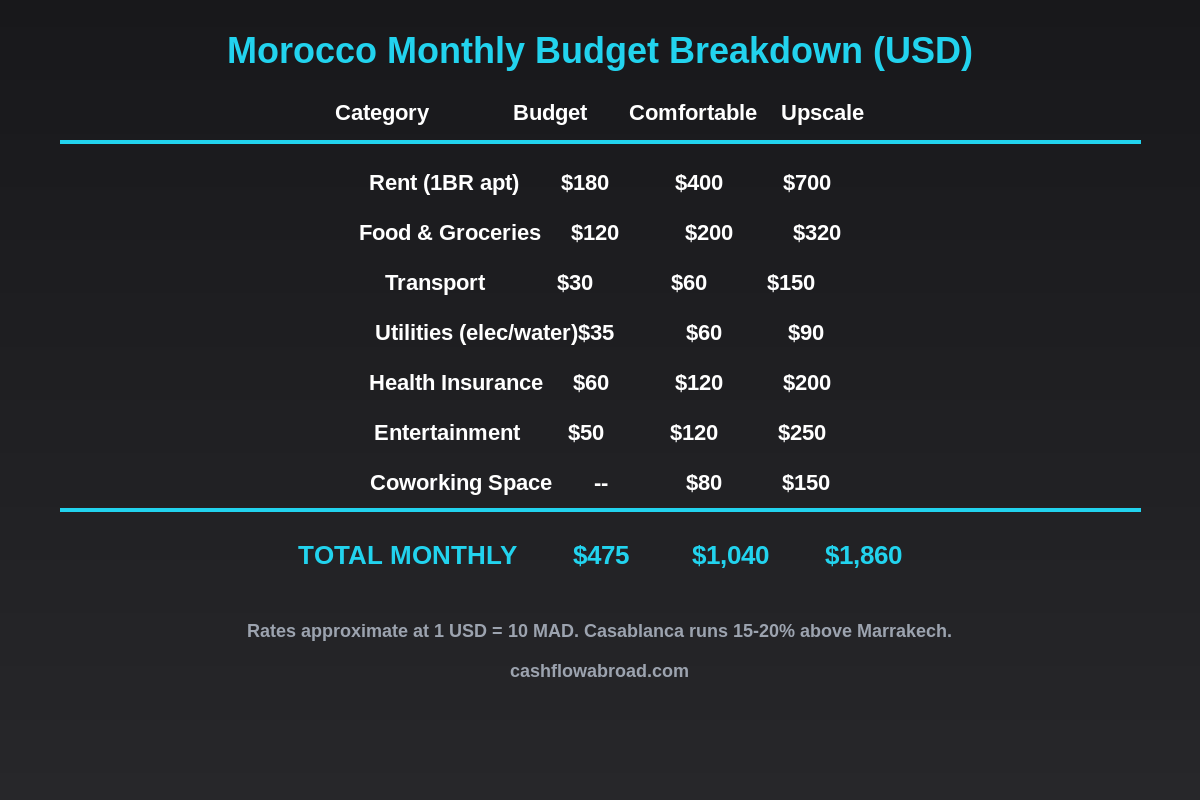
| Expense Category | Budget ($) | Comfortable ($) | Upscale ($) |
|---|---|---|---|
| Rent (1BR apartment) | $180 | $400 | $700 |
| Food & Groceries | $120 | $200 | $320 |
| Local Transport | $30 | $60 | $150 |
| Utilities (electricity/water) | $35 | $60 | $90 |
| Health Insurance | $60 | $120 | $200 |
| Entertainment & Dining Out | $50 | $120 | $250 |
| Coworking Space | — | $80 | $150 |
| Total Monthly | ~$475 | ~$1,040 | ~$1,860 |
Most single expats land in the $1,000–$1,400 range once you factor in health insurance, the occasional nice restaurant, and weekend travel to other cities or day trips to the Atlas Mountains. Casablanca runs 15–20% above those numbers. Fes, Agadir, and smaller coastal towns run 10–15% lower.
One cost that trips people up: international health insurance. Morocco’s public hospitals are functional but inadequate by Western standards, and most expats skip the local system entirely. SafetyWing’s Nomad Insurance runs around $60–80/month and covers you across Morocco and 180+ countries — the right starting point for someone in the first year before committing to a comprehensive local plan.
Morocco Taxes for US Expats: What You Actually Owe
This is where Morocco gets genuinely interesting — and where most articles get it wrong in both directions.
Moroccan Tax Residency: The 183-Day Trigger
Spend 183 or more days in Morocco during a calendar year and you become a Moroccan tax resident. That means Morocco taxes you on your worldwide income at progressive rates from 10% to 38%, with an additional solidarity tax of 2–6% on higher salary income. There is no territorial system here — Morocco expects residents to report global income.
The progressive bracket structure matters: the first 30,000 MAD ($3,000) of annual income is exempt. Income from 30,001–50,000 MAD is taxed at 10%. The top 38% rate kicks in only above 180,000 MAD ($18,000). For most expats earning primarily foreign income, the effective Moroccan rate is considerably lower than the headline 38% suggests, especially combined with treaty protections.
The US-Morocco Tax Treaty
Morocco and the United States signed a tax treaty in 1982, one of the earlier bilateral agreements the US extended to African nations. The treaty provides mechanisms to prevent double taxation through foreign tax credits — dollars you pay to Morocco can offset what you owe the IRS on the same income. You won’t generally pay full rates to both governments simultaneously. This is not a given with every expat destination; it’s a meaningful advantage Morocco holds over countries like Colombia (no US tax treaty) that are otherwise competitive on cost.
The FEIE: The Tool That Changes the Math
For most American expats in Morocco — remote workers, freelancers, and online business owners — the Foreign Earned Income Exclusion is the primary tax planning tool. For the 2025 tax year filed in 2026, the exclusion allows you to exclude approximately $130,000 of earned foreign income from US federal income tax, provided you establish a foreign tax home and meet one of two tests:
- Physical Presence Test: 330 full days outside the US in any 12-month period
- Bona Fide Residence Test: genuine residency in a foreign country for a full tax year
For a freelancer earning $80,000/year remotely while living in Marrakech, this can mean $0 in US federal income tax on earned income. What it doesn’t eliminate: self-employment tax (15.3% on net SE income, though half is deductible) and any Moroccan income tax owed as a local resident. Most expats end up owing some combination of SE tax and Moroccan progressive rates — rarely more than what they’d pay at home in the US, often considerably less.
Passive income — dividends, interest, capital gains, rental income — doesn’t qualify for the FEIE. Those flow through the Foreign Tax Credit or treaty provisions instead. For the full mechanics of when the FTC beats the FEIE and vice versa, the FEIE guide here covers every scenario. The comprehensive expat banking and tax guide ties the whole picture together.
One practical requirement: the IRS still needs a US mailing address for correspondence. Use a virtual mailbox rather than a relative’s address — especially if you’ve severed state ties. Traveling Mailbox provides a real US street address in 50+ cities, scans your mail on demand, and handles check deposits for $15/month. It’s also how you maintain a US bank account while living abroad, which you’ll need for receiving dollar-denominated client payments.
Getting Legal: The Residency Pathway
Americans enter Morocco visa-free for up to 90 days — enough time to find a neighborhood, sign a lease, and start the residency paperwork. Morocco doesn’t have a formal digital nomad visa. What it does have is a functioning, if deliberately bureaucratic, long-stay residency system called the Carte de Séjour.

The Carte de Séjour Process
Applications must be submitted within your initial 90-day entry window at the Bureau des Étrangers of the local prefecture (Préfecture de Police or Commissariat Central). In rural areas, submit to the Gendarmerie. Required documents typically include:
- Valid US passport and copies
- Criminal background check from the US, apostilled
- Medical certificate from a local Moroccan doctor (confirming no contagious diseases)
- Proof of accommodation: signed rental contract or property deed
- Moroccan bank account statement showing sufficient funds
- Passport photos (usually 4 required)
- Notarized copies of all documents at the nearest municipal office (Muqata’a)
The permit fee is 100 MAD ($10) per year of validity. First-time permits are valid for 1 year; renewals can extend to 2, 3, 5, or 10 years. Americans may apply directly for a 10-year permit on renewal — making the total long-term cost 1,000 MAD ($100) for a decade of legal residency. Processing takes 4–8 weeks after submission.
| Stage | Timeline | Cost |
|---|---|---|
| Entry (visa-free) | Day 1 | $0 |
| Find apartment, open bank account | Weeks 1–4 | ~$50 in bank fees |
| Compile and notarize documents | Weeks 2–8 | ~$100–200 |
| Submit Carte de Séjour application | Before day 90 | $10 (1-year permit) |
| Permit issued | 4–8 weeks after submission | — |
| 10-year renewal | Before expiry | $100 total |
One chicken-and-egg problem: you need a Moroccan bank account to apply, but banks often want a residency permit before opening an account. Work around this by presenting your rental contract, proof of income (client contracts, payslips, or a letter from your US bank), and a copy of your US passport. Attijariwafa Bank, Banque Populaire, and CIH Bank have all handled American expat account openings — bring multiple visits and your full documentation. Budget a day and half your patience.
Banking and Moving Money in Morocco
The Moroccan dirham is a controlled currency — not freely convertible outside Morocco. You can’t take more than 10,000 MAD in cash out of the country. Large inbound transfers require documentation showing the source of funds. In practice, this matters less than it sounds: you’ll earn in dollars, receive payments to your US account, and transfer monthly living expenses to your Moroccan account.
For sending money from the US to Morocco, Remitly delivers competitive MAD rates with fast settlement (often within minutes to Moroccan bank accounts) and total costs typically under $5 on transfers up to $5,000. Traditional bank SWIFT wires cost $25–$45 plus a spread — for recurring monthly transfers, that’s $300–$540/year in unnecessary fees.
Keep your US financial infrastructure intact. Mercury is the benchmark for US-based business banking as an expat: no foreign transaction fees, wire transfers included, and fully online. Charles Schwab International remains the most reliable expat brokerage — it doesn’t close accounts when you move abroad, and reimburses all ATM fees worldwide, making it the cleanest way to access cash in Morocco without paying currency conversion fees at every ATM.
Healthcare: What Expats Actually Use
Morocco’s public healthcare system exists and is technically free for residents, but quality varies significantly. Casablanca and Rabat have modern private hospitals that handle serious care well. For anything beyond a routine checkup, the private system is where you want to be.
Costs are reasonable: private GP consultations run 100–200 MAD ($10–$20). A specialist visit costs 150–300 MAD ($15–$30). Private hospital stays run 1,000–3,000 MAD/night ($100–$300) — less than the daily rate on most US ambulances. For routine care, paying out of pocket is entirely sensible. For serious illness or medical evacuation back to the US, you need insurance.
International expat health insurance through providers like SafetyWing starts around $60–80/month for comprehensive worldwide coverage. More complete plans from Cigna Global or Allianz Care run $150–$250/month with higher limits and dental included. The full expat health insurance breakdown compares these plans across price, network, and payout reliability.
Internet, Infrastructure, and Remote Work
Morocco’s internet catches most people off guard. As of 2026, the country ranks first in Africa for mobile internet speeds, with average mobile downloads of 124 Mbps — placing it 39th globally, ahead of plenty of Western European countries. Fixed broadband averages 55.89 Mbps nationally, with fiber-to-building available in central Casablanca, Rabat, and Marrakech. Starlink also operates in Morocco for those working from rural or mountain areas.
Coworking spaces are abundant in the three major cities. Marrakech alone has 20+ operational spaces, running $70–$150/month for a dedicated desk. The spaces cater increasingly to a European and American remote worker clientele — demand reportedly doubled in 2024–2025 as Morocco hit mainstream expat radar.
Electricity is reliable in urban areas. Brief outages occur more frequently outside major cities. Power quality is stable enough for desktop workstations. Worth noting: Morocco is two hours ahead of the UK and five to eight hours ahead of US time zones — favorable for European clients, manageable for US East Coast work schedules, difficult for US West Coast morning syncs.
A VPN is useful. Morocco blocks some VoIP services and the occasional streaming platform. NordVPN handles these cleanly and is good practice on any public coworking wifi.
Best Cities for American Expats in Morocco
Casablanca: The Modern Business Hub
Morocco’s commercial capital feels more like a European city than a North African medina. Strong infrastructure, international restaurants, the largest expat community in the country, and direct Royal Air Maroc flights to New York JFK (9.5 hours). Most expensive Moroccan city at $1,100–$1,600/month for a comfortable single. Best for people building businesses or needing consistent corporate-level infrastructure.
Marrakech: The Classic Expat Choice
Most internationally recognizable, with a large expat community, luxury riads at non-luxury prices, and year-round sun (300+ days). The medina is loud and touristy — live in Gueliz or Hivernage and you’ll barely encounter it. Budget $900–$1,400/month. Best for people who want a vibrant social scene, direct European flight connections, and weekend access to the Atlas Mountains or Sahara.
Rabat: The Underrated Capital
Cleaner and calmer than Casablanca, with a modern tramway, solid universities, and a growing tech and startup scene. Less tourist infrastructure than Marrakech, which means lower prices for equivalent quality. Budget $900–$1,300/month. The most livable city in Morocco that the expat crowd consistently underestimates.
Tangier: Europe on the Horizon
Northern Morocco’s gateway city. Ferry to Tarifa, Spain takes 35 minutes and costs $30–$40. The city has been substantially renovated over the past decade — new marina, international hotels, improving infrastructure. Budget $800–$1,200/month. Best for expats who want Schengen access for travel without building European tax residency, or anyone doing regular business across the Strait.
Fes: The Budget Masterpiece
Morocco’s cultural and intellectual capital, with a UNESCO-listed medina that is genuinely medieval in layout. The least touristy of the major cities in terms of expat-facing commercialization. Rent for a solid 1BR runs $200–$350/month; total comfortable budget $700–$1,000/month. Slower pace, fewer English speakers, quieter business infrastructure — the trade-off for living inside one of the most extraordinary urban environments in the world.
Morocco vs. Other Expat Destinations
| Factor | Morocco | Portugal | Thailand | Colombia |
|---|---|---|---|---|
| Monthly budget (comfortable) | $1,040 | $2,200 | $1,400 | $1,200 |
| Visa-free entry (US passport) | 90 days | 90 days (Schengen) | 60 days | 90 days |
| Long-stay permit cost | ~$10/year | €175–320 | $450/year | ~$150 |
| Internet speed (avg fixed) | 55 Mbps | 100+ Mbps | 75 Mbps | 50 Mbps |
| Flight to US East Coast | $600–900 | $500–800 | $900–1,400 | $350–600 |
| Distance to Europe | 14 km (ferry) | In Europe | 11,000 km | 9,000 km |
| Tax treaty with US | Yes (1982) | Yes | Yes | No |
Morocco’s geographic position is the ace card. No other affordable expat destination pairs EU proximity (you’re closer to Madrid than Philadelphia is to Boston) with sub-$1,200 all-in monthly costs, triple-digit mobile internet speeds, and a US tax treaty. Portugal delivers better infrastructure and legal certainty but at 2–3x the price. Southeast Asia offers similar cost arbitrage but puts you 20+ hours from the US and 11,000 km from Europe.
For those running a direct comparison against Colombia — the other top sub-$1,200 geographic arbitrage destination — the main differences come down to: language (Morocco is French/Arabic vs. Spanish), climate (Morocco’s dry summer heat vs. Colombia’s year-round spring altitude weather), and flight patterns (Morocco is much closer to Europe; Colombia is closer to the US East Coast). Both offer outstanding quality of life relative to cost; both have meaningful trade-offs. The Medellín cost breakdown at ColombiaMove.com has precise monthly numbers if you’re doing a direct comparison.
For the broader strategic framework of earning in strong currencies while spending in weak ones, the geographic arbitrage playbook lays out 10 of the best current setups.
The Downsides Nobody Talks About
Morocco gets romanticized. Here’s what the Instagram version omits:
Bureaucracy is real. Opening a bank account, processing a residency permit, navigating any administrative task — Morocco’s system runs on paper, notarized copies, and multiple in-person visits. Allow extra weeks for anything government-related. Hire a local facilitator if your time is worth more than the cost. Things move at their own pace; fighting that pace costs more energy than it saves.
Language barrier. Darija (Moroccan Arabic) is the daily street language. Modern Standard Arabic and French are the official languages; in Casablanca and Rabat, French gets you through 90% of situations. In smaller cities, English is limited outside tourist areas. If you don’t speak French, enroll in a course immediately upon arrival — it pays back in months.
The tourist tax. In medina neighborhoods, Westerners are quoted different prices for everything. It’s manageable with experience but initially draining. The fix: live in residential neighborhoods, not tourist zones, and the dynamic largely disappears.
Dirham lock-in. Morocco’s managed exchange rate means you can’t freely convert large savings or time currency moves. Keep savings in dollars or euros and transfer only monthly living expenses into MAD. Don’t hold large dirham balances if you’re building long-term wealth — do that in hard currency accounts back home.
Summer heat. Marrakech and inland Morocco hit 43–45°C (110–113°F) in July and August. Casablanca and coastal cities are moderated by Atlantic airflow but still warm. Budget for good air conditioning or plan to be elsewhere in the peak summer months — northern Morocco (Chefchaouen, Tangier) stays cooler, and Europe is 35 minutes away by ferry.
The Bottom Line
Morocco is underpriced for what it delivers. Fourteen kilometers from Spain, fastest mobile internet in Africa, a functioning tax treaty with the United States, $1,200/month for a comfortable expat life, and a residency permit that costs $10 a year. The bureaucracy is real and the language barrier is not nothing — but those are solvable problems. The fundamentals make it one of the most overlooked geographic arbitrage plays for Americans who want EU proximity without EU prices.
The window before this becomes mainstream is closing. Casablanca rents have risen 15% in two years. Marrakech’s coworking scene doubled in the same period. Tangier is being remade into a destination city. The time to get ahead of that curve is before Morocco becomes the next Lisbon — which everyone discovers right after it stops being cheap.
Financial disclaimer: This post is for informational purposes only and does not constitute tax, legal, or financial advice. US expat tax law is complex and changes frequently. The FEIE exclusion amount, bracket thresholds, and treaty provisions cited reflect the 2025 tax year and are subject to IRS adjustments. Consult a qualified CPA or international tax attorney familiar with US expatriate law before making any residency, tax, or financial decisions. Cost-of-living figures are approximate averages and vary by neighborhood, lifestyle, and currency fluctuation.
Liked this article?
Get the next one delivered straight to your inbox — plus a free Expat Tax Cheat Sheet.
Join our subscribers. No spam — just expat finance intel and new post notifications.