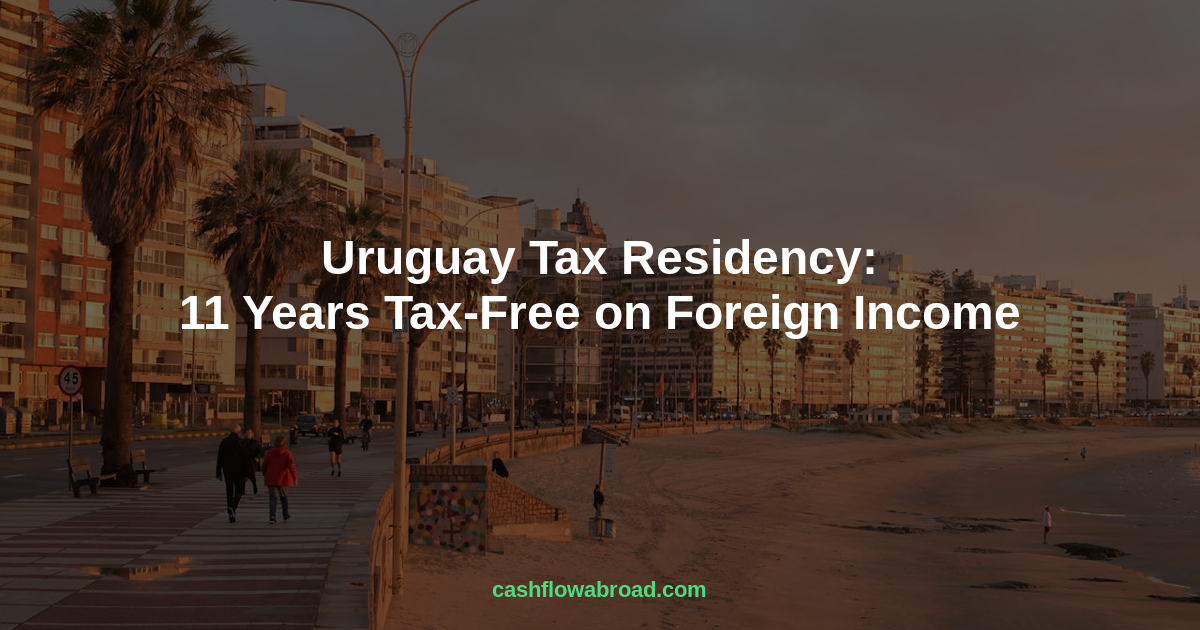
Uruguay Tax Residency: 11 Years Tax-Free on Foreign Income
9 min read · 2,205 words
Most expats chasing zero tax go straight to Paraguay, Georgia, or Dubai. Uruguay barely registers on the radar — which is exactly why smart money is moving there right now. As of January 1, 2026, Uruguay officially upgraded to what tax attorneys are calling the “Tax Holiday 2.0”: new residents get 11 full years of zero tax on foreign-source capital income. Not a reduced rate. Zero. After that, a 6% transitional rate kicks in for 5 years before settling at 12% — still among the lowest in the Americas on passive income. All while living in the safest, most politically stable country on the continent.
If you’ve been eyeing a territorial tax setup but want more than just tax savings — a legitimate path to a strong second passport, real infrastructure, excellent healthcare, rule of law — Uruguay just made a compelling argument.
Why Uruguay’s Tax Holiday Is Different From Paraguay or Georgia
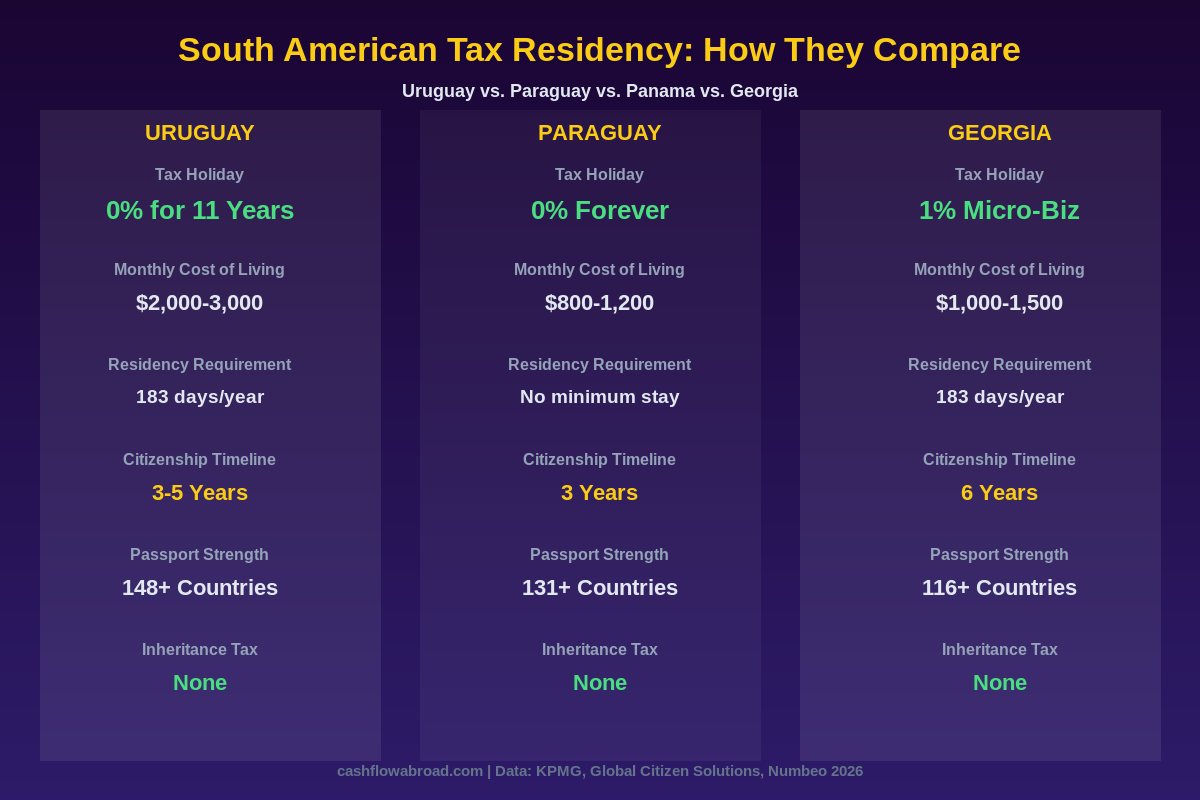
Uruguay doesn’t get lumped in with the typical “territorial tax” crowd, and there’s a reason for that. Most territorial tax jurisdictions — Paraguay, Panama, Georgia — simply exempt foreign income from day one, permanently. Uruguay’s system is more structured: a defined holiday period followed by a low transitional rate, rather than a blanket permanent exemption.
For most expats, this distinction doesn’t matter. Eleven years tax-free on dividends, interest, rental income, and capital gains from abroad is longer than most people stay anywhere. And compared to what you’d pay in the US (up to 37% ordinary income, 20% long-term capital gains plus Net Investment Income Tax), the math is aggressive.
What separates Uruguay from the pack is everything else the package includes: the Uruguayan passport ranks among the top 30 globally with visa-free access to 148+ countries, including the EU Schengen Area. The country has no inheritance tax, no wealth tax, and property taxes that run roughly 0.25%–1.5% of assessed value annually. There’s also a legitimate path to dual citizenship in as little as 3 years for married applicants.
How the Holiday Works: 11 Years, Then What?
Under Law N° 20.446, effective January 1, 2026, new Uruguayan tax residents who meet qualifying conditions are exempt from IRPF (Uruguay’s personal income tax) on foreign-source capital income for the year they establish residency plus the following 10 calendar years — 11 tax years in total.
After the holiday ends, a 5-year transitional period applies at a preferential 6% rate on relevant foreign income. Only after that 16-year window does the standard 12% IRPF rate on foreign capital income apply.
| Period | Tax Rate on Foreign Capital Income | Notes |
|---|---|---|
| Years 1–11 (Holiday) | 0% | Year of arrival + 10 full calendar years |
| Years 12–16 (Transitional) | 6% | Reduced rate, automatically applied |
| Year 17 onward | 12% | Standard IRPF rate on foreign capital income |
Note: The previous “forever 7%” flat-tax option that older residents used is being phased out for new entrants. New residents who establish tax residency from 2026 onward fall under this updated framework. Foreign-source employment income and local Uruguayan income are taxed separately under IRPF’s progressive scale (ranging up to 36%), so structuring matters.
What Counts as Foreign Income?
The 2026 changes significantly broadened what Uruguay treats as taxable foreign-source income — which is relevant after your holiday expires. During the 11-year window, none of this matters. But it’s worth understanding before committing long-term.
Under the new law, foreign-source capital income now explicitly includes:
- Dividends from foreign companies
- Interest income from foreign accounts and bonds
- Capital gains from selling foreign securities, real estate, or business interests
- Rental income from foreign properties
What remains exempt from Uruguayan tax regardless of residency status: income from services rendered entirely outside Uruguay where the economic benefit occurs abroad. A US LLC doing business with US clients, for instance, may still qualify for source-based exemption — but this requires careful structuring and legal advice specific to your situation.
Three Ways to Qualify for the Tax Holiday
Not every Uruguayan resident qualifies for the full 11-year holiday. You must meet one of three conditions set out by the 2026 budget legislation:
Route 1: The 183-Day Physical Presence Route
Spend at least 183 days per year in Uruguay and you qualify automatically, with no investment requirement. This is the clean, low-cost path. You establish actual residency, live there more than half the year, and the full tax holiday applies. Ideal for retirees, remote workers, or anyone restructuring their lifestyle around a lower-cost base.
Route 2: The Real Estate Investment Route
Invest a minimum of 12.5 million Unidades Indexadas — currently approximately USD $2 million — in Uruguayan real estate, spend at least 60 days per year in-country, and you qualify. This threshold was raised significantly as part of the 2026 budget reforms (previously around $380,000). For ultra-high-net-worth individuals who want minimal time requirements, it remains viable. For everyone else, Route 1 is far more practical.
Route 3: The National Innovation Fund Route
The newest addition: invest USD $100,000 per year into Uruguay’s National Innovation Fund for 11 consecutive years — a total commitment of $1.1 million over time. Designed to channel foreign capital into Uruguayan tech and startup ecosystems, it’s a niche play but worth knowing for investors who want non-real-estate diversification.
For the vast majority of expats, Route 1 — 183 days per year — is both the simplest and most affordable. Uruguay’s quality of life makes the time requirement a feature, not a burden.
How to Get Uruguayan Residency: Step by Step
Uruguay doesn’t have a flashy branded visa program. You apply for legal residency through a process that’s been in place for decades — straightforward once you know the steps.
The Rentista Route (Most Common for Expats)
If you have passive income — Social Security, dividends, pension, rental income, business distributions — the Rentista (Independent Means) pathway is your entry point. The standard income threshold advisors recommend is around $1,500/month in recurring, verifiable income, though the government doesn’t publish a fixed floor. You’ll document the source with bank statements, tax returns, or official income letters.
For digital nomads or remote workers, Uruguay also has a Digital Nomad Permit (Decree 238/022) granting a 6-month renewable stay that can lead to permanent residency for those intending to put down longer-term roots.
Timeline and Costs
| Stage | Timeline | Approximate Cost |
|---|---|---|
| Temporary residence permit | 10 days to 2 weeks | Government fees ~$100–200 |
| Permanent residency card | 4–8 months | Included in above |
| Immigration attorney (escribano) | Throughout process | $500–$1,200 one-time |
| Re-entry permit (each trip abroad) | Per exit | ~$40 per permit |
| Citizenship (married applicants) | 3 years from residency filing | Minimal government fees |
| Citizenship (single applicants) | 5 years from residency filing | Minimal government fees |
Documents required: valid passport, birth certificate (apostilled), police clearance from your home country (apostilled), proof of income, and proof of address in Uruguay. The escribano — Uruguay’s hybrid attorney/notary — handles document preparation and is worth every peso. Errors in apostilled documents cause 3–6 month delays and cost more to fix than the attorney fee would have.
One quirk worth budgeting for: every time you leave Uruguay, you need to obtain a re-entry permit (~$40 each). This is unusual by global standards and adds up if you’re a frequent traveler. Build it into your annual travel budget.
To maintain your US banking relationships, IRS correspondence address, and state domicile while living abroad, a virtual mailbox like Traveling Mailbox gives you a real US street address with mail scanning and check deposits — essential infrastructure for any long-term expat. Full details in our virtual mailbox guide.

Cost of Living in Uruguay: What Your Money Actually Buys
Uruguay is more expensive than Paraguay or Georgia — and considerably cheaper than the US, Canada, or Western Europe. Numbeo’s 2026 data puts Montevideo at roughly 17.5% cheaper than the US overall, with rent running 61% cheaper than equivalent American housing. A comfortable couple can live well in Montevideo on around $3,000/month — restaurants, taxis, weekend trips to the coast included.
| Expense | Monthly Cost (Single) | Monthly Cost (Couple) |
|---|---|---|
| Rent (1BR, city center) | $600–$900 | $800–$1,200 (2BR) |
| Groceries | $300–$470 | $500–$700 |
| Utilities (electricity, water, internet) | $80–$120 | $100–$150 |
| Local transport | $40–$80 | $80–$120 |
| Dining out (mid-range) | $200–$400 | $350–$600 |
| Health insurance | $50–$150 | $100–$300 |
| Total comfortable budget | $1,452–$2,100/month | $2,500–$3,200/month |
These numbers reflect a comfortable but not lavish lifestyle in Montevideo. Punta del Este — Uruguay’s Hamptons — runs 30–50% higher. Interior cities like Colonia del Sacramento or Salto come in significantly cheaper and attract expats who want a quieter pace.
Uruguay has public healthcare (ASSE) that legal residents can access, plus a robust private system (mutualistas) that’s cheap by any global standard. Many expats supplement with international coverage. SafetyWing’s Nomad Health plan is popular as a primary or supplemental international layer — see full coverage options in our expat health insurance guide.
The Uruguay Passport: Why 148 Countries Matters
The citizenship timeline is one of Uruguay’s most underrated features. Married couples can apply 3 years from the date they filed for permanent residency. Single applicants wait 5 years. Uruguay explicitly permits dual citizenship — you keep your US passport while adding a Uruguayan one.
A Uruguayan passport grants visa-free or visa-on-arrival access to 148+ countries, including the entire EU Schengen Area, the UK, Japan, South Korea, and most of the Americas. That’s a tier above Paraguay (131 countries) and significantly better than most Latin American passports.
The physical presence requirement for citizenship: at least 6 months per year in Uruguay during the qualifying period. If you’re using the 183-day route for the tax holiday, you’re automatically on track for citizenship simultaneously. One plan, two outcomes.
Compare this to alternatives: Portugal’s passive income visa leads to citizenship in 5 years but involves substantial bureaucracy. Malta’s citizenship by naturalization takes 3 years but costs €750,000+. Uruguay delivers a strong, globally-respected second passport for attorney fees plus living costs — provided you actually live there, which by most accounts isn’t a hardship.
US Tax Obligations Still Apply — Here’s What Changes and What Doesn’t
Uruguayan residency eliminates your Uruguayan tax burden on foreign income during the holiday. It does nothing to your US tax obligations. As a US citizen or green card holder, you file US returns regardless of where you live.
The good news: the Foreign Earned Income Exclusion (FEIE) can shelter up to $130,000 of active employment income in 2026 if you meet the Physical Presence Test (330 days outside the US in a 12-month period). Passive income — dividends, capital gains, interest — does not qualify for FEIE, but portfolio income from a US brokerage still benefits from preferential US capital gains rates (0%, 15%, or 20% depending on your income level), which can be lower than what you’d pay onshore in many countries. The detailed comparison is in our FEIE guide.
FBAR reporting (FinCEN 114) is mandatory if your foreign financial accounts exceed $10,000 at any point during the year. FATCA Form 8938 applies to a broader range of foreign assets at higher thresholds. Uruguay participates in the Common Reporting Standard (CRS), so your Uruguayan accounts will be reported to the IRS automatically. File accurately. Full compliance framework in our US expat banking and taxes guide.
For banking, Mercury handles US business banking for expat entrepreneurs without friction, while Charles Schwab International remains the gold standard for expat brokerage accounts — free global ATM withdrawals, no foreign transaction fees, no account closure for non-US residents. Keep your US financial infrastructure intact while building roots in Uruguay.
For moving money internationally, Remitly handles wire transfers at competitive rates without the hidden spreads common at traditional banks. More on transfer fees in our expat money transfer guide.
Who Should Seriously Consider Uruguay
Uruguay rewards a specific profile. If most of these apply, it deserves a real look:
- You have meaningful passive income — dividends, distributions, rental income, or capital gains you’ve already built. The 11-year zero-tax window compounds hard on larger portfolios.
- You value political and legal stability above all else. Uruguay is Transparency International’s least corrupt country in Latin America, consistently for over a decade. Property rights are enforced. Courts function. The banking system is regulated and solvent.
- You want a legitimate second passport in 3–5 years without paying €750,000 for the privilege.
- You can live comfortably on $2,500–$3,500/month or want access to a South American quality of life while keeping your US financial infrastructure intact.
- You don’t mind physical presence requirements. Uruguay is not a flag-plant-and-leave jurisdiction. You have to actually live there — 183 days a year — to capture the full benefit. Based on the quality of life, most residents consider that a selling point.
If you need a zero-cost, zero-presence tax setup, Paraguay or Georgia make more sense. If you want a complete relocation that pays dividends both financially and in terms of lifestyle and long-term optionality, Uruguay’s 2026 Tax Holiday 2.0 is one of the most complete packages available in the Americas right now.
The Bottom Line
The window for Uruguay’s best terms is open now. New residents who establish tax residency from 2026 onward lock in the full 11-year holiday structure before any future government decides to tighten the rules — as Portugal did with NHR in 2024, and as Uruguay’s own 2026 changes already demonstrated by raising investment thresholds from $380,000 to $2 million. The cost of entry on the 183-day path: a plane ticket, an attorney fee, and the willingness to spend six months a year in one of South America’s most livable cities.
The upside: a decade-plus of zero tax on your investment portfolio, a low-cost transitional phase after that, a path to a strong dual passport, and a stable base in a country that functions. For high-passive-income earners who’ve been sleeping on Uruguay, 2026 is the moment to take it seriously.
Financial disclaimer: This article is for informational purposes only and does not constitute tax, legal, or financial advice. Tax laws change frequently and individual circumstances vary significantly. Consult a qualified cross-border CPA and immigration attorney familiar with both US expat tax law and Uruguayan regulations before making any residency or tax decisions. Uruguay’s IRPF rules and holiday conditions referenced reflect Law N° 20.446 as understood at time of publication.
Liked this article?
Get the next one delivered straight to your inbox — plus a free Expat Tax Cheat Sheet.
Join our subscribers. No spam — just expat finance intel and new post notifications.