How to Pay Zero Federal Tax (Legally) as a US Expat
Every year, thousands of US expats legally pay $0 in federal income tax on up to $130,000+ of earned income. The IRS can and will audit this.
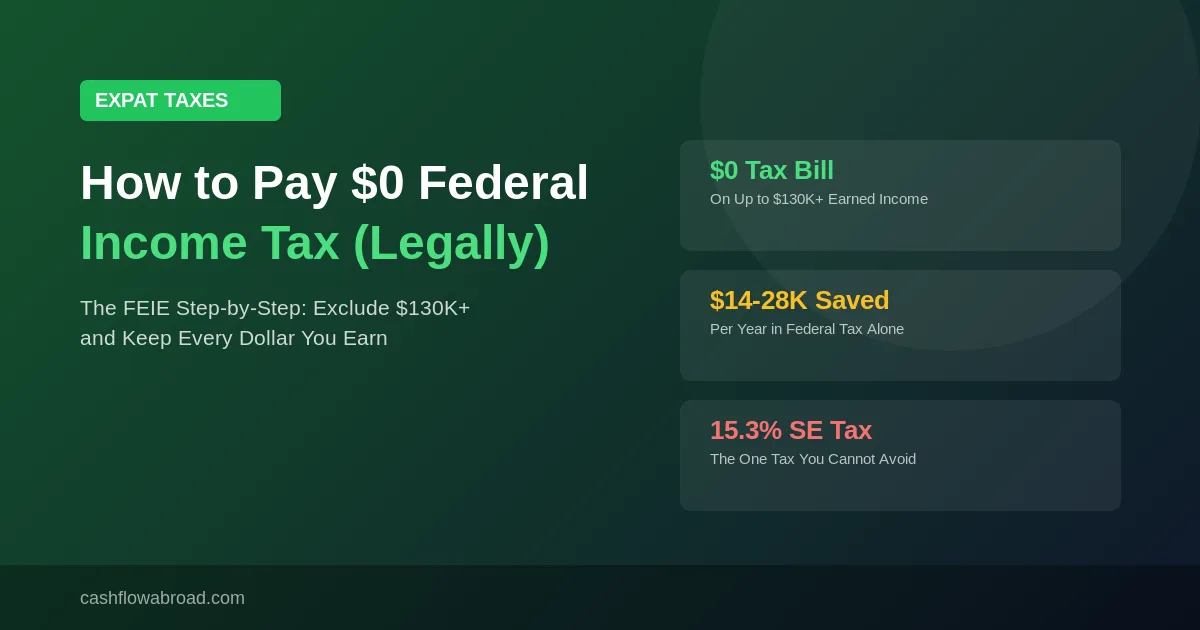
Every year, thousands of US expats legally pay $0 in federal income tax on up to $130,000+ of earned income. The IRS can and will audit this.
Disclosure: this article contains affiliate links. If you open an account through one of them, Cashflow Abroad may earn a referral commission at no extra cost to you.
The FEIE: Your $0 Tax Tool
The Foreign Earned Income Exclusion allows qualifying US citizens and residents living abroad to exclude up to:- 2025: $130,000
- 2026: $132,900
Related: self-employment tax trap guide
How to Qualify: Two Tests
You must pass one of two tests:Physical Presence Test (Most Common)
- Be physically present in a foreign country for 330 full days during any 12-consecutive-month period
- Days do NOT need to be consecutive
- The 12-month period does NOT need to align with the calendar year
- Travel between foreign countries counts; US days do not
- You get 35 days in the US — use them wisely (holidays, family visits, business trips)
Bona Fide Residence Test
- Must be a bona fide resident of a foreign country for an entire calendar year (January 1 - December 31)
- Must be a US citizen (Green Card holders generally can't use this)
- The IRS looks at intent: lease agreements, local bank accounts, community ties, visa type
Real Tax Savings Scenarios
| Income | US Tax (Single, Standard) | With FEIE | Annual Savings |
|---|---|---|---|
| $60,000 | ~$6,300 | $0 | $6,300 |
| $80,000 | ~$10,100 | $0 | $10,100 |
| $100,000 | ~$14,300 | $0 | $14,300 |
| $130,000 | ~$21,500 | $0 | $21,500 |
| $150,000 | ~$26,000 | ~$2,600 | $23,400 |
Above $130K? The Housing Exclusion Adds More
On top of the FEIE, the Foreign Housing Exclusion lets you exclude additional amounts for qualifying housing costs:- Standard cap (2025): additional $18,200 above the base amount
- High-cost cities get more: Hong Kong ($114,300), Geneva ($102,600), Singapore ($82,900)
Related: five-flag strategy guide
The One Tax You CANNOT Avoid: Self-Employment Tax
Here's the critical caveat: the FEIE does not reduce self-employment tax. If you're self-employed (freelancer, LLC owner, consultant), you still owe:- 12.4% Social Security (on earnings up to $176,100 in 2025)
- 2.9% Medicare (no cap)
- Total: 15.3%
State Tax: The Hidden Trap
You can owe $0 federal tax and still owe state tax. California, Virginia, and New Mexico are notorious for continuing to tax residents who move abroad. Most states don't recognize the FEIE. The solution: Establish domicile in a no-income-tax state (Florida, Texas, Nevada, Wyoming, etc.) before moving abroad. I detail the complete strategy in the state tax section of my expat tax guide.Related: Roth IRA expat guide
Common Mistakes That Disqualify You
- Spending too many days in the US — Over 35 days and you fail the Physical Presence Test
- Not tracking days properly — Partial days count as US days if you're in the US at midnight
- Applying FEIE to passive income — It only covers earned income, not investments. Your trading gains are still taxed.
- Forgetting to file — You must file a US return and Form 2555 even if you owe $0
- Revoking the FEIE — If you revoke, you can't re-elect for 5 years without IRS approval
Step-by-Step: Your First Year
- Month 1-2: Establish domicile in a no-tax state if needed — use Traveling Mailbox for a real street address in your new domicile state (from $15/month) — and set up Mercury for business banking that works from anywhere
- Month 3: Move abroad, start your 12-month Physical Presence period
- Months 3-14: Spend at least 330 days outside the US
- April 15 (following year): Taxes owed are due (even with extensions)
- June 15: Automatic 2-month extension for expats (no form needed if tax home is abroad)
- October 15: Extended deadline (file Form 4868 before June 15)
- File Form 2555 with your return to claim the FEIE
- File FBAR separately if foreign accounts exceed $10,000
FEIE vs. Foreign Tax Credit: Quick Decision
- Low/no-tax country (UAE, Panama, Colombia under 183 days) → FEIE
- High-tax country (UK, Germany, Japan) → Foreign Tax Credit
- Above FEIE limit → FEIE on first $130K, FTC on the rest
Paying $0 federal income tax isn't complicated — it just requires living abroad, tracking your days, and filing the right forms. The FEIE saves the average qualifying expat $10,000-25,000/year. Combined with geographic arbitrage savings, you're building wealth at an extraordinary rate. Don't forget health coverage — SafetyWing provides global health insurance from ~$120/month, a fraction of what US plans cost and fully compatible with the nomad lifestyle. Disclaimer: This is not tax advice. Consult a qualified tax professional for your specific situation. Tax laws change; verify current thresholds before filing.
This guide is general information, not personalized tax, legal, or investment advice. Rules change; verify current thresholds with official sources or a qualified professional before acting.
Related guides
 Expat Tax & FinanceMay 29, 2026
Moving Abroad Mid-Year: Maximize Your Tax Benefits
Moving in Q4 instead of Q1 costs you up to $30K in FEIE exclusions. Learn how pro-ration works, state tax traps, and FBAR obligations in year one.
 Expat Tax & FinanceAugust 26, 2026
Qualify Under the FEIE Bona Fide Residence Test
Qualify for the FEIE without counting 330 days. Use the IRS full-year test, avoid the tax-home trap, and file Form 2555 the right way.
 Expat Tax & FinanceAugust 22, 2026
How to Count 330 Days for the FEIE
Count 330 FEIE days correctly, choose the best 12-month window, document travel, and protect your foreign earned income exclusion before filing.