Turkey for US Expats: Taxes, Visas & the $900/Month Life
8 min read · 2,051 words
Ninety-five percent of expats looking for cheap European-adjacent living stop at Portugal, Spain, or Georgia. They’re leaving serious money on the table. Istanbul, right now, offers one of the most compelling currency arbitrage setups in the world: inflation still running above 30%, a lira that’s shed roughly 18% of its value against the dollar over the last 12 months, and a city that rivals Paris for culture at a fraction of the cost. A furnished one-bedroom apartment in a hip neighborhood costs $430–$715 a month. A full sit-down dinner with wine: $12.
Turkey won’t work for everyone — and the caveats are real. But if you’re earning in USD or EUR and willing to navigate some bureaucratic friction, Istanbul might be the highest-leverage move in expat geography right now.
Why Turkey, Why Now
The math is simple and brutal. Turkey’s annual inflation rate hit 31.53% in early 2026 before easing slightly to 30.87% in March. For Turkish residents earning lira, this is a crisis. For dollar earners, it’s a compounding discount. The USD/TRY exchange rate currently sits around 44.7 — and analysts project it could reach 52–55 by year-end as structural pressure continues.
That’s not just cheap rent. That’s your purchasing power growing month over month as you sleep.
Compare that to Portugal’s NHR sunset, Georgia’s increasingly complex tax picture, and Mexico’s dollarizing rental market in expat hotspots. Turkey is actually getting cheaper in real USD terms while most other expat destinations are getting more expensive.
Istanbul specifically sits at the intersection of Europe and Asia — literally. It’s a 3-hour flight from most of Western Europe, 11 hours from the US East Coast, and has direct connections to 300+ cities globally. It’s a city of 16 million with Michelin-starred restaurants, art galleries, ancient ruins, and a food scene that would embarrass most European capitals.
Check out the geographic arbitrage playbook for how Turkey stacks up against 10 other high-value expat destinations.
Where to Live: Istanbul Neighborhoods for Expats
Istanbul is enormous. Where you land matters as much as the city itself.
Kadıköy (Asian Side) — Best for Young Professionals
Kadıköy has quietly overtaken many European-side districts in per-square-meter rents — a testament to how good it is. The Moda and Yeldeğirmeni sub-neighborhoods are full of independent coffee shops, bookstores, Saturday farmers’ markets, and craft beer bars. It’s walkable, safe, and has excellent public transit connections to the European side via ferry. Expect to pay $430–$715/month for a furnished 1-bedroom.
Cihangir & Galata (European Side) — The Boho Scene
Cihangir is Istanbul’s answer to Brooklyn circa 2012. Narrow streets, cats everywhere, independent cafes, and a dense expat community of writers, artists, and digital nomads. Galata, just downhill, has better nightlife access. Rents are higher due to foreigner demand for furnished, short-term-friendly apartments — budget $600–$900 for a 1-bedroom.
Beşiktaş & Nişantaşı — The Upscale Play
If you’re coming from Manhattan and refuse to compromise, Nişantaşı is your neighborhood — luxury boutiques, high-end restaurants, and Bosphorus-view apartments. Beşiktaş is slightly more affordable while still upscale. A modern 1-bedroom in a renovated building runs $1,100–$1,400/month. Still cheaper than most Western European capitals, but you’re paying a premium for the premium.
Beyond Istanbul: Antalya & Izmir
Istanbul isn’t Turkey’s only expat magnet. Antalya on the Mediterranean coast is increasingly popular with European retirees — a 2-bedroom with a sea view runs $400–$600/month, and the climate is significantly better in winter. Izmir, Turkey’s third-largest city, has a relaxed Aegean pace, strong expat community, and lower costs than Istanbul across the board. If remote work is the goal and you don’t need a megacity, both deserve serious consideration.

The Real Cost of Living Numbers
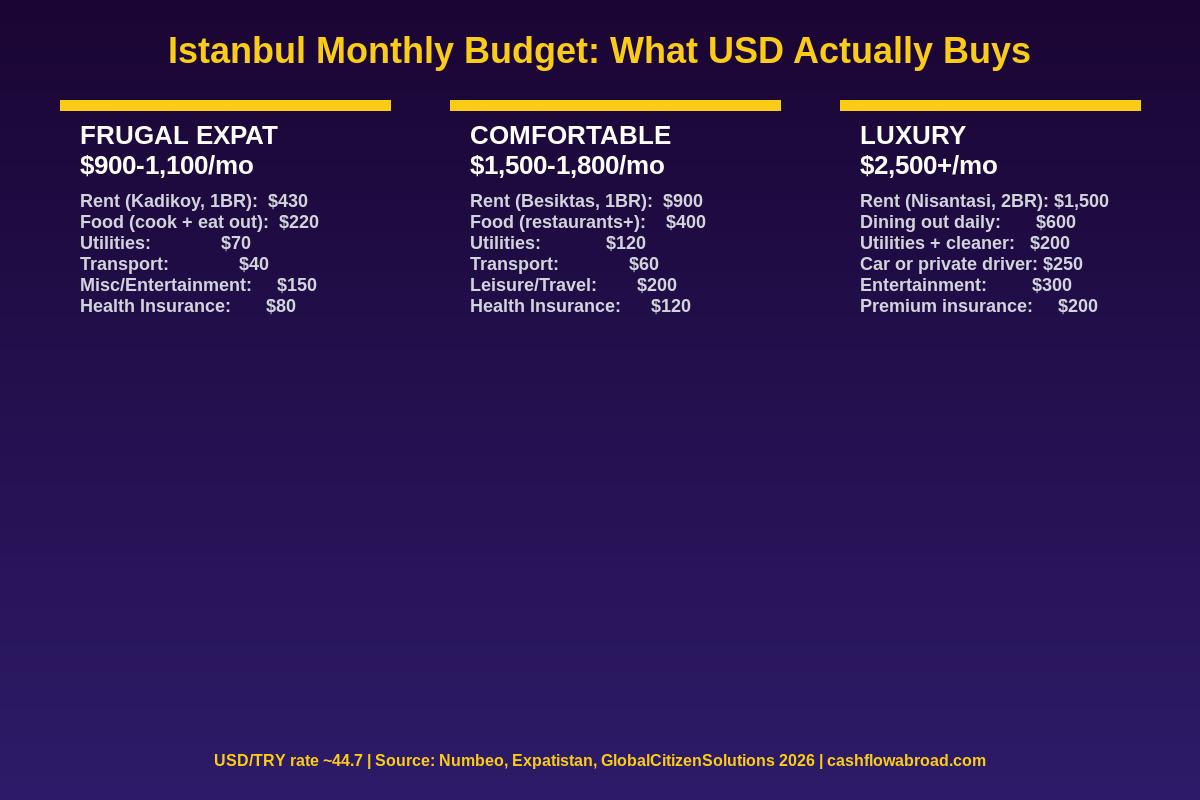
Based on 2026 data from Numbeo, Expatistan, and GlobalCitizenSolutions, here’s what a single person actually spends in Istanbul:
| Expense Category | Budget Tier ($900–1,100/mo) | Comfortable ($1,500–1,800/mo) | Luxury ($2,500+/mo) |
|---|---|---|---|
| Rent (1BR furnished) | $430–$500 | $800–$900 | $1,400–$1,700 |
| Groceries | $150–$200 | $200–$280 | $300+ |
| Eating Out | $80–$120 | $150–$200 | $300+ |
| Utilities | $65–$80 | $100–$130 | $200+ |
| Transport (transit card) | $30–$50 | $50–$80 | $200+ (car/driver) |
| Health Insurance | $60–$100 | $100–$150 | $200+ |
| Monthly Total | $900–$1,100 | $1,500–$1,800 | $2,500+ |
A single lira-priced Turkish meal — lahmacun, doner, börek — runs $1–3. A coffee at a local spot: $0.50. Even in touristy areas, a sit-down fish dinner with drinks rarely exceeds $25 per person. Groceries from the weekly market (where locals actually shop) are a fraction of what expat-facing supermarkets charge. The variance between tourist Istanbul and local Istanbul pricing is enormous; navigate it correctly and you’re living at a genuinely different cost floor.
Turkey’s Digital Nomad Visa: The Specifics
Turkey officially launched a Digital Nomad Visa allowing remote workers to live and work legally in the country with full legal status. Here’s exactly what’s required:
| Requirement | Details |
|---|---|
| Age | 21–55 years old |
| Income | $3,000/month minimum from foreign sources |
| Education | University degree or higher |
| Health Insurance | Required — must include Turkey coverage |
| Passport | 6+ months validity remaining |
| Duration | 1 year, renewable for a second year |
| Eligible Nationalities | US, EU/EEA, UK, Canada, Russia, Ukraine, Belarus + more |
The process starts at the official Digital Nomads GoTürkiye website, where you apply for a Digital Nomad Identification Certificate. Once issued, you attend a visa appointment at the Turkish consulate in your home country. Processing is typically faster than most European nomad visa programs — several applicants report 4–8 weeks from application to certificate.
The $3,000/month income floor keeps out people planning to live purely on savings, but it’s realistic for most remote workers. The upside is that the threshold makes approval more predictable than visa programs with vague “sufficient means” language.
No digital nomad visa yet? Turkey issues a standard e-Visa (processed in minutes online) allowing 90-day stays. Many people test Istanbul on a tourist visa before committing. The 90-day limit on an e-Visa is firm — plan accordingly.
See how Turkey stacks up against other programs in the digital nomad visas ranked guide.
Health Insurance in Turkey
The digital nomad visa requires coverage. Turkish private hospitals — particularly in Istanbul — are excellent by any metric, and private health insurance is remarkably affordable. A local Turkish policy covering hospitalization and outpatient care runs $80–$150/month for adults under 45.
Most expats who travel frequently choose international coverage instead of country-specific plans. SafetyWing Nomad Insurance runs $60–$100/month depending on age and covers you across Turkey and 185+ other countries. Their Remote Health plan adds US coverage if you return home periodically.
Dental work in Turkey deserves special mention: Istanbul has become a medical tourism hub for dental procedures, with costs running 60–80% lower than US prices with comparable quality at top clinics. Read more in the complete expat health insurance guide.
US Taxes While Living in Turkey
Americans abroad don’t escape the IRS. The US taxes citizens on worldwide income regardless of residence — Turkey is no exception. Here’s how the tax picture actually works.
Foreign Earned Income Exclusion (FEIE)
Qualify as a bona fide resident of Turkey or pass the Physical Presence Test (330+ days outside the US in a 12-month period) and you can exclude up to $132,900 of earned income from US taxes in 2026. Earned income means wages, salary, and self-employment income from work performed abroad. Investment income, dividends, and rental income don’t qualify — those require the Foreign Tax Credit.
Self-employed expats face an additional wrinkle: the FEIE excludes income from ordinary income tax but not from self-employment tax (15.3%). The deep dive on FEIE vs Foreign Tax Credit covers which strategy saves you more depending on your income structure.
Turkish Tax Residency
Stay 183+ days in Turkey in a calendar year and you’re considered a Turkish tax resident, subject to progressive income tax of 15–40% on worldwide income. The good news: Turkey and the US have a bilateral tax treaty preventing double taxation. Turkish income taxes paid reduce your US tax bill dollar-for-dollar via the Foreign Tax Credit.
There’s a nuance worth knowing: Turkey treats foreigners who come specifically for employment or business as non-residents even if they cross the 183-day threshold. For digital nomads working for foreign clients, this creates genuine ambiguity. Get qualified advice from a US expat tax specialist before drawing conclusions.
FBAR and FATCA
Opening a Turkish bank account — common and often necessary — triggers US reporting requirements if the balance exceeds $10,000 at any point during the year. Report it on the FBAR (FinCEN 114) by April 15 (auto-extended to October 15). FATCA reporting begins at $50,000 for single filers. Turkish banks comply with FATCA data-sharing agreements — they report account info to the IRS. Don’t assume obscurity is protection. Full compliance framework is in the US expat banking and taxes guide.
Expat Banking Setup for Turkey
Opening a local Turkish bank account requires a tax identification number (Vergi Kimlik Numarası — obtainable at any tax office with your passport), proof of address, and your passport. Akbank, Garanti BBVA, and İşbank all have English-language interfaces and functional mobile apps. Budget 1–3 weeks for the process.
Keep your US banking infrastructure alive. Charles Schwab’s international checking account is the standard recommendation for globe-trotting Americans: no foreign transaction fees, unlimited ATM fee reimbursements worldwide, and no minimum balance. Withdraw lira from any Istanbul ATM at the interbank rate with no fees.
For moving money between your US account and Turkey — or receiving USD from US clients — Remitly offers competitive rates with low flat fees and fast delivery.
US banks increasingly close accounts when they detect prolonged foreign activity. Maintain a US mailing address to keep your accounts intact. A Traveling Mailbox virtual address ($15/month) gives you a real US street address in 50+ cities — your bank statements, IRS correspondence, and brokerage mail get scanned and delivered digitally. Non-negotiable if you’re staying longer than a few months.
Connectivity and the VPN Question
Istanbul has solid fiber internet in most apartments and strong 4G/5G coverage citywide. The infrastructure won’t be your problem. The content restrictions will be. Turkey has a history of blocking social media platforms — Twitter has been temporarily blocked multiple times — and certain news sites are permanently inaccessible. A reliable VPN is table stakes for expat life here. NordVPN works consistently in Turkey and gives you access to US Netflix, banking portals, and anything else that geo-restricts.
For connectivity on arrival or during regional travel, Saily eSIM covers Turkey and most of Europe and the Middle East — skip the airport SIM counter entirely.
The Real Risks: Don’t Go In Blind
Turkey is not without friction. The honest version of this guide has to name the downsides.
Currency risk compounds both ways. The lira’s weakness is your arbitrage — but if Turkey ever achieves macro stability and the lira appreciates meaningfully, your advantage shrinks fast. Some expats price rent contracts in USD specifically to decouple from lira exposure on the payment side; landlords in popular neighborhoods are increasingly demanding this anyway.
Inflation hits local prices continuously. At 31%+ annual inflation, lira-denominated prices are rising fast. A meal that cost 150 TL in early 2025 might cost 200 TL by end of 2026. Dollar earners benefit as long as the lira depreciates faster than local prices rise — which has mostly held true — but it’s not guaranteed.
The political environment is complex. Turkey ranks poorly on press freedom indices, and political speech can carry real risk. Enforcement against foreign nationals is minimal in practice — most expats experience Istanbul as a politically neutral environment for daily life — but understand the context you’re entering.
Banking friction with US institutions. Chase, Bank of America, and other traditional US banks sometimes close accounts when customers show prolonged foreign transaction patterns. The fix is using expat-friendly accounts (Schwab, Mercury for business) and maintaining a US address.
The Bottom Line
Turkey is a high-ceiling, high-complexity play. The arbitrage is real — perhaps the most compelling available in any major city with direct European flight connections. A dollar-earner living in Istanbul at the $1,500/month comfortable tier is enjoying a lifestyle that costs $4,000–$5,000/month in a comparable Western European city.
The digital nomad visa provides legal clarity. The US-Turkey tax treaty prevents double taxation. The FEIE covers up to $132,900 of earned income tax-free. The risks — currency volatility, bureaucratic friction, periodic political instability — are manageable with preparation. The people who dismiss Turkey usually haven’t run the actual numbers against cities they consider “safe” destinations.
Istanbul is one of the great cities of the world. Right now, you can live in it for the price of a studio in Cleveland.
Financial disclaimer: This post is for informational purposes only and does not constitute tax, legal, or financial advice. Tax laws and visa requirements change frequently and individual situations vary significantly. Consult a qualified tax professional specializing in US expat taxation before making decisions about foreign residency, foreign income, or international banking. Exchange rates and cost-of-living figures reflect April 2026 data and will change over time.
Liked this article?
Get the next one delivered straight to your inbox — plus a free Expat Tax Cheat Sheet.
Join our subscribers. No spam — just expat finance intel and new post notifications.