AI Micro-SaaS: $200/Month Stack, $5K/Month Revenue
10 min read · 2,459 words
The median profitable micro-SaaS earns $4,200/month in recurring revenue and costs less than $200/month to run. If you’re living in Medellín, Chiang Mai, or Tbilisi on $1,500/month, that’s a 60–70% net margin lifestyle business that fits in a backpack. Most people building these products are doing it from San Francisco, paying $3,800/month in rent, and watching their margins evaporate. You don’t have to.
This guide covers the exact AI-powered tech stack, the build workflow, the best niche categories, and the geographic arbitrage math that makes micro-SaaS the most asymmetric income model available to expats right now.
What Is Micro-SaaS and Why Expats Win
Micro-SaaS is a small, focused software product — one problem, one audience, subscription pricing. No VC funding, no team of 40, no 18-month roadmap. A well-scoped micro-SaaS might do one thing very well: auto-generate LinkedIn posts from podcast transcripts, analyze Shopify competitor pricing every 24 hours, or turn Google Sheets data into weekly email digests.
In 2026, AI changes the economics entirely. What used to require a backend developer, a frontend developer, and a DevOps engineer can now be built by one non-specialist using Cursor or Windsurf, deployed on Vercel, and backed by Supabase — in days, not months. The AI coding tools handle the boilerplate. You handle the idea and the distribution.
The geographic arbitrage angle is straightforward: your revenue is priced in USD at US market rates ($29–$99/month per user), but your cost of living is priced in local currency. A $5K MRR business in San Francisco leaves you with around $650/month after rent. The same $5K MRR business running from Playa del Carmen leaves you with $3,500+.
If you’re building on the side of a remote job, the math gets even better — read more about that approach in our geographic arbitrage playbook.
The Full AI Tech Stack (Under $200/Month)
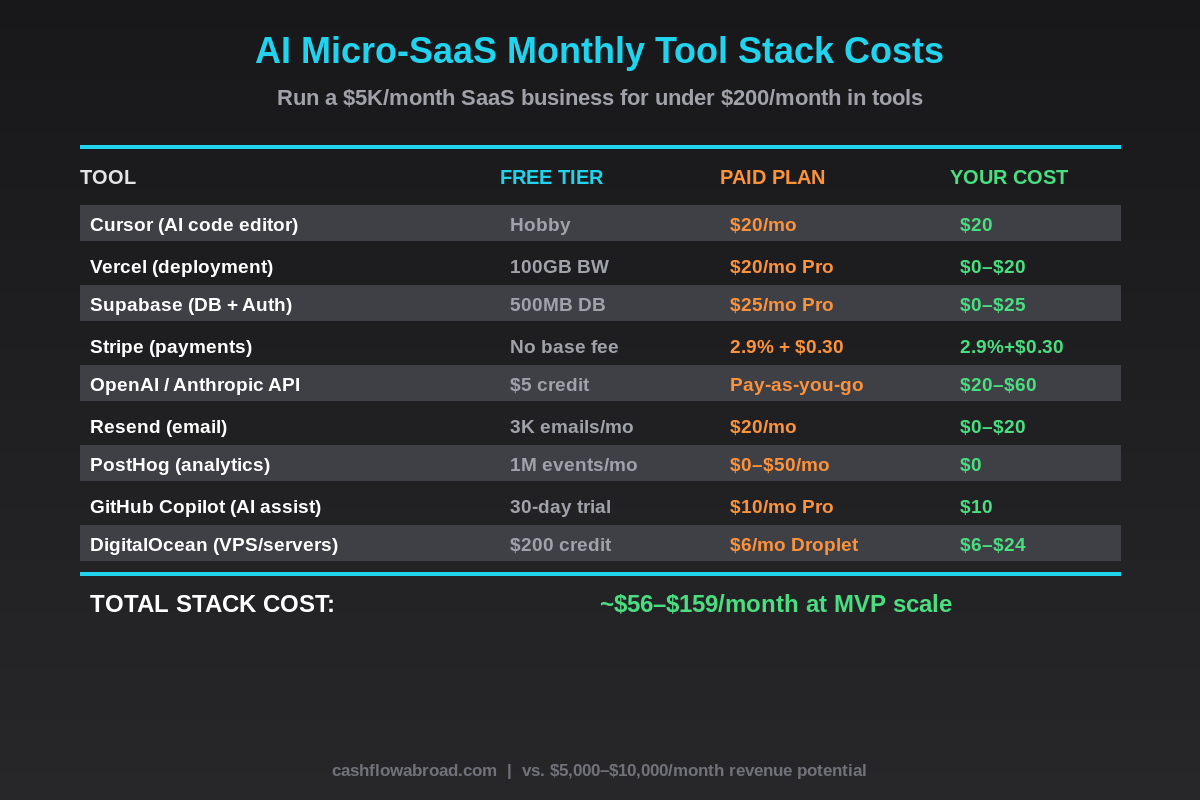
Here’s the exact stack that powers most profitable indie micro-SaaS products in 2026:
AI Coding Tools
Cursor ($20/month Pro) is the go-to for most solo founders. It’s a fork of VS Code with deep AI integration — multi-file editing via Composer, inline code generation, and support for GPT-4o, Claude Sonnet, and other models. The free Hobby tier works for getting started, but Pro at $20/month removes usage limits and gives you the fast model. Most developers ship 40–60% faster with Cursor compared to vanilla VS Code.
Windsurf ($20/month Pro) is the strong alternative, particularly if you’re building agentic workflows. Its Cascade feature lets the AI take multi-step actions across your codebase autonomously. Windsurf raised its Pro price from $15 to $20/month in March 2026, matching Cursor. At the same price point, Windsurf Pro offers unlimited agent usage — a meaningful edge for complex builds.
GitHub Copilot ($10/month Pro) is the best value option if you’re on a tight budget. It integrates into VS Code and JetBrains and gives you solid inline autocomplete without the agentic features. Use it as a complement, not a replacement, for Cursor or Windsurf.
Most experienced builders also keep Claude Code (terminal-native, pay-as-you-go API pricing) in their toolkit for large refactors, security audits, or running parallel tasks across an entire codebase. With a 1M token context window, it handles complex codebases in one pass — useful when you’re deep in debugging across 50 files.
Infrastructure
- Vercel (free → $20/month Pro): Deploys Next.js apps in seconds. The free tier covers 100GB bandwidth and 100K edge requests/month — enough for early validation. You won’t need Pro until you’re generating real traffic.
- Supabase (free → $25/month Pro): PostgreSQL with real-time subscriptions, authentication, and storage baked in. The free tier handles 500MB of data and 50K monthly active users. Most founders upgrade to Pro around 60–100 paying customers.
- DigitalOcean (from $6/month): For anything that needs a persistent server — background jobs, scrapers, webhooks, custom APIs. A $12/month Droplet handles most early-stage workloads easily. New accounts get $200 in free credits, which covers your infrastructure for months while you’re pre-revenue.
Payments and Email
- Stripe: No monthly base fee. 2.9% + $0.30 per transaction. Handles subscriptions, one-time payments, metered billing, and customer portals out of the box. Non-negotiable for any SaaS product.
- Resend: 3,000 emails/month free, $20/month for 50K. Clean API, React email templates, excellent deliverability. Most founders don’t hit the paid tier until they have hundreds of users.
- PostHog: Open-source product analytics with 1M events/month free. Track user behavior, funnels, session recordings. You’ll need this to understand why people churn.
AI APIs for Your Product
If your product uses AI under the hood (it probably should), you’ll be calling one of these:
| Provider | Model | Cost per 1M input tokens | Best for |
|---|---|---|---|
| Anthropic | Claude Sonnet 4.6 | $3.00 | Complex reasoning, long documents |
| OpenAI | GPT-4o mini | $0.15 | High-volume, cost-sensitive tasks |
| OpenAI | GPT-4o | $2.50 | Complex generation, vision tasks |
| Gemini 2.0 Flash | $0.10 | Cheapest capable option | |
| Groq | Llama 3.3 70B | $0.59 | Fast inference, open-source model |
Budget $20–$60/month in API costs at early stages. If your API costs start exceeding $100/month, your pricing model probably needs adjustment — pass usage costs to users through credit systems or tiered plans.
Total stack cost at MVP: $56–$159/month. Against $5K MRR, that’s a gross margin above 96% on infrastructure alone.
Finding the Right Niche: Where AI Micro-SaaS Actually Works
The biggest mistake first-time founders make is building something horizontal (“an AI writing tool”) instead of vertical (“an AI email writer for commercial real estate brokers”). Horizontal tools compete with ChatGPT. Vertical tools compete with nobody.
In 2026, the highest-converting micro-SaaS categories are:
Vertical Automation Tools ($29–$99/month)
These solve one workflow problem for one industry. Examples generating real revenue:
- AI listing description generators for real estate agents — agents pay $49–$79/month for a tool that turns property data into polished MLS descriptions. The workflow is identical every time; AI handles it in 8 seconds.
- AI-powered review response tools for restaurants — restaurants with 50+ Google reviews need to respond quickly; a tool that drafts personalized responses charges $39/month and runs with zero ongoing maintenance.
- ESG compliance reporting for SMBs — charging $200–$500/month to help companies automate sustainability data collection. One developer built this targeting European SMBs facing new EU reporting requirements and hit profitability within 60 days.
Content Automation Tools ($19–$79/month)
Outrank (outrank.so) hit $40K MRR with AI-powered SEO content automation. Hypertxt crossed $4.8K MRR with AI article generation. CheckMySEO hit $2K MRR with 1,500+ users. These products do one thing: take a keyword input and produce publication-ready content with built-in SEO structure.
The category is more competitive than two years ago, but vertical versions aren’t — “AI content automation for financial advisors” or “AI blog generator for SaaS companies” still have low competition and high willingness to pay.
Data Enrichment and Monitoring ($49–$199/month)
Any tool that watches something and alerts you is sticky by nature. Users forget they’re paying for it because it runs silently in the background. Good examples:
- Competitor price monitoring for e-commerce sellers
- Google SERP rank tracking with AI-generated recommendations
- LinkedIn post performance analytics for consultants
- AI-powered contract clause scanner for small law firms
Churn on monitoring tools runs 30–50% lower than on content generation tools because the user’s alternative is doing the monitoring manually — which they’ll never actually do.
The Actual Build Workflow
Here’s a realistic build workflow using the stack above. This assumes basic JavaScript or Python familiarity, not a software engineering degree.
Step 1: Validate Before You Build
Do not write code first. Post your idea in the relevant subreddit (r/smallbusiness, r/realtors, r/freelance — wherever your target customer hangs out) and ask if they currently solve this problem manually. If three people say yes and ask when it’s available, you have a product worth building.
Gil Hildebrand pre-sold 50 lifetime deals for $400 each — generating $20,000 before writing a single line of code for his AI podcast transcription tool. That’s the validation playbook.
Step 2: Scaffold in Hours, Not Weeks
Use Next.js 14 with the App Router. Set up Supabase for auth and database. Wire Stripe for payments from day one — even if you’re not charging yet, the infrastructure should be ready. Use Cursor or Windsurf Composer with a single scaffolding prompt:
Create a Next.js 14 app with:
- Supabase authentication (email/password + Google OAuth)
- Stripe subscription billing (Basic $29/mo, Pro $79/mo)
- Protected dashboard route accessible only to paying users
- Postgres table for user_data with RLS policies
- Tailwind CSS with dark mode
Set up the full project structure with all necessary config files.
That single prompt, in Cursor’s Composer mode, produces 80% of your boilerplate in under 5 minutes. What used to take two days of scaffolding now takes an afternoon.
Step 3: Wire Your Core AI Feature
Call the Anthropic or OpenAI API from a Next.js API route. Always do this server-side so your API keys never expose to the client:
// app/api/generate/route.ts
import Anthropic from "@anthropic-ai/sdk";

const client = new Anthropic();

export async function POST(request: Request) {
  const { userInput } = await request.json();

  const message = await client.messages.create({
    model: "claude-sonnet-4-6",
    max_tokens: 1024,
    messages: [{ role: "user", content: userInput }],
  });

  return Response.json({ result: message.content[0].text });
}
Add rate limiting by user ID using Upstash Redis (free tier: 10K requests/day) to prevent API abuse from free-tier users hammering your endpoints.
Step 4: Deploy and Get First Customers
Push to GitHub, connect to Vercel — it deploys automatically on every commit. Set your environment variables in Vercel’s dashboard. Your app is live within minutes of setup.
First customers: return to the same communities where you validated. Offer the first 10 customers a lifetime deal at 40–50% of your planned annual price. They get perpetual access; you get testimonials, case studies, and product feedback that shapes what you build next.

Realistic Income Timeline
Based on data from 2025 MicroConf surveys and indie hacker reports, here’s the actual distribution:
| Stage | MRR Range | % of Founders Who Reach This | Typical Timeline |
|---|---|---|---|
| Launch | $0–$500 | 100% | Month 1–2 |
| Early traction | $500–$1,000 | ~40% | Month 2–4 |
| Lifestyle business | $1,000–$5,000 | ~18% | Month 4–12 |
| Significant income | $5,000–$15,000 | ~10% | Month 12–24 |
| Full-time + scalable | $15,000+ | ~5% | Month 18–36 |
The median profitable micro-SaaS — products that crossed the $1K MRR threshold — sits at $4,200/month MRR. That’s the realistic target for year one if you stay focused. Not $50K. Not the outlier Chatbase story that hit $50K MRR in months. The median is $4,200. That number is life-changing if your monthly burn is $1,800.
At the high end: at MicroConf 2025, 28% of the 230 attendees reported more than $100K MRR — all bootstrapped, all without venture funding. That ceiling is real. But it’s built on $4K MRR products that kept growing.
The Geographic Arbitrage Math
The same $5K MRR business generates completely different financial outcomes depending on where you operate it:
| City | Monthly Cost of Living | MRR | Tool Stack | Net Monthly Surplus |
|---|---|---|---|---|
| San Francisco | $4,200 | $5,000 | $150 | $650 |
| New York | $3,800 | $5,000 | $150 | $1,050 |
| Medellín, Colombia | $1,400 | $5,000 | $150 | $3,450 |
| Chiang Mai, Thailand | $1,100 | $5,000 | $150 | $3,750 |
| Tbilisi, Georgia | $900 | $5,000 | $150 | $3,950 |
The San Francisco founder is essentially working for $650/month after rent. The Medellín founder banking $3,450/month is compounding faster, building runway, and can afford to take real product risk. By the time the SF founder reaches $10K MRR, the Medellín founder has a 12-month emergency fund saved and owns their product decisions completely.
Setting Up Your US Business Properly
If you’re building a US LLC to receive Stripe payments (recommended for tax and banking reasons), you’ll need a US mailing address. Traveling Mailbox handles this for around $15/month — a registered physical address that forwards your mail digitally, which most US banks and payment processors require for business accounts.
For US business banking, Mercury is the standard choice for remote founders — no monthly fees, FDIC insured, real ACH and wire transfers, and an API if you need to automate financial workflows. Unlike traditional banks, Mercury doesn’t require a physical branch visit to open an account.
For a full walkthrough of the US entity setup process from abroad, see our guide on running a US business while living in Colombia.
Distribution Is the Actual Hard Part
AI coding tools have made building the product trivially fast compared to five years ago. Distribution hasn’t gotten easier. Here’s what actually moves the needle:
SEO and Programmatic Pages
For niche tools targeting professionals, organic search is the highest-ROI acquisition channel at scale. Build content around the problem your tool solves, not around your tool itself. If you’re building an AI tool for landscaping companies, write “how to write a landscaping estimate” and rank for it. The tool is the logical next step for the reader.
Programmatic SEO — generating hundreds of keyword-targeted landing pages from a template — works well for tools with broad keyword surfaces (e.g., “[City] real estate listing generator” × 500 cities). Base44 used this approach, bootstrapped to $189K MRR, and was acquired by Wix.
Reddit and Niche Community Launches
Reddit product launches in targeted subreddits (r/freelance, r/ecommerce, r/marketing) consistently outperform Product Hunt for micro-SaaS with specific verticals. A single front-page Hacker News “Show HN” post can generate 200–500 trial signups in 48 hours if your product has genuine technical interest.
Targeted Cold Outreach
For B2B tools charging $100+/month, cold email still works when it’s genuinely specific. Use Apollo or Clay to build a list of exact-match prospects. Write a 3-sentence email that names their specific problem, names your tool, and offers a free trial. A 2–3% reply rate on 500 targeted prospects is 10–15 demos — which is enough to fill your early-adopter cohort.
Security When Working Remotely
When you’re pushing code from a cafe in Medellín or a co-working space in Chiang Mai, you’re routinely on public networks. Never access admin dashboards, payment dashboards, or push production code without a VPN. NordVPN ($4–$6/month on a 2-year plan) is the reliable standard — fast enough not to slow down AI code completions, and it works consistently across Southeast Asia, Latin America, and Eastern Europe where connectivity can be unpredictable.
The Bottom Line
The gap between “I have a micro-SaaS idea” and “I have a deployed product with Stripe billing live” has collapsed from months to days. AI coding tools did that. What hasn’t changed: you still need a real niche, a real product people actually pay for, and consistent distribution effort.
The geographic arbitrage angle multiplies everything. A $4,200/month MRR business that would be a side income in Austin becomes financial independence in Medellín. A $10K MRR product that would be a decent freelance wage in London is early retirement in Chiang Mai. The revenue is the same. The life is completely different.
Start with the niche. Validate before you build. Use the stack above to ship fast. Then go find somewhere your money goes further while you iterate toward $10K MRR.
For more on the passive income side of running a business abroad, see our full breakdown of passive income streams that work from any country.
Financial disclaimer: Income figures cited in this post are drawn from public indie hacker reports, MicroConf surveys, and third-party analyses. Individual results vary significantly. Building a micro-SaaS business carries financial risk and requires sustained effort — no income is guaranteed. API pricing changes frequently; verify current rates directly with each provider. This post contains affiliate links; we may receive compensation if you sign up through our links, at no additional cost to you.
Liked this article?
Get the next one delivered straight to your inbox — plus a free Expat Tax Cheat Sheet.
Join our subscribers. No spam — just expat finance intel and new post notifications.