Casa Clara: Colombia Just Got Its Zillow Moment
7 min read · 1,710 words
For two decades, buying a home in Colombia meant walking into a casino where only the dealer knew the odds. Ask an agent in El Poblado what a comparable 120-square-meter apartment sold for last quarter and you’d get a shrug, a cigarette, and a number pulled from the air. There was no Zillow. No Redfin. No MLS. The sistema was whatever the seller remembered and whatever the buyer was willing to swallow.
That changed this morning. Colombia Move, the bilingual relocation platform at colombiamove.com, just rolled out Casa Clara — the country’s first transparent housing data layer — and it is arguably the biggest thing to happen to the Colombian real estate market in a decade. Every listing on the platform now carries price history, sold comparables, pending-negotiation flags, and a completeness score that publicly shames half-assed listings. All of it free. All of it bilingual.
If you’re a foreign buyer, a would-be expat, or a Colombian seller tired of watching agents pocket 6% for withholding information you could’ve googled in any normal country, this is the announcement you’ve been waiting on.
Why Colombia’s Housing Market Was a Black Box
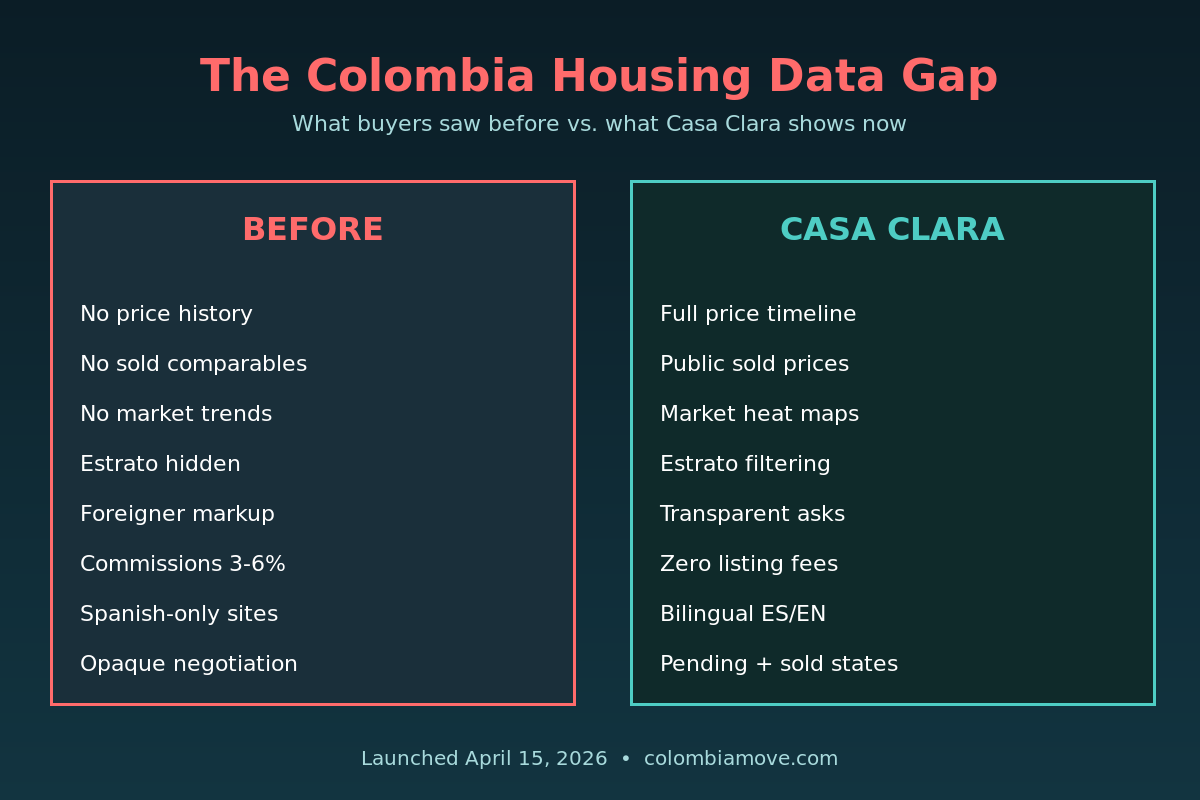
To understand why Casa Clara matters, you have to sit with how bad the status quo was. Colombia never built a centralized multiple listing service. There is no equivalent of the US MLS feeding Zillow and Redfin. Fincaraíz and Metrocuadrado, the two dominant portals, are effectively classified-ad walls — sellers post, prices change invisibly, and the minute something transacts, the listing vanishes without a trace of the sale price.
That information vacuum hits three groups especially hard:
- Foreign buyers — usually Americans, Canadians, and Europeans — walking in blind and routinely paying the “gringo tax” of 15–40% over local market.
- Colombian sellers who genuinely don’t know what their apartment is worth and end up either listing 20% too high (it sits for a year) or 15% too low (the first investor who walks in wins the lottery).
- Honest agents who want to compete on expertise but are stuck in a market where competitors win by hoarding data.
The opacity wasn’t an accident. It was the business model. Commissions in Colombia run 3–6%, and the asymmetric information made those commissions defensible. The minute buyers can see a price timeline, that defense collapses.
What Casa Clara Actually Ships
Casa Clara isn’t a rebrand. It’s a genuine data layer bolted onto the existing Colombia Move marketplace, and the feature list reads like someone finally built what every foreigner who has ever tried to buy in Medellín wished existed.
1. Price History Charts
Every listing now shows the full timeline of what the seller has asked. If a unit in Laureles was listed at 850 million COP in February, dropped to 780 million in March, and is now sitting at 720 million, you see the line chart with percentage deltas. No more agents telling you “the seller just reduced it today” when the reduction happened six months ago.
2. Sold Comparables
This is the quiet bombshell. Sellers can mark a unit as sold and optionally disclose the final price, which then becomes a public comp. Over time — and the network effect here is brutal in a good way — this builds Colombia’s first public database of what properties actually trade for, not what they list for. Every sold price added pulls the market one inch out of the shadow.
3. Pending / “Venta en Negociación” Status
A new listing state that flags properties under active negotiation. In the old system, a property would sit “available” while three buyers unknowingly competed against a fourth who was already in contract. Now you see the pending flag and redirect your effort.
4. Colombia-Specific Filters
Most of what foreigners think they want in a filter — bedrooms, bathrooms, square meters — is table stakes. What Colombia Move added are the filters that actually matter locally:
- Estrato — Colombia’s 1–6 socioeconomic classification system that determines utility rates, resale value, and neighborhood character. A gringo who doesn’t filter by estrato is buying blind.
- Amenity flags — pool, gym, elevator, portería (doorman), BBQ terrace, coworking space, pet-friendly, playground.
- Parking — in cities like Bogotá where a parking space can add 40 million COP to a unit, this isn’t a nice-to-have.
5. Completeness Score
Every listing gets a public quality badge based on how much information the seller provides — photos, floor plan, estrato, year built, condition, amenities. Incomplete listings get a low score. Over time, bad listings get ranked down and the market self-polices toward better data. It’s a clever piece of game design.
The Business Model: Actually Free
Here’s where most “disruption” stories collapse into a premium tier. Casa Clara doesn’t. The core MLS layer is free — zero listing fees, zero mandatory commissions, no paywall on historical data. There is an optional boost-placement product for sellers who want their listing pinned at the top of results, but it’s completely separate from the data layer. You don’t need to pay a cent to see sold prices, price history, or filters.
Why would anyone give this away? Because the value of the marketplace scales with the completeness of the data. Casa Clara’s long game isn’t listing fees — it’s being the default place every buyer starts and every seller posts, which eventually means advertising, premium services for agents, and mortgage/insurance referral economics. The data is the moat.

Who This Actually Helps
The Foreign Buyer Who’s Been Quoted Three Different Prices
If you’re reading this from Austin, Toronto, or Berlin and have been flirting with the idea of buying in Medellín or Cartagena, Casa Clara just eliminated the single biggest risk in your deal: not knowing what the thing is worth. You can now pull up a neighborhood, sort by estrato and amenities, and see what comparable units actually closed at over the past six months. That’s the difference between “I think I paid fair” and knowing it.
The Remote Worker Renting First
Most foreigners shouldn’t buy on day one — they should rent for six to twelve months and let the market teach them what neighborhoods actually feel like. Casa Clara’s filter stack makes the rental search dramatically saner, especially if you know you need coworking, elevator, and estrato 5 or 6 (which you probably do).
The Seller Who’s Been Getting Lowballed
Colombian sellers have historically been at the mercy of agents who told them what their property was worth. With public price history and sold comps, a seller in Envigado can now look at their building’s transaction history and defend their asking price with a screenshot instead of a vibe.
Agents Who Compete on Service, Not Information
This is counterintuitive, but the good agents actually win from transparency. When every buyer walks in with the same baseline data, the agent who adds real value — knowing which building has a pending assessment, which block is getting a new Metro station, which administración fees are about to spike — is the one who closes deals. The bad agents, the ones who made a living gatekeeping prices, are going to have a rough year.
How Casa Clara Stacks Up Against the Alternatives
| Feature | Fincaraíz | Metrocuadrado | Casa Clara |
|---|---|---|---|
| Price history | No | No | Yes |
| Sold comparables | No | No | Yes |
| Pending status | No | No | Yes |
| Bilingual ES/EN | Spanish only | Spanish only | Full EN |
| Estrato filter | Partial | Partial | Full |
| Listing fees | Paid tiers | Paid tiers | Free |
| Completeness scoring | No | No | Yes |
| Signup required | Yes | Yes | No |
What This Means for Colombia’s Housing Market
Transparency doesn’t just help individual buyers — it reprices entire markets. When the US MLS data got aggregated into Zillow, the immediate effect wasn’t a price crash. It was compression of the gap between asking and selling prices, faster days-on-market for fairly-priced units, and a brutal slow-death for overpriced listings. Expect the same dynamic in Colombia.
Neighborhoods that have been quietly overvalued — certain corners of Poblado and Chicó come to mind — are going to see their price ceilings stress-tested. Neighborhoods that have been quietly undervalued — Laureles, Envigado, the good parts of Suba — are going to see faster appreciation as outside buyers can finally see the value gap. This is the kind of infrastructure change that plays out over 18–36 months, but the direction is obvious.
For the geographic arbitrage crowd — and if you’re reading this site you probably are — this is a massive unlock. Colombia has been one of the best risk-adjusted expat plays in Latin America for five years running. The only real friction has been the information asymmetry on housing. That friction just dropped by an order of magnitude.
How to Actually Use It
Casa Clara lives inside the main Colombia Move marketplace. You can reach it directly at colombiamove.com/seccion/vivienda — no signup required for basic browsing. A few things worth doing on day one:
- Pick two neighborhoods you’re interested in (say El Poblado and Laureles) and filter by the exact bedroom/amenity combo you want. Compare the listing counts and median prices side by side.
- Open any listing and check the price history. If you see a sawtooth pattern of increases and decreases, the seller is fishing. If you see a single clean reduction several months ago, you’re looking at motivated.
- Look at the sold comps for the building. If the same building transacted three times in the last year at 15% below current asking, that’s your negotiation floor.
- Filter by completeness score. High-score listings have sellers who are serious. Low-score listings are noise.
If you’re specifically thinking about relocating to Colombia — and not just buying a vacation unit — the broader Colombia Move site covers visas, banking, healthcare, neighborhoods, and cost of living in the same bilingual detail. The main site is the part I’d read before you even touch Casa Clara.
The Bigger Picture
Every emerging market eventually gets its Zillow moment. Mexico got MercadoLibre’s property vertical. Brazil got QuintoAndar. Colombia was the laggard — partly because of the commission structure, partly because the two incumbents had zero incentive to change. Casa Clara routing around both of them with a free, bilingual, data-first product is exactly how these markets typically unlock.
If you’ve been sitting on the fence about Colombia because you couldn’t trust the housing data, the fence just got removed. The hard part now is the same as always — actually getting on a plane, actually spending a month living in a neighborhood before you sign anything, actually doing the visa paperwork. But the one part that used to be genuinely unknowable — what is this place worth? — finally isn’t.
Welcome to a Colombian housing market with the lights on. It was overdue.
Liked this article?
Get the next one delivered straight to your inbox — plus a free Expat Tax Cheat Sheet.
Join our subscribers. No spam — just expat finance intel and new post notifications.