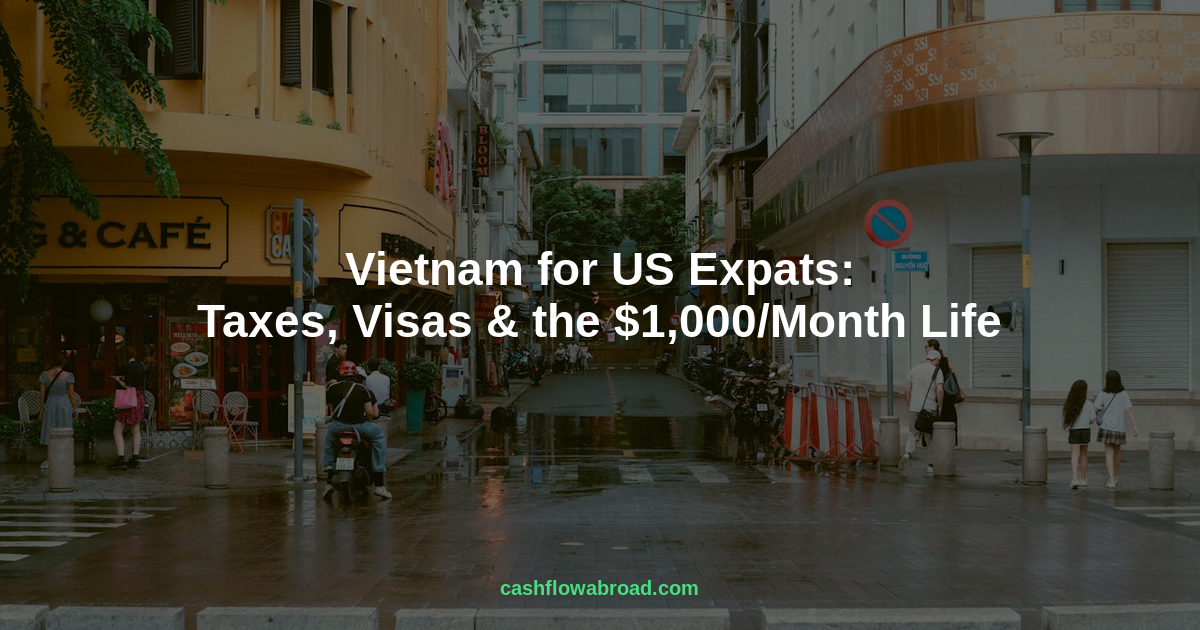
Vietnam for US Expats: Taxes, Visas & the $1,000/Month Life
11 min read · 2,658 words
Here’s a number most Americans don’t expect: $132,900. That’s how much foreign earned income you can exclude from US taxes in 2026. It’s enough to cover almost any salary an expat in Vietnam would earn. But here’s the catch almost nobody warns you about: Vietnam has no tax treaty with the United States and no totalization agreement. If you’re self-employed and working from a café in Da Nang, you may owe the IRS 15.3% in self-employment taxes on top of your regular obligations — no matter how much income you exclude under the FEIE. For a freelancer earning $80,000, that’s $12,240 per year that most expats discover only after their first filing season in-country.
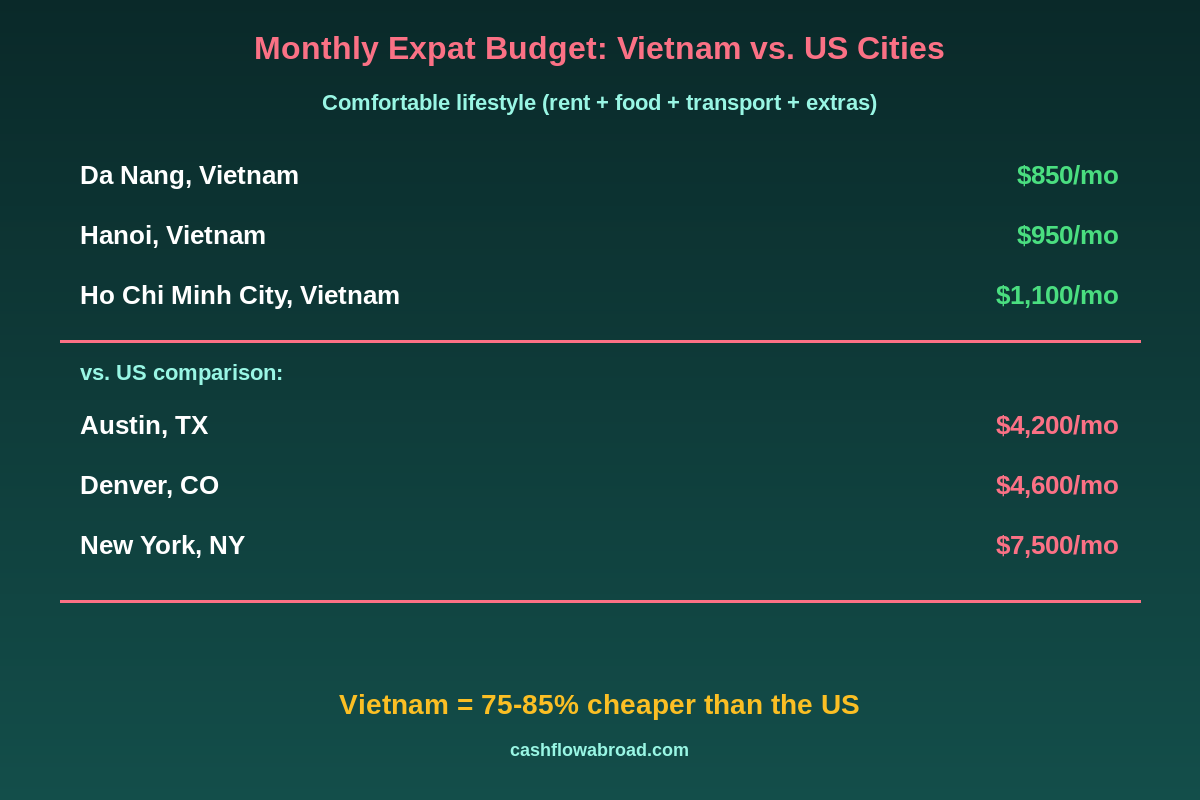
None of that changes the math enough to make Vietnam a bad deal. The food costs $1–3 per meal. A one-bedroom apartment in central Da Nang runs $400–600/month. Total monthly expenses for a single person living comfortably land between $850 and $1,200 — roughly 75% less than equivalent living in Austin or Denver. The self-employment tax issue is real, but it’s manageable with the right structure. The geographic arbitrage advantage is enormous.
This guide covers everything: visa options, the US tax picture, what a real monthly budget looks like in each city, banking setup, healthcare, and who Vietnam actually works for.
Vietnam Visa Options for Long-Term Expats
Vietnam does not have a dedicated digital nomad visa — that’s the first thing to clarify. What it has is a flexible visa framework that tens of thousands of digital nomads and remote workers navigate without issue, as long as they understand the rules going in.
The 90-Day E-Visa (The Starting Point)
Since August 2023, Vietnam issues e-visas to citizens of all countries. Americans can apply at evisa.gov.vn, choosing either a multiple-entry version ($50) or single-entry ($25). The visa is valid for 90 days total. Multiple-entry means you can exit and re-enter within that period — useful for regional travel to Thailand, Cambodia, or Japan — but it doesn’t extend your in-country time past the 90-day window.
The practical workaround most long-term expats use: once your 90 days expire, do a border run to Cambodia or Thailand (a $30–60 bus ride from Ho Chi Minh City or Hanoi), then apply for a fresh e-visa. Vietnamese immigration has grown more attentive to obvious visa-run patterns, but for now, the approach works. It’s not elegant, but it’s functional.
Business Visa (Up to 12 Months)
A DN-visa (business visa) can be issued for up to 12 months with multiple entry, costs $25–$100 depending on the agent handling your invitation letter, and can be extended inside Vietnam without leaving. The catch: you need an invitation letter from a Vietnamese company. Visa facilitation firms provide these letters routinely for a fee — this is a well-established industry in Vietnam, not a gray area. For remote workers wanting to stay 6–12 months at a stretch, the business visa is the most practical solution available.
Talent Visa (5-Year SVEC)
The Talent Visa provides 5-year residency for top academics, executives, and established artists. The bar is extremely high — nomination from a Vietnamese institution is required. Not a realistic option for most expats, but worth knowing it exists if you’re a researcher or executive with existing Vietnamese institutional relationships.
Working Remotely: The Legal Reality
Working remotely for a foreign employer or clients while on a tourist e-visa exists in a legal gray zone under Vietnamese law — officially not permitted, but broadly tolerated and not enforced. Vietnam has no mechanism to detect laptop work for foreign clients, and the government has made no moves to crack down on the digital nomad community. The risk of deportation or fine for working remotely on an e-visa is practically nonexistent based on available evidence. That said, if you’re earning income from Vietnamese clients or running a locally-registered business, the equation changes — you’d need a proper work permit.
US Tax Obligations in Vietnam: The Part Nobody Warns You About
This is where Vietnam diverges from expat destinations like Panama, Portugal, or Paraguay. The tax situation is workable, but it has an expensive wrinkle if you’re self-employed.
The Foreign Earned Income Exclusion in Vietnam
The FEIE lets Americans exclude up to $132,900 of foreign earned income from US federal income tax in 2026. To qualify, you meet either the Bona Fide Residence Test (genuine long-term resident of a foreign country) or the Physical Presence Test (330 days outside the US in any 12-month period). Vietnam’s 90-day e-visa makes the Physical Presence Test achievable for expats who periodically exit and re-enter, as long as you’re genuinely spending most of your time outside the US.
The FEIE covers earned income — wages, freelance revenue, consulting fees. It does not shelter investment income, dividends, or capital gains, which remain taxable at standard US rates regardless of where you live. For a full breakdown of the FEIE and the Foreign Tax Credit interaction, see the complete expat tax guide.
Vietnam Has No US Tax Treaty
The US and Vietnam signed a tax treaty in 2015 — but the US Senate has never ratified it. As of 2026, no double taxation agreement is in force between the two countries. This matters because a functioning treaty would let you credit Vietnamese taxes paid against your US liability, dollar-for-dollar, with additional protections for specific income categories. Without it, you rely on the general Foreign Tax Credit (Form 1116) as your backstop against double taxation.
In practice, this only becomes a real problem if you’re a Vietnam tax resident earning locally. If you’re on an e-visa working for foreign clients, you’re generally not a Vietnamese taxpayer — Vietnam taxes non-residents only on income sourced within Vietnam. A US remote worker earning from US clients, on a 90-day e-visa, owes the Vietnamese government nothing.
The 15.3% Self-Employment Tax No One Mentions
This is the expensive surprise. Self-employed Americans owe 15.3% self-employment tax to cover Social Security and Medicare, on top of income tax. In countries with US totalization agreements — Germany, Japan, Australia, the UK — expats pay into only one social security system, not both. Vietnam has no totalization agreement with the United States.
The consequences:
| Scenario | Annual SE Tax Owed to IRS |
|---|---|
| Freelancer earning $60,000 net profit | ~$9,180 |
| Freelancer earning $80,000 net profit | ~$11,304 |
| Freelancer earning $100,000 net profit | ~$14,130 |
| W-2 employee (employer abroad pays half) | $0 additional to self |
The FEIE does not eliminate self-employment tax. The Foreign Tax Credit does not offset it. It lands on top of everything else. The standard workaround for self-employed expats: elect S-Corp tax treatment on a US LLC, pay yourself a “reasonable salary” (maybe $40,000–50,000), and take the rest as distributions. Distributions are not subject to SE tax. For a $100,000 income earner, this can save $5,000–7,000 per year in SE tax — but it requires quarterly payroll filings and a CPA who understands expat tax. See the expat investor’s playbook for how this layers with other tax strategies.
Vietnam Cost of Living: City-by-City Breakdown
Three cities dominate the expat landscape in Vietnam, and the cost differences between them are meaningful. Here’s a realistic monthly budget at a “comfortable expat” standard in each — not backpacker survival mode, not luxury penthouses:
| Expense | Da Nang | Hanoi | Ho Chi Minh City |
|---|---|---|---|
| 1BR apartment (central) | $400–550 | $500–700 | $600–900 |
| Groceries / month | $80–120 | $90–130 | $100–150 |
| Eating out (daily habit) | $5–12/day | $6–15/day | $7–18/day |
| Transport (Grab + scooter rental) | $30–60 | $40–80 | $50–100 |
| Coworking space | $50–120 | $60–140 | $80–180 |
| Health insurance (SafetyWing) | ~$60 | ~$60 | ~$60 |
| Utilities + fiber internet | $40–70 | $50–80 | $60–90 |
| Monthly total (estimate) | $750–1,000 | $900–1,150 | $1,050–1,400 |
Da Nang: Best Value
Da Nang is where the price-to-quality ratio peaks. Beaches are walkable. The Marble Mountains and Ba Na Hills are 30–45 minutes away. The coworking scene has matured significantly over the past four years. A 1BR in the beachside My Khe neighborhood runs $400–550/month furnished. Internet across the city averages 50–100 Mbps on fiber. The expat community is smaller and more intentional than HCMC — fewer tourists, more people who chose to actually live here. Most long-term expats who’ve tried all three cities end up in Da Nang.
Ho Chi Minh City: The Economic Engine
HCMC (Saigon) is Vietnam’s commercial hub and the most cosmopolitan option. It’s louder, faster, and 20–30% more expensive than Da Nang, but the infrastructure is materially better: more international hospitals, better-connected airports with direct flights to more hubs, a broader range of international cuisine, and a larger English-speaking professional network. The practical choice if you’re running a client-facing business or need to be near serious startup and tech communities. Budget $1,100–1,400/month for a comfortable life.
Hanoi: Culture and History, Cold Winters
The capital has 1,000 years of history, UNESCO World Heritage lakes, and a more authentically Vietnamese character than HCMC. It’s also genuinely cold in winter — January temperatures drop to 15–17°C (59–63°F), sometimes lower. Not Siberian, but not beach weather either. Typically 20–25% cheaper than HCMC for equivalent living. The better option if you’re working on government-adjacent business, research, or want a more integrated cultural experience.

Banking Setup for US Expats in Vietnam
Banking in Vietnam has two layers: keeping your US financial infrastructure intact and managing day-to-day cash access in-country.
US Accounts: Keep Them, Structure Them Right
The worst thing you can do when moving abroad is close your US accounts. You’ll need them for receiving income in USD, maintaining an IRS mailing address, and keeping access to dollars outside Vietnam’s local banking system. Two US accounts that work particularly well for Vietnam expats:
- Charles Schwab brokerage + investor checking: Schwab reimburses all ATM fees worldwide, every month, with no limit. Vietnamese ATMs charge a surcharge; Schwab pays it back. No foreign transaction fees. No minimum balance. This is the single most universally recommended expat banking tool in the community, and it’s not close.
- Mercury (US business banking): If you’re operating a US LLC or S-Corp, Mercury is the best no-fee business checking account for remote entrepreneurs. Clean interface, solid ACH/wire setup, and no monthly fees eating into your operating cash.
One often-overlooked necessity: a US mailing address. Financial institutions flag or freeze accounts when they detect a foreign address on file. Traveling Mailbox ($15/month) gives you a real US street address in 50+ cities, scans incoming mail digitally, and can deposit physical checks. This maintains your US banking relationships, IRS correspondence address, and state domicile while you’re living in Southeast Asia. It’s covered in detail in the virtual mailbox guide.
Vietnamese Bank Accounts
Opening a local bank account in Vietnam before you have residency documentation is possible but involves friction. Vietcombank and BIDV are the most expat-common. You typically need a passport and a valid visa with meaningful remaining time — a business visa works better than a tourist stamp. Americans face additional paperwork due to FATCA: Vietnamese banks must report US-person account holders to the IRS, which makes some branches reluctant and documentation-heavy.
Practically speaking, most short-term expats skip the local account entirely and use ATM withdrawals from Schwab for daily spending, then transfer larger amounts periodically via Remitly, which handles USD→VND transfers at competitive rates with most deposits completing within minutes. Avoid using US bank international wires for regular transfers — they charge $25–50 plus a spread on the exchange rate that eats another 1–3% of every transaction.
Healthcare in Vietnam
Vietnam’s public healthcare system is underfunded and not the right choice for most Western expats. The private hospital network, however, is genuinely solid in all three major cities:
- HCMC: FV Hospital (French-Vietnamese, international accredited), Vinmec HCMC, Columbia Asia
- Hanoi: Vinmec Times City, Hanoi French Hospital, Family Medical Practice
- Da Nang: Vinmec Da Nang, Family Medical Practice Da Nang, Danang Hospital
Costs are dramatically lower than the US. An ER visit with basic treatment: $50–200. Specialist consultation: $30–80. Dental cleaning and examination: $15–30. Complex dental procedures (crowns, implants) cost 85–90% less than equivalent work in the US — Vietnam has a well-established medical tourism dental sector that many expats exploit deliberately.
The smart structure for most expats: carry SafetyWing Nomad Insurance (~$60/month for adults under 40) for hospitalization, major medical, and emergency evacuation. Pay routine care out-of-pocket — it’s cheap enough that the math works. A SafetyWing policy covers you across the region, which matters if you travel through Thailand, Cambodia, or Indonesia during your time in Southeast Asia. Full options comparison in the expat health insurance guide.
Internet and Connectivity
Vietnam consistently ranks in the global top 20 for internet speed. Major cities average 50–100 Mbps on fiber connections; quality coworking spaces hit 100–200 Mbps. Mobile data is extraordinarily cheap — a local SIM from Viettel or Mobifone costs $3–5/month for 30GB of fast 4G data. Coverage is solid in all urban areas and most tourist corridors.
If you’re arriving and need immediate data connectivity before you can get to a SIM counter, a Saily eSIM covers you from the moment your plane lands and works across Southeast Asia if you’re hopping between countries.
Vietnam vs. Other Popular Expat Destinations
| Factor | Vietnam | Thailand | Portugal | Mexico |
|---|---|---|---|---|
| Monthly budget (comfortable) | $850–1,200 | $1,000–1,800 | $2,200–3,500 | $1,200–2,000 |
| US tax treaty in force | No | Yes | Yes | Yes |
| US totalization agreement | No | No | Yes | Yes |
| Long-term visa simplicity | Moderate | Easy | Moderate | Easy |
| Private healthcare quality | Good | Excellent | Excellent | Good–Excellent |
| Internet reliability | Fast | Fast | Fast | Variable |
| Cost advantage over US | 75–80% | 60–70% | 30–45% | 50–65% |
Vietnam wins on pure cost. Thailand wins on visa simplicity and private hospital quality. Portugal wins on tax treaty protection and EU access. Vietnam’s specific advantage is the combination: lowest price point, fast internet, remarkable food culture, a genuinely warm local population, and zero personal safety concerns for Western expats. The tradeoff is the visa logistics and the absence of a tax treaty — both manageable, neither dealbreakers.
Who Vietnam Actually Works For
Vietnam is a near-perfect fit for a specific expat profile: the remote worker or freelancer earning primarily in USD who wants maximum geographic arbitrage and can handle some visa paperwork. A software developer earning $90,000 remotely can live comfortably on $1,200/month in Hanoi and bank $40,000–50,000 after taxes. That savings rate is nearly impossible to achieve in any major US city.
It’s a harder fit for:
- US W-2 employees who travel to the US frequently and can’t clear the 330-day Physical Presence Test for FEIE qualification
- Sole proprietors who haven’t structured their business to minimize SE tax — the 15.3% hit on net profit is real and compounds over years
- Retirees living primarily on investment income — the FEIE doesn’t help them at all, and without a tax treaty, investment income management gets more complex
- People who need reliable access to the US for business or family — the visa-run logistics become genuinely burdensome if you’re crossing in and out every 90 days
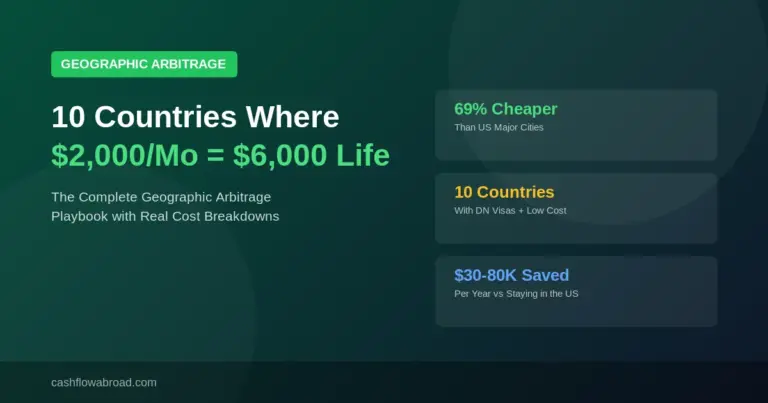
For the remote worker who earns in dollars, spends in dong, and treats visa logistics as an acceptable operational cost, the financial case is overwhelming. See the full geographic arbitrage playbook for how Vietnam stacks against other destinations across 10 variables.
Pre-Departure Setup Checklist
- Open a Charles Schwab investor checking account — free global ATM access, zero foreign transaction fees
- Set up a Traveling Mailbox virtual mailbox to keep your US banking and IRS address intact
- Apply for a multiple-entry Vietnam e-visa ($50) at evisa.gov.vn — takes 3–5 business days
- Get SafetyWing Nomad Insurance before you land
- If self-employed, consult an expat CPA about S-Corp election before your first full tax year abroad — retrofitting is painful
- Download Grab (the regional Uber+DoorDash equivalent) — your primary transport and food app in Vietnam
- Get a Saily eSIM for immediate connectivity on arrival
The Bottom Line
Vietnam is one of the world’s best geographic arbitrage opportunities — not because it’s a tax haven, but because the cost differential is so extreme that even paying full US taxes leaves you financially better off than staying home. The lifestyle — $2 pho, beach access 20 minutes from your coworking desk, fast internet, 90-degree weather — is real and sustainable.
Go in with clear eyes on two things: the self-employment tax exposure (structure your business before you go), and the visa logistics (the 90-day e-visa works but requires periodic exits). Get those right and Vietnam delivers on the promise in a way that more expensive, more famous expat destinations can’t match at this price point.
Financial disclaimer: This post is for informational purposes only and does not constitute tax, legal, or financial advice. US tax law, Vietnam visa regulations, and treaty status change periodically. Consult a licensed CPA specializing in US expat taxation and a qualified immigration professional before making any relocation decisions. The author and cashflowabroad.com bear no responsibility for decisions made based on this content.
Liked this article?
Get the next one delivered straight to your inbox — plus a free Expat Tax Cheat Sheet.
Join our subscribers. No spam — just expat finance intel and new post notifications.