Bulgaria’s 10% Flat Tax: EU Residency Nobody Talks About
10 min read · 2,533 words
While digital nomads debate Portugal’s NHR, Greece’s €100K flat tax, and Cyprus’s non-dom scheme, one country quietly sits at the bottom of Europe’s tax league table with a rate that almost nobody talks about: Bulgaria, at a flat 10%. On everything. Income. Capital gains. The same rate a janitor pays as a tech founder, a retiree as a day trader.
And it’s inside the EU.
The average American pays 22–32% effective federal income tax before state taxes enter the picture. Move to Sofia, spend 183 days, establish tax residency, and your rate drops to 10% flat — with no brackets, no cliffs, no AMT. For someone earning $120,000 remotely, that difference is roughly $15,000–$25,000 annually. Over five years, you’ve funded your Bulgarian apartment twice over.
Here’s what makes Bulgaria genuinely underrated rather than just cheap: it’s the EU’s most affordable country by consumer prices, it has actual internet infrastructure (average broadband speed: 175 Mbps), it launched a digital nomad visa in January 2026, it joined Schengen in January 2024, and it produced a mountain ski town — Bansko — that’s become one of the tightest nomad communities on the planet. All while keeping its tax code embarrassingly simple.
Bulgaria’s Tax Structure: The Flattest in Europe
Bulgaria introduced its 10% flat income tax in 2008 and hasn’t touched the rate since. Unlike most EU countries, there are no progressive brackets — whether you earn €20,000 or €200,000, you pay 10% on taxable income.
What the 10% covers
- Employment income: 10% flat, no exceptions
- Self-employment / freelance: 10% applied to 75% of gross income (automatic 25% expense deduction), giving an effective 7.5% rate
- Capital gains: 10% flat — with significant exemptions for EU stock exchange transactions (see below)
- Dividends: 5% withholding tax. Bulgaria’s 2026 draft budget proposes raising this to 10%, but the legislation hasn’t passed yet
- Rental income: 10% after a 10% standard deduction = effective 9%
Capital gains exemptions worth knowing: gains from selling one residential property per year are exempt if held more than 3 years. Up to two additional properties exempt if held more than 5 years. Securities trading on the Bulgarian Stock Exchange or any EU/EEA regulated market are also completely exempt. If you trade German or Swedish ETFs as a Bulgarian resident, those gains don’t get taxed.
Social security contributions are capped at a maximum monthly income threshold of approximately €1,900 — meaning high earners pay social contributions only on the first ~€22,800 per year. Above that, your marginal tax rate is just 10%.
| Income Type | Tax Rate | Notes |
|---|---|---|
| Employment income | 10% | Flat, no brackets |
| Self-employment / freelance | 7.5% effective | 10% applied to 75% of gross |
| Capital gains (stocks, crypto) | 10% | EU stock exchange gains exempt |
| Dividends received | 5% (10% proposed for 2026) | Draft budget change not yet enacted |
| Rental income | ~9% effective | 10% rate after 10% standard deduction |
| Real estate sale (held 3+ years) | 0% | One primary property per year exempt |
How to Establish Bulgarian Tax Residency
Tax residency in Bulgaria kicks in under any of these conditions:
- Spend 183+ days in Bulgaria in any 12-month period
- Have a permanent address registered in Bulgaria (even without the 183-day test)
- Your center of vital interests — family ties, economic activity, primary social connections — is in Bulgaria
The permanent address rule is the unusual one. In some EU countries, simply renting and registering your address can establish tax residency even if you split time elsewhere. This cuts both ways — it can trigger Bulgarian residency faster than you expect, but also means you can potentially establish residency without spending a full six months there.
As a Bulgarian resident, you’re taxed on worldwide income — not just Bulgarian-sourced income. However, Bulgaria has tax treaties with 72 countries including the US, preventing pure double taxation. The 10% rate is low enough that the Foreign Tax Credit approach works cleanly for most Americans: you pay 10% to Bulgaria, claim the credit against your US liability, and the residual US tax on most income types is minimal or zero. More on the US tax picture below.
For a deep dive on the FEIE vs. Foreign Tax Credit tradeoff: How to Pay Zero Federal Tax (Legally) as a US Expat.
Bulgaria’s Digital Nomad Visa (2026)
Bulgaria launched its digital nomad residence permit in January 2026, following amendments to the Law on Foreigners that took effect in late 2025. Applications officially opened December 20, 2025. It’s one of the newest EU nomad visas, and the income requirement is notably higher than some competitors — but the overall package is compelling.
Requirements
- Citizenship: Non-EU/EEA nationals (US citizens fully qualify)
- Work remotely for employers or clients entirely outside Bulgaria
- Minimum income: €31,000/year (50 × Bulgaria’s €620 monthly minimum wage). That’s roughly $34,000 USD — a bar most US remote workers clear without difficulty
- At least 12 months of freelance or remote work history with a non-Bulgarian employer or clients
- Valid health insurance covering Bulgaria
- Clean criminal record
Application process
- Apply for a Type D long-stay visa at a Bulgarian embassy in your country (4–8 weeks)
- Enter Bulgaria
- Apply for the Digital Nomad Residence Permit within 14 days of arrival
- Permit issued for 1 year, renewable once for a maximum 2-year stay under this category
After completing 5 years of continuous Bulgarian temporary residence (any legal residency category counts, not just the nomad permit), you qualify for permanent residency — with nearly the same rights as a Bulgarian citizen: indefinite stay, access to public healthcare, and full Schengen travel without additional bureaucracy.
See how Bulgaria’s new visa compares with other programs in the full digital nomad visa rankings.
Other Routes to Bulgarian Residency
The digital nomad visa isn’t your only path in:
Company formation
Registering a Bulgarian LLC (EOOD) is one of the most popular moves for freelancers and entrepreneurs. Corporate tax is a flat 10% on profits. Dividends distributed from the company get hit with an additional 5% (or 10% if the proposal passes), giving a blended effective rate of roughly 14–19% on gross income — still dramatically lower than US rates. Setup costs run €1,000–2,000 through a local attorney. Company registration grants you a business residency permit, establishing both legal presence and a clean tax structure in a single move.
Property purchase
Buying real estate valued at €312,000+ qualifies for temporary residency under Bulgaria’s investment track. Sofia property averages €900/m², so €312K buys you roughly 350 square meters — an amount of space most Western Europeans never experience. This route doesn’t fast-track citizenship, but it establishes long-term residency and puts you into one of the EU’s most undervalued property markets.
Bulgarian Golden Visa
Introduced in 2023, the Golden Visa requires a minimum €512,000 investment in Bulgarian-licensed alternative investment funds or ETFs. Permanent residency is granted upon investment; citizenship eligible after 5 years. No minimum stay requirement — the investment can be managed fully remotely. For the right high-net-worth profile, it’s a clean EU permanent residency play without the physical presence grind.
Passive income / retirement route
Non-EU nationals with proven passive income can obtain a long-term residence permit by demonstrating self-support — the threshold is roughly €500+/month, just above Bulgaria’s minimum wage. Retirees living on Social Security, pensions, or investment income find this route far more accessible than the €31K digital nomad bar. See also: how Social Security stretches further abroad.
What Life Actually Costs: Sofia vs. Bansko vs. Plovdiv
Bulgaria has three main expat clusters: Sofia (capital, business hub, international airport), Bansko (mountain ski resort turned nomad capital), and Plovdiv (second city, old town architecture, local feel). Each serves a different lifestyle profile.
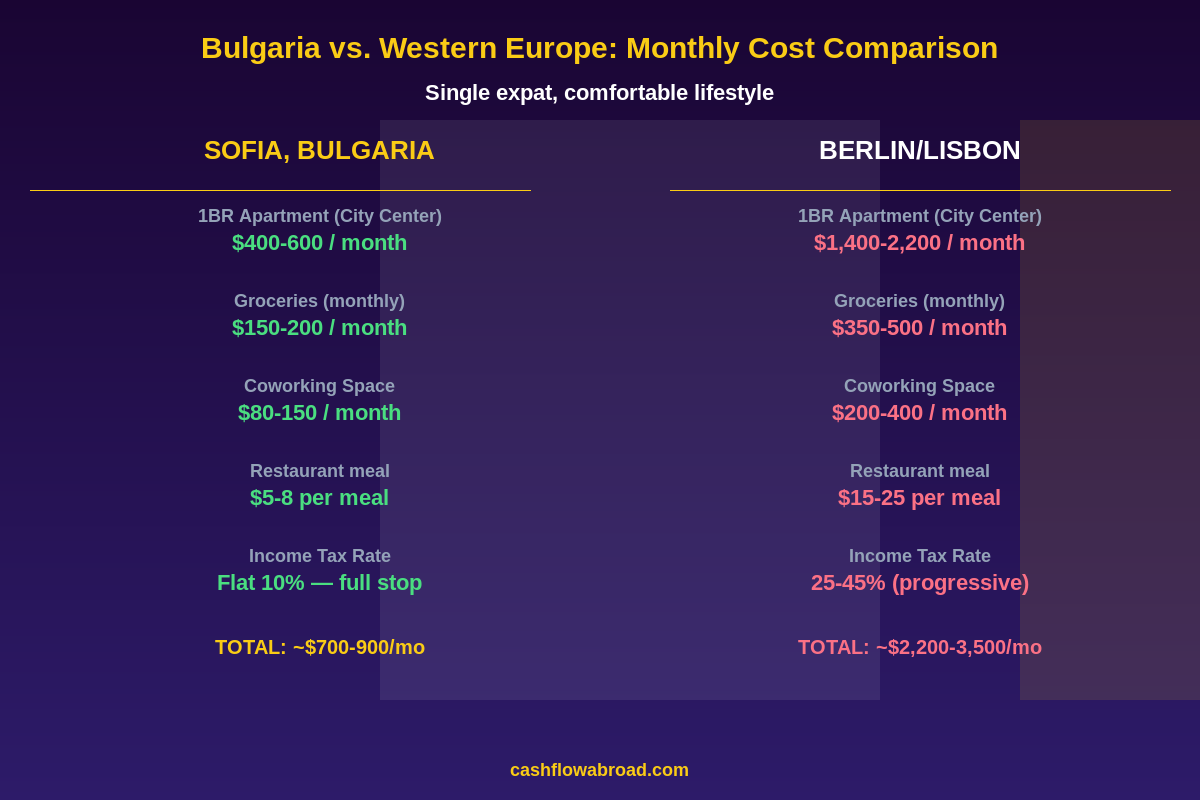
| Expense | Sofia | Bansko | Plovdiv |
|---|---|---|---|
| 1BR apartment (central) | $400–600 | $300–500 | $250–400 |
| Groceries | $150–200 | $120–180 | $120–170 |
| Coworking membership | $80–150 | $99/month flat | $60–120 |
| Eating out (daily lunches + occasional dinners) | $200–300 | $150–250 | $150–230 |
| Monthly transit pass | $30 | $15–25 | $25 |
| Expat health insurance | $60–150 | $60–150 | $60–150 |
| Monthly total | $920–1,430 | $745–1,105 | $665–1,095 |
Benchmarks that put these numbers in context: a Big Mac in Sofia costs $3.30. A metro ride is $0.95. A 5km Uber is $2.50. A sit-down lunch with coffee: $4–6. A two-course dinner with wine at a solid local restaurant: $12–18 per person. Property purchase prices average €900/m² — roughly 20–30% of what comparable space costs in Vienna, Amsterdam, or Copenhagen.
Someone earning $70,000 USD remotely can live in Sofia’s city center on $1,200–$1,400/month — and bank the remaining $4,000+ every month. That’s the geographic arbitrage in practice.
Bansko: Europe’s Most Concentrated Nomad Community
Bansko deserves its own section because it’s genuinely unusual. It’s a small mountain resort town in the Pirin Mountains, two hours south of Sofia, and it has become one of the most concentrated digital nomad communities in Europe.
Coworking Bansko charges €99/month for a hot desk — all-in — and runs events multiple times weekly: ski days, hiking groups, community dinners, workshops, game nights. The Bansko Nomad Fest draws 700+ remote workers annually for a week of networking in the mountains. In winter, you can ski some of Bulgaria’s best pistes in the morning and be at your laptop by noon.
Monthly all-in costs in Bansko typically land between €600–900: apartment (€350–450), food and going out (€150–200), coworking (€99), miscellaneous (€100). For a European lifestyle with a real nomad community, those numbers are hard to beat anywhere on the continent.
The honest trade-off: Bansko is small. If you need a real city — international airport, client meetings, specialty medical care, nightlife variety — Sofia is two hours away. Most people use Bansko for 3–6 month stints and treat Sofia as their transit and logistics hub.

Banking Setup for US Expats in Bulgaria
Bulgarian banking is functional but not seamless for Americans arriving fresh. The main local banks — UniCredit Bulbank, DSK Bank, Raiffeisen Bank Bulgaria — will open accounts for legal residents. You’ll need your residence permit, Bulgarian address registration, and passport. Budget 2–3 weeks for the process.
For your US-side infrastructure, Charles Schwab International remains the standard recommendation for expats: free global ATM fee rebates, zero foreign transaction fees, and a brokerage that explicitly supports non-US-resident accounts. This matters because most US brokerages — Fidelity, Vanguard, TD Ameritrade — restrict or close accounts once you establish foreign residency. Schwab doesn’t.
For US dollar business banking — especially if you’re routing freelance income through a Bulgarian EOOD or receiving USD from US clients — Mercury handles international wires cleanly and works for US-incorporated businesses regardless of where the owner lives.
A US virtual mailing address is non-negotiable for maintaining legitimate US address records while abroad. Traveling Mailbox ($15/month) gives you a real street address in 50+ US cities, scans your mail digitally, and handles check deposits. Your bank statements, IRS correspondence, and brokerage documents stay accessible. Without a US address, US banks start closing accounts and IRS correspondence goes to a void. The full framework: US Expat Banking & Taxes: The Complete FBAR, FATCA, FEIE Guide.
The US Tax Picture in Bulgaria
The standard reminder: US citizens owe US taxes on worldwide income regardless of where they live. Bulgaria’s 10% rate doesn’t eliminate your IRS obligation. But it changes the math significantly.
Foreign Earned Income Exclusion (FEIE)
Meet the physical presence test (330+ days outside the US in a 12-month period) or the bona fide residence test, and you can exclude up to approximately $130,000 (2026 indexed figure) of earned income from US taxation. If your remote income falls below this threshold, you pay nothing to the IRS on earned income — just Bulgaria’s 10%.
Foreign Tax Credit (FTC)
For income above the FEIE exclusion, or for passive income types (dividends, capital gains) that don’t qualify for FEIE, the Foreign Tax Credit applies. You pay 10% to Bulgaria and claim a dollar-for-dollar credit against US taxes. Since Bulgaria’s 10% is below most US bracket rates, a residual US liability typically exists — but it’s far smaller than what you’d pay as a US-based earner.
Concrete example: earn $180,000 remotely in Bulgaria. Use FEIE to exclude $130,000; apply FTC to the remaining $50,000. Total tax burden across both countries might land around 12–15% effective rate. As a US resident in the same bracket, you’d be paying 28–32% effective.
FBAR and FATCA still apply. Bulgarian bank accounts exceeding $10,000 at any point during the year go on the FBAR (FinCEN 114). FATCA Form 8938 kicks in at $200,000 for single filers abroad. Bulgaria participates in FATCA data-sharing — compliance isn’t optional. Deep dive: The Expat Investor’s Playbook: Build Wealth Abroad Without PFICs.
The Schengen Upgrade
Bulgaria joined the Schengen Area in January 2024 — and this is a bigger deal than it sounds for long-term residents. A Bulgarian residence permit now functions as a Schengen travel document. That means borderless travel across 27 European countries without additional paperwork, visa checks, or stamp-counting. You can spend a week in Vienna, a weekend in Prague, a month in Barcelona, and return to Sofia without triggering any 90/180-day counters — because you’re entering as a Schengen resident, not a tourist.
For a nomad building EU life on a single residence base, this unlocks the entire continent. Bulgaria’s cost of living with Europe’s mobility. That combination didn’t fully exist before January 2024.
Health Insurance
Temporary residents in Bulgaria aren’t automatically enrolled in the national health system — you’ll need private coverage to qualify for the digital nomad visa and to access non-emergency care. SafetyWing runs around $45–60/month for US citizens under 40 and covers most real-world needs. For direct billing at Sofia’s private hospitals and full outpatient coverage, Cigna Global or Allianz Care run $100–200/month depending on age. Full comparison: Expat Health Insurance: How to Pay $120/Month for Better Coverage.
After five years of residency leading to permanent resident status, you can enroll in the Bulgarian national health system. Public healthcare in Sofia and major regional hospitals is functional and continuously improving.
Why Bulgaria Gets Ignored — and Why That’s Your Edge
There are a few structural reasons Bulgaria doesn’t headline expat finance content the way Portugal or Spain do:
- No territorial tax system like Panama or Paraguay — Bulgarian residents are taxed on worldwide income, just at 10%
- No wealthy-person marketing campaigns the way Cyprus, Malta, and Greece run actively
- Bulgaria isn’t in the Eurozone — it uses the Bulgarian Lev, pegged to the Euro at a fixed 1.96:1 rate since 1997, making it one of Eastern Europe’s most stable currencies
- Schengen admission only in January 2024 — many expat guides were written before this and haven’t updated
The currency peg is actually a feature, not a risk. Since 1997, the Lev has tracked the Euro exactly. Your monthly budget in EUR terms is 100% predictable. Zero currency risk against the Euro, which is what most of your European spending references.
And the EU membership angle: Bulgaria joined the EU in 2007. Property rights, legal frameworks, and banking infrastructure operate under EU regulations — not the looser standards of some cheaper-but-riskier alternatives. The arbitrage here isn’t buying into risk. It’s buying into an undervalued corner of a stable system.
The Bottom Line
Bulgaria doesn’t compete on prestige. It competes on math. A flat 10% tax rate. The cheapest cost of living in the EU. Full Schengen access. A just-launched digital nomad visa. An extraordinary coworking community in Bansko. EU legal frameworks and property rights. A currency stable since 1997.
If you earn $80,000–$200,000 remotely and spend the majority of that income on quality-of-life inputs — good food, reliable internet, outdoor access, real community — Bulgaria stacks better than every country with more aggressive PR. The math: earn in dollars, pay 10% to Bulgaria, live on $1,000–$1,400/month, invest the spread.
That spread, compounded over 5–10 years, is exactly what geographic arbitrage means. Explore the full strategy: The Geographic Arbitrage Playbook: $2K/Month Buys a $6K Lifestyle.
Financial disclaimer: This article is for informational purposes only and does not constitute tax, legal, or financial advice. Tax laws change frequently, and individual circumstances vary significantly. The FEIE/FTC rules are complex, and the Bulgaria-US tax treaty has specific provisions that affect different income types differently. Consult a qualified CPA or tax attorney with US expat expertise before making residency or tax planning decisions. Visa requirements and income thresholds noted in this post reflect conditions as of April 2026 and are subject to change.
Liked this article?
Get the next one delivered straight to your inbox — plus a free Expat Tax Cheat Sheet.
Join our subscribers. No spam — just expat finance intel and new post notifications.