Georgia’s 1% Tax: The Expat Setup Most Americans Ignore
8 min read · 2,039 words
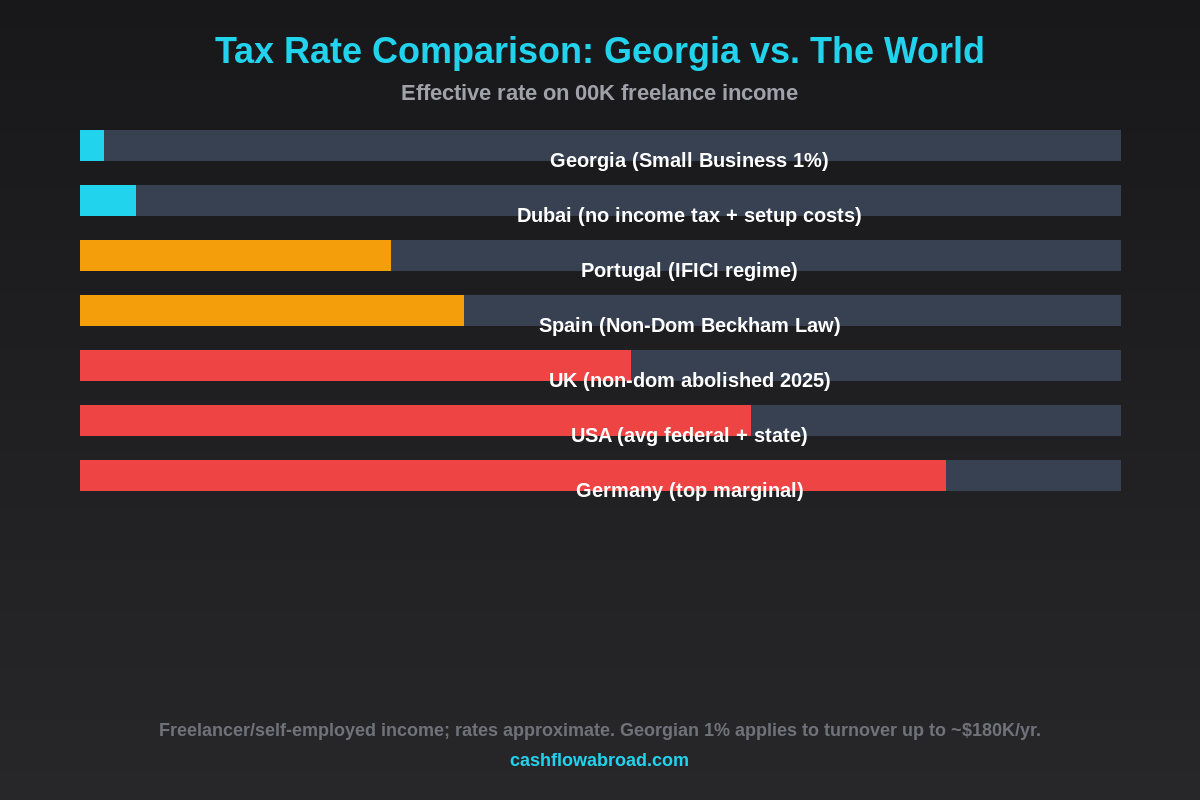
While Portugal gets all the headlines and Dubai gets all the Instagram posts, a country the size of South Carolina is quietly running one of the most aggressive low-tax setups on earth — and the expat community still treats it like a secret. In the country of Georgia, a freelancer earning $100,000 a year can legally pay 1% in tax. Not 10%. Not 15%. One percent. Software companies serving foreign clients pay zero corporate tax on that revenue. And you can stay for a full year with no visa application, no fees, and no embassy appointment.
Georgia — the former Soviet republic in the South Caucasus, not the US state — has built one of the most expat-friendly tax and business environments on the planet. And because it’s not Western Europe, most Americans have never seriously looked at it. That’s a mistake worth correcting.
Three Tax Regimes, Three Very Different Bills
Georgia doesn’t have one “low tax” option — it has three distinct structures, and which one applies to you depends on your business type, income level, and whether you have employees. Most guides conflate these, which creates confusion. Here’s how they actually work:
1. Individual Entrepreneur + Small Business Status: The 1% Rate
This is the headline number. Any foreign national can register as an Individual Entrepreneur (IE) in Georgia and apply for Small Business Status (SBS). The mechanics:
- Tax rate: 1% of gross turnover up to 500,000 GEL per year (approximately $180,000 USD at current exchange rates)
- Above the cap: Revenue exceeding 500,000 GEL is taxed at 3% for that year
- Registration cost: 60–110 GEL ($22–$40) in government fees; service providers typically charge $220–$350 one-time plus ~$150/year for bookkeeping
- Setup time: 1–3 business days. Can be done remotely via power of attorney
- Payment: Monthly, due by the 15th of the following month
The structure works for freelancers, consultants, designers, writers, coaches, and most solo remote workers. You register as a sole trader, not a company, so there are no dividends to worry about — the income flows directly to you.
2. Virtual Zone Status: 0% Corporate Tax for IT Companies
Georgia’s Virtual Zone (VZ) program was introduced in 2012 specifically to attract tech companies and software developers. If your company qualifies, the tax treatment is extraordinary:
- Corporate income tax: 0% on revenue from clients outside Georgia
- VAT: 0% on foreign-sourced services (treated as exports)
- Dividend distribution tax: 5% when you take profits out
- Application fee: One-time EUR 1,500 (~$1,650 USD)
- Processing time: Approximately 10 business days
Who qualifies? LLCs in software development, SaaS, IT consulting, cybersecurity, app development, game development, and related digital services — as long as the work is done in Georgia and delivered to clients outside Georgia. You don’t need a large team or expensive office, but the Revenue Service expects genuine operational presence.
As of 2024, 1,275 companies hold Virtual Zone status. That number is growing fast.
3. Territorial Taxation: Foreign Income Exemption
For high-earners and investors, Georgia operates a territorial tax system: Georgian tax residents pay zero Georgian tax on income genuinely earned abroad. Standard personal income tax is a flat 20% — but that applies only to Georgian-sourced income.
The catch that most guides miss: if you’re physically in Georgia providing services to foreign clients, Georgian tax authorities may classify that as Georgian-sourced income. The territorial exemption was designed for passive income (dividends, capital gains on foreign assets, foreign rental income) — not active remote work. If you’re freelancing from Tbilisi for US clients, the 1% Small Business structure is more reliable than claiming territorial exemption.
No Visa Required — Literally
US citizens, EU nationals, UK, Australian, New Zealand, and 90+ other nationalities can enter Georgia visa-free for up to 365 days. No application, no fees, no embassy visit. You show up with your passport and you’re in for a year.
This is one of only a handful of countries globally that grants Americans a full year on arrival. Compare that to Portugal’s 90 days before you need a visa, or Thailand’s 60-day tourist stamp. Georgia’s open-door policy is genuinely unusual.
A “border run” to Turkey or Armenia resets the clock — a practice that’s legal, widely used, and incredibly easy given Georgia’s geography.
Georgia’s Digital Nomad Program
If you want official recognition while working remotely, Georgia’s “Remotely from Georgia” program (launched 2020) provides up to 12 months with a formal permit. Requirements:
- Monthly income of at least $2,000 OR savings of $24,000
- Employment or contract with a company outside Georgia
- No application fee
It’s non-renewable, but you can transition to a standard residency permit after that if you’ve registered a business.
Becoming a Georgian Tax Resident
To actually use the 1% or 0% regimes, you need to become a Georgian tax resident. The standard route: spend 183+ days per calendar year in Georgia. That’s a genuine lifestyle commitment, not just paperwork.
There’s also a High Net Worth Individual (HNWI) fast-track for those who qualify:
- 3,000,000 GEL in global assets (~$1.1M USD), OR $73,000+/year in income for 3 consecutive years
- Must own Georgian property worth at least $500,000 USD
- Benefit: full Georgian tax residency certificate with no physical presence requirement
The HNWI route is expensive to qualify for but attractive for investors and executives who want a low-tax certificate without actually living in Tbilisi full-time.
The 2026 Change Most Nomad Guides Haven’t Covered
Here’s a real-time development that’s flown under the radar: starting in 2026, foreign Individual Entrepreneurs in Georgia are required to obtain a work permit from the Ministry of Labor. Processing time is 30–60 days; the cost is approximately 200 GEL (~$74). Without it, fines run 2,000–6,000 GEL (~$730–$2,200).
This doesn’t kill the 1% regime — the tax math is unchanged. But it adds a procedural step that wasn’t required before, and many nomad blogs haven’t caught up to it yet. Build 30–60 extra days into your setup timeline if you’re starting from scratch in 2026. Service providers who specialize in Georgian business registration can handle this as part of a package setup.
What $1,500/Month Gets You in Tbilisi
The tax math gets even better when you run it alongside cost of living. Tbilisi saw a rent surge in 2022–2023 as Russian and Ukrainian emigrants poured in. That wave has stabilized, and rents corrected roughly 12% in early 2025. Current numbers:
| Expense | Budget Range | Mid-Range |
|---|---|---|
| 1BR apartment (city center) | $400–520/mo | $650–900/mo |
| Groceries (1 person) | $150–185/mo | $200–250/mo |
| Restaurant meal (local) | $5–9 | $12–20 |
| Coworking hot desk | $55–75/mo | $150/mo |
| Home fiber internet (100+ Mbps) | $15–25/mo | — |
| All-in monthly total | $800–1,000 | $1,200–1,500 |
Tbilisi’s coworking scene has grown dramatically. Terminal hosts 9,000+ square meters with 1,100-person capacity. Impact Hub at Fabrika is the social hub for nomads at around $150/month. SpaceZ offers a budget desk from $55/month. Internet speeds are fast, reliable, and cheap — fiber is widely available and regularly clocks 200+ Mbps for under $25/month.
The math for a freelancer earning $60,000/year: pay $600 in Georgian tax (1%), live comfortably for $13,000–$18,000/year, bank the rest. That’s a savings rate that’s genuinely hard to match anywhere in Western Europe.

Banking: Georgia + Keeping Your US Infrastructure
Georgian banking is practical for foreigners. Both Bank of Georgia and TBC Bank open accounts for foreign nationals with a passport only — you can pre-register online and complete verification at a branch. Both offer English-language apps, international debit cards, and solid mobile banking. Georgian Lari savings accounts carry higher interest rates than most Western alternatives.
Most expats maintain US banking in parallel. Mercury is the standard for US business banking while abroad — fully online, no branch visits, integrates cleanly with Stripe, Wise alternatives, and international payment processors. For US brokerage and global ATM access, Charles Schwab International is the go-to: no foreign transaction fees, unlimited ATM fee reimbursements worldwide, and they don’t close expat accounts when they detect a foreign address (unlike Fidelity and Vanguard, which routinely do — see our breakdown of expat banking and brokerage options).
You’ll want a US mailing address while abroad to maintain banking relationships and IRS compliance. Traveling Mailbox gives you a real US street address in 50+ cities, mail scanning, and check deposits for around $15/month. It’s one of those boring tools that quietly prevents a lot of financial headaches. Full breakdown in the virtual mailbox guide for expats.
The American Catch: You Still Owe Uncle Sam
This is the part that needs saying clearly. Georgia’s 1% regime reduces your Georgian tax bill dramatically. It does nothing to your American tax bill — because the US taxes citizens on worldwide income regardless of where they live.
Your two main tools for the US side:
- Foreign Earned Income Exclusion (FEIE): Excludes up to $126,500 in 2024 from US federal income tax, provided you meet the physical presence or bona fide residence test. If you’re genuinely living in Georgia for 183+ days, you should qualify. Full breakdown at our FEIE guide.
- Foreign Tax Credit (FTC): Credits foreign taxes paid against your US bill. At 1%, Georgia’s tax is so low it provides almost no meaningful offset. The FEIE is almost always the better tool for Georgia-based expats.
Self-employment tax (15.3% on net self-employment income) is a separate issue. The US-Georgia totalization agreement — if one exists — would help; check with a qualified expat CPA on this specifically. This is distinct from income tax and catches a lot of freelancers off guard.
Georgia has double taxation treaties with 55+ countries. For non-Americans, these can significantly reduce or eliminate home-country tax. For US citizens, DTAs don’t eliminate the US filing obligation, but they can be useful for preventing double taxation on specific income types.
Who the Georgia Setup Actually Works For
| Profile | Georgia Fit | Why |
|---|---|---|
| Non-US freelancer, <$180K/yr | Excellent | 1% rate, low living costs, 365-day free stay |
| IT/SaaS company serving foreign clients | Excellent | Virtual Zone = 0% corporate tax on foreign revenue |
| US citizen, <$126K income, FEIE-eligible | Good | FEIE wipes most US federal tax; 1% on Georgia side |
| US citizen earning $150K–$250K | Moderate | Income above FEIE exclusion still taxed by IRS |
| Investor with passive foreign income, non-US | Good | Territorial system = 0% on genuine foreign passive income |
| Business with significant Georgian customer base | Poor | Standard 15% corporate tax applies to local revenue |
For a broader comparison of low-tax destinations, the Geographic Arbitrage Playbook covers ten countries with detailed cost-of-living and tax breakdowns. For visa options across the region, Digital Nomad Visas Ranked compares 15 programs on income requirements, tax, and lifestyle.
Setting Up: The Actual Steps
- Enter Georgia visa-free. Book a flight to Tbilisi. No advance paperwork for US citizens — just show up.
- Get a Georgian tax ID (TIN). Visit any Revenue Service office with your passport. Takes under an hour.
- Register as an Individual Entrepreneur. At the House of Justice in any Georgian city. 60–110 GEL, 1–3 business days. Remote setup via power of attorney is also possible through registered agents.
- Apply for Small Business Status. Filed with the Revenue Service. Automatic approval if you meet the criteria. Takes a few days.
- 2026: Apply for a work permit. Ministry of Labor, 30–60 day processing, approximately $74. Required as of 2026 for foreign IEs.
- Open a Georgian bank account. Bank of Georgia or TBC, in-person or via online pre-registration.
- File monthly tax payments. 1% of monthly revenue, due by the 15th of the following month. Accounting software that supports Georgian tax filings makes this easy.
Total out-of-pocket to get operational: under $500 in government fees if you do it yourself; $700–$1,200 if you use a service provider. The work permit adds roughly $74 in government fees plus any professional fees if you use an agent.
Bottom Line
Georgia is not a theoretical tax haven. It’s an operational one — with a functional banking system, solid infrastructure, fast internet, genuinely low costs, and a government that has spent years making business setup easier for foreigners. The 1% Small Business rate on up to $180,000/year isn’t a loophole or gray area — it’s written directly into Georgian tax law and has been in place since 2012.
The reason most Americans haven’t made the move is inertia, not analysis. Tbilisi doesn’t have the brand recognition of Lisbon or the glamour of Dubai. But for a freelancer or remote worker running honest numbers, it outperforms both on cost of living, tax burden, and ease of setup — with a full year of visa-free access before you’ve committed to anything.
The 2026 work permit requirement adds a step, not a barrier. If you’re running a service business internationally and paying 30–45% at home, there’s a version of this that costs you 1%. Worth doing the math.
Disclaimer: This article is for informational purposes only and does not constitute legal, tax, or financial advice. Tax situations vary significantly by citizenship, income type, and residency status. US expats in particular have complex obligations under FBAR, FATCA, FEIE, and self-employment tax rules. Consult a qualified expat tax professional before restructuring your business or residency.
Liked this article?
Get the next one delivered straight to your inbox — plus a free Expat Tax Cheat Sheet.
Join our subscribers. No spam — just expat finance intel and new post notifications.