Portugal IFICI: Is the NHR Replacement Worth It?
NHR ended in 2025. Portugal's IFICI replacement gives tech workers and researchers a 20% flat tax for 10 years — but retirees and passive investors are out.
NHR ended in 2025. Portugal's IFICI replacement gives tech workers and researchers a 20% flat tax for 10 years — but retirees and passive investors.
Around 10,000 expats applied for Portugal's Non-Habitual Resident (NHR) status in its final year alone — scrambling to lock in a decade of near-zero foreign income taxation before the window closed. On January 1, 2025, NHR officially ended. Within months, expat forums were filled with people declaring Portugal "done." They were wrong.
Portugal replaced NHR with IFICI — the Incentivo Fiscal à Investigação Científica e Inovação — a narrower but still powerful tax regime that hands qualifying professionals a flat 20% income tax for 10 years. If you're a software engineer, doctor, architect, or researcher, IFICI delivers nearly identical savings to what NHR once offered. If you're a retiree living off a pension or a passive investor, Portugal just got a lot more expensive. Here's how to know which camp you're in — and what to do about it.
What Was NHR, and Why Did Portugal Kill It?
NHR (Non-Habitual Residency) launched in 2009 as Portugal's bid to attract wealthy foreigners and skilled professionals. For 10 years from the date of registration, qualifying residents paid:
- 20% flat tax on Portuguese-sourced professional income
- 0% on most foreign-sourced income — dividends, interest, rental income, self-employment, even foreign pensions
For a US retiree collecting Social Security and living off a US investment portfolio, NHR was essentially a 10-year tax holiday in a country with great weather, 300+ days of sun, and a glass of wine for €2. The program ran for 15 years and became one of the most cited reasons expats chose Portugal over Spain or France.
Portugal killed it because it worked too well. Lisbon housing prices rose roughly 60% between 2016 and 2023. Local politicians — and a lot of locals — blamed wealthy foreigners who used NHR to pay little to nothing in taxes while driving up rents. The government announced NHR's end in late 2023, stopped accepting new applications after March 2025, and launched IFICI as the replacement.
Critical note for existing NHR holders: If you already have NHR status, you are grandfathered. Your 10-year window runs to completion, unchanged.
IFICI in Plain English: The New 20% Flat Tax
IFICI stands for "Tax Incentive for Scientific Research and Innovation" — the name signals exactly who it's designed for. The core mechanics are straightforward:
- 20% flat personal income tax on qualifying Portuguese-sourced professional income
- 10% on certain foreign-sourced income within qualifying categories (down from NHR's 0%)
- Duration: 10 consecutive years from the year you first register
- No renewal: after 10 years, you move to Portugal's standard progressive rates, which reach 48% at the top bracket
Compare that to Portugal's standard progressive income tax. A single earner at €100,000 faces a 48% marginal rate plus a solidarity surcharge of 2.5%–5% on income above €80,882. After standard deductions, effective rates typically land between 38% and 44% at that income level. For a tech worker earning €100K under IFICI versus the standard regime, the annual difference is roughly €18,000–€23,000. Over 10 years: €180,000–€230,000 that stays in your account instead of going to Finanças.
Who Qualifies for IFICI — and Who Doesn't
The Three Baseline Requirements
Before looking at professional categories, you must meet all three of these:
- Become a Portuguese tax resident after January 1, 2024. You trigger tax residency by spending more than 183 days in Portugal in a calendar year, or establishing a habitual residence there.
- Not have been a Portuguese tax resident in the previous 5 years. The same 5-year lookback applied under NHR, so returning expats know this rule.
- Not have previously benefited from NHR or another special tax regime.
The Degree Requirement
This is where IFICI gets stricter than NHR. You need to demonstrate one of the following:
- EQF Level 6 qualification (bachelor's degree) plus at least 3 years of relevant professional experience in a qualifying activity, or
- EQF Level 8 qualification (PhD or doctorate) — the work experience requirement is waived at this level
For most professionals with a university degree and a few years of industry experience, this hurdle is straightforward. But it does exclude self-taught professionals and people without formal credentials who might have qualified under NHR on the basis of professional activity alone.
Qualifying Professional Categories
IFICI targets workers in sectors Portugal considers strategically valuable. Explicitly qualifying activities include:
- Technology: software engineering, data science, information systems, cybersecurity
- Scientific research and R&D at recognized institutions
- Medicine and healthcare professionals
- Engineering and architecture
- Academia — university professors and teaching staff at accredited Portuguese institutions
- Auditors and certain financial professionals
- Entrepreneurs and startup founders in tech or innovation sectors
- Qualified investors whose capital generates measurable Portuguese economic activity
- Green energy and sustainability professionals
The formal list references specific CAE occupation codes under Portuguese tax law. The application process requires you to demonstrate that your activity falls within those codes. If your work is in tech, engineering, medicine, or research, you almost certainly qualify. If your income comes primarily from dividends, rental properties, crypto gains, or a pension — you do not.
Who Gets Left Out
IFICI deliberately excludes several profiles that NHR served well:
- Retirees and pensioners — pension income is explicitly excluded from IFICI's preferential treatment. It's taxed under Portugal's standard progressive rates, subject to any applicable double tax treaty provisions.
- Passive investors — dividend and interest income from foreign portfolios generally does not benefit from the 10% preferential rate for non-qualifying profiles
- Most remote workers in non-qualifying fields — a freelance marketer, copywriter, or online coach working remotely for a foreign company will likely not qualify unless their specific occupation code appears on the list
- Crypto traders — Portugal introduced a 28% flat capital gains tax on crypto in 2023; crypto gains fall outside IFICI's scope
If you're in one of these categories, Portugal still has a lot going for it as a country. But the tax math now looks closer to France than to Dubai. For profiles that don't fit IFICI, the geographic arbitrage playbook covers lower-tax alternatives with fewer professional activity requirements.
The Real Numbers: What You Actually Save
Three realistic scenarios for a single person with Portuguese-sourced employment income:
| Annual Income | Standard PT Tax (est.) | IFICI Tax (20%) | Annual Savings | 10-Year Total Saved |
|---|---|---|---|---|
| €60,000 | ~€20,400 (~34%) | €12,000 | ~€8,400 | ~€84,000 |
| €100,000 | ~€40,000 (~40%) | €20,000 | ~€20,000 | ~€200,000 |
| €150,000 | ~€68,000 (~45%) | €30,000 | ~€38,000 | ~€380,000 |
| €200,000 | ~€96,000+ (~48% + surcharge) | €40,000 | ~€56,000 | ~€560,000 |
These are estimates before social security contributions (Portugal charges employees 11% on gross salary) and deductions. A qualified Portuguese tax advisor can model your exact situation. But even after adjustments, the directional advantage is substantial — particularly above €80,000.
One specific nuance worth understanding: the old NHR exempted most foreign passive income at 0%. Under IFICI, certain foreign income is taxed at 10%. So if you're a senior engineer earning €120,000 from a Portuguese employer plus €30,000 in US dividends, your total Portuguese tax bill is €24,000 + €3,000 = €27,000. That's still dramatically better than the standard regime estimate of approximately €62,000 for the same combined income — but the foreign income component now has a real cost.
NHR vs IFICI: Side-by-Side
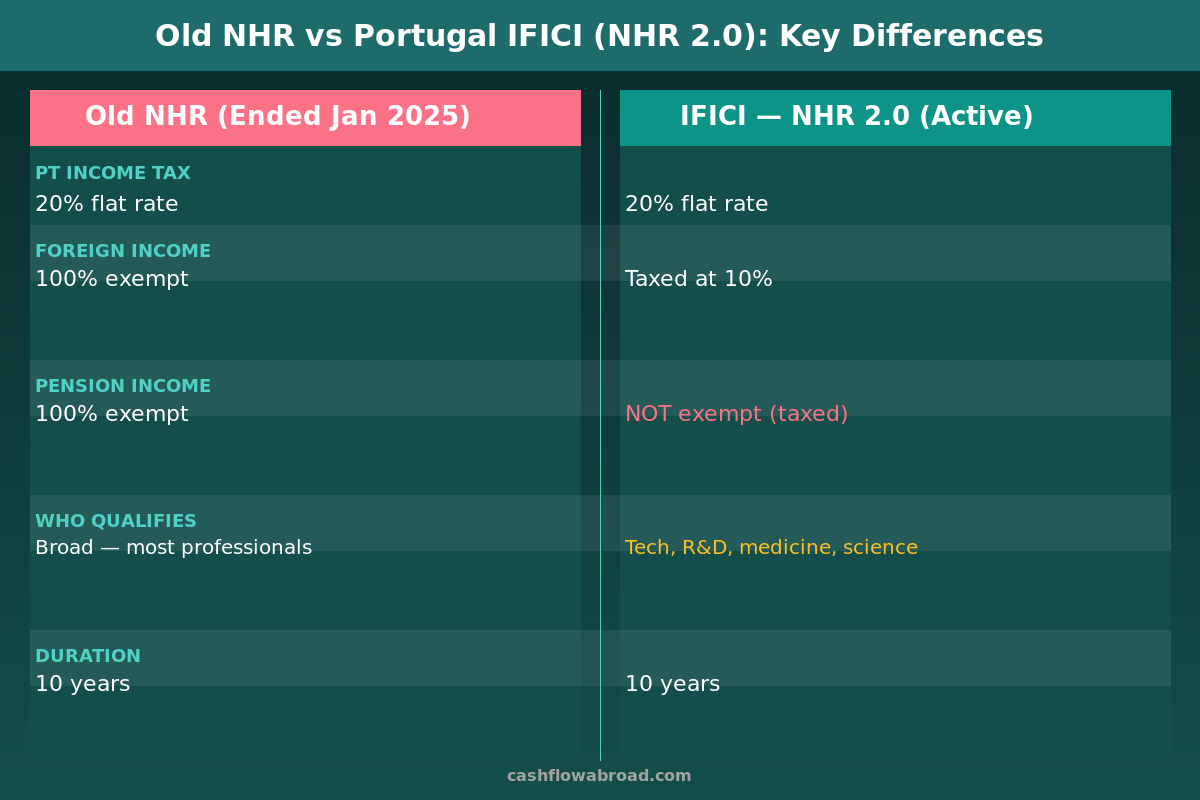
| Feature | Old NHR | IFICI (NHR 2.0) |
|---|---|---|
| Flat tax on PT-sourced income | 20% | 20% |
| Foreign employment income | Exempt (0%) | 10% |
| Foreign pension income | Exempt (0%) | Standard progressive rates |
| Foreign dividends / interest | Exempt (0%) | 10% (qualifying profiles only) |
| Duration | 10 years | 10 years |
| Eligibility scope | Broad — most professionals | Narrow — tech, R&D, medicine, science |
| University degree required | No | Yes (EQF Level 6+ or PhD) |
| Prior PT residency exclusion | 5 years | 5 years |
| Available for new applicants | No (closed Jan 2025) | Yes |
The conclusion: IFICI is NHR with targeted eligibility and a slightly higher foreign income rate. For qualifying professionals, the economic impact is nearly identical. For passive earners and retirees, it's a significant downgrade.
How to Apply: The Step-by-Step Process
IFICI applications run through Portugal's tax authority (AT) via the Portal das Finanças. The sequence:
- Establish Portuguese tax residency — typically by spending 183+ days in Portugal in a calendar year, or signing a lease that establishes a habitual residence
- Obtain a NIF (Número de Identificação Fiscal) — Portugal's tax ID number. Apply at any Finanças office, or through a fiscal representative if you're not yet in the country
- Update your NIF registration to reflect tax residency — this step is often missed by people who obtained a NIF years ago as a non-resident
- Submit the IFICI application via the AT portal — the deadline is January 15th of the year following the year you first became tax resident. If you become resident in 2026, you must apply by January 15, 2027. Miss this and you lose eligibility for that year.
- Submit supporting documentation — degree certificate, employment contract or client agreements, professional experience documentation if required
Processing typically takes 2–3 months from a complete submission. Once approved, the regime applies retroactively to the start of the tax year in which you became resident.
Professional fees for IFICI applications via a Portuguese tax advisor range from approximately €800 to €2,500 depending on income complexity. At €20,000 in annual savings, this advisory cost is recovered in the first two weeks of the first year.
If you're entering Portugal on a D8 digital nomad visa, confirm that your specific activity qualifies under IFICI's occupation codes before assuming automatic eligibility. The D8 visa and IFICI have overlapping but distinct criteria — not every D8 visa holder qualifies for the preferential tax rate.

Portugal in 2026: The Cost of Living Reality
Portugal's appeal was never just the tax rate — it was the combination of low taxes and genuinely affordable living by Western European standards. That equation has shifted, but it hasn't broken.
Lisbon has gotten expensive. A single expat living comfortably in Lisbon — central neighborhood, dining out a few times weekly, gym, unlimited transit pass — should budget €1,800–€2,800/month in 2026. A 1BR apartment in sought-after neighborhoods like Príncipe Real, Chiado, or Mouraria runs €1,300–€1,900/month. By European capital standards, this is still materially cheaper than London, Amsterdam, or Zurich. By geographic arbitrage standards, it no longer competes with Southeast Asia or Latin America.
Porto is the smarter move for cost-conscious expats. Porto runs 16–25% cheaper than Lisbon on comparable lifestyles — a 1BR in central Porto is €900–€1,200/month, and total monthly budgets land around €1,400–€2,200. The Algarve (Faro, Lagos, Tavira) offers similar pricing to Porto with better year-round weather and slower pace.
For US expats, practical infrastructure matters. Charles Schwab International offers a checking account with 100% ATM fee reimbursement worldwide and no foreign transaction fees — and the brokerage account keeps your US investment portfolio accessible without the PFIC complications that come with local European funds. For the full picture on investing as a US expat, the PFIC rules are the main thing to get right before picking where to park money.
Health coverage has two realistic options. Portugal's public health system (SNS) is available to registered residents — EU citizens access it for free, and non-EU citizens can purchase SNS membership for roughly €30–€150/month depending on assessed income. Private insurance for faster access and English-speaking specialists runs €80–€250/month. SafetyWing Nomad Insurance starts around $56/month and covers Portugal for international travel and gaps in local coverage — a sensible option for the first year while establishing residency and evaluating SNS membership.
One often-overlooked infrastructure piece: maintaining a US address. US expats in Portugal still need a US street address for IRS correspondence, state domicile purposes, US banking relationships, and brokerage accounts. Traveling Mailbox provides a real US street address in 50+ cities at $15/month, with mail scanning, check deposits, and forwarding on demand. This is the same infrastructure discussed in the virtual mailbox expat guide — and it solves a genuinely tricky compliance problem for the cost of two coffees per week.
For moving money between US accounts and Portuguese bank accounts, Remitly consistently offers competitive EUR/USD exchange rates with low transfer fees — typically $0–$3.99 per transfer under $10,000. The full money transfer comparison guide covers the fee structures in detail.
If IFICI Doesn't Work for You
Portugal is not the only game in Europe or globally. For profiles that don't fit the IFICI criteria:
- Georgia — 1% Small Business Status for freelancers earning under 500,000 GEL (~$185K), 183-day residency rule, visa-free for 95+ nationalities, $1,100–$1,400/month cost of living in Tbilisi
- Paraguay — territorial taxation means 0% on all foreign-sourced income, no income requirement for residency, and one of the lowest costs of living in South America
- Malta — EU member, English-speaking, offers the Malta Retirement Programme at a flat 15% on foreign remittances for pensioners
- Cyprus — 60-day tax residency option, 5% flat rate on dividends for qualifying non-domiciled residents
- UAE / Dubai — 0% personal income tax with no qualifying profession requirement, though cost of living and lifestyle vary significantly from Portugal
The common thread: each jurisdiction has a different profile it rewards. IFICI rewards high-earning professionals who happen to want to live in Western Europe. Paraguay rewards people who want low taxes and don't care about EU access. Georgia rewards freelancers who want urban affordability. Know your profile before picking your flag.
The Bottom Line
The expats declaring Portugal "dead" after NHR's end are largely the ones who benefited from NHR's broad foreign income exemptions — retirees, passive investors, and income-diverse earners who used NHR as a near-universal tax shield. For them, IFICI is genuinely a downgrade, and the math no longer works.
For a qualifying professional — software engineer, startup founder, biotech researcher, architect, physician — the picture is different. IFICI offers the same 20% flat rate on Portuguese income, a decade of preferential treatment, and access to one of the most livable countries in Western Europe, where a glass of wine is still €2 in a local tasca and a monthly transit pass is €30. The eligibility bar is higher, the foreign income exemption has been trimmed, and pensions are out. But the core arbitrage between IFICI's 20% and the standard regime's 48% is intact and substantial.
Two questions determine whether Portugal makes sense under IFICI: Does your occupation fall within the qualifying CAE codes? And have you been outside Portugal as a tax resident for at least the past 5 years? If both answers are yes — and if you have a qualifying degree — it's worth getting a NIF and speaking to a Portuguese tax attorney before writing the country off on the basis of a regime that no longer exists.
Financial Disclaimer: This article is for informational purposes only and does not constitute tax, legal, or financial advice. Portuguese tax laws, IFICI eligibility criteria, and regulations change frequently, and individual circumstances vary significantly. Consult a qualified Portuguese tax advisor and, for US citizens, a US expat CPA before making relocation decisions based on tax considerations. The author may receive compensation from affiliate links in this post.
This guide is general information, not personalized tax, legal, or investment advice. Rules change; verify current thresholds with official sources or a qualified professional before acting.
Related guides
 Expat Tax & FinanceMay 9, 2026
Portugal's NHR Is Gone — What IFICI Means for Expats
NHR closed in 2024. Portugal's IFICI replacement has a 20% flat rate — but no pension exemption. See who qualifies, who doesn't, and the real tax
 Expat Tax & FinanceMay 31, 2026
The 183-Day Tax Rule: What Expats Get Wrong
Most expats misunderstand the 183-day tax rule. Learn how it actually works country by country and why it is irrelevant for US citizens abroad.
 Expat Tax & FinanceMay 25, 2026
State Domicile for Expats: Avoid the States That Chase You Abroad
California can tax your foreign income at 13.3% even after you leave. Learn how to change state domicile and save 5,000+ per year as a US expat.