AI Automation Agency: Build $10K/Month from Anywhere
8 min read · 2,024 words
A 27-year-old in Medellín is clearing $38,000 a month. His office is a co-working space that costs $150/month. His entire tool stack runs $220/month. His clients are dentists, real estate brokerages, and SaaS companies in the US — none of whom have any idea he’s operating from Colombia at 70% lower overhead than any American agency he competes with.
He runs an AI automation agency. And right now, it’s one of the most favorable business models on the planet for anyone living outside a major Western city.
This isn’t a vague “AI is changing everything” post. This is a breakdown of exactly how these businesses work, what they charge, which tools they use, what niches pay the most, and how geographic arbitrage turns a $10K/month revenue business into something that actually feels like financial freedom.
What an AI Automation Agency Actually Does
An AI automation agency (AIAA) builds custom AI-powered workflows for businesses. The typical client has repetitive, high-cost processes — lead follow-up, customer service, appointment booking, content creation, data entry — that humans are currently doing manually. Your job is to automate them using AI tools, charge for the setup, and often charge a monthly retainer to maintain and optimize the system.
The economics are absurd in your favor:
- Gross margins run 70–85% because AI does the heavy lifting, not staff you hire
- You’re billing in USD, GBP, or EUR while paying rent in local currency
- A single good client can be worth $15,000–$40,000 in Year 1
- You need zero employees to start — just a laptop and the right tool stack
This is not a trend. Businesses are under intense pressure to cut costs and move faster. The ones that figure out AI-assisted operations first will outcompete those that don’t. You’re selling them exactly that advantage.
The Exact Tool Stack You Need
You don’t need to code. You need to know three categories of tools: workflow automation platforms, AI model APIs, and agent builders. Here’s what actually matters:
Workflow Automation Platforms
| Tool | Pricing | Best For |
|---|---|---|
| n8n | Free (self-hosted) / Cloud pay-per-execution | Technical users, unlimited workflows, AI-native (70+ LangChain nodes in 2.0) |
| Make.com | From $9/month (10,000 operations) | Visual builder, “Maia” AI builds scenarios from prompts, great for client demos |
| Zapier | From $19.99/month (750 tasks, annual billing) | 8,000+ app integrations, “Zapier Agents” for autonomous multi-step tasks |
Most established agencies run n8n self-hosted on a $6/month DigitalOcean droplet. It eliminates per-execution fees entirely and gives you full control over client data. For pitching non-technical clients, Make.com’s visual flow builder wins on presentation — they can see exactly what you built.
AI Model APIs
- OpenAI API — GPT-4o: ~$2.50/1M input tokens, ~$10/1M output tokens. No platform fee. Pay for exactly what you use.
- Anthropic (Claude API) — Claude Sonnet: $3/1M input, $15/1M output. Stronger at following complex multi-step instructions; better for agentic workflows that require nuanced reasoning.
- Groq — Runs open-source models (Llama 3, Mixtral) at 10–100x lower cost per token. Excellent for high-volume, cost-sensitive automations where you’re generating thousands of text snippets per day.
For most client work, you’ll spend $20–$80/month on API calls. Nothing compared to what you’re billing.
Agent and Chatbot Builders
- Voiceflow — Design conversational AI agents visually. Free tier for prototyping; paid plans for production. Best for customer-facing chatbots and lead qualification agents.
- Botpress — Open-source with a generous free cloud tier. Supports GPT backends and is easier to customize for complex conversation flows.
- Relevance AI — Higher-level agent builder for non-coders. Build multi-step AI agents with tool use from a visual interface. From $19/month.
Your Monthly Stack Cost
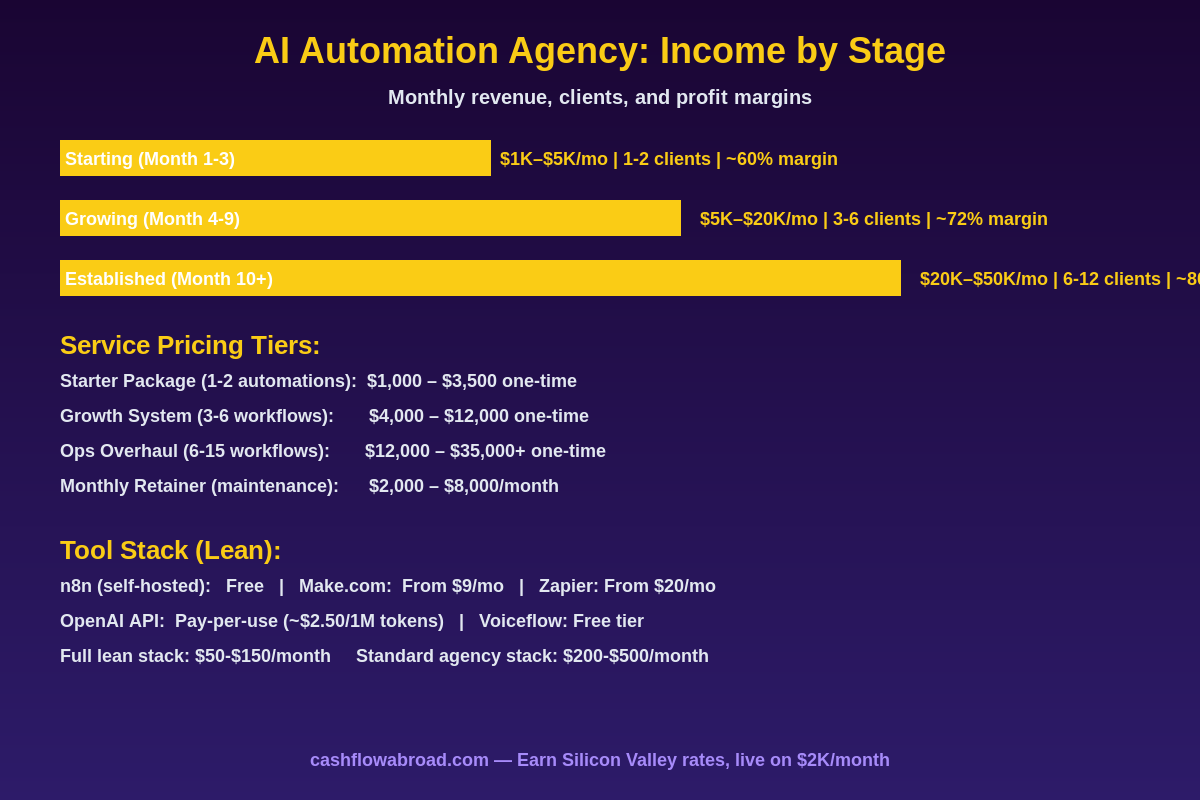
Lean starter setup: n8n on DigitalOcean ($6) + Voiceflow free tier + OpenAI API pay-as-you-go (~$30) + Make.com Starter ($9) = $45–$75/month total.
Full agency stack (add CRM, proposal software, LinkedIn Sales Navigator): $200–$500/month. Still trivial at $5K/month revenue.
The Niches That Actually Pay
The biggest beginner mistake: calling yourself a “general AI automation agency.” Niche down hard. A real estate AI agency closes faster, builds case studies faster, and gets referrals within the same vertical faster. Here are the niches with the best economics:
Real Estate (Best ROI for Clients, Fast Close)
Real estate agents are drowning in lead follow-up. The average agent responds to less than half of online leads within 24 hours. An AI system that answers inquiries instantly, qualifies leads against buyer criteria, and books showings automatically is genuinely transformative — and the ROI pitch is obvious.
Typical build: Voiceflow chatbot integrated with CRM (HubSpot or Follow Up Boss) + Make.com for data routing + OpenAI GPT-4o for natural language lead qualification. Build time: 2–3 weeks.
Pricing: $8,000–$12,000 setup + $1,500–$2,500/month maintenance. A mid-size brokerage sees the ROI in 60 days and rarely churns.
Dental and Healthcare (High Volume, Predictable)
Dental practices spend $800–$2,000/month on staff for social media management, appointment reminders, and patient FAQs. An AI system handles all three. They’re not sophisticated buyers — they just want the problem solved. Straightforward builds, sticky retainers.
Typical build: n8n workflow that pulls Google reviews, generates social posts via Claude API, schedules via Buffer, and sends SMS appointment reminders via Twilio.
Pricing: $1,000–$1,500/month retainer per practice. Seven dental clients = $7,000–$10,500/month for 15–20 hours of actual work per week.
E-Commerce (High Complexity, High Fees)
E-commerce stores need: customer service automation, cart abandonment sequences, product description generation at scale, and inventory alerts. Complexity is higher, but so is the budget — DTC brands at $2M+ revenue have serious tool budgets.
Typical build: Botpress customer service agent trained on product catalog + Klaviyo integration for cart abandonment + OpenAI Batch API for bulk product description rewrites.
Pricing: $3,000–$8,000/month retainer.
SaaS / B2B Companies (Highest LTV)
Automating onboarding flows, support ticket triage, lead scoring, and internal knowledge base queries. These clients understand what you’ve built, have long LTV, and pay the highest retainers. One SaaS client at $5,000/month = your entire cost of living in Southeast Asia.
Pricing: $4,000–$15,000/month. One or two of these clients and you’re financially set.
How to Price Your Services
Price on value, not time. The frame is never “I’m charging you X for Y hours.” The frame is always ROI: “This system will save you $40,000/year in labor costs. We’re asking $10,000 to build it and $2,000/month to maintain it. Payback period: 7 months.”
| Package | Scope | Price Range |
|---|---|---|
| Starter | 1–2 core automations (e.g., lead capture + CRM sync) | $1,000–$3,500 one-time |
| Growth System | 3–6 workflows + dashboards + QA | $4,000–$12,000 one-time |
| Ops Overhaul | 6–15 workflows, full integration, training | $12,000–$35,000+ one-time |
| Monthly Retainer | Maintenance, optimization, new automations | $2,000–$8,000/month |
The paid discovery call: Before any project starts, charge $500–$1,500 for a workflow audit. You map their existing processes, identify the highest-ROI automation targets, and deliver a written report. This filters out tire-kickers, funds your research time, and converts directly into implementation contracts.
How to Get Your First Clients
Cold outreach on LinkedIn is the fastest path. Build a profile positioned around your chosen niche, then reach out with a hyper-specific message:
Hey [Name], I work with real estate brokerages to build AI systems
that auto-qualify leads and book showings. Similar to what [Firm X]
implemented last quarter — they cut lead response time from 6 hours
to 90 seconds. Worth a 15-min call to see if there's a fit?
That message names a specific outcome (response time), references a real result, and keeps the ask tiny (15 minutes). Generic “I help businesses with AI” messages get ignored. Specificity converts.
Other acquisition channels:
- Case study content on LinkedIn — One detailed case study (before/after, tool stack, ROI numbers) generates more inbound than 3 months of cold outreach. Do this early.
- YouTube/short-form video — Screen record a live automation running. These videos compound over months.
- Upwork/Freelancer — Lower rates but fast portfolio building. Use for your first 2–3 projects, then move to direct outreach.
- Local business networks — In your home city or expat hub, chambers of commerce and business associations. Easy to stand out as “the AI person” in a room full of accountants and lawyers.
Why Running This From Abroad Changes the Math

Here’s the number that rarely gets discussed: a US-based solo founder making $10,000/month in revenue keeps roughly $4,000–$5,000 after taxes, rent, health insurance, and cost of living. The same founder operating from Medellín, Tbilisi, or Chiang Mai keeps $7,500–$8,500 — 65–70% more discretionary income from identical revenue.
Your tool costs don’t change. Your clients don’t care where you are. Your delivery is remote-native. The only variables are your cost of living and your tax structure.
The practical math at $10K/month from Medellín, Colombia:
- Revenue: $10,000
- Tool stack: $250
- Rent (nice apartment, Laureles neighborhood): $700
- Food, transport, gym, coworking: $600
- Health insurance (SafetyWing or local plan): $80–$150
- Discretionary income: ~$8,000–$8,400/month
For US citizens living abroad, the Foreign Earned Income Exclusion lets you exclude up to $126,500 (2024) of qualifying foreign-earned income from US federal taxes. If your agency income qualifies — meaning you’re genuinely domiciled abroad — you may owe zero federal income tax on the first $126K. Run this by an expat-specialist CPA before acting on it, but the potential savings are significant.
For maintaining a US footprint while abroad: a Traveling Mailbox virtual mailbox ($15–$25/month) handles mail scanning, forwarding, and check deposits remotely. Pair it with a Mercury business checking account — free, no foreign transaction fees, built for remote-first founders — and your entire US business infrastructure costs under $40/month.
For travel between countries, Saily eSIM covers 150+ countries without SIM-swapping headaches — useful when client calls don’t pause for border crossings.
If Colombia is on your radar as a base, the infrastructure for remote workers has gotten genuinely excellent — fast fiber, quality coworking spaces, and a thriving expat community. The full setup guide, including the digital nomad visa process, is at ColombiaMove.com.
Realistic First-Year Timeline
- Month 1–2: Learn n8n or Make.com deeply. Build 2–3 practice automations for fake clients. Set up LinkedIn with niche positioning. Land a first paid Upwork project ($500–$1,500) for the testimonial.
- Month 3–4: First real client from cold outreach. Sell a Growth System ($4,000–$8,000). Deliver it, document the case study. Monthly revenue: $2,000–$5,000.
- Month 5–7: Use case study for outbound. Add 2–3 clients. Convert one-time clients to maintenance retainers. Monthly revenue: $5,000–$12,000.
- Month 8–12: Referrals start coming in. Add a VA ($1,500–$2,000/month) for client communication and routine edits. Monthly revenue: $12,000–$25,000. Margins stay above 70%.
The outliers hit $20K in month 6. Others take 18 months to reach $5K. The determining variable is almost always how fast you commit to a single niche and produce one compelling case study. The model works consistently — the only question is execution speed.
The First 7 Days: Exact Steps
- Day 1: Create a free n8n Cloud account. Connect it to your Gmail. Make it send you an email when a Google Form is submitted. Takes 30 minutes. This is your first automation — actually do it.
- Day 2–3: Choose your niche. Real estate is the easiest entry point: large market, clear ROI, unsophisticated buyers. Watch 3 YouTube case studies of real estate AI setups to understand what’s been built.
- Day 4–5: Build a demo for your niche using free tools. A real estate lead chatbot (Voiceflow free tier) that qualifies leads and syncs to a Google Sheet via Make.com. Budget one weekend.
- Day 6: Set up LinkedIn. Headline: “AI Automation for [Niche] Businesses | [Specific Result].” Post your screen recording demo as a video.
- Day 7: Send 20 personalized LinkedIn messages to your niche. Track replies in a Google Sheet. This is your pipeline. Repeat weekly.
First-month tool costs: approximately $15. Everything else is free until you have revenue to invest. See the broader framework for building a six-figure online business you can run from anywhere — the AI agency model is one of the fastest tracks to get there.
The Bottom Line
The AI automation agency model requires a real skill set, real sales effort, and real client results. What makes it exceptional for expats and digital nomads is the structural advantage: cost of living drops 50–70%, revenue stays in hard currency, and the service is infinitely deliverable from anywhere with a reliable connection.
There are a thousand ways to make money online. Very few allow $10,000–$30,000/month with 70–80% profit margins, no inventory, no large team, and no geographic anchor. The ones that do are worth taking seriously.
Financial disclaimer: Income figures cited in this post reflect publicly reported founder case studies and industry surveys. Individual results vary significantly based on niche selection, sales ability, market conditions, and execution. This post is for informational purposes only and does not constitute financial, legal, or business advice. Consult qualified professionals for tax guidance specific to your situation as a US citizen living abroad.
Liked this article?
Get the next one delivered straight to your inbox — plus a free Expat Tax Cheat Sheet.
Join our subscribers. No spam — just expat finance intel and new post notifications.