The US Exit Tax: What Americans Owe When They Renounce
9 min read · 2,212 words
The United States is one of only two countries on earth that taxes its citizens based on citizenship rather than residence. The other is Eritrea. When you decide you’ve had enough and want out, the IRS has a parting gift waiting: the Exit Tax. And starting April 13, 2026 — six days from now — the cost to renounce just dropped 81%, from $2,350 to $450. Expect the queue to get much longer.
But the fee is a sideshow. The real cost of leaving American citizenship behind isn’t paid at the consulate window. It’s the tax bill you carry out the door — potentially six or seven figures — assessed on assets you haven’t sold, retirement accounts you haven’t touched, and income you haven’t received yet. Facebook co-founder Eduardo Saverin’s exit tax bill alone was estimated at $365 million. Most people won’t face that kind of number, but the mechanism applies whether you’re worth $2 million or $200 million.
Here’s how the exit tax actually works, who it hits hardest, and what the math looks like when you run the real numbers.
Who Gets Taxed: The Covered Expatriate Tests
Not every American who renounces owes exit tax. The IRS created a category called a covered expatriate — if you qualify, the full exit tax regime under IRC Section 877A applies. You’re covered if you meet any one of three tests on the day before your expatriation date:
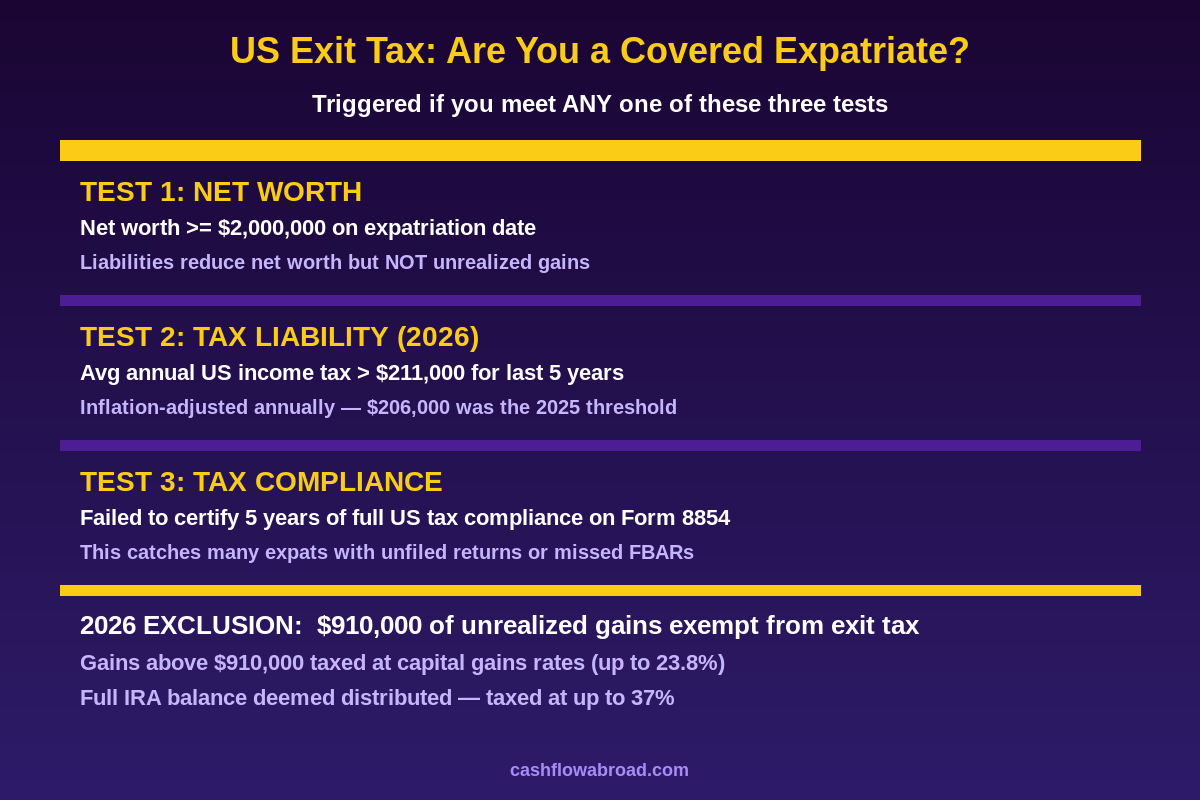
| Test | 2026 Threshold | What It Actually Catches |
|---|---|---|
| Net Worth | $2,000,000+ | Millionaires — including those whose wealth accumulated outside the US |
| Tax Liability | Average $211,000+/year (prior 5 years) | High earners who’ve been paying large US tax bills |
| Compliance | Failure to certify 5 years of full US tax compliance on Form 8854 | Anyone with unfiled returns, missed FBARs, or outstanding obligations |
The compliance test is the trap door most expats don’t see coming. You can have a net worth well under $2 million and pay minimal US tax — but if you missed filing a single FBAR, have a year with an unfiled return, or can’t certify full compliance, you’re a covered expatriate and subject to the full exit tax. The IRS doesn’t require intent. It requires paperwork.
There’s also a subtle math trick in the net worth test: liabilities reduce your net worth for purposes of hitting the $2 million threshold, but those same liabilities do not reduce unrealized gains for the actual tax calculation. A rental property worth $1 million with a $700,000 mortgage counts as $300,000 toward the net worth test — but potentially generates $1 million of taxable gain at exit. The IRS measures your wealth one way and your tax exposure another.
How It Works: A Deemed Sale of Everything You Own
If you’re a covered expatriate, IRC 877A treats the day before your expatriation as though you sold every asset you own at fair market value — whether you actually sell anything or not. Stocks, bonds, US real estate, foreign real estate, business interests, cryptocurrency, art, jewelry, collectibles. Every asset, globally.
The 2026 exclusion is $910,000. You subtract that from total unrealized gains, and the remainder is taxable at capital gains rates. Long-term gains are taxed at 0%, 15%, or 20% depending on income, plus 3.8% Net Investment Income Tax for higher earners. Effective top rate: 23.8%.
Losses in the deemed sale offset gains, but you can’t carry them forward. Use them or lose them on that final return.
The Numbers in Practice
A covered expatriate with $3.5 million in assets: house bought for $400K now worth $900K (unrealized gain: $500K), investment portfolio with $800K in gains, business interest worth $400K above basis. Total unrealized gain: $1.7 million.
Subtract the $910,000 exclusion: $790,000 taxable. At 23.8%: ~$188,000 in exit tax on investment and real estate gains alone.
Add a $500,000 IRA, and the number gets much uglier.
The Retirement Account Trap
This is where the exit tax turns particularly brutal for Americans who’ve spent decades building retirement savings.
Traditional IRAs and Roth IRAs are classified as “specified tax-deferred accounts” under 877A. On the day before expatriation, the entire account balance is deemed distributed to you — not just the gains, the entire balance. Taxed at ordinary income rates up to 37%. A $500,000 IRA generates up to $185,000 in exit tax on money still sitting in the account that you haven’t touched.
401(k)s from US employers are treated differently — they’re “eligible deferred compensation” and escape the mark-to-market deemed distribution. Future 401(k) distributions to you as a nonresident will be subject to 30% withholding at the time of payment. Still painful, but at least it’s taxed when you actually receive the money.
Foreign pension plans generally get the worse treatment: deemed distributed as a lump sum at expatriation, taxed at ordinary rates on the full balance. This is one of the most common overlooked disasters in expat exit planning — someone who’s been contributing to a Swiss or UK pension for 20 years faces a catastrophic phantom income event the day they renounce.
Who Actually Does This — And Why
About 5,000 Americans renounce each year, a number that’s climbed steadily since FATCA took effect in 2010 and foreign banks began closing American clients’ accounts rather than deal with US reporting requirements. The 2020 record of 6,705 was partly driven by pandemic-era consulate backlogs clearing.
Most renunciants aren’t billionaires. They’re retirees who’ve lived abroad for decades, entrepreneurs in countries where a US passport has become an active liability for banking, and people who’ve acquired second citizenship elsewhere and simply want to simplify their lives. But the high-profile cases illustrate the scale of what’s at stake.
Eduardo Saverin renounced in September 2011, roughly eight months before Facebook’s May 2012 IPO. By expatriating before the IPO, he reportedly saved an estimated $700 million in capital gains taxes, though his exit tax bill itself was estimated at $365 million or more. His destination: Singapore, which has zero capital gains tax and does not recognize dual citizenship with the US. The move triggered a proposed “Ex-PATRIOT Act” from Senators Schumer and Casey that would have barred tax-motivated renunciants from re-entering the US. It never passed.
Tina Turner renounced in 2013 after 16 years in Switzerland and acquiring Swiss citizenship. She had no plans to return to the US and wanted to simplify her life with her husband, German music executive Erwin Bach. She passed away in 2023 as a Swiss citizen.

Accidental Americans: The Most Unfair Cases
Millions of people hold US citizenship without ever meaningfully living in the country — born in the US to foreign parents, born abroad to a US-citizen parent, or acquired citizenship as children of naturalizing parents. Under citizenship-based taxation, they owe US tax returns, FBAR filings, and FATCA disclosures for life, even if they’ve never earned a dollar in the US and don’t speak English.
The enforcement regime is brutal. FBAR penalties for willful non-filing can reach the greater of $100,000 or 50% of the account balance, per violation, per year. Most accidental Americans owe zero actual US tax — the Foreign Earned Income Exclusion and foreign tax credits typically eliminate liability entirely — but the compliance requirement never disappears. Missing an FBAR while technically owing no tax can still trigger a six-figure penalty.
Foreign banks have responded by closing American accounts. French, Belgian, Dutch, and Swiss banks have been particularly aggressive about refusing US-citizen clients rather than navigate FATCA reporting costs. An accidental American living in Lyon may find themselves unable to open a local bank account, finance a car, or participate in an employer pension plan — all because of a passport they may not even remember acquiring.
At $450 per renunciation (starting April 13), this group finally has a realistic path out. The old $2,350 fee was a meaningful financial hardship for someone living in a modest European apartment who happens to hold a US passport from birth. The fee drop was largely driven by over 900 public comments to the State Department citing FATCA hardship — and for once, the government listened.
Before renouncing, accidental Americans should seriously evaluate the IRS Streamlined Foreign Offshore Procedures: file 3 years of back returns, file 6 years of FBARs, certify the non-compliance was non-willful, pay any taxes owed plus interest, and all FBAR and FATCA penalties are waived. For someone who genuinely didn’t know about the requirements, getting compliant first — without losing the passport — is often the smarter move. For the full compliance framework, see our complete guide to US expat banking and taxes.
The Inheritance Tax Nobody Tells You About
There’s a consequence of covered expatriate status that most people completely miss until it’s too late: what happens when you try to leave money to your US-citizen family.
Under IRC Section 2801 — with final IRS regulations effective January 1, 2025 — any US citizen or US resident who receives a gift or inheritance from a covered expatriate owes tax on it at the top gift and estate tax rate: 40%. This is paid by the recipient, not the estate. There’s an annual exclusion of $19,000 per recipient in 2026, but anything above that triggers 40% at the recipient’s end — separate from and in addition to any exit tax the expatriate already paid when they left.
If you renounce, pay the exit tax, then leave $5 million to a US-citizen child 20 years later, your child owes $1.99 million to the IRS. The fact that you already paid US taxes for 40 years, and already paid exit tax when you left, is irrelevant to this calculation. The IRC 2801 tax and the exit tax are independent obligations that stack.
This is the most commonly overlooked factor in renunciation planning for people with US-citizen heirs. Our full breakdown of expat estate planning across jurisdictions covers structures for managing this exposure.
What to Do Before You Renounce
Renunciation is permanent. There’s no appeal, no reinstatement, and no “I changed my mind.” A few things that must happen — or at minimum be carefully analyzed — before anyone signs Form DS-4083:
| Action | Why It Matters |
|---|---|
| Secure a second passport first | Renouncing without another citizenship leaves you stateless — a genuine legal emergency with serious travel consequences |
| Be 5 years tax-compliant | Unfiled returns or FBARs trigger the compliance test — you become a covered expatriate regardless of net worth |
| Harvest gains strategically | Selling appreciated assets before expatriation may be advantageous depending on your current vs. future tax rates |
| Consider Roth IRA conversion | Converting pre-expatriation pays income tax now; avoids the 37%-rate deemed distribution at exit |
| Inventory deferred compensation | Foreign pensions and non-qualified deferred comp are taxed as a lump sum — quantify what you’re triggering |
| Keep a US mailing address | IRS correspondence, state domicile requirements, and banking may still require a US address post-renunciation |
On banking: after renunciation, you lose the right to open US bank accounts as a citizen. Setting up your financial infrastructure beforehand matters. Charles Schwab’s international accounts offer free ATM withdrawals worldwide and are one of the best options for expats who want dollar access and US brokerage outside the full US banking system. For those still needing a permanent US address for IRS correspondence, state domicile, or business registration after renouncing, Traveling Mailbox provides a real US street address in 50+ cities with mail scanning and check deposit for $15/month — worth keeping even after you drop the citizenship. See our complete guide to virtual mailboxes for expats.
Crypto holders face a specific calculation: all unrealized Bitcoin, Ethereum, and other crypto gains count toward the exit tax deemed-sale. If you’ve held since 2018, the numbers can be large. Running your full crypto position through CoinTracking before finalizing any renunciation timeline helps you understand your exact exposure. Our crypto tax guide for US expats covers the rules in more detail.
The Alternative: Stay American, Eliminate the Bill
For many expats, the answer isn’t renunciation — it’s compliance optimization. The Foreign Earned Income Exclusion eliminates US tax on the first $126,500 of earned income for qualifying expats in 2024. The Foreign Tax Credit eliminates double taxation for those in higher-tax jurisdictions. Used together properly, most middle-income Americans living abroad owe zero US federal income tax year after year — while keeping their passport, Social Security rights, and the ability to hold US bank accounts.
Renunciation makes clear sense for Americans who’ve permanently relocated, secured a second citizenship, have no US-citizen heirs to worry about under IRC 2801, and face a meaningful annual tax compliance burden with limited offsetting benefits. For people with US family ties, US business interests, or plans to return someday, the cost-benefit calculation usually doesn’t favor walking out the door — especially when the tax bill follows you out anyway.
See our breakdown of how to pay zero federal income tax legally as an expat for the full optimization approach on the stay-and-comply side of the equation.
The Bottom Line
The exit tax is the IRS’s mechanism for ensuring that decades of US tax-advantaged growth — in stock accounts, real estate, retirement funds — don’t leave the country without a final accounting. For high-net-worth covered expatriates, the bill runs easily into six figures and can reach seven. For accidental Americans with modest assets, the April 13 fee cut to $450 makes an exit they couldn’t previously afford suddenly realistic.
Neither path is simple. IRC 877A interacts with retirement account rules, foreign pension rules, crypto treatment, and estate planning in ways that require professional guidance to navigate without expensive mistakes. The $10,000 penalty for an incomplete Form 8854 alone is a reminder that the IRS treats this area seriously. Before making any decisions in either direction, a cross-border CPA who specializes in expatriation is the single most valuable investment you can make.
This post is for informational and educational purposes only and does not constitute tax or legal advice. US exit tax law is complex and highly fact-specific. Consult a qualified international tax attorney or CPA before making any decisions regarding expatriation or citizenship renunciation.
Liked this article?
Get the next one delivered straight to your inbox — plus a free Expat Tax Cheat Sheet.
Join our subscribers. No spam — just expat finance intel and new post notifications.