Buying Property Abroad: Countries, Costs and Tax Traps
11 min read · 2,636 words
The average American homeowner pays $1,700 in property taxes alone every month in California. For that same monthly cost, a US expat in Medellín is sitting on a paid-off two-bedroom with a rooftop terrace — earning 8% annually in rent from a local tenant. International real estate isn’t a lifestyle flex. For the right buyer, it’s one of the most tax-efficient, high-yield investments available outside the US stock market.
But buying property abroad as a US citizen is not like buying a condo in Miami. You’ll encounter foreign ownership restrictions, exotic mortgage structures, IRS reporting landmines, and transaction costs that can hit 15% before you close. This guide covers the countries that actually make sense, the ones that look good on paper but aren’t, and the US tax obligations that most buyers discover too late.
Why International Real Estate Makes Sense Right Now
A few structural trends are converging. First, US property prices remain historically stretched — the median US home price hit $407,000 in 2025, with net rental yields in major cities often below 3% after taxes and expenses. Second, the dollar has stayed strong against currencies in major expat destinations, meaning US buyers get outsized purchasing power abroad. Third, several countries have scrapped capital gains taxes on property entirely for foreign residents.
Emerging markets like Turkey and Colombia saw dollar-denominated property appreciation of 40–80% over the past five years. That’s not speculative flipping — that’s holding a modest apartment in Istanbul or Bogotá while a combination of currency dynamics and local demand pushed values up. And you collected rent the entire time.
The math gets more interesting when you factor in geographic arbitrage: you’re earning in dollars or euros and paying property taxes, maintenance, and management fees in a weaker local currency. Your cost base shrinks every year the local currency depreciates.
Countries Where US Citizens Own Outright
Not every country lets foreigners hold full freehold title. Here are the major markets where a US citizen can own land and buildings directly in their own name, with no trust structures, no nominee arrangements, and no percentage caps.
Portugal: Stable Yields, EU Legal Framework
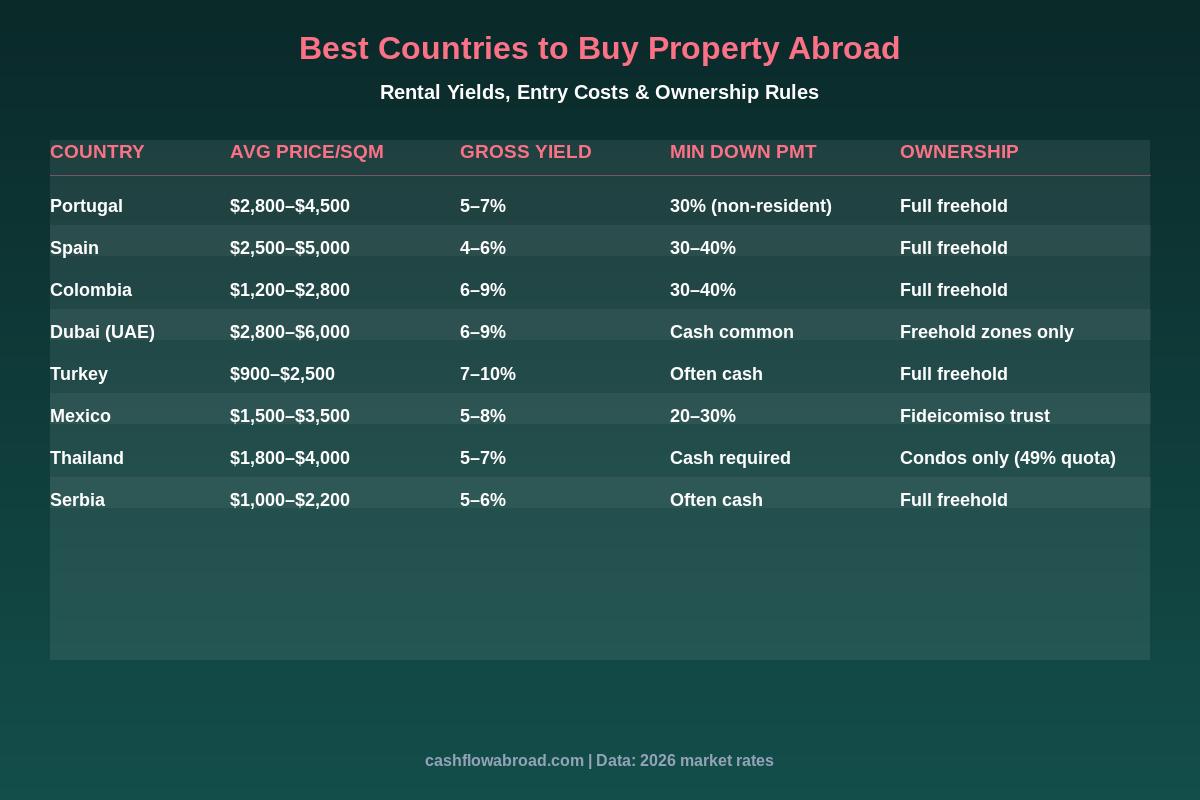
Portugal remains one of the cleanest markets for US buyers. Full freehold ownership, a straightforward civil law system, and banks that will lend to non-residents at rates of 3–4.5% fixed for those who can put down 30%. Lisbon city-center apartments run $4,000–$5,000 per square meter, but Porto and the Algarve coast offer the same legal framework at $2,800–$3,500. Gross rental yields range from 5–7% depending on location and whether you’re doing long-term or seasonal rentals — though Lisbon has imposed restrictions on new short-term rental licenses, so check municipality rules before buying for Airbnb.
Spain: Cheaper Mortgages, Higher Transaction Costs
Spain offers mortgage rates as low as 2.8–3.5% fixed for non-residents — lower than Portugal — but requires 30–40% down. The catch is transaction costs: between transfer taxes (6–10% depending on region), notary, registry, and legal fees, budget 12–15% of the purchase price on top of the sticker price. Prices in Barcelona and Madrid run $3,500–$6,000 per sqm; Valencia, Seville, and the Costa Blanca offer entry points under $2,500. Long-term rental yields of 4–6% are realistic — higher in seasonal markets.
Colombia: High Yields, Dollar Purchasing Power
Colombia is genuinely underrated for US buyers. Full freehold ownership, no restrictions on foreigners, and property prices that still feel surreal from a US perspective. A modern two-bedroom in El Poblado, Medellín costs $130,000–$200,000. Rental yields run 6–9% gross. The peso has weakened significantly against the dollar over the past three years, which means US buyers are getting dramatically more apartment for their money than they were in 2021.
Local financing is expensive — Colombian mortgage rates hover around 14–16% in pesos — so most US buyers pay cash or use US-side financing. Wiring money for a property purchase means navigating SWIFT transfers and Colombian foreign exchange declarations (declaración de cambio), which you’ll want a local attorney to handle. Remitly works for smaller recurring transfers; for wire transfers in the $50K–$500K range, use a bank or licensed FX broker. For buyers already in Colombia holding stablecoin balances, ARQ Finance offers a practical way to convert USDC to Colombian pesos for local property payments.
For on-the-ground detail on neighborhoods, visas, and the full Medellín property-buying process, see ColombiaMove.com’s complete guide to moving to Colombia.
Dubai: Zero Tax, 6–9% Yields
Dubai’s freehold zones allow 100% foreign ownership with no annual property tax, no capital gains tax, and no income tax on rental revenue. Gross yields run 6–9% — among the highest in any developed real estate market globally. Entry points start around $150,000 for a studio in emerging neighborhoods; palm-facing apartments in prime locations hit $600,000–$2M+. The catch: most transactions are cash (banks lend to non-residents but at tighter LTVs of 50–60%), and off-plan purchases from developers carry completion risk that buyers sometimes underestimate.
Turkey: Highest Yields, Highest Volatility
Turkey has posted the most dramatic returns of any major expat property market over the past five years. Buyers who purchased Istanbul apartments in dollars in 2019–2020 saw prices rise roughly 80% in dollar terms by end of 2024, driven by local demand and currency dynamics. Gross rental yields run 7–10%, the highest of any market in this guide. Property prices in prime Istanbul neighborhoods run $1,500–$2,500 per sqm in dollar terms; coastal Antalya runs $900–$1,800.
The risk is real: Turkish lira volatility means that any lira-denominated investment or loan can erode value fast. Buy in dollar-denominated or euro-denominated contracts where possible, and avoid lira-denominated mortgages unless you have lira income to service them.
Serbia: EU-Adjacent, Overlooked
Belgrade offers full freehold ownership for US citizens, a flat 15% capital gains tax, and gross yields of 5–6% with a rapidly urbanizing population. Average prices in central Belgrade run $1,500–$2,200 per sqm — cheaper than any EU capital for comparable quality. Serbia isn’t in the EU, which limits the residency upside, but as a long-term hold the fundamentals are solid. A bilateral property treaty between the US and Serbia explicitly permits ownership on equal terms to Serbian nationals.
Countries With Restrictions (And the Workarounds)
Several popular expat destinations restrict foreign land ownership — but they’re not completely off the table. They just require more legal infrastructure.
Mexico: The Fideicomiso Trust
Mexican law bars foreigners from directly owning property within 50 kilometers of the coast and 100 kilometers of international borders — which covers almost every destination Americans want (Cancún, Los Cabos, Puerto Vallarta, Playa del Carmen). The workaround is a fideicomiso: a bank trust where a Mexican bank holds title on your behalf. You own the beneficial interest; the bank is the legal holder. Fideicomisos cost $500–$1,000 to set up plus $500–$800 annually in bank fees. They’re fully legal and well-established — thousands of US buyers use them. Interior Mexico cities like Mexico City, San Miguel de Allende, and Oaxaca have no coastal restriction and allow direct foreign ownership. Prices run $1,500–$3,500 per sqm depending on the market.
Thailand: Condos Only (49% Quota)
Thailand’s land code prevents foreigners from owning land or houses outright. The nominee company workaround the government cracked down on aggressively — it now carries serious legal risk. What foreigners can own directly: condominium units, provided foreign ownership in the building doesn’t exceed 49% of total units. For houses, the legal options are long-term leases (30 years, sometimes renewable), usufruct rights, or superficies registrations — all registerable at the Land Department and legally enforceable. Thai condo prices run $1,800–$4,000 per sqm in Bangkok and Phuket; Chiang Mai is cheaper at $900–$1,500. Yields of 5–7% are achievable in tourist-heavy markets.
Philippines: 40% Cap and the New 99-Year Lease
Like Thailand, the Philippines bars foreign land ownership under its constitution. Foreigners can own condominium units as long as foreign ownership in the project doesn’t exceed 40%. For houses and lots, the option since 2025 is a 99-year registered lease — extended from the previous 50-year maximum under a 2025 reform. A 99-year lease at age 35–40 is, practically speaking, a permanent hold. Cebu and Metro Manila condos run $1,200–$2,500 per sqm; yields of 5–8% are common in central business districts.
Can You Get a Mortgage on Foreign Property?
Foreign banks do lend to non-residents — but the terms are stricter than what you’re used to in the US.
| Country | Non-Resident LTV | Rate Range (2026) | Key Requirements |
|---|---|---|---|
| Portugal | 60–70% | 3.0–4.5% | DSTI under 35%, full income docs, 2+ years tax returns |
| Spain | 60–70% | 2.8–3.5% | NIE number, 30–40% down, full documentation |
| France | 70–80% | 3.2–4.0% | Income verification, French notary required |
| Dubai (UAE) | 50–60% | 4.5–6.0% | Employment or investment income proof |
| Turkey | Rarely offered to foreigners | N/A | Cash purchases strongly preferred |
| Colombia | Available locally at 14–16% AER | 14–16% (pesos) | Most US buyers use cash or US home equity |
For US expats with equity in a US property, a cash-out refinance or HELOC is often the cheapest way to fund an overseas purchase — you’re borrowing at US rates rather than whatever the local bank charges a foreign national with no local credit history. Charles Schwab International is one of the few US financial institutions that genuinely works for expats — it doesn’t close accounts when you move abroad, offers free worldwide ATM reimbursements, and is useful for keeping a US financial anchor while your capital moves internationally.
The US Tax Side: What You Must Report
This is where most articles about buying property abroad go vague. The rules are specific and the penalties for getting them wrong are not.
Rental Income: Schedule E, Not FEIE
If you rent out your foreign property, that rental income is fully taxable by the IRS — reported on Schedule E of Form 1040, exactly as you’d report a domestic rental. The Foreign Earned Income Exclusion (FEIE) does not apply to rental income because it’s passive income, not earned income. You can, however, deduct expenses just as you would with a US rental: mortgage interest, property taxes paid abroad, depreciation, repairs, management fees, and insurance. Foreign residential property depreciates over 30 years rather than the 27.5 years used for US property — a subtle but meaningful difference for your Schedule E math.
Capital Gains: Taxable, With a Credit Offset
When you sell foreign property at a profit, the gain is reportable to the IRS as a capital gain. If you also owe capital gains tax in the country where the property is located, you can claim a Foreign Tax Credit on Form 1116 to offset US taxes on that same income — preventing double taxation. Countries with zero capital gains tax (UAE, some Caribbean nations) offer no offsetting credit, but you also owe nothing locally, so the US liability stands alone. For the full breakdown of how this interacts with your overall investment strategy, see the Expat Investor’s Playbook.
FBAR and FATCA: The Reporting Triggers
Here’s what most buyers don’t know: directly owned foreign real estate is NOT reportable under FATCA (Form 8938) or FBAR. A house in Lisbon, in your name, doesn’t appear on either form. What triggers reporting is what flows through foreign financial accounts in connection with that property.
If rent lands in a Portuguese bank account that exceeds $10,000 at any point in the year, that account gets FBAR’d (FinCEN 114). If your total foreign financial assets exceed $200,000 at year-end (single filer living abroad), Form 8938 is required. For 2025 tax returns filed in 2026, the FBAR deadline is April 15, 2026, with an automatic extension to October 15.
Property held through a foreign entity — a Colombian SAS or a Mexican S.A. de C.V. — adds a layer of reporting complexity: you may need Form 5471 (foreign corporation) or Form 8865 (foreign partnership). Get a CPA who specializes in expat tax before using a foreign entity to hold real estate. Our full guide to expat banking and taxes covers the FBAR/FATCA mechanics in depth.
The Hidden Costs Nobody Talks About
Transaction costs are the first shock. In the US, buyers pay 2–3% to close. Abroad, budget 8–15%:
| Cost Component | Typical Range | Notes |
|---|---|---|
| Transfer / stamp tax | 2–10% | Varies widely by country and property type |
| Notary fees | 0.5–1.5% | Mandatory in civil law countries (EU, LATAM) |
| Land registry | 0.1–1% | Registering the title transfer |
| Legal / attorney fees | 1–2% | Do not skip — local counsel is non-negotiable |
| Mortgage arrangement fee | 1–2% | If financing; banks often charge origination fees |
| Currency conversion spread | 0.5–2% | Use a specialist FX provider, not your bank’s wire rate |
Beyond closing, ongoing carrying costs differ from the US. Property management fees abroad run 10–20% of rental income. Annual property taxes are often lower than the US (Dubai has none; Colombia’s are under 1%; Spain’s IBI tax is typically 0.5–1.1% of cadastral value), but maintenance costs vary with building quality and local labor rates. Using Remitly for recurring management fee payments saves significantly over bank wire fees on smaller amounts.
Currency risk is structural. If you’re holding property in Colombia and the peso weakens 20% against the dollar, your property’s dollar-denominated value drops 20% even if the peso-denominated price is unchanged. Some landlords in high-demand expat markets negotiate dollar-denominated leases to partially hedge this — but you can’t eliminate currency exposure entirely in an emerging market.
Matching Your Goal to the Right Market
Highest rental yield: Turkey (7–10%), Dubai (6–9%), Colombia (6–9%). All require cash or cash-equivalent purchases — local financing is either unavailable or prohibitively expensive for foreigners.
Easiest financing for US buyers: Portugal and Spain, where established banks offer non-resident mortgages at competitive rates with predictable approval criteria. France is viable but requires more documentation complexity.
Best residency linkage: Dubai’s Golden Visa requires a $545,000 property investment. Greece’s Golden Visa threshold starts at €250,000 in non-prime zones. Portugal’s current residency programs are not directly tied to property purchases post-2023, but owning property simplifies the D7 passive income visa application.
Lowest entry cost: Serbia ($1,000+/sqm), Turkey ($900+/sqm in secondary cities), Colombia ($1,200+/sqm in Medellín). All three allow full freehold ownership.
Most stable, rule-of-law markets: Portugal, Spain, Germany, France — the EU core. Higher prices, lower yields, but legal protections as a property owner are robust and your investment thesis doesn’t depend on political stability holding.
Moving Money and Maintaining Your US Financial Life
Buying property abroad means moving significant capital internationally. For transfers in the $50,000–$500,000 range, use a specialist FX broker or a SWIFT wire from a US account rather than retail transfer apps. For recurring payments — property management, maintenance, utility bills — Remitly is cost-effective and reliable. Our full breakdown of international money transfers for expats covers the fee math in detail.
While you’re living abroad and owning foreign property, the IRS and your US bank still need a US address. A virtual mailbox like Traveling Mailbox gives you a real US street address — not a PO box — in one of 50+ cities, with mail scanning and check deposit capability, for $15/month. It solves IRS correspondence, state domicile questions, and the reason your US brokerage hasn’t closed your account. Our guide to virtual mailboxes for expats covers this in full.
For US banking, Mercury maintains US banking access for expats operating internationally. Charles Schwab International remains the most consistently recommended expat brokerage — it doesn’t close accounts when you move abroad, reimburses all ATM fees worldwide, and is the benchmark for expats who need a US financial anchor.
The Bottom Line
Foreign real estate is not for every expat. It locks up capital, requires local legal infrastructure, adds IRS reporting considerations, and ties you to currency risk you can’t fully control. But for the buyer who’s done the research, committed to a specific market, and isn’t expecting to flip in two years — the yields, the dollar purchasing power advantage, and the portfolio diversification make it a genuinely compelling asset class.
The countries where it works best: Colombia for pure yield and dollar purchasing power, Portugal and Spain for financing accessibility and EU legal framework, Dubai for zero-tax rental income, and Turkey for those who can stomach volatility in exchange for outsized return potential. The countries that require significant legal infrastructure but aren’t deal-breakers: Mexico, Thailand, and the Philippines — just know the structure before you wire the deposit.
Start with a local attorney. Always.
Disclaimer: This article is for informational purposes only and does not constitute financial, legal, or tax advice. International real estate laws, tax treaties, and regulations change frequently. Consult a licensed attorney in the relevant jurisdiction and a CPA specializing in US expat taxation before making any property investment abroad. Currency values and property yields cited reflect current market conditions and are subject to change.
Liked this article?
Get the next one delivered straight to your inbox — plus a free Expat Tax Cheat Sheet.
Join our subscribers. No spam — just expat finance intel and new post notifications.