Hungary: The EU’s Lowest Corporate Tax Most Expats Skip
8 min read · 1,959 words
Most Americans hunting for European tax efficiency shortlist Portugal, Spain, or maybe Bulgaria. Almost nobody puts Hungary on the board — which is exactly why it deserves a closer look. Hungary charges 9% corporate tax, the lowest rate in the entire European Union. Ireland’s famed 12.5% rate, the one that drew Apple and Google to Dublin? Hungary beats it by more than a third. Add a 15% flat personal income tax, Schengen-area travel, and a capital city that costs 60% less than London, and you’ve got a setup that most expat finance circles have almost entirely ignored.
This guide breaks down exactly what Hungary offers US expats — the real numbers on taxes, visa options, cost of living, and the gotchas that could derail your plans if you go in blind.
Why Hungary’s Tax Structure Stands Out
Hungary operates under one of the most straightforward tax codes in the EU. There’s no progressive income tax bracket climbing toward 45% like in Germany or France. There’s one rate: 15% flat on all personal income — wages, freelance earnings, dividends, capital gains, rental income. All of it.
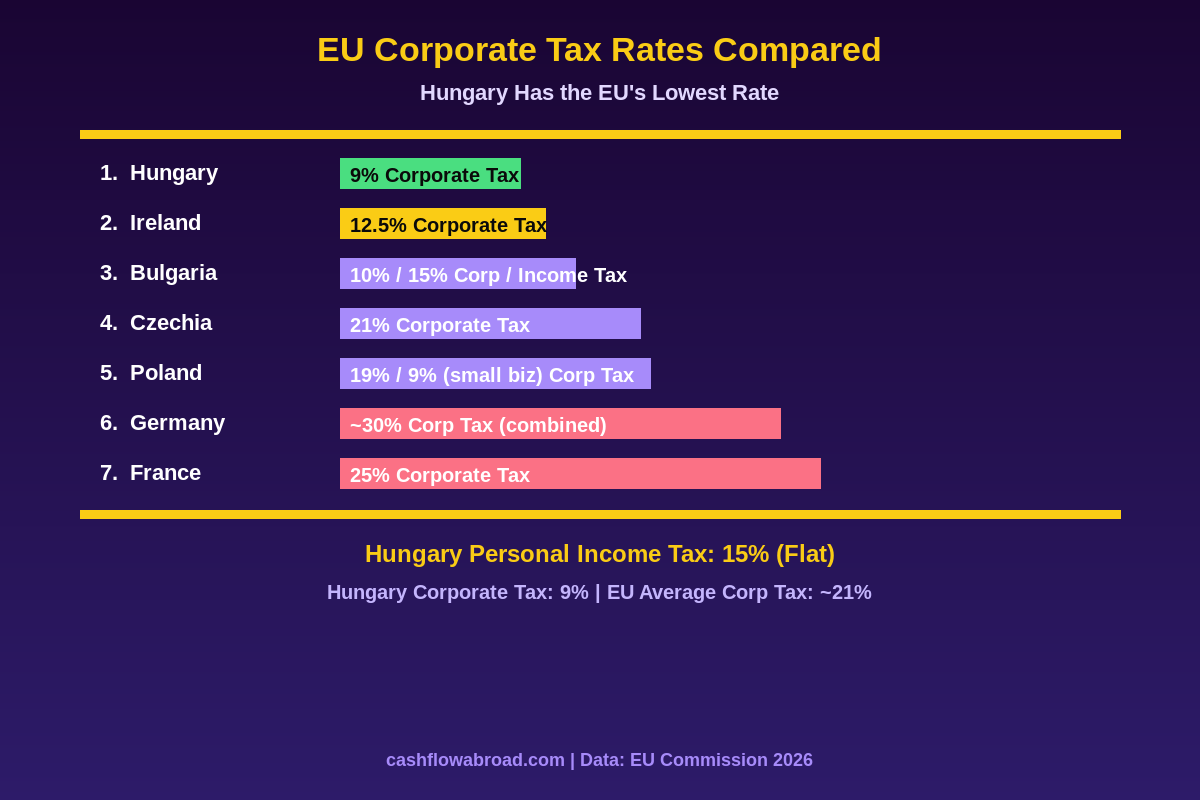
The corporate side is even more striking. At 9%, Hungary’s corporate tax rate is the lowest in the EU and lower than most jurisdictions globally that aren’t outright tax havens. For context:
- Ireland (the “low-tax EU country everyone knows”): 12.5%
- Bulgaria: 10%
- Poland: 19% standard, 9% for small businesses
- Germany: ~30% effective (combined federal + trade tax)
- France: 25%
- EU average: approximately 21%
If you’re running a foreign-owned Hungarian company — a Kft (the Hungarian LLC equivalent) — you’re paying 9% on profits. That’s before any FEIE or foreign tax credit considerations on the US side.
What This Means for US Expats (The Real Picture)
US citizens owe American taxes no matter where they live — that’s the baseline reality of citizenship-based taxation. But Hungary’s structure creates real opportunities to minimize the bill legally.
FEIE vs. Foreign Tax Credit in Hungary
If you qualify for the Foreign Earned Income Exclusion, you can exclude up to approximately $130,000 of foreign-earned income from US federal tax (2026 figures). Income excluded under FEIE can’t also claim a Foreign Tax Credit, so the math matters.
For income above the FEIE ceiling, Hungary’s 15% flat rate generates a tax credit you can apply against your US liability. Since the US top marginal rate is 37%, you’d still owe the difference — but 15% Hungarian tax plus roughly 22% additional US tax beats a 37% flat US rate with no offset. The FEIE vs. Foreign Tax Credit calculation is worth running with a tax professional before you move, because the right choice depends heavily on your income type and amount.
Passive income — dividends, capital gains, rental income from outside Hungary — follows different rules. Hungary taxes it at 15%, and the US-Hungary tax treaty (signed 1979, last updated 2010) determines how double-taxation relief applies to each income category.
FBAR and FATCA Still Apply
Opening a Hungarian bank account triggers US reporting obligations if your aggregate foreign accounts ever exceed $10,000 on any day during the year (FBAR, FinCEN Form 114). FATCA Form 8938 kicks in at $200,000 for single filers living abroad at year-end. These aren’t optional — penalties for willful non-filing reach the greater of $165,353 or 50% of the account balance per violation.
Hungary doesn’t offer banking secrecy. Hungarian financial institutions report US account holders to the IRS under FATCA. What Hungary offers is legitimate tax reduction, not concealment — a meaningful distinction.
The White Card: Hungary’s Digital Nomad Visa
Hungary launched its digital nomad residence permit — officially called the White Card — to capture remote workers and freelancers looking for a European base. The requirements are straightforward but specific:
| Requirement | Detail |
|---|---|
| Minimum monthly income | €3,000 (verified via 6 months of bank statements or employment contract) |
| Minimum savings | €10,000 in accessible funds |
| Employer location | Must be outside Hungary — no income from Hungarian sources |
| Employment type | Contract must explicitly permit remote work |
| Validity | 1 year, renewable once (2 years max per application cycle) |
| After 2 years | Must exit Hungary and reapply from scratch |
The €3,000/month income threshold is roughly 3x Hungary’s average wage, which means the government isn’t targeting budget travelers — they want remote professionals with stable income who’ll spend money locally without competing for Hungarian jobs.
The two-year cap with a required exit is the most significant limitation. If you’re looking for a permanent European base, the White Card isn’t it. It’s a two-year window — useful for testing Hungary before committing to a longer residency path.
Paths to Long-Term Residency
After living in Hungary for 5 years continuously with valid residence permits, you can apply for long-term EU residence status. That opens doors to living and working across the EU without new visas.
Hungary also relaunched a Golden Visa program in 2024. The minimum is €500,000 invested in an accredited Hungarian real estate investment fund — not direct property. In return, you get a 10-year renewable residence permit. The fund structure avoids the direct property speculation concerns that killed Portugal’s original Golden Visa, but the threshold limits it to serious capital allocators.
Budapest Cost of Living: The Numbers
Tax efficiency means nothing if the cost of living negates the savings. Budapest works in your favor here. A comfortable single-person budget in 2026 runs €1,800–2,500 per month, including rent. That’s roughly what you’d pay for rent alone in New York, London, or Amsterdam.
| Expense | Monthly Cost (EUR) |
|---|---|
| 1-bedroom apartment, city center | €550–750 |
| 1-bedroom apartment, outer districts | €400–500 |
| 3-bedroom apartment, city center | €900–1,300 |
| Groceries (single person) | €200–380 |
| Utilities (electricity, water, heat) | €100–150 |
| Monthly public transport pass | €25 |
| Gym membership | €25–45 |
| Mid-range restaurant, two people | €45–55 |
| Private health insurance | €80–150 |
That transport number deserves emphasis. A monthly unlimited pass on Budapest’s metro, tram, and bus network costs about €25. Compare that to London’s Oyster card at £135/month, New York’s MetroCard at $132/month, or Paris at €86/month. Budapest’s public transit is comprehensive, reliable, and priced for locals.
Rental costs have climbed over the past three years — Budapest is no longer the bargain it was in 2019. But it’s still dramatically cheaper than Western European capitals, and you get a city with serious cultural infrastructure: thermal baths, a vibrant restaurant scene, excellent architecture, and a central location that makes weekend travel across Europe trivially easy.

Banking and Money in Hungary
Hungary uses the Hungarian Forint (HUF), not the euro — this surprises some expats who assume all EU countries share a single currency. Currency conversion is an ongoing cost to factor in, especially if your income comes in dollars or euros.
Opening a local bank account requires your residence permit, passport, and proof of address. OTP Bank, K&H, and Erste Bank all serve expats, though English-language service varies by branch. For day-to-day spending and FX, fintech accounts work well. For USD-to-HUF transfers, Remitly offers transparent fee structures and competitive rates.
Don’t close your US bank accounts when you move. Maintaining a US address and US banking infrastructure is critical for IRS correspondence, credit history, and financial flexibility. A Traveling Mailbox gives you a real US street address in 50+ cities with mail scanning and check deposit capability for $15/month — the infrastructure that keeps your US financial life intact while you’re based in Budapest. For more on this, see our guide on virtual mailboxes for expats.
For US expat banking, Mercury works well for business banking. Charles Schwab’s international checking account reimburses ATM fees globally — genuinely useful when pulling HUF from Budapest ATMs.
Health Insurance for Expats in Hungary
White Card holders can opt into Hungary’s national health insurance system (NEAK) by paying voluntary contributions — roughly €150–200/month. Coverage includes hospital care, GP visits, and specialist referrals. English-speaking doctors are more concentrated in private clinics, particularly in Budapest.
For the first year or two, private international health insurance is typically easier to navigate than the public system. SafetyWing Nomad Insurance starts at around $56/month for Americans under 39, with global coverage and reasonable deductibles — a practical holding pattern while you get established. Our full Expat Health Insurance Guide covers the major options in detail.
Running a Company from Hungary
The 9% rate applies to Hungarian Kft (Korlátolt Felelősségű Társaság), Hungary’s LLC equivalent. Minimum share capital is HUF 3 million (roughly €8,000). Setup through a local attorney runs €1,000–2,000 in fees and takes 2–4 weeks.
The critical US complication: if you’re a US person and you own a Hungarian company that qualifies as a Controlled Foreign Corporation (CFC), you face Subpart F income rules and potentially GILTI (Global Intangible Low-Taxed Income) taxes. GILTI imposes a minimum US tax on foreign corporate profits — often eliminating the benefit of a 9% foreign corporate rate. The math isn’t impossible, but you need a US international tax attorney involved before incorporating, not after. Our Expat Investing Playbook covers how anti-deferral rules affect offshore structures.
Non-US nationals — those who’ve renounced US citizenship or hold another passport — face none of these complications. For them, a Hungarian Kft at 9% is a straightforwardly efficient structure.
Hungary vs. the Alternatives
| Country | Income Tax | Corp Tax | EU/Schengen | DN Visa | Monthly Budget |
|---|---|---|---|---|---|
| Hungary | 15% flat | 9% | Yes | White Card (€3k/mo) | €1,800–2,500 |
| Bulgaria | 10% flat | 10% | Yes (Schengen 2024) | No official | €1,200–1,800 |
| Portugal (NHR) | 20% flat (restricted) | 21% | Yes | D8 Visa | €2,500–3,500 |
| Georgia | 1% (small biz) | 15% (distributed) | No | Visa-free 365d | €1,000–1,800 |
| Albania | 15% flat | 15% | No (candidate) | No official | €900–1,500 |
Bulgaria beats Hungary on personal income tax (10% vs 15%) and raw cost of living, but Sofia doesn’t have Budapest’s infrastructure. Georgia’s 1% small business rate is impossible to beat on paper, but puts you outside the EU and Schengen zone. Portugal’s NHR is increasingly restricted and costs significantly more. Hungary hits a specific sweet spot: EU access, reasonable taxes, world-class city, manageable cost of living.
The Realities Nobody Mentions
Political climate. Hungary under Viktor Orbán has had significant friction with EU institutions over rule-of-law concerns, freezing some EU funding. For most expats this is background noise; for businesses depending on EU grants or operating in regulated sectors, it warrants attention.
Language barrier. Hungarian is one of the most difficult languages for English speakers to learn. Budapest daily life is very manageable in English, but navigating bureaucracy or contracts without local help creates real friction.
White Card renewal cliff. The two-year cap is a genuine planning constraint. If you want long-term EU residency through Hungary, you need a different permit category — typically self-employment or investor route — before month 24. Plan for this from day one.
Currency risk. HUF has been volatile against the dollar and euro. A weakening forint benefits dollar earners; a strengthening one erodes purchasing power. Factor exchange rate volatility into your budget modeling.
Practical First Steps
- Consult a US international tax attorney on your business structure, FEIE eligibility, and GILTI exposure before spending anything on a move.
- Set up US infrastructure: virtual mailbox, keep US bank accounts open, ensure IRS correspondence address is covered.
- Visit first. A 2–3 week exploratory trip to Budapest lets you assess neighborhoods, coworking spaces, and the expat community before committing.
- Engage a local Hungarian attorney for the White Card application. Budget €500–1,000 for this; it dramatically reduces bureaucratic friction.
- Open a local bank account. Most Hungarian banks require in-person visits with original documents. Budget several weeks after arrival — it’s rarely same-day.
For the full picture on managing US taxes while living abroad, our US Expat Banking & Taxes Guide covers everything from FEIE to FBAR to maintaining your US financial infrastructure from overseas.
Bottom Line
Hungary isn’t the flashiest expat destination. It doesn’t have Dubai’s zero-tax headline or Portugal’s brand recognition. What it has is the EU’s lowest corporate tax, a flat personal income tax competitive with the best rates in Europe, Schengen access, and a genuinely excellent capital city at a fraction of Western European prices. For US expats running location-independent businesses or freelancing above the FEIE ceiling, it’s a legitimate option that most people haven’t seriously evaluated. That information gap, for now, is your advantage.
Disclaimer: This article is for informational purposes only and does not constitute tax, legal, or financial advice. US tax law is complex and individual circumstances vary. Always consult a qualified US international tax professional and a licensed attorney in your target country before making residency, tax, or business structure decisions. Tax laws change — verify all figures with current official sources before acting.
Liked this article?
Get the next one delivered straight to your inbox — plus a free Expat Tax Cheat Sheet.
Join our subscribers. No spam — just expat finance intel and new post notifications.