Portugal NHR Is Dead: Who Still Gets the 20% Tax Rate
9 min read · 2,154 words
Portugal’s Non-Habitual Resident tax regime was so good that the European Commission essentially complained about it. By 2023, roughly 74,000 people held NHR status — including tens of thousands of French, German, and American expats who had structured their finances around Portugal’s 10% flat tax on foreign pensions and 20% flat rate on Portuguese employment income. Then, on January 1, 2024, the government closed the door.
What replaced it — IFICI, or the Incentivo Fiscal à Investigação Científica e Inovação — keeps some of the benefits but strips out most of what made NHR so broadly appealing. If you’re a retiree, a general freelancer, or a digital nomad who works remotely for a non-Portuguese company, the new regime offers you almost nothing. But if you’re a tech professional, STEM researcher, PhD holder, or executive at a qualifying Portuguese export company, IFICI still represents one of the most favorable tax positions in the EU — potentially saving you €190,000 or more over a decade.
Here’s exactly what changed, who still qualifies, and whether Portugal’s tax deal is still worth building your life around.
What NHR Was (And Why the Government Killed It)
The Non-Habitual Resident regime launched in 2009 as a tool to attract foreign capital and skilled workers. At its peak, it offered:
- 20% flat tax on Portuguese-sourced employment income from “high-value” professions
- 10% flat tax on foreign pension income (added in 2020)
- Exemption on most foreign-sourced passive income — dividends, interest, capital gains, rental income
- 10-year duration, non-renewable
The pension benefit is what really drove the migration wave. French retirees — who would otherwise pay up to 45% under France’s progressive system — poured into Lisbon and the Algarve. German pensioners followed. American expats on Social Security and investment income discovered they could live in one of Western Europe’s most livable cities for a fraction of Northern European tax costs.
By 2023, the regime was costing Portugal an estimated €1.7 billion per year in foregone tax revenue. France lobbied hard, the EU flagged Portugal for harmful tax competition, and a new Socialist government found the political cover to kill it. The final NHR applications were accepted for those who established Portuguese residency by December 31, 2023. That window is permanently closed.
IFICI Explained: The Same Rate, A Fraction of the Eligibility
IFICI launched January 1, 2024 and was formally regulated by Ordinance n. 352/2024/1, which came into force on December 24, 2024 — with retroactive effect to the start of the year. The core benefit is familiar: a 20% flat income tax rate for 10 consecutive years. But the eligibility criteria are dramatically narrower.
To understand what changed, here’s the standard Portuguese progressive tax scale you’d face without IFICI:
| Annual Income (EUR) | Standard Rate |
|---|---|
| Up to €7,703 | 13.25% |
| €7,703 – €11,623 | 18% |
| €11,623 – €21,321 | 23–26% |
| €21,321 – €39,791 | 32.75–37% |
| €39,791 – €81,199 | 43.5–45% |
| Above €81,199 | 48% + solidarity surcharges (up to 53%) |
At an income of €80,000, you’d owe roughly €35,000–€38,000 in standard income tax. Under IFICI, you’d owe €16,000. That’s a real-money difference of €19,000–€22,000 per year — or €190,000–€220,000 over the 10-year benefit window.
Who Actually Qualifies for IFICI
IFICI has a two-part qualification test: you need to meet the credential requirements and you need to work for a qualifying employer. Meeting one without the other is not enough.
Credential Requirements
You must have one of the following:
- A bachelor’s degree (EQF Level 6) plus at least 3 years of relevant professional experience in the field
- A PhD or doctorate (EQF Level 8) — no experience requirement
There is no provision for people with strong industry backgrounds but informal credentials, or for those who are self-taught professionals. The bar is explicitly academic.
Qualifying Employer Categories
Even with the right credentials, your employer must fall into one of these buckets:
- Export companies — must derive at least 50% of annual turnover from exports (in the current or either of the two prior years). Your role must be “highly qualified” — engineers, senior developers, data scientists, managers.
- Certified startups — companies certified under Portugal’s Startup Law (Law 21/2023) by Startup Portugal
- RFAI-eligible companies — firms with approved tax credits under Portugal’s investment incentive regime
- R&D entities under SIFIDE — companies with approved R&D tax credits
- Higher education institutions and national scientific research centers
- “Relevant economy” companies — holding companies, engineering firms, fund managers in designated sectors
The export threshold is the most relevant for tech workers. Portuguese software and IT services companies (classified under CAE 62) frequently qualify — Portugal’s tech sector is heavily export-oriented, with hundreds of SaaS companies generating 50%+ of revenue from outside Portugal.
Eligible Professions
The ordinance lists specific professional categories that qualify, including:
- University professors and scientific researchers
- Physicians and healthcare specialists
- Engineers and physical/mathematical scientists
- ICT professionals and software developers
- Industrial designers and product engineers
- Senior executives and general managers at qualifying firms
- Biotechnologists and life sciences researchers
Notably absent: marketing consultants, designers, writers, legal professionals (unless in highly specialized research roles), and most service-sector freelancers.
The Pension Disaster: What Retirees Lost
This is the single biggest change — and it upended the plans of thousands of people who had been targeting Portugal specifically because of the 10% pension rate.
Under old NHR, foreign pension income (including US Social Security, 401(k) distributions, private pensions, and UK/German state pensions) was taxed at a flat 10% in Portugal. Under IFICI, pensions are not eligible for any special rate. They’re taxed at the standard progressive scale — potentially 48–53% at higher income levels.
For a retired American drawing $60,000 per year from a pension and IRA, the difference between 10% and 48% is $22,800 annually. Over 10 years: $228,000. The math no longer works for retirees who structured their finances around the NHR pension benefit.
Portugal offers no alternative special rate for retirees. The D7 Passive Income Visa — which requires €760/month in documented passive income — gets you legal residency but no favorable tax treatment. If you’re a retiree looking for favorable European tax treatment, there are still options worth exploring, but Portugal under IFICI isn’t leading that conversation anymore.
The Digital Nomad Problem
Portugal launched a specific Digital Nomad Visa in 2022 targeting remote workers. It requires income of at least €3,480/month (4x Portugal’s minimum wage) and allows you to legally live and work in Portugal while employed by a foreign company.
The catch: working remotely for a foreign employer almost certainly does not qualify you for IFICI. Your foreign employer isn’t a Portuguese export company, isn’t a certified Portuguese startup, and isn’t on any of the other qualifying entity lists. So you’d get residency — and full progressive taxation.

There is one partial workaround: if you restructure as a freelancer and provide services to a qualifying Portuguese employer (e.g., a startup or export-oriented tech company contracts you), you may qualify. But this requires more than just “I have clients in Portugal” — the employer must genuinely meet the IFICI criteria, and you’d need to confirm your professional category qualifies. Get a Portuguese tax attorney before attempting this structure.
For digital nomads who want genuine tax optimization in Europe, other geographic arbitrage plays currently offer better terms. Georgia’s 1% flat business tax is dramatically simpler for most remote workers. Colombia’s digital nomad visa is another low-friction option in a country with sub-$2,000/month living costs.
How to Apply for IFICI
For those who qualify, here’s the process:
- Secure Portuguese residency: You need a valid visa or residence permit first — D3 (Highly Qualified Activity Visa), Digital Nomad Visa, Golden Visa, or EU freedom of movement.
- Get a NIF (tax ID number): Done in-person at a Finanças office or remotely via a fiscal representative. Takes 1–2 weeks.
- Establish tax residency: Requires 183+ days in Portugal per year, or maintaining a habitual residence (primary address) there.
- Gather documentation: Degree certificate, employment contract with a qualifying employer, proof of employer’s export certification, proof of not having been Portuguese tax resident in the prior 5 years.
- Submit via Portal das Finanças: Must be filed by January 15 of the year following when you established tax residency.
- Await Tax Authority approval: Typically 4–6 weeks. If approved, the 10-year clock starts from the first year of residency.
Professional advisory costs for the application typically run €1,000–€3,000 depending on complexity. Given that the employer certification requirements are easy to misread, hiring a local specialist is worth it.
IFICI vs. NHR: Full Side-by-Side
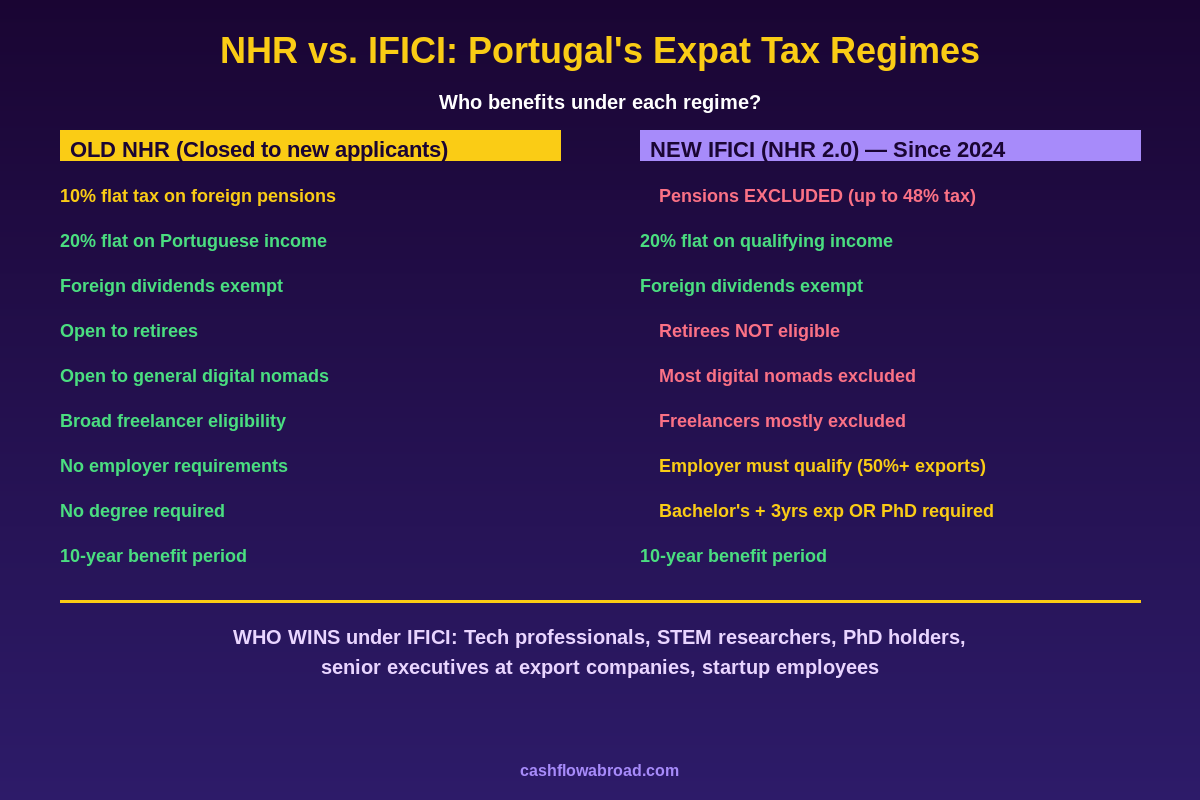
| Feature | Old NHR | New IFICI |
|---|---|---|
| Portuguese employment income | 20% flat | 20% flat (qualifying roles only) |
| Foreign pension income | 10% flat | Standard progressive (up to 53%) |
| Foreign dividends/interest | Exempt | Exempt (with progression caveat) |
| Foreign capital gains | Exempt | Exempt (with progression caveat) |
| Retirees eligible? | Yes | No |
| Digital nomads eligible? | Yes | Rarely (only if employer qualifies) |
| General freelancers eligible? | Yes | No |
| Degree requirement? | No | Bachelor’s + 3yrs exp, or PhD |
| Employer requirement? | None | Must qualify (export/startup/R&D) |
| Benefit duration | 10 years | 10 years |
| Still open to new applicants? | No (closed Jan 2024) | Yes |
The Cost of Living Math Still Works
Even setting aside the tax benefit, Portugal remains one of Western Europe’s most cost-effective countries for educated professionals. A single person living comfortably in Lisbon spends €1,200–€1,800/month including rent. Porto runs €1,000–€1,400/month. Outside major cities, €900–€1,200 is achievable.
Compared to where most qualifying IFICI candidates come from:
- Portugal is roughly 39% cheaper than the UK
- 45% cheaper than Germany
- 55% cheaper than France
For a software engineer earning €80,000 at a Lisbon SaaS company, the IFICI tax savings (€19,000–€22,000/year vs. standard rates) combined with a significantly lower cost of living adds up to a real economic advantage over Northern European tech hubs. Over 10 years, that combined differential can easily exceed €300,000 compared to staying in London or Munich.
You’ll want solid health insurance while building out your life in Portugal. SafetyWing offers expat health plans starting around $45/month that cover you across Portugal and internationally — practical during the first year before you establish local coverage. And if you’re a US citizen maintaining stateside ties, a Traveling Mailbox gives you a real US street address for IRS filings, banking, and state domicile purposes — essential if you’re still filing FBAR or maintaining a US brokerage account.
US Expats: What IFICI Means for Your IRS Obligations
IFICI changes how Portugal taxes you. It doesn’t change your US filing obligations. As a US citizen or green card holder, you still file a US return annually, still report global income, and still need to weigh the Foreign Earned Income Exclusion against the Foreign Tax Credit. See our full guide on zeroing out your US federal tax bill legally for how these interact.
Portugal and the US have a tax treaty, and Portugal is not on the US blacklisted-jurisdiction list. This means income flowing through Portugal generally doesn’t trigger extra IRS scrutiny. But the combination of IFICI’s 20% rate and the US Foreign Tax Credit math requires careful planning — at some income levels, you’ll want to use the FTC rather than FEIE to avoid double taxation. The full FBAR/FATCA/FEIE guide covers the framework for how to think about this.
Who Should Still Seriously Consider Portugal
Despite the NHR closure, there is still a well-defined cohort for whom Portugal under IFICI makes strong financial sense:
- Software engineers and tech professionals with a bachelor’s degree and 3+ years experience, who can get hired by a Portuguese tech company with 50%+ export revenue — genuinely common in Lisbon’s growing startup ecosystem
- PhD holders in any qualifying field, especially if joining a university or R&D institute
- Senior executives at international companies establishing Portuguese operations
- Biotech and life sciences professionals, particularly in clinical research or pharmaceutical R&D
- Startup founders who can get their company certified under Portugal’s Startup Law
If you don’t fit these categories, Portugal is still a phenomenal place to live — just not a tax optimization play anymore. The Digital Nomad Visa gets you residency, the lifestyle is exceptional, and the cost of living beats most of Western Europe. But you’d be optimizing for quality of life over tax efficiency, which is a different calculation than the old NHR regime offered.
Conclusion
Portugal’s IFICI regime isn’t NHR. It’s a substantially narrower benefit designed for a specific cohort — STEM professionals, tech workers, researchers, and executives at export-oriented or startup companies. For that group, the 20% flat tax for 10 years plus Portugal’s lower cost of living still adds up to a compelling financial case. For retirees, digital nomads, and general freelancers, the math largely evaporated when NHR closed.
The broader lesson is one that runs through all expat tax planning: regimes that are broadly attractive tend to get closed or restricted. The countries most willing to offer favorable treatment to incoming foreigners are usually the ones that need the economic activity — which is why understanding multiple geographic arbitrage options matters more than betting everything on a single country’s regime. Portugal tried to have it both ways within the EU, and the EU pushed back. IFICI is what remains when you strip out the parts that caused political friction.
If you’re actively considering Portugal, get a local tax advisor who specializes in IFICI applications. The employer certification requirement in particular is easy to get wrong, and a rejected application means you’re in the standard system from day one.
Financial Disclaimer: This article is for informational purposes only and does not constitute tax, legal, or financial advice. Tax laws change frequently, and individual circumstances vary. Always consult a qualified tax professional familiar with both Portuguese and your home country’s tax law before making relocation or tax planning decisions. The author is not a licensed tax advisor.
Liked this article?
Get the next one delivered straight to your inbox — plus a free Expat Tax Cheat Sheet.
Join our subscribers. No spam — just expat finance intel and new post notifications.