
Estonia e-Residency: Build an EU Company From Anywhere
9 min read · 2,125 words
Here’s a number that should stop you mid-scroll: Estonia collected nearly €125 million in direct tax revenue in 2025 from companies founded by people who don’t live there, have never lived there, and aren’t Estonian citizens. A record 5,556 new businesses were registered that year — 15% more than 2024 — by entrepreneurs sitting in Bali, Bogotá, and Bangkok.
That’s the quiet revolution behind Estonia’s e-Residency program. Since launching in 2014, it has attracted more than 135,000 people from 185 countries who collectively own 39,000+ Estonian companies. The pitch is simple: get a government-issued digital ID, open a private limited company (OÜ) fully online, and run an EU-registered business from anywhere on earth. No flights to Tallinn required.
But here’s what the glossy brochure skips: e-Residency is not residency. It won’t cut your tax bill by itself. And for US citizens, it barely moves the needle on IRS obligations. This guide covers what it actually does — and whether it’s worth the €415 to find out.
What Estonia e-Residency Actually Is
e-Residency is a digital identity card issued by the Estonian government. It lets you:
- Sign documents with a legally valid EU digital signature
- Register and manage an Estonian private limited company (OÜ) entirely online
- File taxes and submit annual reports through Estonia’s e-government portal
- Access Estonian e-services and open certain fintech/business bank accounts
What it does not give you:
- The right to live in Estonia or enter the EU
- Estonian tax residency
- Exemption from your home country’s taxes
- A travel document or immigration status of any kind
The digital ID card is essentially a cryptographic key to Estonia’s digital state. It’s remarkable technology — Estonia has built one of the world’s most advanced digital governments, with 99% of public services available online, e-voting since 2005, and blockchain-secured medical records. But the card itself is a means to an end, not the end.
Who This Actually Makes Sense For
The ideal e-resident is a location-independent entrepreneur who:
- Needs EU credibility for clients — invoicing German SaaS buyers or UK agencies as an “Estonian OÜ” carries weight
- Sells to EU customers and wants to be VAT-compliant within the single market
- Is already a tax resident somewhere favorable and just needs a clean EU corporate wrapper
- Is a non-US freelancer or consultant who wants to defer dividends and reinvest profit tax-free at the company level
The program’s largest user groups by nationality include Finns, Germans, Ukrainians, Indians, and Americans. For non-US citizens especially, the Estonian tax structure offers a genuinely unusual advantage worth understanding in detail.
The Tax System: Why 0% Becomes 24%
Estonia has one of the most unusual corporate tax systems in the OECD. An Estonian OÜ pays zero corporate income tax on retained earnings. The tax clock only starts when you distribute profits as dividends.
From January 2026, the dividend tax rate increased to 24% (up from 22%). There’s also a temporary 2% additional surcharge on company profits through 2028. The practical result: you pay 24% on what you take out, and 0% on what stays in the company.
For someone building a service business with healthy margins, this defer-and-compound structure is legitimately powerful — as long as you don’t need to extract all earnings each year. A SaaS founder reinvesting €60,000 of profit into growth pays zero Estonian corporate tax that year. Extract €30,000? That €30,000 gets taxed at 24%.
| Scenario | Revenue | Expenses | Profit | Dividend Taken | Estonian Corporate Tax |
|---|---|---|---|---|---|
| Reinvest everything | €120,000 | €40,000 | €80,000 | €0 | €0 |
| Extract half | €120,000 | €40,000 | €80,000 | €40,000 | €9,600 |
| Extract all profit | €120,000 | €40,000 | €80,000 | €80,000 | €19,200 |
Note: Personal income tax in your country of tax residency may apply when you receive dividends. Estonia has tax treaties with many countries — but coverage varies. Confirm with a local tax advisor.
How to Apply: The Full Process
The application takes about 20 minutes online. Physical card pickup takes longer depending on where you live.
- Apply at e-resident.gov.ee. Fill in basic personal info, a passport scan, digital photo, and a motivation statement explaining your business purpose. State fee: €150.
- Background check. Estonian Police and Border Guard review your application — typically 2–8 weeks. Applications from sanctioned countries or applicants with criminal records are commonly declined.
- Pick up your card. Collect the physical digital ID kit (smart card + card reader) from an Estonian embassy, consulate, or designated pickup point. This is the one in-person step — there is no remote delivery option. Card is valid for 5 years.
- Register your company. Log in to Estonia’s Business Register (ariregister.rik.ee) using your e-Residency card. Set up an OÜ in 1–3 business days. Company registration fee: €265. Minimum share capital: €0.01 per shareholder.
- Set up banking and accounting. The part most guides skip — covered below.
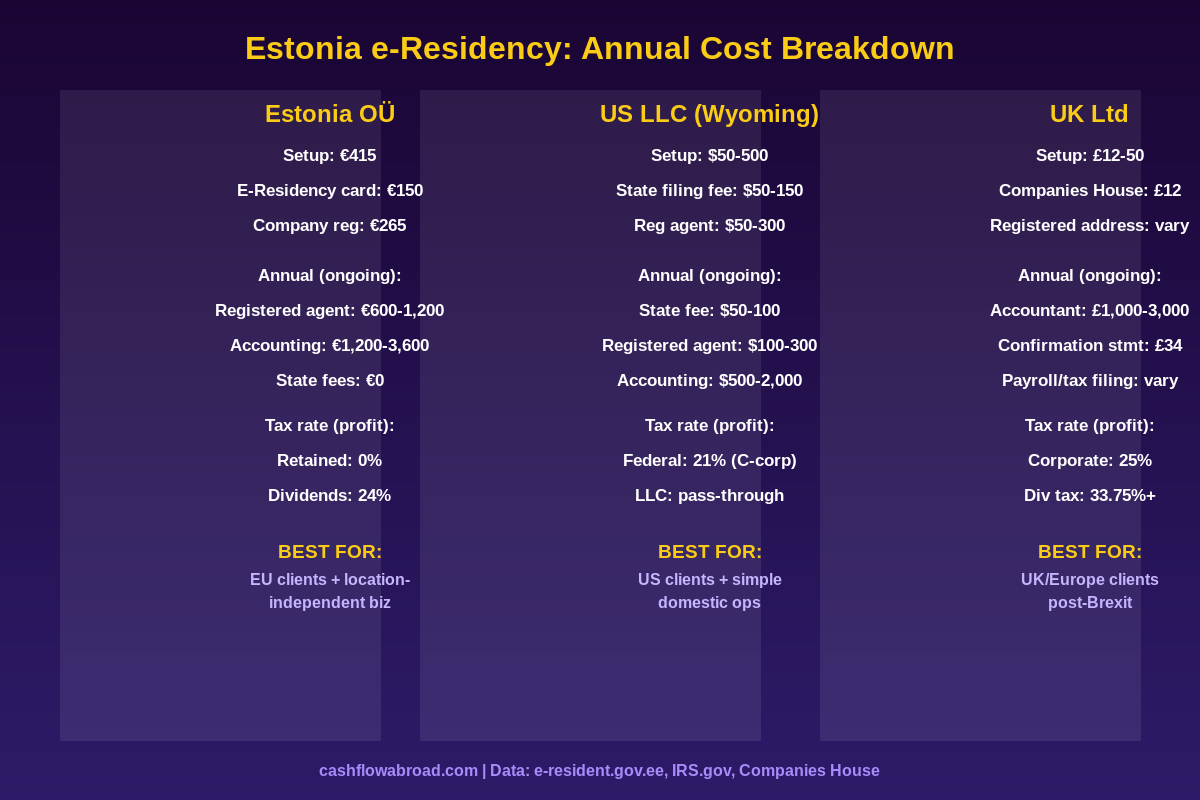
The True Annual Cost (What Nobody Advertises)
The €150 application fee plus €265 registration gets you through the door. The ongoing costs are where the math gets real — and why e-Residency only makes financial sense above a certain revenue threshold.
| Cost Item | Annual Range | Notes |
|---|---|---|
| e-Residency card renewal (every 5 yrs) | ~€30/year equiv. | €150 every 5 years |
| Registered address / contact person | €600–€1,200 | Legally required for all OÜs |
| Accounting & annual report filing | €1,200–€3,600 | Depends on transaction volume |
| Business bank account (fintech) | €0–€300 | Varies by provider |
| VAT registration (if applicable) | €0–€500 | Required if EU revenue exceeds €40,000 |
| Total ongoing (low end) | ~€1,830/year | |
| Total ongoing (high end) | ~€5,600/year |
The registered contact person requirement trips people up. You can’t list your own address — you don’t live in Estonia. You must use a licensed service provider. Popular options include Xolo, Leapin, 1Office, and Unicount — all offering bundled packages of registered address + accounting. Budget at least €150/month for a properly run setup.
The hard-nosed bottom line: Estonian e-Residency makes financial sense at €30,000–€50,000+ in annual revenue from EU clients. Below that, overhead consumes too much of your margin. If you’re a freelancer billing $2,000/month in US dollars to US clients, a Wyoming LLC and a Mercury account is cheaper and simpler.
Banking: The Part Most Guides Skip
Opening a traditional Estonian bank account as an e-resident has become genuinely difficult. LHV Bank — historically the main bank serving e-residents — has tightened KYC significantly. They want to see a real economic connection to Estonia, which most remote founders don’t have. Applications from US citizens face an additional layer of compliance friction due to FATCA reporting obligations.
The practical workaround: use EEA-licensed fintech accounts. Most e-resident businesses operate through Revolut Business, Wise Business, or Payoneer — all of which accept Estonian OÜ companies. These support IBAN transfers, multi-currency accounts, and card payments for day-to-day operations.
For US founders running parallel US-side operations, Mercury remains the gold standard for US business banking — zero fees, no minimum balance, clean international wire support, and startup-friendly underwriting. An Estonian OÜ paired with a Mercury USD account is a common stack for founders serving both US and EU clients.
The US Citizen Reality Check
Read this section twice if you hold a US passport.
The United States taxes its citizens on global income regardless of where they live — and regardless of where their company is incorporated. Registering in Estonia does not change your IRS obligations.
Key issues for Americans considering e-Residency:
- FBAR & FATCA: If your Estonian or fintech business account exceeds $10,000 at any point during the year, you must file an FBAR. Accounts above $50,000 (or $200,000 for filers abroad) trigger FATCA reporting on Form 8938. See the complete US expat banking and tax guide for details.
- Controlled Foreign Corporation (CFC): Own more than 50% of a foreign corporation — which you will if it’s your OÜ — and the IRS classifies it as a CFC. This triggers additional reporting requirements (Form 5471) and can pull certain income into US taxation even before dividends are distributed.
- GILTI: Global Intangible Low-Taxed Income rules can tax retained earnings in your Estonian company at US rates. This potentially eliminates the 0%-on-retained-profits advantage entirely — the exact benefit Estonia is marketed on.
- Self-employment tax: If your OÜ pays you a salary, you likely owe US self-employment tax (15.3% on the first ~$168,600 of net earnings in 2026).
This doesn’t make e-Residency useless for Americans — it means the structure needs proper legal and tax architecture. The EU credibility and deferred-profit structure can still add value, but the GILTI exposure is real and demands CPA guidance before your first distribution.
For US-based tax minimization strategies that actually move the needle for Americans, start with the FEIE deep dive. For running a US business entity from abroad rather than a foreign one, the framework in this guide on running a US business while living overseas is more relevant to most American founders. And if you’re operating internationally and need to maintain a legitimate US address for IRS correspondence, state domicile, and banking, a Traveling Mailbox virtual address ($15/month, real US street address, mail scanning, check deposits) keeps your US infrastructure intact without being physically present.

e-Residency vs. the Alternatives
| Structure | Setup Cost | Annual Overhead | EU Access | Best For |
|---|---|---|---|---|
| Estonian OÜ (e-Residency) | €415 | €1,800–€5,600 | Full | EU clients, VAT compliance, profit deferral |
| US LLC (Wyoming / New Mexico) | $50–$500 | $650–$2,400 | None | US clients, simple structure, pass-through tax |
| UK Ltd | £12–£100 | £1,000–£4,000 | Limited post-Brexit | UK clients, professional credibility |
| Georgia LLC | ~$200 | $500–$1,500 | None | 1% tax if qualifying small biz, low overhead |
| Hong Kong Ltd | ~$500 | $2,000–$6,000 | None | Asia-Pacific trade, territorial tax system |
For most non-EU entrepreneurs generating under €50,000 a year, a US LLC or home-country structure is cheaper and simpler. The Estonian OÜ earns its place when EU market access, VAT compliance, and profit deferral all matter at the same time.
Who Should Skip e-Residency
Don’t bother if:
- You earn under €30,000/year. Annual overhead will consume 6–18% of revenue before you pay yourself anything.
- All your clients are in the US. The EU credibility angle adds nothing. The IRS complexity isn’t worth it.
- You need a physical presence or local team. Estonia requires actual substance for corporate tax residency — a virtual address won’t satisfy a genuine tax audit.
- You want visa or immigration benefits. The card is not a travel document. It does not help you enter, live in, or work in Estonia or any EU country.
- You’re chasing a tax haven. Estonia taxes dividend distributions at 24%. Your home country’s rules stack on top of that. This is a deferral structure, not an avoidance one.
Getting Started the Right Way
If you decide to proceed, the strongest setup stack for a location-independent entrepreneur looks like this:
- Apply for e-Residency at e-resident.gov.ee — budget €150 and 4–8 weeks for processing.
- Choose a service provider bundle. Xolo, Unicount, or Leapin offer registered address + accounting + company formation as a package. Compare pricing against your expected transaction volume.
- Open an EEA fintech account. Revolut Business or Wise Business for the OÜ’s operating account — multi-currency EUR/GBP/USD under one roof.
- Protect your connections. Managing European financial accounts, e-government portals, and business registrations across multiple countries means accessing region-specific banking systems from changing locations. A reliable VPN like NordVPN prevents fraud flags and keeps your connections secure when you’re operating from cafés, co-working spaces, or hotel lobbies across time zones.
- Hire an international CPA. If you’re American, this is non-negotiable. CFC rules, GILTI exposure, FBAR/FATCA — professional guidance before your first dividend distribution is far cheaper than the penalty risk.
One practical note: the entire OÜ can be managed without ever returning to Estonia after your initial card pickup. You can run the company from anywhere. For digital nomads moving between countries, an eSIM like Saily covers 150+ countries without roaming charges — essential when you’re managing banking logins, tax filings, and client invoicing across multiple time zones on a single trip.
The Bottom Line
Estonia’s e-Residency is one of the most innovative government programs in the world, and the results back it up: 135,000 e-residents, 39,000+ companies, and €125 million in annual tax revenue prove real entrepreneurs are using it for real business.
For non-US digital entrepreneurs with EU-facing businesses generating €50,000+, it’s a legitimate and tax-efficient structure. The 0%-on-retained-profits system is genuinely unusual in the OECD, and operating a full EU company entirely online from anywhere on earth is a capability that didn’t exist before 2014.
For US citizens, it’s more of a credibility tool than a tax tool — useful if your clients want EU invoices, not a solution to your global tax obligations. Layer it carefully with a CPA, maintain your US compliance infrastructure, and don’t let elegant marketing convince you it does more than it actually does.
The €415 startup cost is low enough to experiment. The real question is whether €2,000–€5,000 in annual overhead fits your margin — and whether EU credibility is worth the price of entry for your specific business model.
For the broader framework on building an online business that runs from anywhere: How to Build a $100K/Year Online Business You Can Run from Anywhere.
Financial disclaimer: This post is for informational purposes only and does not constitute tax, legal, or financial advice. Tax rules are complex and vary by country, residency status, and individual circumstances. CFC, GILTI, and FBAR rules are particularly nuanced for US citizens with foreign corporate structures. Consult a qualified CPA or international tax attorney before making any decisions about corporate structure, tax residency, or international business formation. Information reflects conditions as of April 2026 and is subject to change.
Liked this article?
Get the next one delivered straight to your inbox — plus a free Expat Tax Cheat Sheet.
Join our subscribers. No spam — just expat finance intel and new post notifications.