Costa Rica Expat Guide: $2,100/Month, 0% Foreign Tax
Costa Rica taxes zero on foreign income. Live comfortably on $2,100/month, qualify with $1k/month SS. Complete expat visa, tax, and banking guide.
Costa Rica taxes zero on foreign income. Live on $2,100/month and qualify with $1k/month SS. Complete visa, tax, banking, and cost of living guide.
Disclosure: this article contains affiliate links. If you open an account through one of them, Cashflow Abroad may earn a referral commission at no extra cost to you.
American retirees living in Costa Rica pay an average of $2,100 a month — and their foreign income, Social Security, pension, or freelance earnings are completely untouched by the Costa Rican tax authority. Meanwhile, the median US household spending is $5,111 monthly. That gap is not a lifestyle downgrade. It's an upgrade to better weather, world-class private hospitals, and a healthcare system that ranks above the United States on multiple WHO metrics — at a fraction of the price.
Costa Rica is not Panama-lite or "Latin America for beginners." It's a stable democracy with no standing army since 1948, a literacy rate of 97%, and a government that has actively courted foreign residents for decades. It is also — and this is the part most expat guides bury in paragraph 11 — a territorial tax country. Foreign-source income is not taxed. Period.
The Tax Setup: Territorial + FEIE = Powerful Stack
Costa Rica taxes only income earned within Costa Rica. If your money comes from a US employer, remote clients, dividends from a US brokerage, Social Security, or a foreign pension, the Dirección General de Tributación — Costa Rica's IRS — wants nothing to do with it.
This creates an unusual stacking opportunity for US citizens. Costa Rica takes $0. The US takes less because you qualify for the Foreign Earned Income Exclusion, which lets you exclude up to $130,000 in earned foreign income in 2025 if you spend 330+ days outside the US. On top of that, foreign taxes paid can offset US liability dollar-for-dollar via the Foreign Tax Credit — but since Costa Rica isn't taxing you anyway, you're largely relying on the FEIE alone.
The result: many expats in Costa Rica earning under $130,000 annually in freelance, remote employment, or consulting income owe zero US federal income tax — legally, by design.
One caveat: self-employment tax (15.3%) still applies to US citizens who work remotely, unless you structure properly. See the expat investing playbook for how high earners handle this.
Four Legal Paths to Live Here
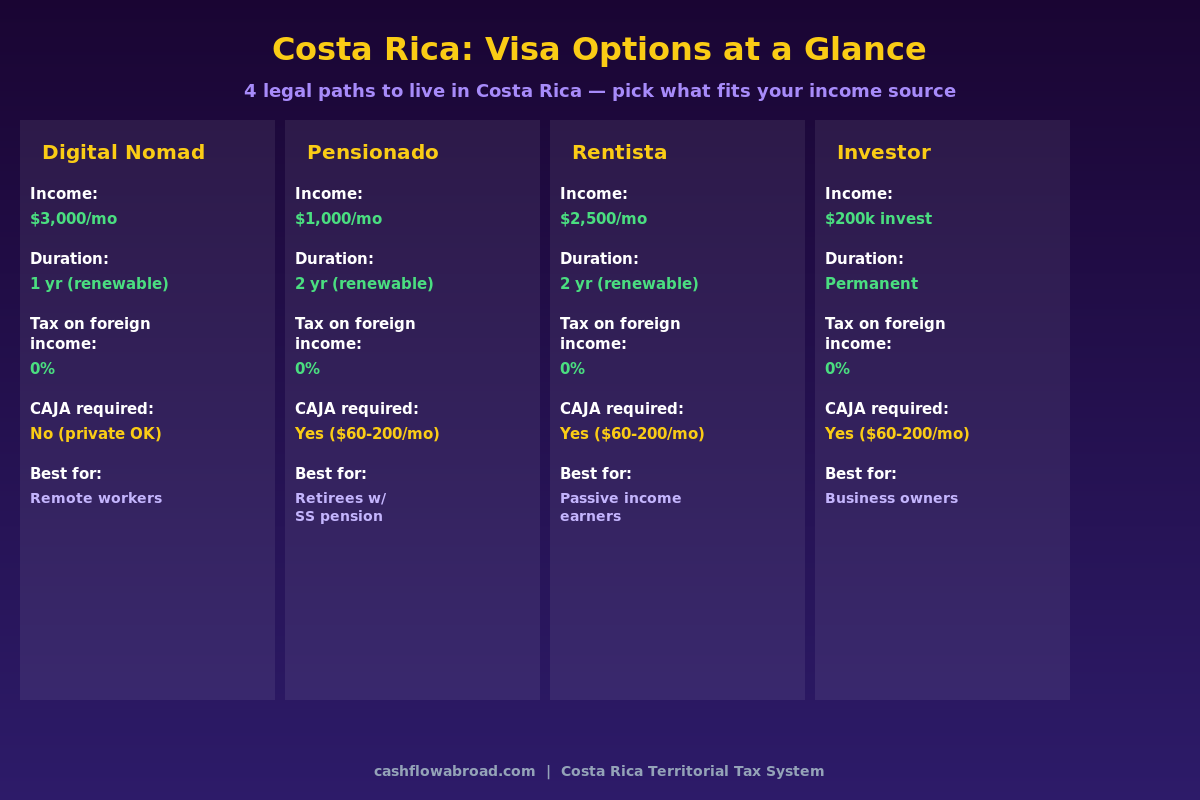
Costa Rica offers more residency options than almost any other country in the region. Here's how they break down:
| Visa Type | Min. Income / Asset | Duration | Work Permitted | CAJA Required |
|---|---|---|---|---|
| Digital Nomad | $3,000/month ($4,000 w/ dependents) | 1 year, renewable | Remote only (non-CR employers) | No — private insurance with $50k+ coverage required |
| Pensionado (Retiree) | $1,000/month lifetime pension | 2 years, renewable → permanent | No local employment | Yes — $60–$200/month |
| Rentista (Passive Income) | $2,500/month OR $60,000 CR bank deposit | 2 years, renewable | No local employment | Yes — $60–$200/month |
| Inversionista (Investor) | $200,000 invested in CR (real estate, business) | 2 years → permanent | Can operate invested business | Yes |
The Pensionado visa is the most popular among American retirees because Social Security qualifies as a lifetime pension. If you receive $1,000+ monthly in SS, you qualify — no savings minimum required. The application costs around $100 and processes in approximately 15 business days via Costa Rica's TramiteYa immigration portal.
Digital nomads who don't yet have permanent residency can stay on tourist visas (90 days per entry) while their applications process — a practical reality most applicants use.
What $2,100/Month Actually Gets You
The most honest number for a comfortable single-person expat budget in San José or the Central Valley — not roughing it, not splurging — is $1,600–$2,100/month. Here's where it goes:
| Category | Budget Option | Comfortable Option |
|---|---|---|
| Rent (1BR apartment, central area) | $550–$700 | $800–$1,100 |
| Groceries (local markets + supermarket) | $200–$250 | $300–$400 |
| Eating out (2–4x/week, local restaurants) | $100–$150 | $200–$300 |
| Transportation (bus + occasional Uber) | $50–$80 | $100–$150 |
| Utilities (electricity, water, internet) | $80–$120 | $120–$180 |
| Healthcare (CAJA or private insurance) | $60–$100 | $150–$350 |
| Entertainment, travel within CR | $100–$150 | $200–$300 |
| Total | $1,140–$1,550 | $1,870–$2,780 |
Escazú — the neighborhood most Americans gravitate toward, with its Whole Foods-style supermarkets, American chains, and English-speaking professionals — runs 15–20% above this. A two-bedroom apartment in Escazú with a pool and 24-hour security will cost $1,200–$1,800/month. Still roughly half of comparable US suburban housing costs.
Beach towns like Nosara, Tamarindo, and Santa Teresa are lifestyle premium zones. Budget $2,500–$3,500/month if you want oceanfront living with solid internet for remote work.
The dollar stretches further here because of what doesn't cost money: bus rides run $0.50–$1.50, local sodas (neighborhood restaurants) serve full meals for $4–$8, and fresh produce at ferias del agricultor (farmers' markets) costs a fraction of US supermarket prices.
Healthcare — The Real Reason Many Expats Never Leave
Costa Rica consistently outperforms the United States on life expectancy and ranks in the top 40 globally for healthcare quality. The dual-track system — public CAJA and private hospitals — is what makes it exceptional for expats.
CAJA (Caja Costarricense de Seguro Social) is the national public system. Once you're a permanent resident, enrollment is mandatory. The cost is 7–11% of your declared monthly income, which for most Pensionado or Rentista visa holders amounts to $60–$200/month. That buys everything: specialist visits, hospital stays, surgery, prescription drugs, and dental — with zero co-pays. Pre-existing conditions are covered from day one.
Private hospitals — CIMA in Escazú, Clínica Bíblica in San José, Hospital Metropolitano — are staffed by US- and European-trained physicians. A specialist visit costs $80–$120 out of pocket. A procedure that costs $30,000 in the US often runs $4,000–$8,000 at CIMA with no insurance at all.
Many expats carry both: CAJA for comprehensive coverage and a SafetyWing international policy (from $45/month) for emergency evacuation and fast private hospital access. Digital Nomad visa holders must show private health insurance with $50,000+ in coverage — SafetyWing satisfies this requirement for most applicants.
The math is jarring. A 55-year-old American paying $850/month for ACA marketplace coverage in the US can switch to CAJA at $100/month plus a private supplement at $200/month — and gain faster specialist access with no deductibles. For more on structuring expat health coverage, see the complete expat health insurance guide.

The Banking Stack That Actually Works Here
Costa Rica's local banks (Banco Nacional, Banco de Costa Rica, BAC Credomatic) open accounts for residents, but the process is bureaucratic and some branches require a cédula (residency ID) before accepting international wire deposits over $1,000/month. While you're working through residency, you run on US-side banking.
The go-to setup for most US expats in Costa Rica:
- Charles Schwab International Checking — reimburses all ATM fees worldwide with no limit. No foreign transaction fees. Daily ATM withdrawal limit of $1,000. This is the non-negotiable anchor of any expat banking stack in Costa Rica, where ATMs are plentiful but fees from local machines ($3–$7 per withdrawal) add up fast.
- Mercury — for freelancers and business owners who need a US business bank account that accepts international wires without triggering compliance flags.
- Local BAC Credomatic or Banco Nacional account — once you have residency. Required for CAJA payments, utility bills, and building a local credit history.
For transferring money from the US to Costa Rica, Remitly offers competitive USD-to-CRC exchange rates with transparent fees and delivery in minutes to major Costa Rican banks. Avoid airport kiosks and hotel exchange desks — spreads there can run 8–12% worse than interbank rate.
If you're maintaining US banking, brokerage accounts, or IRS correspondence while abroad, a Traveling Mailbox ($15/month) gives you a real US street address for financial institutions that won't accept PO boxes. This keeps your US banking relationships intact and gives the IRS a domestic address for correspondence — important for FEIE filers. See the full virtual mailbox expat guide for the setup sequence.
What the IRS Still Wants From You
Costa Rica's territorial tax system doesn't change your IRS obligations. As a US citizen, you file a US return regardless of where you live. Here's what applies in Costa Rica:
- FBAR (FinCEN 114): Required if your aggregate Costa Rican bank balances exceed $10,000 at any point during the year. The Rentista path (depositing $60,000 in a CR bank) immediately triggers this requirement. File by April 15, extendable to October 15.
- FATCA Form 8938: Required for single filers with $200,000+ in foreign financial assets at year-end. Many Costa Rica residents don't hit this threshold.
- FEIE (Form 2555): Excludes up to $130,000 in earned foreign income for 2025 if you pass the Physical Presence Test (330 days abroad in a 12-month period) or the Bona Fide Residence Test.
- Self-employment tax: Costa Rica has no totalization agreement with the United States. US freelancers and self-employed expats still owe 15.3% SE tax on net self-employment income regardless of where they live and work.
For the full filing mechanics — FEIE elections, the bona fide residence test, and how to avoid the state tax domicile trap — the US expat banking and taxes guide covers it in detail.
Who Costa Rica Is Actually For
Costa Rica works best for three types of American expats:
Early retirees (45–60) who want a lower cost of living without sacrificing healthcare quality or personal safety. The Pensionado visa's $1,000/month requirement is accessible for anyone receiving Social Security, and CAJA removes the biggest financial risk of early retirement in the US.
Remote workers earning $3,000–$10,000/month who want to cut their cost base while stacking the FEIE. Living on $2,100/month while earning $6,000/month remotely means you're saving or investing $3,900/month — capital that compounds faster than most US metro budgets allow. The geographic arbitrage playbook breaks down how this arithmetic plays out across 10 countries.
Geographic arbitrage planners who want a stable, English-friendly base with direct US flights (3.5 hours to Miami, 5 hours to New York) and a genuine pathway to permanent residency. Unlike some visa programs that dead-end, Costa Rica's Pensionado and Rentista visas convert to permanent residency after two consecutive renewals — and citizenship is available after 7 years of continuous legal residence.
Costa Rica is not ideal for those chasing absolute minimal tax friction (Panama and Paraguay have cleaner structures with fewer CAJA obligations), or those who want a digital nomad visa with a lower income bar (Malaysia's MM2H and Thailand's LTR both have alternative qualifying paths). But for the combination of safety, healthcare, English accessibility, and proximity to the US, Costa Rica outcompetes nearly every other territorial tax country in the hemisphere.
The Actual Calculation
At $2,100/month in Costa Rica, you're spending roughly what a single American spends on rent alone in Austin, Denver, or Seattle. The difference is you're also getting healthcare, food, transportation, entertainment, and stable internet — plus zero tax on the income that funds it.
The expats who stay longest aren't the ones who came for the tax savings. They're the ones who discovered that the savings funded a life that was simply better: slower, warmer, medically secure, and surrounded by people who chose it deliberately. The money is the entry ticket. The country keeps you.
Financial Disclaimer: This article is for informational purposes only and does not constitute tax, legal, or financial advice. Tax laws change and vary by individual circumstance. Consult a qualified international tax professional and immigration attorney before making residency, visa, or financial decisions. US citizens abroad remain subject to IRS filing requirements regardless of foreign residency status.
This guide is general information, not personalized tax, legal, or investment advice. Rules change; verify current thresholds with official sources or a qualified professional before acting.
Related guides
 Geographic ArbitrageJune 1, 2026
Argentina for US Expats: Costs, Visas, Banking
US dollar earners can live comfortably in Buenos Aires for $1,500/month. Complete guide to Argentina visas, banking, taxes, and healthcare for US
 Geographic ArbitrageMay 28, 2026
Panama Residency: Live on $2,000/Month, Zero Local Tax
Panama taxes zero on foreign income and runs on the US dollar. Full guide to visas, costs, banking, and Pensionado discounts for expats.
 Geographic ArbitrageMay 27, 2026
Cambodia Expat Guide: Dollar Economy, $800/Month, No Foreign Tax
Cambodia uses US dollars, costs under $1,200/month, and exempts foreign income from local tax. Full guide for US expats with real numbers and IRS