Argentina Expat Guide: Dollar Income, Peso Prices
Buenos Aires costs $1,500/month for a comfortable expat life. Milei ended the black market premium — and it's still one of the world's best value cities.
Live comfortably in Buenos Aires for $1,500/month. Full guide to cost of living, tax rules, residency visas, and banking after Milei's 2025 reforms.
In early 2023, bringing a stack of USD cash to Buenos Aires and exchanging it on the black market got you 100% more pesos than the official rate. Expats were essentially living for half price. That era is over — the blue dollar spread collapsed to under 3% after Milei's April 2025 IMF deal. Yet Buenos Aires remains one of the most livable cities on earth for under $1,500/month. That's the counterintuitive story nobody's telling: Argentina got better for expats when it got more financially normal.
Why Argentina, Right Now
Javier Milei took office in December 2023 with Argentina running 211% annual inflation and a 5% of GDP fiscal deficit. By late 2025, annual inflation had fallen to 31.8% — Argentina's lowest in over seven years. The economy grew 4.4% in 2025, the peso stabilized under a managed float band (initially 1,000–1,400 pesos per USD), and Argentina secured a $42 billion IMF-led package in April 2025 that let Milei formally abolish the capital controls distorting the economy for years.
For dollar earners, this matters because the chaos that used to make Argentina cheap has been replaced by something more durable: a structurally low cost base in a first-world city. You're not exploiting a broken system anymore. You're taking advantage of purchasing power parity in a country with world-class infrastructure, exceptional food culture, and a European-influenced urban fabric — all priced in a currency weaker than yours.
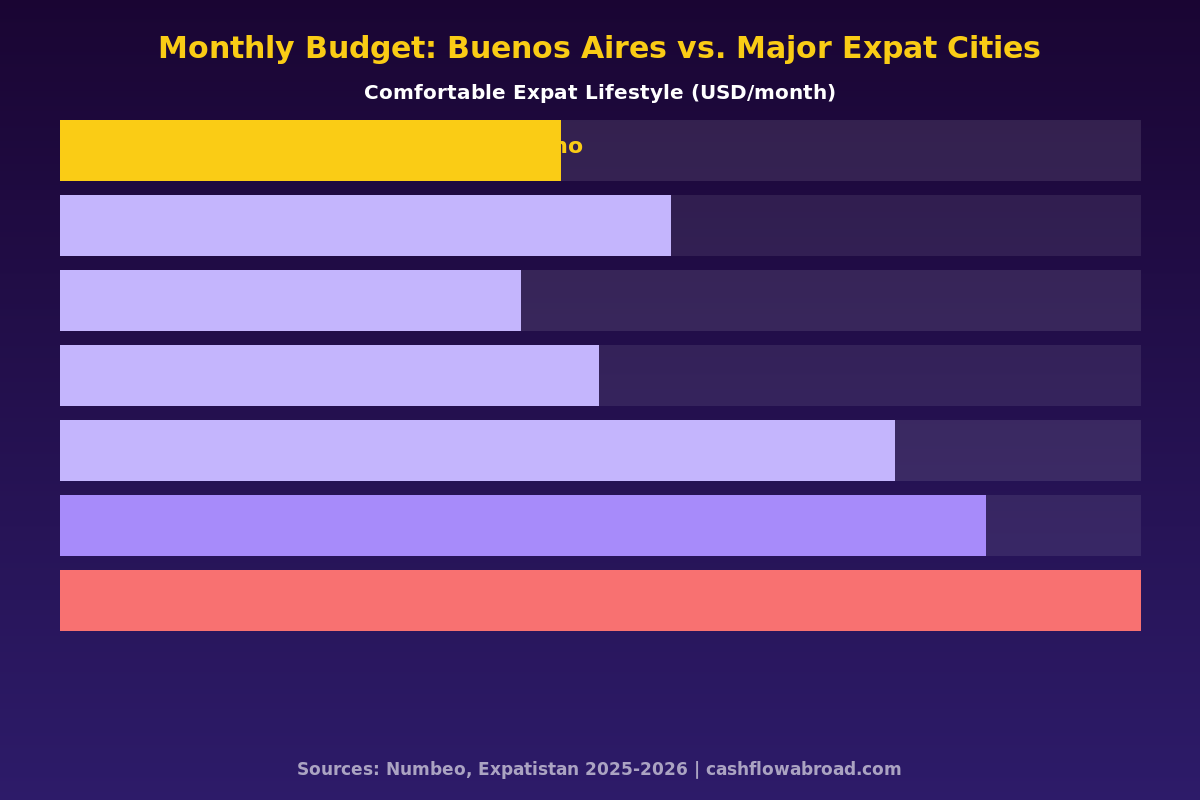
The practical result: a comfortable single expat lifestyle in Buenos Aires runs $1,200–$1,800/month. A couple with a decent apartment in Palermo or Recoleta, eating out regularly and traveling on weekends, lands around $2,500–$3,000/month combined. Compare that with comparable quality in Barcelona ($3,200/month), Lisbon ($2,800/month), or New York ($5,500/month).
What It Actually Costs to Live Here
Real numbers — not aspirational budget travel figures, but what a professional with reasonable standards actually spends:
Housing
| Neighborhood | 1BR Monthly Rent (USD) | Vibe |
|---|---|---|
| Palermo / Recoleta (modern) | $700–$1,200 | Upscale, walkable, expat-heavy |
| San Telmo / Montserrat | $500–$800 | Historic, artsy, cobblestone streets |
| Villa Crespo / Chacarita | $450–$650 | Up-and-coming, local feel |
| Puerto Madero (luxury) | $1,500–$2,000 | Waterfront, glass towers, premium |
| Suburbs (GBA) | $250–$400 | Local neighborhoods, less English |
Note: landlords in Buenos Aires frequently price long-term rentals in USD and want payment in cash or informally. This is legal — Argentina never banned dollar-denominated contracts. Utilities (electricity, gas, water) run $50–$100/month, though Milei has been cutting energy subsidies, so expect gradual increases.
Day-to-Day Spending
- Groceries: 1kg quality ribeye steak ≈ $10. A mid-range Malbec ≈ $5–$7. A 30-pack of eggs ≈ $4.50.
- Restaurants: Casual lunch or dinner runs $10–$12 per person. A proper steakhouse with wine: $30–$40 per person — and it's genuinely world-class beef.
- Coffee: Specialty café cortado ≈ $3–$4.
- Subway/bus: $0.60–$0.70 per ride. One of the cheapest rapid transit systems in any major city.
- Short Uber: 4–5km ride ≈ $6–$10.
- Private health insurance: $150–$250/month — now mandatory for non-permanent residents after Decree 366/2025 eliminated their access to free public healthcare.
For health coverage, SafetyWing's Nomad Health plan works as a stopgap while you assess the local insurance market. Local plans from Swiss Medical or OSDE can be more comprehensive once you have a CUIL (Argentine tax ID). See the full comparison in our expat health insurance guide.
The Currency Situation: No More Black Market Premium
The "blue dollar" defined expat life in Argentina for a decade. Under the cepo (capital controls), the government maintained an artificially suppressed official rate while dollars traded on the black market at massive premiums — at its worst in mid-2024, 100–150% more pesos per dollar informally versus officially.
On April 14, 2025, backed by a $20 billion IMF disbursement (plus $22 billion from the World Bank and IDB), Milei abolished the cepo and introduced a managed floating band. Within weeks, the spread between the official rate and the blue dollar collapsed to 2–3%. Foreign credit cards now receive approximately the MEP rate — effectively the best available market rate.
| Exchange Rate | ARS per USD (early 2026) | Spread vs. Official |
|---|---|---|
| Official (BNA) | ~1,450 | — |
| MEP (financial dollar) | ~1,460 | ~1% |
| Blue Dollar | ~1,480–1,500 | ~2–3% |
| Crypto Dollar | ~1,520–1,550 | ~5% |
The practical implication: the old "bring cash, exchange on the black market" playbook is essentially obsolete. You can use your foreign Visa or Mastercard at close to market rates. The era of needing a contact to get the "real" rate is over.
Currency risk remains real. The peso is still subject to devaluation pressure if the IMF program derails or political winds shift. Keeping savings in USD or stablecoins rather than Argentine pesos remains standard expat practice. If you're managing cross-border cash flows in the region, ARQ Finance lets you hold balances in USDC/EURc, earn up to 4% on dollar balances, and spend via a Mastercard with cashback — available for users in Argentina, Mexico, Colombia, and Brazil.
Residency Options for US Citizens
Most US passport holders enter Argentina visa-free and can stay up to 90 days. Extending is simple: leave the country briefly — Uruguay via ferry from Buenos Aires is the classic move — and your 90-day clock resets. Many digital nomads and remote workers stay on perpetual tourist status for years.
If you want legal residency, Argentina offers several paths:
Rentista Visa (Passive Income)
The most popular formal visa for expats not employed locally. Requires demonstrating passive income — dividends, interest, rental income, royalties — of approximately $1,700/month (5x Argentina's minimum wage; this figure adjusts with peso changes). Employment income doesn't qualify. Active freelance income is a gray area that often requires a lawyer's creative framing.
Processing takes 4–6 months and costs $5,000–$7,000 all-in (legal fees, document apostilles, translations, government fees). After 2–3 years of temporary residency, you qualify for permanent residency. After 2 years of continuous legal residence, you can apply for citizenship.
Retirement / Pensionado Visa
For retirees receiving a verifiable pension or Social Security income. The income threshold mirrors the Rentista. Straightforward for US Social Security recipients — and Argentina's cost structure makes even a modest benefit go far. See how Social Security stretches in low-cost countries in our guide to retiring abroad.
New: Investment Citizenship (2025)
Under Milei's 2025 reforms, Argentina introduced a $500,000 USD investment pathway to citizenship that eliminates the typical residency waiting period — aimed at high-net-worth individuals who want an Argentine passport without the years-long residency requirement.

The Tax Rules US Expats Actually Need to Know
Most expat content about Argentina handwaves the tax details. Here's what actually matters:
When Argentina Claims You as a Tax Resident
Argentine tax residency triggers under two conditions (Article 116 of Argentina's Income Tax Law):
- You obtain permanent residency — effective from the first day of the month after grant.
- You complete 12 continuous months of authorized temporary stay — effective from the first day of the following month. Absences exceeding 90 days during that 12-month window reset the clock.
This is critical. Being in Argentina for 6 months establishes residency only for personal deductions purposes — it does not activate worldwide income taxation. That kicks in at 12 months. Many expats manage this deliberately by taking a 90+ day trip before the 12-month anniversary, resetting the clock and maintaining non-resident status indefinitely.
Non-Resident Taxation
As a non-resident, Argentina can only tax your Argentine-source income. For most location-independent workers and investors earning from US or other foreign sources, this means zero Argentine income tax while you're on tourist or temporary visitor status.
If You Do Become a Tax Resident
Once Argentine tax residency kicks in, Argentina operates a worldwide income tax system with progressive rates from 5% up to 35% on income above roughly $50,000 USD equivalent. There is also a Personal Assets Tax on worldwide assets — including your US brokerage accounts, real estate, and foreign bank deposits.
Compounding the complexity: the US and Argentina have no bilateral tax treaty. Foreign taxes paid can be credited against Argentine tax obligations, but the absence of a treaty means careful planning is required to avoid double taxation on some income types.
For US citizens, the FEIE (Foreign Earned Income Exclusion) may reduce your US federal tax bill significantly even while living here — see the detailed breakdown in our FEIE guide. But Argentine tax residency means filing in both countries.
The clean strategy most expats use: stay under 12 consecutive months of authorized temporary residency in any rolling 12-month period. Travel, do a border run, take a long trip. Keep the clock reset. Pay zero Argentine income tax and enjoy all the lifestyle benefits.
Banking and Moving Money to Argentina
Getting money into Argentina is the most practically frustrating part of expat life here. A few realities:
Foreign cards now work at market rates. Post-cepo removal, Visa and Mastercard transactions convert at close to the MEP rate. This is genuinely new. For shorter stays, living off a foreign debit card with no foreign transaction fees is now a reasonable approach. Charles Schwab's international checking account reimburses all ATM fees worldwide — no minimums, no monthly fees.
Local bank accounts are possible. You need a CUIL (Argentine tax ID, obtainable at any ANSES office with just your passport), proof of address, and patience. Banco Santander Río, Banco Macro, and HSBC Argentina will open accounts for foreigners. Accounts can be peso or USD-denominated. The process has gotten easier post-2025 reforms.
International wire transfers remain clunky. Banks often apply poor exchange rates on incoming international wires, and transfers can take weeks. Many long-term expats keep their primary banking abroad and use Remitly for regular transfers, supplemented by Charles Schwab for ATM access.
Maintain your US banking infrastructure. Argentine banking instability has a long history. Keep your core accounts in the US. A Traveling Mailbox virtual US address ($15/month) keeps your US bank statements, IRS correspondence, and state domicile tied to a legitimate US street address — critical for maintaining US financial infrastructure while abroad. For a full breakdown of how this fits into an expat banking stack, see the virtual mailbox expat guide.
Connectivity and Practical Setup
Buenos Aires has solid 4G LTE coverage from Claro, Movistar, and Personal. Getting a local SIM as a foreigner requires a CUIL, which creates a chicken-and-egg problem on arrival. For the first days or weeks, an international eSIM from Saily keeps you connected without the bureaucratic setup. Argentina's fiber internet infrastructure in Buenos Aires is surprisingly good — 100–300 Mbps plans run $15–$25/month once you have an address.
Is Argentina the Right Move?
Buenos Aires rewards people who love cities. It's a genuine world-class metropolis — 3 million people in the city proper, 15+ million metro — with a subway system, world-class restaurants, a thriving startup scene, and a cultural depth that takes years to exhaust. Spanish is non-negotiable for deeper integration; you can get by on English in tourist areas and co-working spaces, but Argentine Spanish rewards investment.
The lifestyle quality per dollar spent is remarkable. A $1,500/month budget buys a nice 1BR apartment in a desirable neighborhood, the ability to eat at excellent restaurants several times a week, and enough left for weekend travel. That same budget gets you a shared apartment in a mid-tier US city with little left for anything else.
For a broader look at how geographic arbitrage plays out across multiple countries, our Geographic Arbitrage Playbook compares cost structures, tax environments, and lifestyle quality across 10 top destinations. Buenos Aires consistently ranks near the top for the combination of urban quality and cost. For a direct comparison with another leading LATAM option, the Medellin monthly budget breakdown on our sister site is worth reading side-by-side.
Argentina is not for everyone. Inflation, even at 32% annually, erodes peso-denominated savings fast. The banking system has collapsed before and could again. The political environment — while currently reform-oriented — is historically volatile. If you want tax certainty and simplicity, territorial tax countries like Georgia (1% flat tax) or Paraguay (zero tax on foreign income) are cleaner options.
But if you want to live in a world-class city, eat extraordinary food, enjoy sophisticated urban culture, and spend dramatically less than you would anywhere comparable in Europe or North America — Buenos Aires in 2025–2026 is one of the best deals on the planet. The chaos is fading. The value remains.
For a complete picture of your US obligations while living abroad, the US Expat Banking and Taxes Guide is the right starting point.
Financial Disclaimer: This article is for informational purposes only and does not constitute tax, legal, or financial advice. Tax laws in Argentina and the United States change frequently. Consult a qualified international tax attorney or CPA before making residency, visa, or financial decisions. The author is not a licensed financial advisor. Affiliate links in this post may generate a commission at no additional cost to you.
This guide is general information, not personalized tax, legal, or investment advice. Rules change; verify current thresholds with official sources or a qualified professional before acting.
Related guides
 Geographic ArbitrageJune 1, 2026
Argentina for US Expats: Costs, Visas, Banking
US dollar earners can live comfortably in Buenos Aires for $1,500/month. Complete guide to Argentina visas, banking, taxes, and healthcare for US
 Geographic ArbitrageMay 15, 2026
Argentina Expat Guide: Why Dollars Go Further in Buenos Aires
US expats can live well in Buenos Aires for $1,200–$1,600/month. Visa options, tax rules, banking, and neighborhoods explained.
 Geographic ArbitrageMay 24, 2026
Ecuador's Dollar Advantage: The Expat's Best-Kept Secret
Ecuador runs on the US dollar — zero currency risk. Visa from $482/month, $25 doctor visits, $1,400/month lifestyle. The complete US expat guide.