Costa Rica Rentista Visa: $2,500/Month for Residency
9 min read · 2,365 words
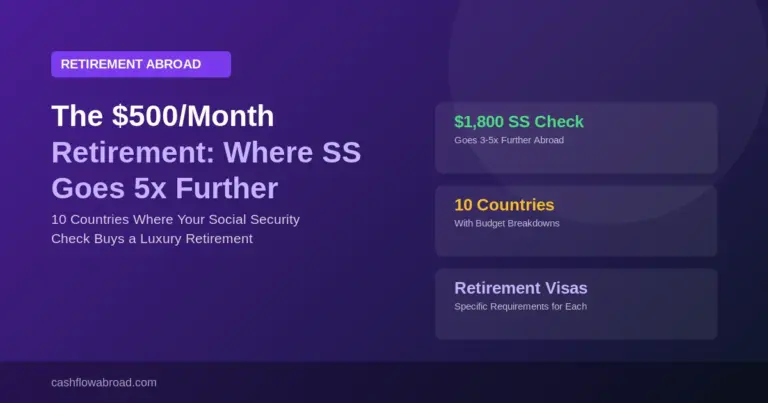
The average US Social Security benefit is $1,907/month. Costa Rica’s most popular retirement visa requires just $1,000/month in guaranteed pension income. Do the math: a large share of Americans already qualify for residency in one of Latin America’s most stable, biodiverse, and expat-friendly countries — and have no idea.
Costa Rica has held the top spot as the most popular expat destination in Latin America for two decades running, and the reason isn’t just the beaches. The country runs a strict territorial tax system — your US pension, Social Security, dividends, or remote work income earned outside Costa Rica is literally exempt from Costa Rican taxes. Zero. And a comfortable life in the Central Valley runs $1,800–$2,500/month for a couple, all-in. That’s not poverty living — that’s a decent apartment, eating out regularly, private healthcare supplements, and weekend trips to the Pacific.
This guide covers the two main residency tracks, exactly what they cost, the tax advantages, cost of living by region, the path to a second passport, and how to set up your US financial infrastructure before you leave.
Two Tracks Into Costa Rica: Pensionado vs Rentista
Costa Rica’s residency categories for income-independent foreigners are the Pensionado (retiree visa) and the Rentista (independent means visa). They produce the same outcome — temporary residency, then permanent residency, then citizenship — but the income thresholds and qualifying sources are very different.
| Feature | Pensionado | Rentista |
|---|---|---|
| Minimum monthly income | $1,000/month guaranteed pension | $2,500/month passive income |
| Alternative: lump sum deposit | No | $60,000 in Costa Rican bank |
| Qualifying income sources | Government or private pension only (SS qualifies) | Investments, rentals, royalties, business distributions |
| Work for Costa Rican employers | No | No |
| Remote work for foreign clients | Yes | Yes |
| Temporary permit duration | 2 years (renewable) | 2 years (renewable) |
| Minimum annual presence | 4 months/year | 4 months/year |
| Path to permanent residency | 3 years | 3 years |
| Path to citizenship | 7 years total | 7 years total |
Pick the track that matches your income: If you receive a pension (Social Security qualifies — the SSA issues a pension verification letter), take the Pensionado route. The threshold is $1,500/month lower than the Rentista. If your income comes from dividend portfolios, rental properties, or business distributions — not from a pension — the Rentista is your track. The Rentista’s $60,000 bank deposit alternative is particularly useful for people who have capital but haven’t yet structured a consistent monthly cash flow.
What You Actually Need to Apply
Both visas run through Costa Rica’s Dirección General de Migración y Extranjería (DGME). The paperwork is substantially the same between the two programs:
Required Documents
- Valid passport — at least 12 months remaining validity
- Proof of income: For Pensionado, a letter from the pension-issuing institution (SSA issues these on request) confirming your monthly benefit. For Rentista, 12 months of bank statements showing consistent deposits of $2,500+/month, or a certified letter from a Costa Rican bank confirming a $60,000 deposit.
- Birth certificate — apostilled and officially translated to Spanish
- FBI background check — apostilled (submit online via the FBI Identity History Summary service; allow 6–10 weeks)
- Two passport-style photos
- Proof of Costa Rican address — rental contract or property deed
- CAJA enrollment — you register for national health insurance simultaneously with residency
True Cost of the Visa
| Expense | Estimated Cost |
|---|---|
| DGME application fee | ~$250 |
| Immigration attorney (strongly recommended) | $1,500–$3,000 |
| Document apostilles + Spanish translations | $300–$600 |
| FBI background check | $18 |
| CAJA monthly contribution (ongoing) | $100–$250/month |
| Rentista bank deposit (accessible after 2 years) | $60,000 |
| First-year total (Pensionado track) | ~$3,500–$5,500 |
Processing time is the main friction point: currently 6–18 months from submission to approval. During that window, most applicants live on 90-day tourist entries, doing a border run to Nicaragua or Panama to reset the clock. An attorney can flag bottlenecks and keep your file from sitting in a bureaucratic queue — well worth the fee given the timeline.
Costa Rica’s Territorial Tax System: Your Foreign Income Is Off the Table
Costa Rica taxes only income generated within Costa Rica. Your US pension, Social Security payments, dividends from US stocks, rental income from a US property, or distributions from a foreign business — none of it is taxed by Costa Rica. This is a clean, statutory carve-out, not a gray area or an informal understanding that could change with an auditor.
That combination — low cost of living, zero tax on foreign income, stable democracy, functioning infrastructure — is genuinely rare. Countries with no-tax regimes are usually either tiny islands with nothing to do or wealthy jurisdictions that cost more than the US. Costa Rica threads a needle that few countries match.
If you earn local income — say, through a Costa Rican consulting arrangement or local business activity — 2026 tax brackets apply:
| Annual Local Income (CRC) | Approx. USD | Rate |
|---|---|---|
| Up to ₡6,244,000 | ~$11,600 | 0% (exempt) |
| ₡6,244,001 – ₡9,367,000 | $11,601–$17,400 | 10% |
| ₡9,367,001 – ₡15,614,000 | $17,401–$29,000 | 15% |
| ₡15,614,001 – ₡31,225,000 | $29,001–$58,000 | 20% |
| Over ₡31,225,000 | $58,001+ | 25% |
A significant 2026 reform also allows independent workers to deduct 25% of gross income automatically — no receipts required. If you’re running a side consulting practice through a Costa Rican entity, that’s a meaningful simplification.
One thing that doesn’t change: As a US citizen, you still file US taxes regardless of where you live. Costa Rica’s territorial system eliminates your liability there, not in the US. See the FEIE guide for how to offset your US tax bill on earned income, and the full FBAR/FATCA compliance breakdown for what you’re required to report.
What You’ll Actually Spend Each Month
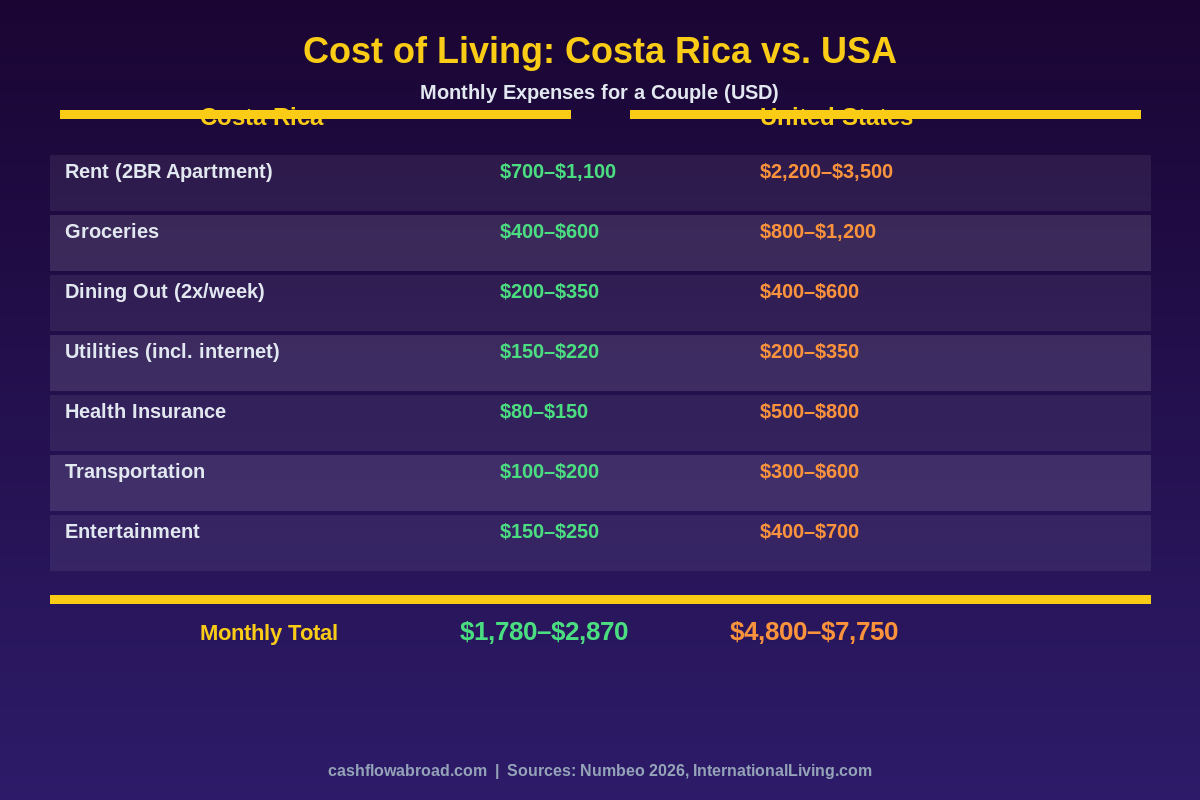
The chart above shows median ranges, but where you live in Costa Rica matters enormously. Three zones account for most expat arrivals:
Central Valley: Escazú, Atenas, Santa Ana
The sweet spot for value and infrastructure. Escazú — the upscale suburb closest to US comforts, 20 minutes from San José’s international airport — runs $700–$1,100/month for a furnished two-bedroom. Atenas, a mountain town consistently rated one of the world’s best climates, comes in $150–$200 cheaper for comparable space. The Central Valley has everything: US-standard private hospitals (CIMA, Clínica Bíblica), major supermarkets, stable fiber broadband, and multiple daily flights to Miami and other US hubs.
Pacific Coast: Tamarindo, Manuel Antonio, Jacó
Beach living adds 10–25% to most line items. A furnished two-bedroom in Tamarindo runs $1,200–$1,800/month. Internet quality is solid in most developed tourist corridors. If you want ocean access and don’t have a complex medical situation nearby, coastal towns are viable — but budget $500–$800/month more than the Central Valley equivalent.
Off-the-Radar Interior: Grecia, San Ramón, Puriscal
Under $1,500/month for a couple is genuinely achievable here. You’ll trade international restaurant density and English-language services for dramatically lower rent and a more authentic Tico lifestyle. Infrastructure is still there — paved roads, clinics, decent internet. These towns attract the expats who want to integrate rather than live in an American satellite community.
One cost you cannot avoid: CAJA. As a resident, you must enroll in Costa Rica’s national health insurance system. Contributions run 9–11% of your declared income, with a practical minimum of roughly $100–$250/month for most retirees. What you get in return: access to the full public hospital network — surgeries, specialists, medications — at zero cost per visit. CAJA quality ranges from excellent at major hospitals (Hospital México, Hospital San Juan de Dios) to variable at rural clinics. Most expats supplement with a private plan for faster wait times.
Healthcare: CAJA Plus Private Coverage
The hybrid approach most long-term expats settle on: CAJA handles major procedures and hospitalizations; a private supplement covers English-speaking doctors and faster same-day access for routine care. Private consultations in San José run $50–$80 — compare that to a US urgent care copay with insurance.
While your residency application processes (that 6–18 month window), you’re living on tourist entries without CAJA coverage. SafetyWing’s Nomad Insurance covers you globally at $40–$60/month for adults under 40, and bridges the gap before CAJA kicks in. Once you have your cédula (residency card) and enroll in CAJA, you can transition to local private supplemental coverage that typically runs $80–$150/month for comprehensive private access.
For a broader look at international health coverage options ranked by cost and coverage, see the expat health insurance guide.

Banking Setup for Costa Rica Residents
Opening a Costa Rican bank account before residency is notoriously difficult. Public banks (Banco Nacional, Banco de Costa Rica) require your cédula, which you won’t have until approval. Some private banks — Scotiabank and BAC Credomatic in particular — will open accounts for non-residents with passport and income documentation, but expect branch visits and 2–4 weeks of paperwork.
The practical solution during the application window: keep your USD in a US account and transfer funds as needed. Remitly handles USD → CRC transfers with transparent fees — typically $2–$4 per transfer under $1,000, with mid-market-adjacent exchange rates. Transfers arrive within minutes on most corridors.
For your US-side account, Charles Schwab’s investor checking account remains the expat banking gold standard. It reimburses 100% of ATM fees worldwide — pull colones from any ATM in Costa Rica and Schwab reimburses the local surcharge at month end. No foreign transaction fees, no minimum balance, no annual fee.
One often-neglected setup item: a US mailing address. Your IRS correspondence, brokerage accounts, and US banking relationships all need to reach you via a domestic US address. When financial institutions detect a foreign address on file, accounts get flagged or frozen. Traveling Mailbox gives you a real street address in 50+ US cities, scans your mail digitally, and can deposit physical checks — all for $15/month. This is how you protect your US financial infrastructure while living in Escazú.
The Path to a Second Passport
Costa Rica’s naturalization path is among the clearest in Latin America for lifestyle expats who actually want to live there:
- Year 0–2: Temporary residency (Pensionado or Rentista). Minimum 4 months/year in-country. Can own and operate businesses, invest locally, and work remotely for foreign clients.
- Year 3: Eligible for permanent residency after demonstrating continued income compliance and physical presence. Annual presence requirement drops to just 3 days/year after PR is granted.
- Year 7: Eligible for Costa Rican citizenship and passport. Requirements include a Spanish language proficiency exam, a civic knowledge test, and evidence of integration into Costa Rican society. Costa Rica permits dual nationality — you do not surrender US citizenship.
The Costa Rican passport grants visa-free or visa-on-arrival access to 150+ countries, including the full EU Schengen zone, the UK, Japan, and South Korea. For those pursuing the geographic arbitrage strategy, a Costa Rican second passport provides banking and travel optionality that a US passport alone sometimes complicates.
Compare this to citizenship-by-investment programs: Costa Rica’s 7-year path requires no multimillion-dollar investment — just residency compliance and normal living expenses. The main cost is time, not capital.
Who This Visa Is Built For
The Pensionado and Rentista programs work best for specific profiles:
- Social Security retirees. The $1,907 average SS benefit already exceeds the $1,000 Pensionado threshold. Americans who can barely afford to retire in the US can live comfortably on Social Security alone in Costa Rica — and often have $500–$900 left over each month. The Social Security abroad guide benchmarks this math across 10 countries.
- Early retirees with investment income. A dividend portfolio generating $2,500–$3,000/month triggers zero Costa Rican tax on those dividends. The $2,000–$2,500/month Central Valley cost of living means you’re living well and likely banking the rest.
- Remote workers with foreign clients. Both visas explicitly permit working remotely for non-Costa Rican employers and clients. Your foreign consulting income is tax-exempt in Costa Rica.
- People who want a legitimate second citizenship pathway without paying $100,000+ for a Caribbean CBI program. Seven years of residency, a language test, and a civic exam — and you have an EU-quality travel document and a genuine second home.
It’s a weaker fit if you need local employment income in Costa Rica, can’t commit to 4 months/year during the temporary residency period, or need a crypto/offshore banking hub (Panama, Paraguay, and the UAE are better picks for that specific use case).
Step-by-Step Application Process
- Choose your track. Pension income (including Social Security) → Pensionado. Investment, rental, or business income → Rentista. Capital but no monthly income stream → Rentista with $60,000 bank deposit.
- Hire a Costa Rican immigration attorney. Not legally required, but the DGME process is document-heavy, all Spanish-language, and prone to bureaucratic delays. Budget $1,500–$3,000. Well-reviewed firms include Jaros Immigration and several Escazú-based legal practices.
- Order your FBI background check. Submit online at the FBI Identity History Summary portal. Request apostille through the US Department of State. Total process: 6–10 weeks minimum — start this immediately.
- Gather and apostille documents. Birth certificate, marriage certificate if applicable. Each requires a state-level apostille and certified translation to Spanish.
- Secure Costa Rican accommodation. A 12-month rental lease works. You don’t need to have already moved in — a signed contract is sufficient.
- Enter Costa Rica on a tourist stamp. You can begin the residency application process while living on 90-day tourist entries. Most applicants do a border run to Panama or Nicaragua every 90 days while the residency processes.
- File through your attorney. Attorney submits your complete file to DGME. Approval timelines currently run 6–18 months from submission.
- Receive your cédula and enroll in CAJA. Once approved, you get your cédula (residency card) and complete CAJA enrollment at a local office. Contributions begin immediately.
The Bottom Line
Costa Rica has dominated the expat destination rankings for two decades because the math is genuinely compelling. Territorial taxes mean your foreign income flows in untouched by the local government. Permanent residency is available in three years. A second passport — one that opens the Schengen zone and 150+ countries — comes in seven. And the cost of a comfortable life in Atenas or Escazú runs $2,000–$2,500/month for a couple, compared to $7,000–$10,000+ in most US metros.
The single biggest friction point is the 6–18 month processing timeline — plan your finances and border compliance accordingly. Use that window to get your US financial infrastructure right: Schwab for fee-free ATM access globally, a virtual mailbox to keep your US banking and IRS address active, and Remitly for cost-effective currency transfers while you wait.
Pura Vida isn’t just a phrase Costa Ricans say. It’s an actual description of the pace and cost of life here — and for expats from expensive English-speaking countries, it lands differently when you see the bank balance at the end of the month.
Disclaimer: This article is for informational purposes only and does not constitute legal, tax, or immigration advice. Costa Rican visa requirements, income thresholds, and tax regulations change periodically. Consult a licensed Costa Rican immigration attorney and a qualified US expat tax professional (CPA or Enrolled Agent) before making any residency or relocation decisions. The author and cashflowabroad.com bear no responsibility for decisions made based on information in this post.
Liked this article?
Get the next one delivered straight to your inbox — plus a free Expat Tax Cheat Sheet.
Join our subscribers. No spam — just expat finance intel and new post notifications.