Philippines SRRV: Permanent Residency for a $15K Refundable Deposit
9 min read · 2,325 words
Most retirement visas make you spend money — €500K into Italian government bonds, €250K into a Greek real estate fund, ₹30 lakh sitting in an Indian bank. The Philippines does something almost nobody else does: that $15,000 required deposit? You get it back when you leave.
The Special Resident Retiree’s Visa (SRRV) is arguably the most underrated permanent residency program in the world. For as little as $15,000 — held in a PRA-accredited bank, earning interest, refunded in full when you cancel — you get permanent, indefinite residency in a 7,640-island archipelago where $1,400/month buys a genuinely comfortable life. No annual renewal. No minimum stay requirements. No employment restrictions.
And in September 2025, the Philippine Retirement Authority quietly dropped the minimum eligibility age from 50 to 40. That changes the calculus entirely.
What the SRRV Actually Is
The Special Resident Retiree’s Visa is a long-term residency visa administered by the Philippine Retirement Authority (PRA), a government agency under the Department of Tourism. It grants the holder indefinite stay in the Philippines with multiple-entry privileges — meaning you can leave and return as many times as you want without dealing with Bureau of Immigration queues or 30-day tourist stamp extensions.
Unlike most visas, the SRRV is not a temporary residency that converts to permanent — it is permanent residency from day one. You’re not on a path to citizenship (the Philippines doesn’t offer naturalization by investment), but you’re also not renewing paperwork every year. The SRRV is valid as long as you don’t cancel it.
The PRA has been issuing SRRVs since 1985. Over 80,000 foreign retirees currently hold the visa, with Americans and Koreans making up the largest cohorts.
The 5 SRRV Categories
Most articles collapse this into one number and get it wrong. There are distinct SRRV sub-types, each with different deposit requirements and qualifying criteria:
SRRV Classic
The standard option for most foreign retirees. Since September 2025, the minimum age dropped from 50 to 40.
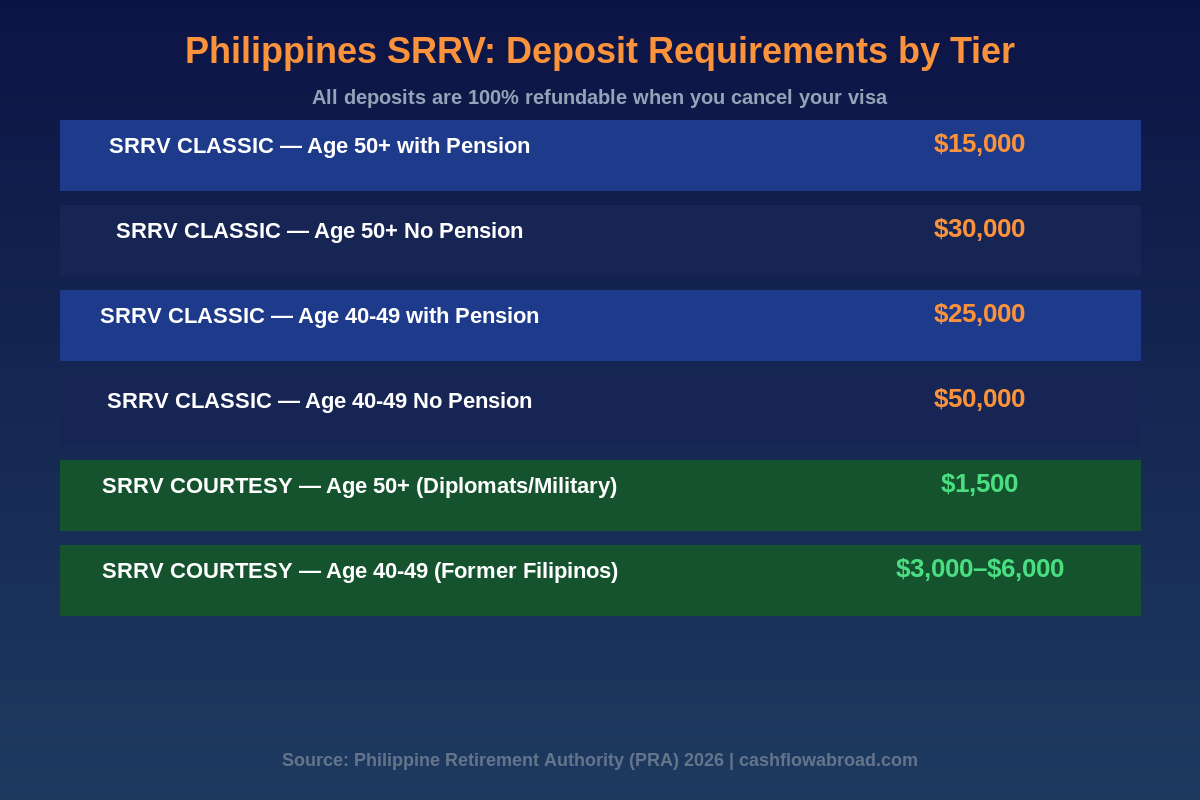
| Age Group | Has Monthly Pension | No Pension |
|---|---|---|
| 50 and above | $15,000 | $30,000 |
| 40 to 49 | $25,000 | $50,000 |
The pension threshold is low: any regular monthly pension or annuity qualifies. Social Security at 62 counts. A modest 401(k) distribution or annuity payment counts. Rental income generally does not — it has to be classified as a pension or annuity stream.
SRRV Courtesy
For retired diplomats, retired military personnel, “high achievers” (Olympic medalists, Nobel laureates, etc.), and former Filipino citizens who’ve acquired foreign nationality. The deposit floor is dramatically lower:
- Age 50+ with pension: $1,500
- Age 40–49 with pension: $3,000
- Age 40–49 without pension: $6,000
SRRV Human Touch, Smile, and Expanded
These sub-types cover applicants with ongoing medical treatment in the Philippines, long-stay visitors who’ve accumulated significant time in-country, and a legacy category that predates the current PRA structure. Most new applicants go through SRRV Classic or Courtesy.
The Part Everyone Gets Wrong: The Deposit Is Refundable
This is where the SRRV shines. That $15,000 or $25,000 deposited into a PRA-accredited bank (currently BDO Unibank or Metrobank) is not a fee, not an investment minimum, not lost money. It’s a deposit in the truest sense of the word.
When you cancel your SRRV and repatriate, the PRA releases the deposit and it’s wired back to you — minus any outstanding dues, but otherwise in full. The deposit also earns interest at whatever rate the PRA-accredited bank offers (typically 1.5–3.5% annually on time deposits). You’re not getting rich off it, but you’re not losing it either.
There’s one exception: if you use the deposit to purchase a PRA-approved ready-for-occupancy real estate property worth at least $50,000, the deposit converts into that investment and is no longer cash-refundable. That’s a choice, not a requirement.
Compare this to Portugal’s former Golden Visa (€500K minimum, now effectively closed to most investors), or Malaysia’s MM2H (a $150K–$1M fixed deposit requirement), and the SRRV starts looking extraordinarily rational. You’re not tying up capital. You’re parking it temporarily.
What the SRRV Actually Gets You
Beyond indefinite residency and multiple-entry privileges, the SRRV comes with a package of concrete tax and customs benefits that most guides bury in the fine print:
- Pension/annuity tax exemption: All pension and annuity income earned abroad is fully exempt from Philippine income tax, whether or not it’s remitted to the Philippines. You can have your Social Security or 401(k) distributions hit a Philippine bank account and owe zero tax locally.
- Duty-free import allowance: Upon first arrival with the SRRV, you’re allowed to import household goods and personal effects duty-free up to $7,000. Moving a household’s worth of furniture and electronics carries real customs savings.
- Travel tax exemption: If you stay in the Philippines for less than one year in a given period, you’re exempt from the travel tax that Philippine residents normally pay when departing internationally.
- Bureau of Immigration exemption: SRRV holders skip the annual report requirement that other long-stay foreigners face.
- No minimum stay requirement: Unlike Malaysia MM2H or Portugal’s NHR, the SRRV has zero minimum days you must physically be in the country. You can spend six months in the Philippines and six months elsewhere without jeopardizing your status.
The tax exemption on foreign pension income is particularly significant for US retirees collecting Social Security. The Philippines taxes residents on Philippines-source income only — and even that is exempt if it’s pension or annuity classified. Combined with the US Foreign Earned Income Exclusion or the US-Philippines tax treaty framework, many retirees end up with a very low effective global tax rate.
What $1,400/Month Actually Buys You
The Philippines is one of the few places left where “cheap” doesn’t mean “compromised.” The economy runs on a weak peso (₱56–₱58 per USD as of early 2026), English is a co-official language, and the private healthcare infrastructure in major cities is genuinely solid.
| Expense | Metro Manila | Cebu City | Dumaguete |
|---|---|---|---|
| 1BR apartment (city center) | $600–$900 | $400–$600 | $200–$350 |
| Utilities (with A/C) | $120–$160 | $90–$140 | $70–$110 |
| Groceries (monthly) | $200–$300 | $150–$250 | $100–$180 |
| Dining out (weekly) | $120–$200 | $80–$150 | $60–$100 |
| Transport | $60–$100 | $40–$70 | $25–$50 |
| Total Monthly | $1,400–$2,000 | $1,000–$1,500 | $700–$1,100 |
Dumaguete deserves a closer look. It’s a mid-sized university city on Negros Oriental island — 140,000 people, a functional private hospital, reliable fiber internet, and a well-established expat community that’s been there for decades. Cost of living sits significantly below Cebu or Manila. A retired couple can live well there for under $1,800/month combined, including a condo with ocean views. Cebu splits the difference: larger city amenities, international airport with direct regional connections, and costs that undercut Manila by 20–30%.

Healthcare: The Hidden Advantage
The Philippines has a private hospital system in major cities that’s dramatically cheaper than the US and, for non-emergency care, often materially better than what most Americans can access domestically. A private specialist consultation runs $20–$50. Day surgery that would cost $15,000 in the US might run $1,500 here. Dental implants: $400–$600 in the Philippines versus $4,000–$6,000 in the US.
That said, every expat should carry international health insurance. The public system (PhilHealth) doesn’t cover foreign residents without SRRV-linked enrollment, and even with enrollment, gaps are real. SafetyWing’s Nomad Insurance covers expats globally for around $50–$120/month depending on age — significantly less than US premiums and accepted at Philippine private hospitals. For a deeper look at structuring expat health coverage, see the full expat health insurance guide.
US Taxes: What You Still Owe
The SRRV’s pension tax exemption is a Philippines-side benefit. The US taxes citizens and green card holders on worldwide income regardless of where they live, so moving to the Philippines doesn’t make you invisible to the IRS. Here’s the practical picture for a US retiree:
- Social Security: Still potentially taxable in the US if combined income exceeds the thresholds ($25K single / $32K married). The US-Philippines tax relationship provides some treaty-level protections but doesn’t eliminate Social Security taxation entirely.
- 401(k) / IRA distributions: Taxable in the US as ordinary income. The Philippines won’t tax them either (pension exemption), so you’re dealing with one jurisdiction, not two.
- Foreign bank accounts: If your Philippines bank balance exceeds $10,000 at any point during the year, you must file an FBAR. The PRA-required deposit account triggers this for most SRRV holders from day one. See the FBAR and FATCA guide for full details.
- Earned income: If you work remotely or consult, the Foreign Earned Income Exclusion can shelter up to $130,000+ annually from US federal income tax.
Banking Setup
The SRRV deposit must be remitted to a PRA-accredited bank (BDO Unibank or Metrobank) via official wire transfer — retain all documentation. After that, most expats open a local Philippine account for daily peso expenses. BDO and BPI have the most straightforward expat onboarding and issue debit cards usable globally.
On the US side, Charles Schwab’s international checking account is the standard for expat banking: zero foreign transaction fees, full ATM fee rebates worldwide with no monthly limit, and they don’t close accounts because you live abroad. Filipino ATMs charge surcharges; Schwab rebates them in full. This matters when you’re making regular cash withdrawals in pesos.
For moving money from the US to the Philippines, Remitly consistently offers competitive USD→PHP rates with same-day delivery to Philippine banks — far better economics than international wire transfers through US banks, which charge $25–$50 flat plus a spread on the exchange rate.
One admin detail most expats overlook: maintaining a valid US mailing address. Philippine banks report FATCA-relevant accounts to the IRS, but you still need a real US address for brokerage accounts, state domicile, and IRS correspondence. A virtual mailbox like Traveling Mailbox ($15/month, real US street address in 50+ cities, mail scanning, check deposits) handles this cleanly. It’s covered in detail in the virtual mailbox guide.
How to Apply: Step by Step
The SRRV process is administrative rather than investment-driven — no lawyer is required, no real estate agent commission, no fund subscription. Here’s the sequence:
- Remit the deposit: Wire the required amount to the PRA-designated account at BDO or Metrobank. Retain all wire transfer documentation — you’ll need to present it with your application.
- Gather documents: Passport (6+ months validity), apostilled police clearance from your home country, medical certificate (within 60 days of application), Bureau of Immigration clearance certificate, two passport photos.
- Submit application: Apply through the Philippine Retirement Authority main office in Makati, or satellite offices in Cebu, Davao, or Clark. Principal applicant fee: $1,500. Each dependent: $300. Additional dependents beyond two require an extra $15,000 deposit each (except former Filipinos).
- Receive SRRV ID: Processing typically takes 2–4 weeks after complete submission. You receive a PRA ID card and a visa notation in your passport.
- No annual report: Unlike most other Philippine visa types, SRRV holders are not required to report annually to the Bureau of Immigration. The PRA manages status independently.
One practical note: you can apply for the SRRV while already in the Philippines on a tourist visa. Many applicants visit first, confirm they want to stay, and convert in-country rather than flying home to apply at a Philippine consulate.
Philippines SRRV vs. Other Retirement Visas
| Country | Min. Age | Capital Required | Refundable? | Tax on Foreign Income |
|---|---|---|---|---|
| Philippines (SRRV) | 40 | $15,000 deposit | Yes, fully | Exempt (pension) |
| Malaysia (MM2H) | 35 | $150K–$1M fixed deposit | Partial | Exempt (foreign source) |
| Costa Rica (Pensionado) | Any | $1,000/month pension | N/A | Exempt (foreign source) |
| Ecuador (Pensioner) | Any | $800/month pension | N/A | Exempt (foreign source) |
| Panama (Pensionado) | Any | $1,000/month pension | N/A | Exempt (territorial) |
| Portugal (D7) | Any | €760/month income | N/A | NHR expired; now taxed |
Costa Rica, Ecuador, and Panama require lower monthly income but don’t have a comparable refund mechanism — you’re proving ongoing income, not posting a deposit. Malaysia’s MM2H is the closest structural comparison, but the capital tie-up is 10–60x larger. For retirees who have savings but not guaranteed pension income meeting a threshold, the SRRV Classic with its flat deposit model is often the easier path.
For broader retirement destination comparisons, see where Social Security goes furthest and the full visa comparison across 15 countries.
The Honest Reality of Retiring in the Philippines
The Philippines is not for everyone. Traffic in Manila is some of the worst in Southeast Asia. Typhoon season (June through November) affects large parts of the archipelago with real property and infrastructure damage. Bureaucracy runs on Filipino time — expect delays on anything government-adjacent. And the tropical heat is relentless unless you’re in the mountains near Baguio or Tagaytay.
There’s also a property ownership restriction that surprises Americans: foreigners cannot own land in the Philippines. You can own a condominium unit (as long as foreign ownership in the building doesn’t exceed 40%), but land must be leased or owned through a Filipino spouse or company structure. Most expat retirees rent — which is easy and very affordable — or purchase a condo unit. This is a practical constraint, not a deal-breaker, but it shapes your real estate strategy differently than, say, Panama or Ecuador.
On the upside: the Philippines is genuinely English-speaking in a way that Southeast Asia rarely is. You can navigate hospitals, government offices, and daily life in English with almost no friction. The local culture is warm toward foreigners in a way that feels authentic rather than transactional. The food is excellent and cheap. The beaches — particularly in Palawan, Siargao, and the Visayas — are legitimately world-class. And the 80,000+ SRRV holders already there have built a functioning expat infrastructure of English-language services, medical providers, and social networks.
Bottom Line
The Philippines SRRV is a rare residency visa where the headline number — $15,000 — is not the real cost. It’s a deposit you’ll eventually get back, sitting in a bank earning interest while you hold permanent, no-expiry residency in one of the most livable low-cost countries in the world. The September 2025 age reduction to 40 opened this program to a generation of remote workers and early retirees who previously had to wait a decade.
If you’ve looked at retiring abroad and been scared off by six-figure investment minimums, the SRRV deserves serious consideration. The deposit math works. The lifestyle math works. The tax math works.
For the banking and FBAR compliance side of living in the Philippines long-term, start with the expat banking and FBAR guide.
Financial Disclaimer: This post is for informational purposes only and does not constitute financial, tax, legal, or immigration advice. SRRV requirements, fees, and Philippine Retirement Authority policies change without prior notice — always verify current requirements directly with the PRA before applying. Consult a licensed tax professional familiar with US expat taxation before making any decisions about relocating abroad.
Liked this article?
Get the next one delivered straight to your inbox — plus a free Expat Tax Cheat Sheet.
Join our subscribers. No spam — just expat finance intel and new post notifications.