US Exit Tax: What You Owe Before Renouncing Citizenship
The 50 renunciation fee is the least of your worries. Here's how the US exit tax works, who owes it, and how to plan before you walk into that consulate.

Covered expatriate rules, the $910k exclusion, IRA lump-sum treatment, and 401k 30% withholding — the real cost of renouncing US citizenship.
Disclosure: this article contains affiliate links. If you open an account through one of them, Cashflow Abroad may earn a referral commission at no extra cost to you.
In March 2026, the US State Department quietly slashed the renunciation fee from $2,350 to $450 — an 80% cut. Within weeks, global demand for renunciation appointments surged past 30,000. Wait times at US embassies are now measured in years, not months. Meanwhile, most of the people joining that queue have no idea what's actually waiting for them on the tax side. The $450 fee is the cheapest part of leaving.
The US exit tax — formally called the expatriation tax under IRC §877A — treats you as if you sold everything you own the day before you give up citizenship or long-term residency. If you're a "covered expatriate," the IRS wants its cut before you walk out the door. If you're not, you owe $0. Understanding which camp you fall into before you make any moves is the difference between a clean exit and a very expensive mistake.
Who Actually Owes the Exit Tax
The exit tax does not apply to everyone who renounces. It only applies to "covered expatriates." Most Americans who renounce — particularly those who've lived abroad for years on modest incomes — are not covered expatriates and owe nothing beyond their normal final-year tax return.
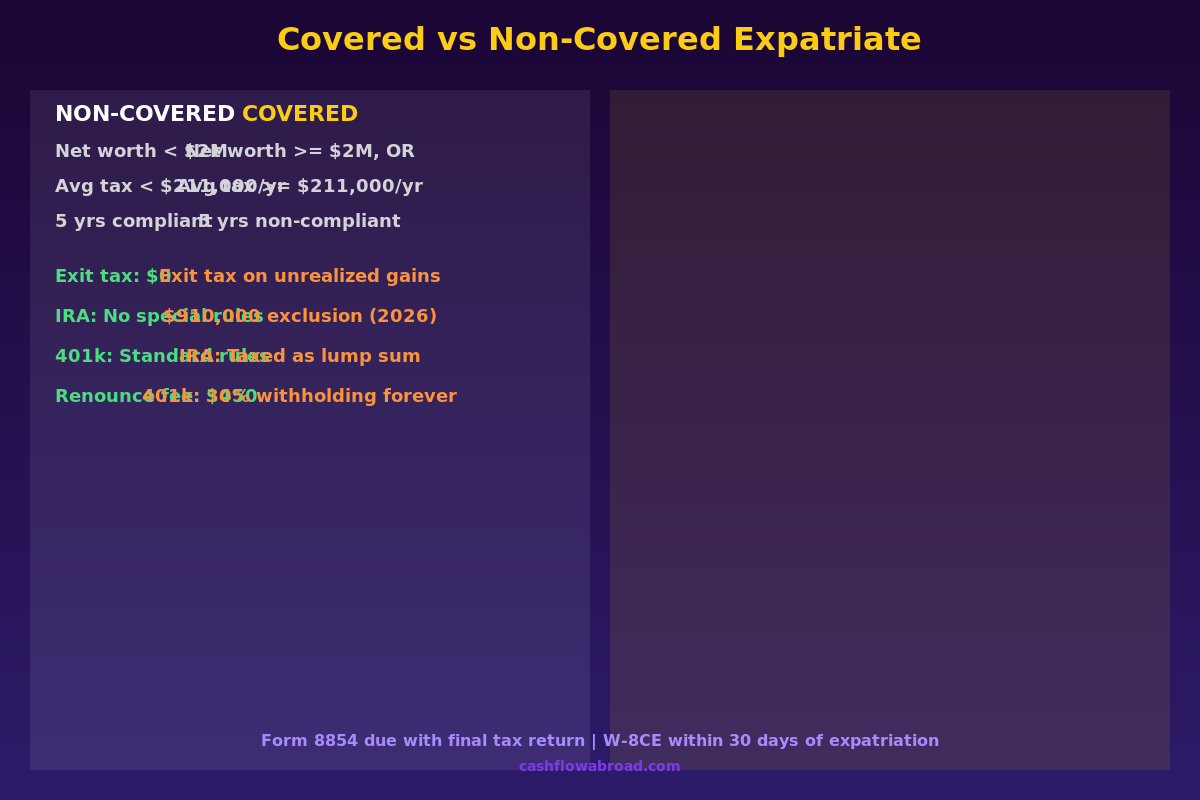
You become a covered expatriate if you meet any one of three tests:
Test 1: The $2 Million Net Worth Test
If your total global net worth on the date of expatriation is $2 million or more, you're covered. That's all assets — retirement accounts, real estate, business interests, crypto, brokerage accounts, foreign assets — minus liabilities. It's a bright-line test with no exceptions for illiquid assets. Own a $1.8M paid-off house and $300k in a 401(k)? You're covered.
Test 2: The $211,000 Average Tax Liability Test
Look at your US federal income tax for the five years immediately before you expatriate. If your average annual liability exceeds $211,000 (the 2026 threshold, adjusted annually for inflation), you're a covered expatriate. This threshold was $190,000 in 2023 — it rises every year, but so do incomes.
Test 3: The Certification Test
This is the one most people overlook. Even if your net worth is $500k and your tax liability is $30k a year, you can still be a covered expatriate if you fail to certify compliance with all US tax obligations for the five years before expatriation. That certification goes on Form 8854, filed with your final US return. Miss it or get it wrong, and you're automatically covered — with all the consequences that follow.
How the Exit Tax Is Calculated
If you're a covered expatriate, the IRS treats your entire worldwide asset portfolio as if it were sold the day before you expatriate. Every stock, every property, every business interest — marked to market at fair value. The resulting gain above a fixed exclusion amount gets taxed at capital gains rates.
For 2026, the exclusion is $910,000. That's a one-time figure applied to your total combined net gain across all mark-to-market assets — not $910,000 per asset. If you have $3 million in unrealized stock gains and $500,000 in real estate gains, your taxable gain is $2,590,000. At the 20% long-term capital gains rate plus 3.8% net investment income tax, you're looking at a tax bill north of $610,000 before you've even started on your retirement accounts.
The Retirement Account Trap
This is where most high-net-worth expats get blindsided. Retirement accounts are not treated as mark-to-market assets. They have their own, often harsher, rules — and the $910,000 exclusion doesn't touch them.
IRAs: The Lump-Sum Hit
IRAs are classified as "specified tax-deferred accounts" under §877A. As a covered expatriate, the IRS treats your entire IRA balance as if it were distributed to you on the day before expatriation — fully taxed as ordinary income in a single year. Not capital gains rates. Ordinary income rates, which top out at 37%. And the $910,000 exclusion does not apply.
The Roth IRA trap is even more counterintuitive: even though you already paid income tax on contributions, the IRS still treats the entire balance as a taxable distribution at expatriation. Someone with $800,000 in a Roth IRA — built over decades with after-tax dollars — faces an immediate ordinary income tax bill on the entire amount as a covered expatriate.
401(k): Deferred But Permanently Penalized
401(k) plans are classified as "eligible deferred compensation," which means you don't owe tax at the moment of expatriation — distributions are still taxed when taken. That sounds like relief, until you see the permanent consequence: a flat 30% withholding rate on every future distribution, with no tax treaty relief available.
This is a huge deal. Most countries have tax treaties with the US that reduce withholding on retirement distributions to 15% or even 0%. Covered expatriates are explicitly carved out of treaty benefits. That 30% applies to every 401(k) withdrawal for the rest of your life, regardless of where you live or what tax treaties exist. There's also a hard deadline: you must file Form W-8CE with your plan administrator within 30 days of expatriation. Miss it, and withholding can be even higher.
Asset Treatment Summary
| Asset Type | Treatment at Expatriation | $910k Exclusion? | Tax Rate |
|---|---|---|---|
| Stocks / ETFs / Funds | Mark-to-market deemed sale | Yes (combined) | 0–23.8% capital gains |
| Real estate | Mark-to-market deemed sale | Yes (combined) | 0–23.8% capital gains |
| Business interests | Mark-to-market deemed sale | Yes (combined) | 0–23.8% capital gains |
| Traditional IRA | Full balance as ordinary income | No | Up to 37% ordinary income |
| Roth IRA | Full balance as ordinary income | No | Up to 37% ordinary income |
| 401(k) / 403(b) | Deferred; 30% withholding on distributions | No | 30% flat (no treaty relief) |
| Defined benefit pension | 30% withholding on each payment | No | 30% flat (no treaty relief) |
The Compliance Trap: The Test That Catches Everyone Else
The certification test catches people who would otherwise owe $0 in exit tax. You certify compliance on Form 8854, Part I, under penalty of perjury. If you can't make that certification — because you missed FBAR filings, didn't report foreign income, skipped a Form 3520 for a foreign inheritance, or any other lapse — you're automatically a covered expatriate, regardless of net worth or income.
The IRS increasingly has the data to verify those certifications. FATCA has wired up over 110 countries to automatically share US account holder information. Signing Form 8854 with unfiled FBARs in your history is not a grey area — it's perjury with a paper trail.
The fix, if you have compliance gaps, is the Streamlined Foreign Offshore Procedure (SFOP). For expats living outside the US who have non-willfully failed to file, SFOP lets you catch up on three years of tax returns and six years of FBARs with a 0% offshore penalty. Closing compliance gaps before expatriation can be the difference between owing $0 and triggering covered expatriate status on everything you own.
Strategies to Avoid Covered Expatriate Status
Covered expatriate status is often avoidable — but only with years of lead time. None of these strategies work if you start them the month before your embassy appointment.
Get below $2 million before the count date. Gifts to US-citizen spouses are unlimited for gift tax purposes. The annual gift tax exclusion ($19,000 per recipient in 2026) lets you systematically shift assets to family members. Charitable contributions reduce net worth dollar-for-dollar. Strategic gifting combined with charitable giving can move someone from covered to non-covered status with multi-year planning.
Drain IRAs before expatriation. Because IRA balances will be hit with ordinary income tax at expatriation regardless, distributing over several years beforehand spreads the income across multiple tax brackets instead of stacking it all in one year. If your marginal rate is 22% in years before expatriation versus potentially 37% in the expatriation year itself, the math favors early drawdowns.
Roth conversions, done early. Converting IRA funds to Roth over time means paying ordinary income tax at today's rates. For covered expatriates, Roth balances are still hit at expatriation — but converting early locks in your rate at the time of conversion rather than the potentially higher rate at expatriation, and allows years of tax-free growth in between. The investment structure inside those accounts also matters: US mutual funds and ETFs avoid PFIC treatment, which compounds with covered expatriate rules in ugly ways.
Green card holders: watch the 8-year clock. Long-term permanent residents — those who've held a green card for at least 8 of the last 15 years — face the same exit tax rules as citizens. Surrender your green card before hitting year 8, and you escape exit tax exposure entirely. After year 8, you're treated as a long-term resident and subject to the same three tests as a citizen.

The Filing Timeline You Cannot Afford to Miss
| Action | Form / Step | Deadline |
|---|---|---|
| Book renunciation appointment | DS-4079 at US consulate | Now — 6 to 18+ month wait |
| Notice to deferred comp plan | Form W-8CE to plan administrator | Within 30 days of expatriation |
| Final US tax return | Form 1040 (dual-status year) | April 15 after expatriation year |
| Expatriation statement | Form 8854 (filed with final 1040) | Same as final return |
| Exit tax payment | With final 1040 | April 15 — no installment option |
There is no installment plan for the exit tax. The full amount is due with your final return. If you owe $400,000 in exit tax, you need $400,000 liquid by April 15 of the following year. Illiquid assets — real estate, business interests, private company shares — create serious cash-flow problems because the deemed sale triggers a tax bill even though you didn't actually sell anything and received no cash. An election under §877A(b) can defer tax on certain illiquid assets with IRS approval, but it requires posting adequate security and paying interest.
The Passport Worth Keeping
Before joining the 30,000-person renunciation queue, it's worth asking whether you've exhausted the tax-minimization options available to US citizens living abroad. The Foreign Earned Income Exclusion shelters up to $130,000 of foreign earned income from US tax in 2026. The Foreign Tax Credit eliminates double taxation on most passive income. The five-flag strategy — legal tax residence in a zero or low-tax jurisdiction — can legally get your effective US tax rate to near-zero for most income categories, without giving up the passport and triggering an exit tax.
Renunciation makes sense for some people: those with truly global income streams who've permanently left the US tax system, those whose net worth and income make covered expatriate status unavoidable, and those for whom the compliance burden of US citizenship abroad genuinely exceeds the benefits. But "renunciation as a tax strategy" often fails the math test once the exit tax is accounted for. Estate planning and investment structure frequently accomplish more, with less irreversibility.
While you're still planning, keep your US financial infrastructure solid. Charles Schwab International remains the best US brokerage for expats — no foreign account closure policies, no international wire fees, free ATM withdrawals worldwide. And if you're managing a final US tax return, Form 8854, and IRS correspondence from abroad, a US virtual mailbox ensures nothing gets lost — especially critical with an April 15 hard deadline and no room for missed notices.
The Bottom Line
The $450 renunciation fee is the footnote. The exit tax is the story. For covered expatriates with substantial retirement accounts, the bill can run into six figures — sometimes seven — while handing you zero cash to pay it with. The three covered expatriate tests catch people who don't expect to be caught: a home owner with $2.1M in equity, someone who missed FBAR filings for three years, a freelancer whose business grew faster than their tax planning. None of them are wealthy by any conventional measure, but all of them would face a meaningful exit tax event.
The most expensive renunciation mistakes happen when people treat it as an administrative event rather than a tax event. The paperwork is genuinely the easy part. The planning — especially around IRAs, retirement accounts, and the five-year compliance certification — needs to start years before you walk into that consulate.
Financial disclaimer: This article is for informational and educational purposes only and does not constitute tax, legal, or financial advice. US expatriation tax rules are complex, fact-specific, and subject to change. Consult a qualified US international tax attorney or CPA before making any decisions about renouncing US citizenship or abandoning long-term permanent residency. Thresholds referenced are for the 2026 tax year.
This guide is general information, not personalized tax, legal, or investment advice. Rules change; verify current thresholds with official sources or a qualified professional before acting.
Related guides
 Expat Tax & FinanceJune 19, 2026
IRC 877A: Deemed Sale Rules for Departing Americans
IRC 877A deems all worldwide assets sold before departure. Learn the 2026 exclusion, IRA deemed-distribution rules, and Form 8854 filing deadline.
 Expat Tax & FinanceJune 11, 2026
US Expatriation Tax: Section 877A Rules Explained
A $2M net worth triggers Section 877A mark-to-market tax on departure. Learn how covered expatriates are taxed and what to plan before you leave.
 Expat Tax & FinanceJune 8, 2026
US Exit Tax: What Triggers It and What You'll Owe
IRC 877A exit tax rules for 2026: who qualifies as a covered expatriate, how the $910K exclusion works, and planning moves to reduce your bill.