Spain’s Beckham Law: Pay 24% Flat Tax for 6 Years
8 min read · 2,117 words
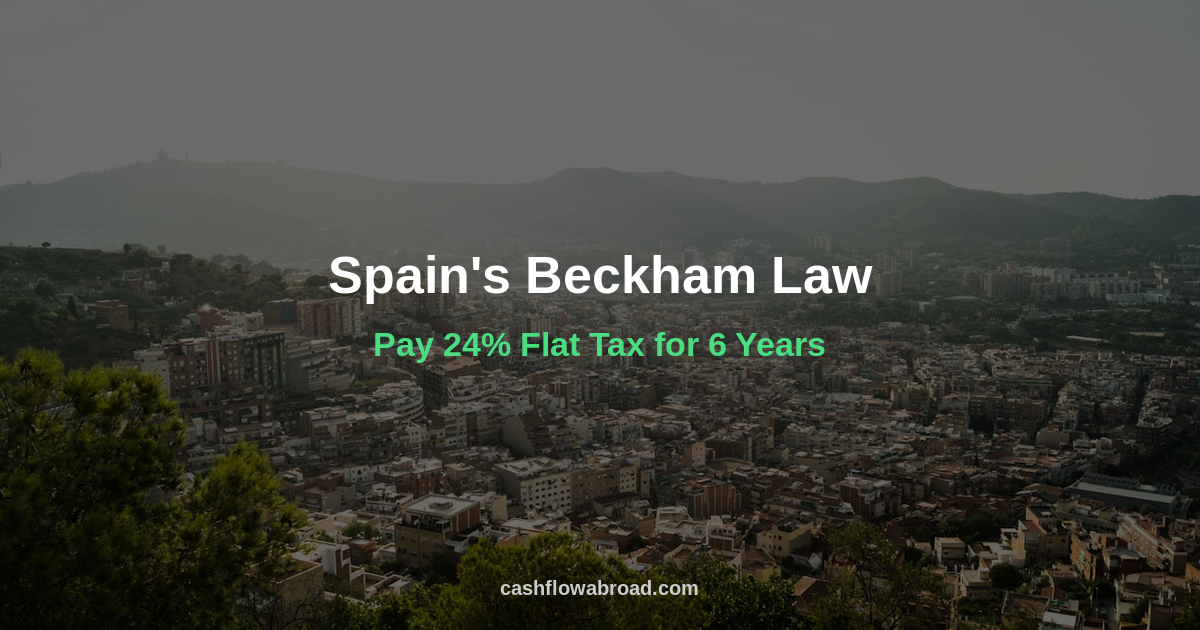
Spain’s top income tax rate is 47%. Ouch. Yet tens of thousands of expats living in Barcelona, Madrid, and Valencia are legally capped at 24%—and their foreign dividends, capital gains, and overseas rental income don’t get taxed in Spain at all. They’re using a 20-year-old law that most people have never heard of, named after a soccer player.
The Beckham Law—officially the Régimen Especial para Trabajadores Desplazados—has been on the books since 2005. David Beckham used it when he moved to Real Madrid. Since then, it’s quietly become one of Europe’s most underrated expat tax regimes, and a 2022 overhaul made it accessible to remote workers and entrepreneurs for the first time. If you’re moving to Spain and don’t know about this, you’re leaving real money on the table.
What the Beckham Law Actually Does
Under Spain’s standard progressive tax system (IRPF), residents pay between 19% and 47% on worldwide income. At €100,000, you’re already looking at a blended rate above 34%. At €300,000+, you’re at 47% on every euro above that threshold. Spain takes the tax residency definition seriously: spend more than 183 days in the country and you’re in the system.
The Beckham Law punches a hole in that. For up to six years after arriving in Spain, qualifying individuals are taxed as non-residents on their Spanish-sourced income only—at a flat 24% on the first €600,000. What this means in practice:
- Spanish employment income: flat 24% up to €600,000 (47% above that threshold)
- Foreign dividends: taxed at 19–28% if remitted to Spain, but most expats structure to avoid this
- Foreign capital gains: exempt from Spanish tax during the regime period
- Foreign rental income: exempt if property is outside Spain
- Spanish wealth tax: exempt—you’re treated as a non-resident for this too
The result is a tax structure that makes Spain—widely assumed to be an expensive, high-tax EU country—suddenly competitive with places like Portugal (post-NHR) and even some territorial tax jurisdictions. Six years is a long runway to build wealth before the standard rates kick in.
Who Qualifies in 2026
The 2022 Startup Law (Law 28/2022) significantly expanded eligibility. The original Beckham Law only worked for corporate employees relocated to Spain. Now three distinct groups can apply:
1. Employees Assigned or Hired by a Spanish Company
The original use case. If you’re transferred to a Spanish subsidiary or hired directly by a Spanish employer, you qualify. The employment contract must predate or accompany your move. This covers multinationals relocating executives, startups hiring foreign talent, and traditional inbound assignments.
2. Digital Nomad Visa Holders Working for Foreign Companies
As of 2023, Spain’s International Telework Visa (Digital Nomad Visa) allows non-EU citizens to live in Spain while working remotely for foreign clients or employers. Crucially, employees on this visa can now apply for the Beckham Law. Note: if you’re self-employed under the DNV, the picture is murkier—consult a gestoria before assuming you qualify.
The income threshold for the Digital Nomad Visa was updated in early 2026: applicants must demonstrate monthly income of at least €2,849 (225% of Spain’s minimum wage). Add 75% of SMI per dependent for a spouse, 25% per child.
3. Entrepreneurs and Highly Qualified Professionals
If you’re starting an innovative company in Spain or working as a senior professional (think C-suite, engineers, researchers), you can qualify even without an employment contract—provided your activity is certified as innovative or you hold a qualifying visa. This opened the door for founders relocating to build EU-based businesses.
The Hard Rules
Regardless of category, three conditions must be met:
- You must not have been a Spanish tax resident during the five tax years before arrival
- Your activity must require you to be present in Spain (not just a mail drop)
- You must apply within six months of registering with Spanish Social Security or beginning qualifying activity—miss this window and you lose it permanently for that stint
The Tax Math: Real Numbers
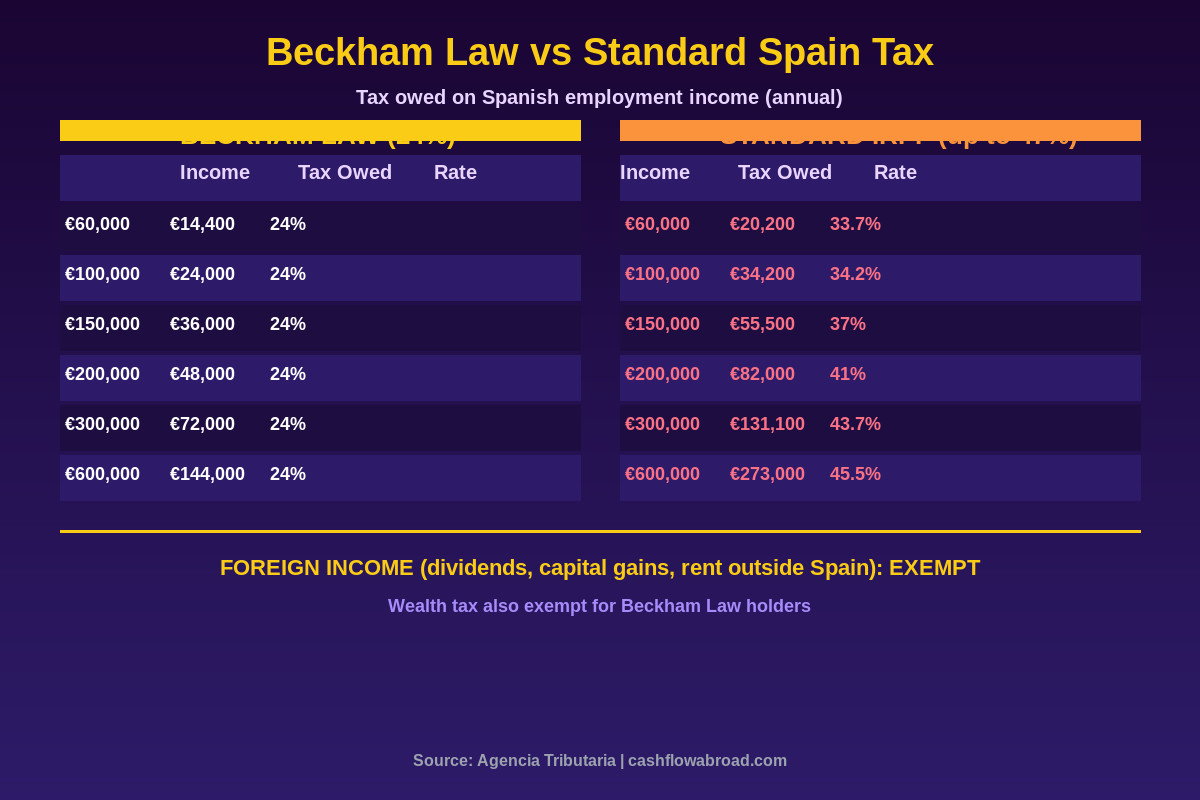
The chart above tells the story. Here’s a clean breakdown:
| Annual Income | Beckham Law (24%) | Standard IRPF | Annual Savings |
|---|---|---|---|
| €60,000 | €14,400 | €20,200 | €5,800 |
| €100,000 | €24,000 | €34,200 | €10,200 |
| €150,000 | €36,000 | €55,500 | €19,500 |
| €200,000 | €48,000 | €82,000 | €34,000 |
| €300,000 | €72,000 | €131,100 | €59,100 |
| €600,000 | €144,000 | €273,000 | €129,000 |
Even at a modest €100,000 salary, you’re saving over €10,000 per year—a €60,000 tax break over the six-year regime, purely from the rate difference. Stack the foreign income exemption on top and the advantage compounds dramatically for anyone with investment portfolios, rental income, or equity from a previous company.
Social security contributions are a separate line: Spain’s employee SS contribution runs around 6.35% of gross salary (employer pays ~30% more). This doesn’t change under Beckham Law—both you and your employer still pay standard Spanish SS. The Beckham benefit is purely on income tax.
The Foreign Income Exemption: Where It Gets Interesting
Here’s what most expats miss. Under the Beckham Law, you’re treated as a Spanish non-resident for income-sourcing purposes. Income generated outside Spain isn’t in scope for Spanish IRPF. This has real-world implications:
- US dividend portfolio: Dividends from US stocks held in a US brokerage account aren’t Spanish income. You’ll still deal with US dividend tax, but Spain doesn’t touch them.
- UK or US rental property: Rental income from property outside Spain isn’t reported to the Agencia Tributaria under the Beckham regime.
- Capital gains from foreign assets: Sell a US stock position, shares in a foreign company, or property abroad—none of that triggers Spanish capital gains tax during the Beckham period.
- Foreign pension distributions: Generally exempt, though treaty specifics vary by situation.
This is why the Beckham Law particularly appeals to people who’ve already built wealth. If you have a US investment account generating $50,000–$100,000/year in dividends and capital gains, the tax savings on that alone—income Spain never touches—can exceed the salary tax difference.
One watch-out: the exemption applies to income sourced outside Spain. If you’re billing Spanish clients, that’s Spanish-source income even if you invoice through a foreign entity. The Agencia Tributaria looks at where value is created, not where the invoice originates.
For managing US investment accounts while living in Spain, a Charles Schwab International account is the cleanest setup: no foreign transaction fees, unlimited free ATM withdrawals worldwide, and an account that stays open for expats. Unlike Fidelity and Vanguard, which routinely close or restrict accounts when clients move abroad, Schwab actively serves the expat market.
The Digital Nomad Visa + Beckham Law Stack
Spain’s Digital Nomad Visa launched in 2023 and has been steadily gaining traction. It’s a 12-month visa (renewable up to 5 years) for remote workers employed by foreign companies or working for foreign clients. The income requirement is €2,849/month as of 2026, higher with dependents.
Employees on the DNV can apply for the Beckham Law regime. This creates a clean structure for high-earning remote workers: live in Barcelona or Madrid, work for a US or UK employer, pay 24% flat on salary, keep foreign investment income outside Spain’s tax base. The math for a US tech worker earning $150,000 (roughly €135,000) looks like this:
- Standard Spain tax on €135,000: approximately €49,000
- Beckham Law tax on €135,000: €32,400
- Annual saving: ~€16,600 (~$18,000)
- Over six years: ~€100,000 in tax savings
Add the lifestyle component: a two-bedroom apartment in a nice Madrid neighborhood runs €1,200–1,800/month. The average restaurant meal costs €12–18. Spain’s public healthcare system is world-class, and private international coverage through SafetyWing or local insurers fills any gaps during the initial residency period. The full breakdown on expat health options is at Expat Health Insurance.
If you’re comparing Spain against other EU digital nomad destinations, the Digital Nomad Visas Ranked guide puts Spain’s DNV in context alongside Portugal, Germany, and 12 others.

How to Apply: Form 149 and the 6-Month Window
The application process is straightforward in structure, bureaucratic in execution. Here’s the step-by-step:
Step 1: Get Your NIE
The Número de Identificación de Extranjero is Spain’s foreigner ID number. You need it before everything else. Apply at a Spanish consulate in your home country or at a police station in Spain. Budget 2–6 weeks in most jurisdictions.
Step 2: Register with Social Security
Your employer registers you, or you register as autónomo if self-employed. This date starts your six-month clock for Form 149.
Step 3: File Form 149
Form 149 is the formal Beckham Law application to the Agencia Tributaria. Required documentation:
- Passport and NIE
- Employment contract or documentation of qualifying activity
- Proof of social security registration
- Certificate of tax residency from your home country for the prior 5 years (proving you weren’t resident in Spain)
Processing takes 1–3 months. The Agencia Tributaria issues a formal approval letter.
Step 4: File Model 151 Annually
Beckham Law holders file Model 151 instead of the standard Model 100 return. It’s a simplified non-resident-style return covering only Spanish-sourced income. A Spanish gestor with Beckham experience handles this for €300–600/year—a trivial cost against the tax savings.
What Beckham Law Doesn’t Fix
You Still Owe the IRS
US citizens and green card holders remain taxable on worldwide income regardless of where they live. The Beckham Law reduces your Spanish burden—it does nothing for your US filing. Depending on your situation, you may use the Foreign Earned Income Exclusion or the Foreign Tax Credit against your US liability. These interact in non-obvious ways with the Beckham regime: using the FEIE to exclude Spanish income means you can’t claim a Foreign Tax Credit for Spanish tax paid on that income, which can create an unexpected US liability. Run the numbers with a US expat CPA before finalizing your structure.
Crypto Has Extra Reporting Requirements
Spain added Model 721 in 2023, requiring disclosure of crypto assets held on foreign exchanges above €50,000. The Beckham Law’s non-resident treatment may reduce Spanish capital gains tax on foreign crypto, but the reporting requirement stands. If crypto is significant in your portfolio, get specific advice—the penalties for late filing Model 721 are steep.
Six Years Ends
When the Beckham regime expires, standard IRPF rates apply to worldwide income. Many expats use years 4–6 to plan their next move—whether to a territorial tax country, another EU regime, or home. The Geographic Arbitrage Playbook maps the best next stops.
Spain’s Beckham Law vs. Other European Options
| Country | Regime | Rate on Local Income | Foreign Income | Duration |
|---|---|---|---|---|
| Spain | Beckham Law | 24% flat (to €600K) | Exempt | 6 years |
| Portugal | NHR 2.0 | 20% flat on qualifying income | Partial exemptions | 10 years |
| Italy | 7% Flat Tax (South) | 7% flat on foreign income | 7% flat | 10 years |
| Greece | Non-Dom Regime | Standard Greek rates | €100K flat annual fee | 15 years |
| Malta | Non-Dom Status | Standard Maltese rates | Remittance basis (0% if not remitted) | Indefinite |
Spain’s Beckham Law is strongest for high-income earners with significant foreign passive income in the €60,000–€600,000 range. Portugal’s NHR 2.0 offers a longer 10-year window at a lower 20% rate, but the eligible income categories are narrower post-2024 reforms. Italy’s southern flat tax wins on simplicity if you can tolerate living in rural Calabria or Sicily.
For US expats, Spain’s extensive treaty network matters. The Spain-US tax treaty provisions affect dividend withholding and pension distributions—details that determine whether you’re better off with the FEIE or the Foreign Tax Credit. The full interaction is covered in the US Expat Tax guide.
Practical Setup: Before You Land
A few things to sort before moving that most expats skip:
Maintain a US address. Once you’re in Spain, your US banks and brokerages need an active US address—not a P.O. box. Traveling Mailbox provides a real US street address in 50+ cities with mail scanning and check deposits for $15/month. It keeps your US accounts open, your IRS correspondence handled, and your state domicile clean. This is not optional if you want to keep Schwab, Mercury, or your US brokerage functioning.
Sort connectivity. Spain’s phone infrastructure is solid, but if you’re arriving before a local SIM is set up, a Saily eSIM gets you online immediately—works across 150+ countries and lets you keep your US number active while abroad.
Keep your US business banking. Mercury is built for US-registered businesses with founders living anywhere—no foreign fees, API access, and clean wire transfer tools for international payments.
Bottom Line
The Beckham Law is one of the EU’s best-kept expat tax secrets—a legitimate, well-documented regime that caps your Spanish income tax at 24% flat for six years while shielding foreign investment income entirely. At €100,000 of income, that’s €10,000+ in annual savings. At €300,000, it’s nearly €60,000 per year.
The caveat: this isn’t a DIY project. The six-month application window, the US tax interaction, the social security structure, and the post-regime planning all require professional guidance. A good Spanish gestoria plus a US expat CPA is a €2,000–4,000/year investment that pays for itself many times over.
Spain offers an unusual combination: EU stability, excellent infrastructure, low cost of living relative to Northern Europe, and—for the first six years—a tax rate you’d expect from a territorial tax haven. For the right expat profile, it’s a compelling case.
Financial disclaimer: This article is for informational and educational purposes only and does not constitute legal, tax, or financial advice. Tax laws change frequently and outcomes vary by individual circumstances. Consult a qualified tax professional with expertise in Spanish tax law and US expatriate taxation before making any financial or relocation decisions.
Liked this article?
Get the next one delivered straight to your inbox — plus a free Expat Tax Cheat Sheet.
Join our subscribers. No spam — just expat finance intel and new post notifications.