AI Affiliate Sites: The $8K/Month Expat Blueprint
11 min read · 2,831 words
A niche affiliate site run by one person in Medellín generated $9,200 in a single month last year — $8,800 of which was pure profit after tool costs. The operator spent 15 hours a week on it, lived on $1,400/month, and kept nearly every dollar earned. That math doesn’t work in San Francisco. It works spectacularly in Southeast Asia, Latin America, or Eastern Europe, where the same AI toolkit that costs $156/month buys you a lifestyle most people need $8,000/month to approximate in the US.
This is the business model: you build content websites optimized for search, monetize them with affiliate commissions, and use AI to handle the research-to-publish workflow that used to require a team. The geographic arbitrage angle means your cost structure is absurdly favorable. And unlike chasing clients or building a product, the revenue compounds — a post you wrote six months ago keeps ranking, keeps converting, and keeps paying you while you’re at a café in Cartagena.
Here’s the exact playbook.
How the AI Affiliate Site Model Actually Works
The core mechanics are simple: you publish content targeting search queries where people are actively comparing or deciding to buy something. A reader lands on your “best project management software for freelancers” roundup, clicks your affiliate link to ClickUp, subscribes, and you earn 25–30% of their subscription every month they stay active — typically $8–$40 recurring per referral depending on the tool’s pricing.
Scale that across 80 active referrals on a $99/month SaaS tool at 30% recurring, and you’re earning $2,376/month from a single content cluster. Build a portfolio of 100–150 articles across three or four affiliate programs and the compounding effect is significant. The difference between running this business in 2020 and running it now is that AI compresses the content production timeline by 60–70%, turning what used to be a 12–18 month ramp into something a focused operator can accelerate to 6–8 months before seeing meaningful revenue.
What AI handles well in this workflow:
- Content research and brief generation — Claude or ChatGPT can analyze the top 10 ranking pages for a keyword and produce a structured content brief in under 3 minutes, compared to 45 minutes manually
- First-draft writing — Not publishable alone, but a strong Claude draft with your added experience, genuine opinions, and editing pass takes 45 minutes instead of 4 hours
- Keyword clustering and site architecture — Drop 200 keywords into Claude and ask it to cluster them by topic intent; it returns a content calendar in 2 minutes
- On-page optimization — Tools like Frase and NeuronWriter score your content against competitors and flag exactly what semantic terms you’re missing
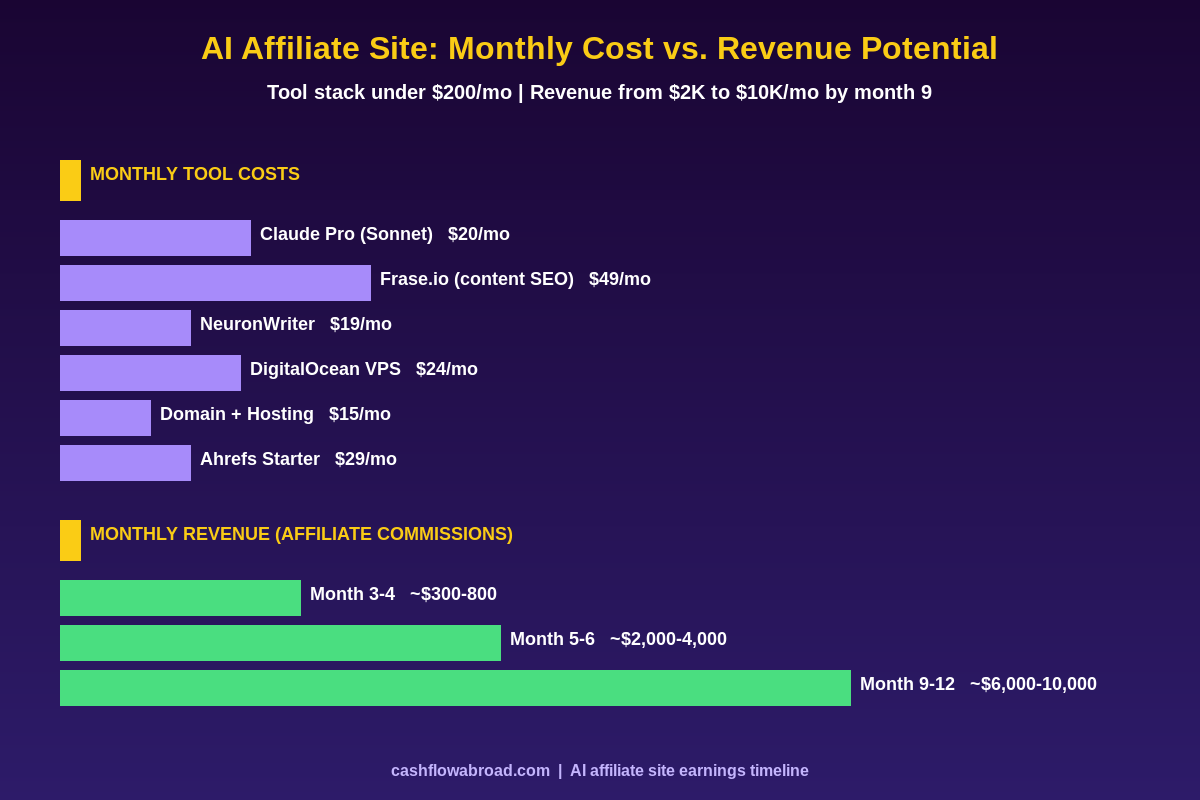
The Exact Tool Stack (Total Cost: $156/Month)
Here’s what a lean, effective AI affiliate site operation looks like in 2026. You can start for less and add tools as revenue scales.
| Tool | Purpose | Monthly Cost | Free Option |
|---|---|---|---|
| Claude Pro (Sonnet) | Content drafting, briefs, editing | $20 | Yes (rate-limited) |
| Frase.io | SERP research, content scoring, outlines | $49 | 5-day trial |
| NeuronWriter | NLP semantic optimization | $19 | No |
| Ahrefs Starter | Keyword research, backlink data | $29 | No |
| DigitalOcean VPS | WordPress hosting (1GB droplet) | $24 | $200 credit trial |
| Domain + Cloudflare | Domain registration, CDN, DNS | $15 | Cloudflare free |
| Total | $156/mo |
A few things worth noting in this stack. NeuronWriter at $19/month is criminally underpriced compared to Surfer SEO at $89/month. Both analyze the top-ranking competitors for your target keyword and tell you what semantic terms, word counts, and heading structures to include. NeuronWriter’s NLP analysis is arguably deeper for the price; the main thing Surfer has over it is a cleaner interface and a bigger brand. Frase handles the earlier-stage work — pulling the top 10 SERP results, extracting the questions people ask, and generating a content brief you can hand directly to Claude.
For hosting, a DigitalOcean droplet running Nginx and WordPress comfortably handles 50,000 monthly pageviews. It’s faster, cheaper, and more configurable than any shared hosting plan you’ll find. DigitalOcean’s $200 free credit for new accounts effectively gives you two months of hosting for free while you’re building your content base.
Picking a Niche: Where the Recurring Revenue Lives
The three most reliable affiliate niches for AI-assisted content in 2026 are SaaS tools, personal finance, and health/wellness — in that order by commission quality. SaaS is the sweet spot for this model because recurring commissions turn a referral made in March into income that’s still paying in November without additional effort.
What separates a good niche from a great one for this model:
- Recurring commissions — SaaS programs paying 25–30% monthly beat one-time e-commerce payouts every time, over any timeframe beyond 6 months
- High average order value — A $99/month SaaS tool at 30% recurring beats a $50 product at 10% one-time after the first three months, and compounds from there
- Dense comparison query volume — “Best X for Y,” “X vs Y,” and “X alternative” searches have high buying intent and are structurally easier to rank for than broad informational queries
- Active affiliate programs with history — Avoid programs launched in the last 12 months; look for programs that have been paying affiliates for 2+ years without issues
Specific sub-niches with strong affiliate economics in 2026: AI productivity tools (Jasper, Copy.ai, Notion AI), project management software (ClickUp, Monday.com, Asana), email marketing platforms (ConvertKit, ActiveCampaign, Beehiiv), cybersecurity (NordVPN, ExpressVPN, Malwarebytes), and online course platforms (Teachable, Kajabi, Podia). Each has a thick ecosystem of products, multiple affiliate programs paying 20–40% recurring, and a consistent stream of comparison searches.
The 20-Minute Keyword Research Process
Open Ahrefs Starter and filter for keywords in your niche with Keyword Difficulty (KD) under 30, monthly volume between 500 and 10,000, and containing words like “best,” “vs,” “review,” “alternative,” or “for [specific use case].” Export 200 keywords, then drop them into Claude with this prompt:
Categorize these 200 keywords into clusters by topic intent. Flag the ones with clear buying intent (comparison, review, and alternative searches) and remove purely informational queries. Return a prioritized list of 30 target articles ordered from lowest keyword difficulty to highest, and suggest a logical internal linking structure between them.Claude returns a structured content plan in under 2 minutes. This session used to take a senior SEO analyst half a day. It’s one of the starkest examples of what AI actually accelerates in this workflow — not the writing, but the strategy layer.
The Content Workflow: From Keyword to Published in 3 Hours
This is the actual sequence that gets a competitive 2,000-word affiliate review from keyword to published in under 3 hours. Not a framework — a workflow.
Step 1: Generate the Content Brief with Frase (15 min)
Open Frase, create a new document, and enter your target keyword (e.g., “best email marketing software for small business”). Frase pulls the top 10 SERP results, extracts their heading structures, word counts, and the questions showing up in “People Also Ask.” It gives you a content score for the current top-ranking article — usually 65–75 out of 100. Your target is to beat 80 to be competitive.
Export the brief as text. You now have: recommended sections, target word count, semantic terms that top-ranking articles all use, and the reader questions you need to answer. This is the brief you hand to Claude.
Step 2: Draft with Claude Pro (45 min)
Paste this into Claude (use the Projects feature to give it persistent context about your site’s voice and niche):
You are writing a detailed affiliate review for [site name].
Target keyword: [keyword]
Audience: [describe your readers — e.g., "freelancers and solopreneurs who need to manage client communication"]
Tone: practical, direct, slightly opinionated — like a knowledgeable peer who's actually used these tools, not a corporate blog
Required sections: [paste Frase outline]
Semantic terms to include: [paste Frase's term list]
Word count target: [X words]

Write the full article. Be specific about pricing, real features, and actual limitations. Give a clear recommendation rather than vague "it depends" answers. Include a comparison table near the top. Flag where I should add personal experience or specific examples.
Claude’s output is roughly 75–80% of the way to publishable. It has the structure, comparisons, and most facts right. What it consistently lacks: your personal experience, recent news (anything from the last few months), and the opinionated takes that actually keep readers on the page. That’s your 45-minute editing pass — add a genuine take in each section, update any outdated pricing you spot, and kill any filler paragraphs Claude padded in.
Step 3: NLP Score with NeuronWriter (20 min)
Paste your edited draft into NeuronWriter and run an optimization check against the top 10 competitors. It scores your content and highlights missing semantic terms — phrases like “automation workflows,” “A/B testing,” or “deliverability rates” that every top-ranking article includes but your draft might be light on. Hit the flagged terms naturally, bump your score above 70, and you’re positioned competitively. Above 75 and you’re likely outpacing at least half the current first-page results.
Step 4: Publish and Link (20 min)
Upload to WordPress, add affiliate links through a cloaking plugin like Pretty Links (keeps URLs clean and trackable), set internal links to related articles on your site, and submit the URL to Google Search Console for indexing. That’s it.
At 3 articles per week — realistic for a focused 10–15 hour week — you’ll have 36 articles after 3 months and 80 articles by month 6. That’s the inflection point where compounding kicks in.
Affiliate Programs That Actually Pay
Not all affiliate programs are worth building content around. The ones worth targeting share three traits: recurring commissions, a minimum 25% rate, and a cookie window of at least 60 days. Here are the programs with proven payment histories and solid economics:
| Program | Commission Rate | Type | Cookie Window | Avg. Annual Value/Referral |
|---|---|---|---|---|
| Jasper AI | 25% | Recurring | 45 days | $300–$600 |
| Frase.io | 30% | Recurring | 60 days | $175–$300 |
| Surfer SEO | 25% | Recurring | 60 days | $250–$500 |
| ConvertKit (Kit) | 30% | Recurring | 60 days | $200–$1,200 |
| ActiveCampaign | 20–30% | Recurring | 90 days | $300–$2,400 |
| ClickFunnels | 30–40% | Recurring | 45 days | $400–$2,000 |
| NordVPN | 40% | One-time + renewals | 30 days | $50–$100 |
The compound math on recurring commissions is what makes this model sustainable. Earn 100 active referrals on a $99/month SaaS tool at 30% recurring: that’s $2,970/month, every month, without producing anything new. Add a second program and a third, and you’re hitting $8,000–$10,000/month on a content base you built over 8–10 months. The average SaaS affiliate earns $5,967/month according to 2025 industry survey data — that’s not just the top earners, that’s the average for active operators who’ve been at it for 12+ months.
The Geographic Arbitrage Multiplier
This is where the model becomes genuinely life-changing for expats. Consider the monthly arithmetic for someone running this business from Medellín versus Austin:
| Expense | Austin, TX | Medellín, Colombia |
|---|---|---|
| Rent (1BR, central) | $1,800 | $550 |
| Food + dining out | $800 | $300 |
| Transport | $400 | $80 |
| Health insurance | $350 | $65 |
| Misc | $600 | $250 |
| Monthly total | $3,950 | $1,245 |
At $8,000/month in affiliate revenue, the Austin operator pockets $4,050 after expenses. The Medellín operator pockets $6,755. Over a year that gap compounds to $32,000 in additional capital — which goes into index funds, into a second site, or into a retirement account. The Medellín operator is also eligible for Colombia’s digital nomad visa, allowing up to two years of legal stay while earning foreign income. This guide covers the full Colombia nomad visa process if that’s on your radar.
The same math applies across Southeast Asia, the Balkans, and Central America. The business earns in dollars. The expenses land in pesos, baht, or lev. That asymmetry is the whole game — and the geographic arbitrage playbook covers exactly where that asymmetry is strongest right now.
For health coverage while building out the business, SafetyWing Nomad Insurance runs $65–$100/month depending on age and covers most countries — what most nomads carry in the early stages before establishing local coverage.
Setting Up a Bankable US Business From Abroad
This is where most people get stuck: how do you collect affiliate payments, open a real business bank account, and maintain US tax compliance when you’re running this from Chiang Mai or Tbilisi? Straightforward answer: it takes under a week and the infrastructure works exactly the same as if you were home.
Register a Wyoming LLC remotely. Wyoming has no state income tax and charges $62/year in annual fees — the lowest in the US for a real LLC. Register through a registered agent service like Northwest Registered Agent ($125/year) and you’ll have your LLC docs in 3 business days. You don’t need to be a US citizen or resident. The LLC gives affiliate networks a legitimate business entity to issue payments to.
Get a US mailing address. Affiliate networks, payment processors, and banks all want a real US address. A Traveling Mailbox subscription ($15–$25/month) gives you a real US street address (not a PO box) in a state of your choosing, scans your mail digitally, and handles check deposits. Anchor it in Wyoming or South Dakota to maintain a no-income-tax state domicile. This is the piece most nomads miss until an affiliate network flags their account for a missing US address.
Open Mercury for business banking. Mercury is the business bank almost every online operator in this space uses. Free, no minimum balance, opens remotely with your LLC docs and EIN, and accepts ACH payments from virtually every affiliate network. Affiliate programs that pay via Stripe or PayPal connect directly.
Protect your sessions with a VPN. Affiliate networks flag unusual login locations as potential fraud. If you’re jumping between Vietnam, Serbia, and Mexico in a month, a consistent exit IP from NordVPN ($3.99/month on the 2-year plan) eliminates that risk. It also protects your affiliate dashboards and WordPress admin from public WiFi threats — which matters when you’re managing $5,000+/month in commissions.
Realistic Income Timeline
Here’s what the revenue curve looks like based on operator reports and published case studies from 2024–2025. Assumes 10–15 hours per week of focused work:
- Month 1–2: Infrastructure setup, keyword research, first 20–25 articles published. Revenue: $0. First organic traffic appearing at the tail end of month 2.
- Month 3: Content gets indexed, first ranking keywords appearing. First affiliate clicks but minimal conversions. Revenue: $50–$200.
- Month 4: First real affiliate conversions. Several articles on page 2, a few breaking page 1. Revenue: $300–$800.
- Month 5–6: Site gains topical authority, rankings solidify. Recurring commissions from month 4 referrals start compounding. Revenue: $1,500–$4,000.
- Month 7–9: Content clusters ranking, evergreen articles driving consistent traffic. Recurring commissions from established referral base. Revenue: $4,000–$8,000.
- Month 10–12: Compounding effect in full force. Revenue from existing content + new articles. Revenue: $6,000–$12,000+.
The fastest way to compress this timeline: target low-competition keywords first (KD under 20), build 2–3 authoritative “hub” articles that rank for broad category terms, and link all supporting content to them. Sites that establish topical authority in a tight cluster rank faster than sites spreading content thin across many disconnected topics.
Shortcut: Buy an Existing Site
Sites with 6–18 months of history trade on Flippa and Empire Flippers at 25–40x monthly revenue. If a site earns $500/month and lists at 32x, you’re paying $16,000 for an asset that’s already earning, already ranking, and already has established affiliate relationships. For operators with $10,000–$20,000 to deploy, acquisition compresses the 9-month build timeline to day one. The caveat: due diligence matters. Verify traffic sources in Google Analytics, confirm affiliate network login access, and check for manual penalties in Google Search Console before buying anything.
What AI Doesn’t Actually Fix
Worth being honest here: AI doesn’t solve the link-building problem. Content quality has improved dramatically with AI assistance, but Google still uses backlinks as a primary domain authority signal. You need a link acquisition strategy — guest posting on established sites in your niche, building tools or resources that naturally attract links, or digital PR. Budget 2–3 hours per week on outreach starting around month 4, when you have enough content to reference in pitches.
AI also consistently struggles with the most valuable parts of a review: firsthand experience. Affiliate content that converts has a distinct voice and specific observations that pure AI text doesn’t capture. The top-performing affiliate sites in competitive niches aren’t using AI to write everything — they’re using it to handle scaffolding, research, and structural drafts while a human writer provides the differentiated perspective. That combination is where the durable edge is. Pure AI content works in low-competition niches; in anything competitive, it’s table stakes at best.
For a broader view on building income that works from anywhere, see how to build a $100K online business you can run from anywhere and passive income streams that hold up across any country.
Bottom Line
AI affiliate sites are one of the cleanest cash flow models available to expats in 2026: under $200/month in tool costs, no client work, no inventory, recurring revenue, and a production workflow that AI has made genuinely faster without sacrificing quality if you apply the human layer correctly. The geographic arbitrage angle turns a good business into an exceptional one — $8,000/month in Medellín is a qualitatively different life than $8,000/month in Austin, and the gap in retained capital over three years is six figures.
The window for building in lower-competition niches is still open, but it narrows every year as more operators figure out this is the play. Sites built today have an advantage over sites built in 2028 in the same way sites built in 2022 had an advantage over those built in 2025. The time to start is before the curve steepens.
Financial disclaimer: Income figures cited are based on published case studies and industry surveys from active affiliate marketers and should not be interpreted as typical results or guarantees. Affiliate marketing requires consistent effort, particularly during the 3–9 month ramp-up period before meaningful revenue appears. Past performance of other operators does not predict your results. This post contains affiliate links — if you purchase through them, we may earn a commission at no additional cost to you.
Liked this article?
Get the next one delivered straight to your inbox — plus a free Expat Tax Cheat Sheet.
Join our subscribers. No spam — just expat finance intel and new post notifications.