Bahrain for US Expats: 0% Tax Without the Dubai Price Tag
8 min read · 2,015 words
Most Americans chasing a 0% tax life abroad default to Dubai. That’s expensive tunnel vision. The island kingdom sitting 25 kilometers off Saudi Arabia’s east coast runs on the same Gulf oil money, enforces the same zero personal income tax, has the same US-dollar-pegged currency — and costs 31% less than Dubai across the board. Bahrain is the Gulf’s best-kept expat secret, and the gap between its reputation and reality is where the opportunity lives.
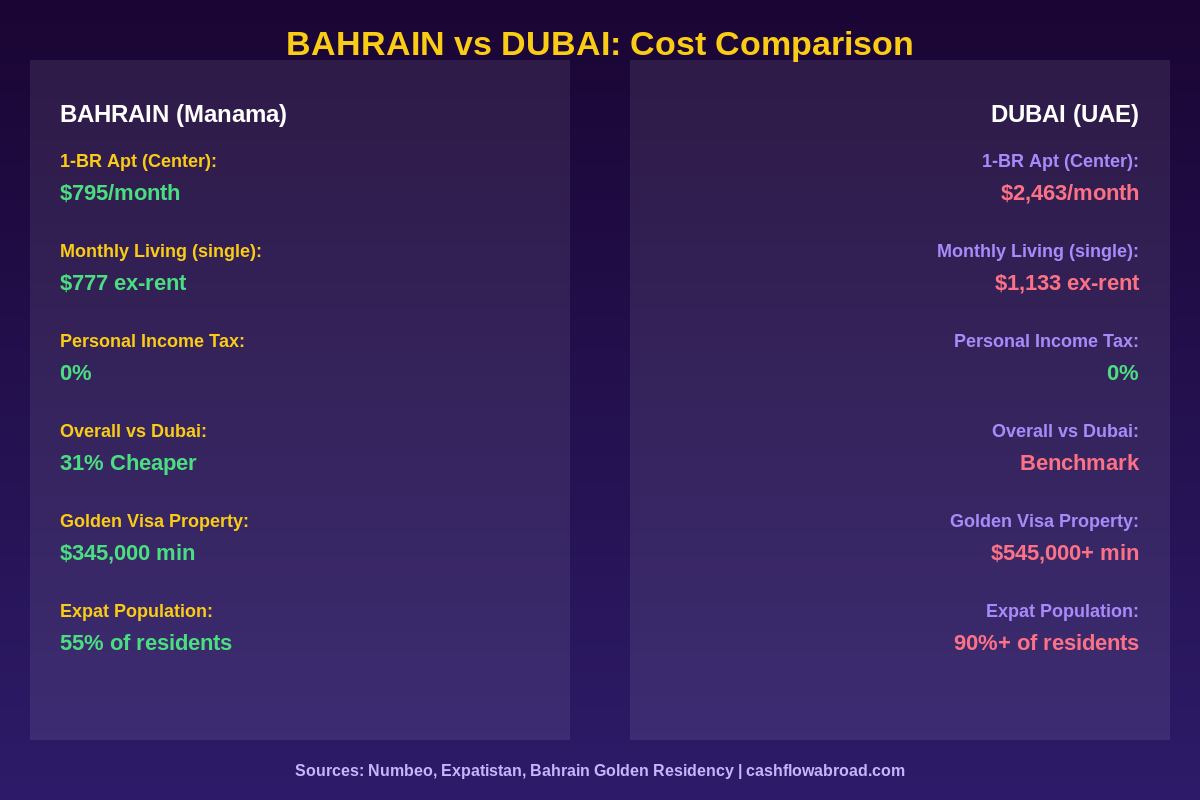
A one-bedroom apartment in central Manama runs around $795 a month. The Dubai equivalent clocks in at $2,463. Both charge you 0% in personal income tax. Do the math: you’re keeping the same tax advantage and banking an extra $1,668 every month just by picking the less-Instagrammed address.
Why Bahrain Lands Different for US Expats
Bahrain punches above its weight in ways that matter to Americans specifically. The Bahraini Dinar (BHD) has been pegged to the US dollar since 1980 — 1 BHD = $2.65 USD, no exceptions, no currency risk. Your US income holds its value. There’s no VAT equivalent for most consumer goods. There’s no wealth tax, no capital gains tax, no inheritance tax.
The country is roughly 55% expat by population. That means the infrastructure, banking, healthcare, and social scene are genuinely built for people who moved here from somewhere else. English is universally spoken in business. Bahrain has the Gulf’s most relaxed social environment — alcohol is legal and widely available, entertainment venues are abundant, and the culture has centuries of experience absorbing traders and expatriates from across the world.
Unlike Dubai, Bahrain is small enough to feel navigable. The entire country is about twice the size of Washington D.C. You don’t need a car for the first few months. The Bahrain International Airport connects you to Europe, Asia, and North America without the layover drama. And unlike some Gulf states, Bahrain has no mandatory dress code requirements for non-Muslim expatriates in most settings.
Visa Pathways for Americans
Bahrain doesn’t have a single-entry digital nomad visa the way Portugal or Indonesia does. But it has three practical routes that cover most situations.
Employer-Sponsored Work Permit
The most common path. If you’re hired by or seconded to a Bahrain-registered company, your employer handles the work permit through the Labour Market Regulatory Authority (LMRA). Permits are issued for one or two years, renewable. The employer fronts most of the paperwork — you need a valid passport, medical clearance, and in some roles, verified educational credentials. This route has no minimum income requirement and is the fastest path to a legal residency ID.
Golden Residency Visa — 10 Years, No Sponsor
Bahrain cut the Golden Residency property investment minimum by 35% in early 2026, bringing it down to BHD 130,000 (approximately $345,000 USD). That’s considerably below what comparable programs in Dubai or Portugal demand. The visa runs for 10 years, renewable, and it’s self-sponsored — no local employer or kafala system involved.
Golden Residency qualifications include:
- Real estate investors: Own property worth at least $345,000 at time of purchase
- Long-term employed professionals: Minimum 15 years of work experience in Bahrain
- Retirees: Pension income above BHD 2,000/month ($5,305 USD)
There’s no minimum time you must spend in Bahrain per year to maintain Golden Residency — that’s significant for people who want the residency as an anchor while still traveling. You can sponsor your spouse, children, and parents on the same application.
Freelancer and Business Owner Route
Bahrain’s old Flexi Permit (the self-sponsorship freelancer visa) was discontinued in 2022. The current route for independent workers is registering an Individual Establishment or a WLL (limited liability company), which qualifies you for an investor residency visa. Business registration fees run BHD 755 for a one-year permit or BHD 953 for two years — roughly $2,000–$2,525 USD annually. Practitioners suggest having verified income of at least $4,000/month to make this pathway smooth.
What Living in Bahrain Actually Costs
The “Gulf tax-free lifestyle” reputation usually comes with Dubai pricing — $3,500–$5,000/month for a decent setup. Bahrain breaks that assumption. A single expat can live comfortably here for $2,400–$3,200/month. Here’s the actual breakdown:
| Expense | Bahrain (Manama) | Dubai (UAE) |
|---|---|---|
| 1-BR apartment, central | $795/month avg | $2,463/month avg |
| 1-BR apartment, outer districts | $550/month avg | $1,537/month avg |
| Monthly living ex-rent (single) | $777 | $1,133 |
| Utilities (electricity, water, cooling) | $80–$160 | $200–$350 |
| Internet | from $32/month | from $55/month |
| Personal income tax | 0% | 0% |
| Social security (expats, Bahrain-source income) | 4% | 0% |
The 4% social security contribution only applies to income earned from Bahraini employers — if you’re a remote worker paid by a US company or a freelancer with foreign clients, you typically don’t owe it. For most US expats working remotely, the effective local tax burden is genuinely zero.
Where to Live in Manama
Bahrain’s expat population clusters in a handful of distinct neighborhoods, each with a different character:
- Juffair: The densest expat zone, loaded with restaurants, bars, and walkable street life. Rents are mid-range. Popular with younger professionals and US military families (the US Navy’s Fifth Fleet is based here).
- Seef District: Modern towers, malls, and offices. The financial and business hub. Best for professionals who want a polished, Dubai-lite feel without the Dubai price tag.
- Amwaj Islands: Waterfront living, family-oriented, quieter. A causeway-connected island with private beaches and newer developments.
- Adliya: Arts and dining scene. Old Bahrain character. Boutique restaurants and gallery spaces. Good for people who want local texture.
- Saar: Suburban villas, good schools, quieter pace. Popular with families who want space over walkability.
For most single expats and remote workers, Juffair or Seef hit the right balance of access and price. Families with school-age children tend to gravitate toward Saar or Amwaj Islands.
US Tax Obligations: What Doesn’t Change
Bahrain’s 0% income tax is genuine — but it doesn’t make you invisible to the IRS. The US taxes its citizens on worldwide income regardless of where they live. Moving to Manama doesn’t cancel your US filing obligation. Here’s what you’re actually dealing with:
Foreign Earned Income Exclusion (FEIE)
The FEIE lets you exclude up to $132,900 (2026 limit) of foreign-earned income from US federal tax. If you pass the 183-day physical presence test or establish bona fide Bahrain residency, this exclusion is available. Since Bahrain charges no income tax, you can’t use the Foreign Tax Credit to offset US taxes — but the FEIE does the job for most earners under the exclusion limit.
Earn more than $132,900? The excess is taxed at US rates, reduced by any applicable credits. Self-employed expats also owe US self-employment tax (15.3%) regardless of location — Bahrain has no totalization agreement with the US to eliminate this. That’s the one real stinger in the setup.
FBAR and FATCA Reporting
If you maintain a Bahraini bank account and the balance ever exceeds $10,000 across all foreign accounts, you must file FinCEN 114 (FBAR) annually. Foreign accounts with aggregate balances above $200,000 (or $300,000 at any point during the year) trigger FATCA Form 8938. Bahrain’s banks are well-established and FATCA-compliant — the Bank of Bahrain and Kuwait, Ahli United Bank, and National Bank of Bahrain all have experience with US account holders.
The complete picture of US expat banking and tax filing requirements is covered in our full FBAR and FATCA guide.
Banking and Moving Money
Getting a local Bahraini bank account requires your residency permit (or your employer’s sponsorship), a local address, and your passport. Most major banks offer accounts in both BHD and USD. The USD account is genuinely useful — the BHD peg means your USD transfers land at a fixed rate with no conversion roulette.
For your US side: Charles Schwab’s international brokerage account reimburses all ATM fees worldwide, makes an excellent companion to a Bahrain setup, and doesn’t close accounts just because you moved abroad — unlike Fidelity and Vanguard, which have a documented pattern of restricting expat accounts.
For transferring larger sums between your US accounts and Bahrain, Remitly handles USD-to-BHD transfers with transparent fees and good rates. Wire transfers from Bahraini banks to the US are straightforward — no capital controls, no exit taxes on moving money. See our expat money transfer guide for fee-by-fee comparisons.
Healthcare for US Expats
Bahrain has a functioning public healthcare system, but most expats — especially Americans — use private hospitals. The American Mission Hospital in Manama and the International Hospital of Bahrain both have English-speaking staff and solid reputations. A GP consultation at a private clinic runs BHD 15–30 ($40–$80). Quality care exists, but prices are lower than the US and below most Western European capitals.
Employer-sponsored expats typically receive health coverage as part of their package. Remote workers and freelancers need to arrange their own. SafetyWing’s Nomad Insurance covers Bahrain and works well for remote workers — it’s one of the most cost-effective international health plans at around $56–$100/month depending on age and coverage tier. For more comprehensive coverage, our expat health insurance comparison runs through SafetyWing, Cigna, and Allianz side by side.
Practical Setup: First 90 Days
Bahrain doesn’t require a visa for US citizens for stays up to 14 days, and you can obtain a 30-day tourist visa on arrival. Most expats land on a tourist visa, find housing, and convert to a residency permit once their employment or business registration is finalized.
Virtual mailbox: Before you leave the US, set up a Traveling Mailbox — it gives you a real US street address in any of 50+ cities, scans your mail, and handles check deposits remotely. This keeps your US bank accounts, IRS correspondence, and state domicile address intact while you’re abroad. Essential infrastructure, not optional.
Connectivity: Bahrain’s mobile network is excellent. Batelco and Zain both offer competitive SIM plans. Before arriving, a Saily eSIM keeps you connected from the airport while you sort a local SIM. NordVPN is worth running — some US streaming services, banking apps, and government portals geo-restrict to US IP addresses.
Housing: Most Manama apartments list on Propertyfinder.bh and Bayut.bh. Landlords typically ask for 2–4 post-dated cheques covering the full annual rent — a local banking quirk. Negotiate: many landlords now accept monthly or quarterly payments for shorter-term expats.
Who This Setup Actually Works For
| Profile | Bahrain Fit | Best Route |
|---|---|---|
| Remote worker, US employer | Excellent | Business registration / investor visa |
| Hired by Bahrain company | Excellent | Employer-sponsored work permit |
| Retiree with $5,300+/month pension | Excellent | Golden Residency (retiree category) |
| Investor with $345K+ to deploy | Strong | Golden Residency (property) |
| Freelancer, under $4K/month income | Moderate | Tourist visa rotations / consider alternatives |
| Digital nomad wanting max flexibility | Good base, limited nomad | Business registration required |
Bahrain works best as a base, not a visa-run destination. The residency pathways require some commitment — a job, a business registration, or a property purchase. It’s not Indonesia’s on-arrival social visit visa that you can theoretically live on indefinitely. But if you’re willing to plant a flag, the financial math is among the best in the region.
For a broader look at how geographic arbitrage works across different countries, our geographic arbitrage playbook compares 10 countries where US income buys significantly more life.
The Real Math: What You’re Actually Escaping
A US expat earning $150,000/year working remotely, living in California or New York, pays combined federal and state taxes of roughly $47,000–$55,000 annually. Move to Bahrain, claim the FEIE, and the first $132,900 drops to zero federal liability. On income above that threshold, US federal rates apply — but no California state tax, because California can’t tax you if you’ve properly severed domicile.
That’s a $40,000–$50,000 annual swing in take-home pay. Combined with Bahrain’s lower cost of living versus Dubai, a professional earning $120,000–$180,000 remotely can realistically save $70,000–$90,000 per year here. The compounding effect of that over five years makes most Golden Visa property investments look like a rounding error.
The Bottom Line
Bahrain is the Gulf expat setup hiding behind Dubai’s marketing budget. Zero personal income tax, a dollar-pegged currency, 31% lower cost of living than Dubai, a 55% expat population, multiple clear residency pathways, and a recently-discounted Golden Residency at $345,000. It’s not as flashy. It’s not on as many Forbes lists. That’s precisely the point.
If Dubai is the Gulf for people who want to be seen, Bahrain is the Gulf for people who want to keep more of what they earn.
Financial disclaimer: This post is for informational purposes only and does not constitute tax, legal, or financial advice. US expatriate tax situations are complex and fact-specific. Consult a qualified CPA or tax attorney with international expertise before making decisions based on this content. Tax laws and visa requirements change frequently — verify current rules with official government sources before acting.
Liked this article?
Get the next one delivered straight to your inbox — plus a free Expat Tax Cheat Sheet.
Join our subscribers. No spam — just expat finance intel and new post notifications.