Sell AI Digital Products: $5K/Month From Anywhere
Build a $3K–$8K/month passive income stream selling AI-generated templates, prompt packs, and mini-courses on Etsy, Gumroad, and Payhip — from anywhere in the world.
Build a $3K–$8K/month passive income stream selling AI templates, prompt packs, and mini-courses on Etsy, Gumroad, and Payhip from abroad.
A creator in Medellín, Colombia uploads a Notion template pack on a Tuesday morning. By Friday she's made $1,800 — never talked to a customer, never shipped anything, never woken up to a support ticket. Her cost of goods: a Claude Pro subscription ($20/month) and 14 hours of work spread across a week. Her cost of living: $1,400/month. The math gets uncomfortable fast.
Selling AI-generated digital products isn't new. What is new is how fast the tools have gotten, how low the quality floor is, and how aggressively platforms like Etsy and Gumroad have developed organic search traffic for this product category. In 2026, a disciplined solo operator living somewhere cheap can build a $3,000–$8,000/month passive income stream from digital products in 60–90 days. This guide shows exactly how.
Why AI Digital Products Are Perfect for Geographic Arbitrage
Most remote income models still trade time for money — you bill clients hourly, you write for publishers, you consult for companies. Digital products break that link entirely. You build the asset once; it sells indefinitely. When you're living in Chiang Mai on $1,100/month, even $2,000/month in passive product revenue is transformative. At $5,000/month it's life-changing.
The other reason digital products work especially well for expats: no US nexus problems, no physical inventory, no location-dependent business relationships. You create files, upload them to platforms, and collect money. Your tax situation stays clean (especially under the Foreign Earned Income Exclusion, which excludes up to $126,500 in 2024 if you're abroad 330+ days). Your operations are fully portable.
And unlike freelancing or consulting, your earnings don't disappear when you close the laptop. That's the whole point of building passive income streams from any country.
The 5 Most Profitable AI Digital Product Types
Not all digital products are equal. These five have the highest revenue-per-hour-of-creation ratio, based on 2025–2026 creator income data:
1. Notion Templates ($1,000–$3,500/month)
Notion has 30+ million users. A substantial portion will pay $15–$49 for a well-designed productivity template they don't have to build themselves. The categories that convert best: business operating systems, project management dashboards, financial trackers, content calendars, and client portals.
How to build one with AI: Open Claude (claude.ai, free tier works) and paste: "Design a complete Notion database structure for a freelance content agency. Include: client management, project tracking, invoice database, content calendar, and team task board. Give me the full database schema with properties, views, and formulas." Claude outputs the entire architecture. You build it in Notion, add custom icons (Flaticon, free), record a 5-minute Loom walkthrough, and you have a $29 product in about 4 hours of focused work.
Where to sell: Start on Etsy — its 95+ million active buyers search "Notion template" thousands of times daily. Once you have 25+ reviews, route your social traffic to Gumroad where you keep more of each sale.
2. Canva Template Bundles ($1,500–$5,000/month)
Canva has 170 million users. Most are small business owners, coaches, and creators who want professional-looking social graphics, pitch decks, and brand kits — without hiring a designer. A bundle of 30–50 cohesive social templates prices at $27–$67 and sells repeatedly from a single listing.
The AI workflow: Use ChatGPT to generate 30 post ideas for a hyper-specific niche (fitness coaches, real estate agents, coffee shop owners). Canva's own AI tools — Magic Design, background remover, Magic Write — handle most of the design work. Export your templates as shareable Canva links, bundle them with a PDF usage guide, and you have a shippable product within a weekend.
Volume is the variable: Creators who build shops of 50+ listings consistently out-earn those with 5 "perfect" listings. At $27/bundle, selling 4 bundles/day across 50 listings is $3,000+/month with essentially zero marginal cost per additional sale.
3. AI Prompt Packs ($300–$2,000/month)
PromptBase has 450,000+ users and 270,000+ prompts listed. Individual prompts sell for $1.99–$9.99, with PromptBase taking a 20% cut. But the real money is in bundling 25–50 prompts into a themed pack and selling it on Gumroad for $19–$49. A "Complete Marketing Agency Prompt Library" or "Real Estate Agent ChatGPT Pack" can move 50+ units/month with no ad spend once it has organic traction.
One seller who crossed 1,000 PromptBase sales at $4/prompt netted over $3,200 from that platform alone. Combined with custom prompt services and Gumroad bundles, she was pulling $6,000–$8,000/month total from prompts across platforms.
To build a pack: Use Claude to generate prompt variants for a target use case. Prompt it: "Generate 40 high-quality ChatGPT prompts for e-commerce store owners covering: product descriptions, email sequences, customer service scripts, ad copy, and review responses. Format each prompt so it's immediately copy-paste ready." Test each prompt, document the output, and include screenshots. Buyers pay for results, not just text — those output screenshots are your best marketing asset.
4. AI-Assisted Mini-Courses ($2,000–$8,000/month)
A "mini-course" means 5–10 short videos (10–20 minutes each) on a specific, actionable skill. Not a 40-hour masterclass — a focused toolkit people complete in a weekend. Priced at $47–$197, they convert far better than longer courses for cold traffic, and the margin is near-100% after platform fees.
Build the entire course with AI — here's the exact workflow:
- Use Claude: "Create a 6-module mini-course on [topic] for [audience]. Each module: 3 key lessons, one hands-on exercise, one actionable takeaway."
- Ask Claude to write full scripts for each lesson (15–20 minutes of content per module)
- Record on Loom ($8/month) or OBS (free) — screen recordings work just as well as face-cam
- Host on Gumroad (unlimited file storage on any plan) or Payhip
- Create the sales page thumbnail and graphics in Canva using DALL-E 3 or Midjourney imagery
One creator sold a 5-module course on "Using ChatGPT for Etsy SEO" to 400 buyers at $67 each — $26,800 total. She spent three weekends building it. The Etsy community on YouTube did her marketing for her.
5. eBooks & Swipe Files ($800–$3,000/month)
The most crowded category, but also the fastest to create and launch. Best-performing formats: hyper-specific playbooks ("The 7-Day Etsy Shop Launch Playbook"), swipe file collections (email sequences, LinkedIn post templates, sales page copy), and niche reference guides ("The 2026 Freelance Writer's Rate Guide").
Claude can draft a 5,000-word ebook in 20 minutes. Your job: edit for accuracy, add personal examples and specific data points, design a clean PDF layout in Canva. Price singles at $17–$37 on Gumroad; bundle three related ebooks at $67–$97 on Payhip to capture the higher average order value.
Platform Breakdown: Where to Sell What
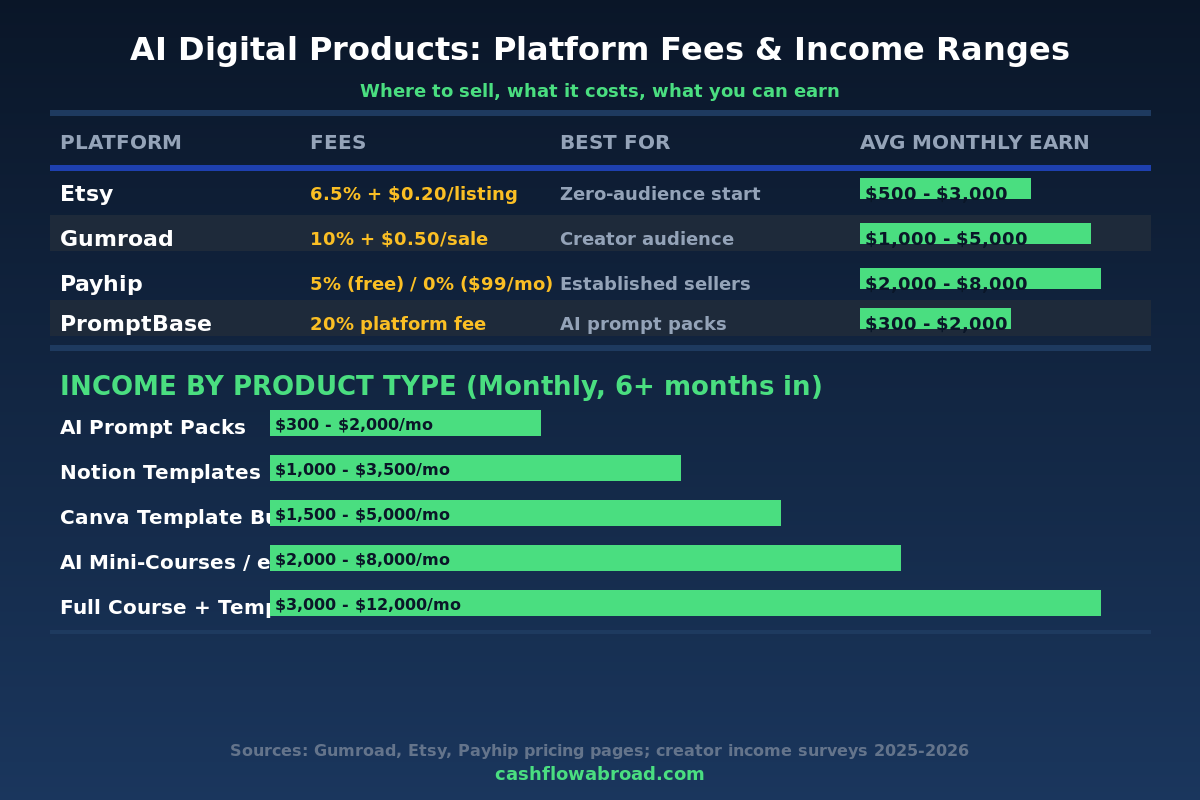
| Platform | Fees | Built-in Traffic | Best For | Ideal Stage |
|---|---|---|---|---|
| Etsy | 6.5% + $0.20/listing | Very High (95M buyers) | Templates, planners, printables | Starting with zero audience |
| Gumroad | 10% + $0.50/sale | Low | Courses, prompt packs, software | Once you have an audience |
| Payhip | 5% (free) / 0% ($99/mo) | Minimal | High-ticket bundles, memberships | Established ($2,000+/mo) |
| PromptBase | 20% platform cut | High (niche AI buyers) | AI prompts specifically | Any stage |
| Notion Marketplace | 0% (direct) | Medium (built-in users) | Notion templates only | Starting out |
The three-platform strategy: List your core products on Etsy first for organic marketplace traffic. Once you hit 25+ reviews, create a Gumroad storefront and start routing social traffic there (you keep more per sale). For bundles priced above $97, use Payhip — at $99/month the 0% fee saves real money at volume.
For collecting international payments into a fee-free US account while living abroad, Mercury is the cleanest option — free, FDIC-insured, no foreign transaction fees on the debit card. Both Stripe and Gumroad require a US address at setup; a virtual US mailbox like Traveling Mailbox handles that for $15–$25/month and scans your mail so you don't miss anything.
The Full AI Tool Stack: $67–$77/Month Total
| Tool | Use | Cost |
|---|---|---|
| Claude Pro (claude.ai) | Curriculum design, content drafting, prompt engineering, copy | $20/mo |
| Canva Pro | Template design, PDF layout, brand kits, AI tools | $15/mo |
| Notion | Building and hosting Notion templates before export | Free |
| Loom | Course videos, product walkthrough recordings | $8/mo |
| Carrd | Landing pages linking to Gumroad products | ~$2/mo |
| ChatGPT Plus (optional) | DALL-E 3 product mockup images, additional model access | $20/mo |
| DigitalOcean (optional) | Custom storefront or WordPress shop for full control | $12/mo |
If you skip ChatGPT Plus (Claude handles most of what you need), your tool stack costs $45/month. That's your entire infrastructure. For a custom product site beyond Gumroad/Carrd, a DigitalOcean Droplet at $12/month is cheaper and more flexible than managed WordPress hosting at 3× the price.
The 60-Day Launch Playbook

Days 1–7: Research before you build anything
Search Etsy for your product category and sort by "Most Recent." Find the newest listings with 50+ sales — these are your product briefs. Note exactly what titles, keywords, and price points they use. Check PromptBase's top sellers. Look at Gumroad's Discover page. Write down the 5 most-sold product types. Pick the one you can build in a weekend.
High-demand niches in 2026: productivity systems for freelancers, real estate agent social media templates, financial tracker dashboards, AI prompt packs for specific industries (legal, medical, e-commerce), and course creation toolkits for coaches.
Days 8–14: Build your first three products
Use the Claude workflows above. Build three related products that sell individually and bundle together. A bundle priced 20–30% above the sum of its parts will become your highest converter within 60 days. Budget 3–4 hours per product, plus 1 hour for the bundle listing.
Days 15–21: Launch on Etsy
Etsy listing SEO is 80% of the job. Lead your title with the exact keyword (e.g., "Notion CRM Template | Client Management Database for Freelancers"). Use all 13 tags. Upload 10 mockup images — use Canva's mockup frames or Smartmockups.com (free tier). Price 10–15% below your target to generate initial sales velocity, then raise after your first 25 reviews.
Days 22–45: Add listings, hit 15+, launch Gumroad
Create 2 new listings per week minimum. Etsy's algorithm gives temporary visibility boosts to new listings — use this consistently. Build your Gumroad storefront in parallel. In every Etsy description, mention (without linking): "Full bundle available at [yourname].gumroad.com." Start posting on Twitter/X (#BuildInPublic) and Pinterest — pins have a long shelf life and drive passive traffic for months.
Days 46–60: Bundle, email buyers, collect reviews
With sales data in hand, bundle your two best-selling product types into a premium pack. Create a Carrd landing page pointing to your Gumroad bundle. Email every buyer (Gumroad provides addresses): "Thank you — I've added a bonus [related resource] to your download." This 10-minute email generates reviews and repeat purchases without any tools beyond what you already have.
What the Numbers Actually Look Like at $1,500/Month Abroad
Medellín, Colombia: $1,400–$1,600/month covers a nice furnished apartment, food, social life, and gym membership. Here's the 12-month income trajectory for a creator running this playbook seriously:
| Month | Gross Revenue | Platform Fees (~8%) | Tool Costs | Net Profit |
|---|---|---|---|---|
| 1 | $400 | $32 | $47 | $321 |
| 2 | $1,100 | $88 | $47 | $965 |
| 3 | $2,400 | $192 | $67 | $2,141 |
| 6 | $5,500 | $440 | $77 | $4,983 |
| 12 | $9,200+ | $736 | $77 | $8,387+ |
At month 6, profit-to-cost-of-living ratio: 3.3×. The FEIE compounds this further — if this is your primary income and you're abroad 330+ days, up to $126,500 annually is excluded from US federal income tax. A $60K/year digital product business taxed at 0% federal beats a $100K W-2 taxed at 24% by a margin that's worth running the numbers on. See our full FEIE breakdown for the calculation.
For the full picture on countries where this cost-of-living math makes the most sense, see Geographic Arbitrage: 10 Countries That Actually Work.
Three Mistakes That Kill Digital Product Businesses Early
1. Building for yourself, not the buyer. You create the template you would want, not what buyers are searching for. Fix: do keyword research on Etsy before you build anything. The listings with 200+ sales are your product brief.
2. Underpricing to compete. A Canva bundle at $5 requires 400 sales/month to hit $2,000. At $37 it requires 54 sales. The higher-priced version often converts better because it signals quality. Price singles at $19–$29 minimum, bundles at $47–$97+.
3. Building one listing and waiting. Sellers making $3,000+/month typically have 30–80 listings. The passive income is the aggregate. The first 90 days are active product development, not passive income collection. Treat it like building inventory, not a lottery ticket.
The Bottom Line
The geographic arbitrage case for AI digital products is unusually clean: $47–$77/month in tools, no inventory, no clients, no location dependency, and a 60–90 day runway to meaningful recurring revenue. Living somewhere that costs $1,200–$1,800/month means you break even fast and compound faster.
The playbook: niche down hard, build with AI (Claude for content, Canva for design), start on Etsy for organic traffic, migrate high-value sales to Gumroad as your audience grows, and use Payhip for bundles above $97. Stack 50 listings before you judge results. Treat month 1 as R&D, not income.
If you're still working through the logistics of running a US business from abroad — banking, virtual mailbox, entity structure — check out our guide to virtual mailboxes for expats for the operational setup. For the broader income strategy, Passive Income Streams That Work From Any Country covers the full picture.
Financial disclaimer: Income figures in this post are drawn from publicly available creator case studies, platform surveys, and income reports from 2025–2026. Individual results vary significantly based on niche selection, product quality, marketing consistency, and effort. Nothing here constitutes financial, legal, or tax advice. Consult a qualified professional for advice specific to your situation. Some links are affiliate links — we may earn a commission at no extra cost to you.
This guide is general information, not personalized tax, legal, or investment advice. Rules change; verify current thresholds with official sources or a qualified professional before acting.
Related guides
 AI Income & Cash FlowMay 14, 2026
AI Affiliate Sites: Earn $5K/Month Living on $1,500 Abroad
Build an AI-powered affiliate site for under $200/month, earn $5K+/month in recurring commissions, and keep 80% by living in a low-cost country.
 AI Income & Cash FlowApril 30, 2026
Geographic Arbitrage + AI: Earn $8K/Month Abroad
Earn $75-$150/hr with AI skills while living on $1,500/month abroad. Real tools, rates, cities, and a 60-day client-landing plan.
 AI Income & Cash FlowJune 1, 2026
AI Automation Agency: Earn $15K/Month Abroad
Learn how to run a one-person AI automation agency from abroad, charging $3K–$5K/month retainers while keeping overhead under $300/month.