AI Affiliate Sites: Earn $5K/Month Living on $1,500 Abroad
Build an AI-powered affiliate site for under $200/month in tools, earn $5K+/month in recurring commissions, and keep 80% of it by living in a low-cost country abroad.
Build an AI-powered affiliate site for under $200/month, earn $5K+/month in recurring commissions, and keep 80% by living in a low-cost country.
The average affiliate marketer earns $8,038 per month. That's not a fantasy — it's the median reported by established practitioners in the space. Now here's the part most people miss: if you're running your affiliate operation from Chiang Mai, Medellín, or Tbilisi instead of San Francisco or New York, that same $8K/month income lands like $24K in purchasing power. Your rent is $600. Your food costs $400. Your total monthly burn? $1,200–$1,800. You're pocketing 75–85% of your gross.
AI has collapsed the time and capital required to build a serious affiliate site from 18–24 months of grinding to 6–12 months of focused execution. The full tool stack costs under $200/month. You don't need a team, an office, or even a reliable 9-to-5 internet connection — just a solid process, the right tools, and the discipline to stay consistent longer than your competition.
This guide breaks down exactly how to build an AI-powered affiliate content operation from scratch, designed specifically for expats and digital nomads who want to run it from a low-cost base.
Why AI Affiliate Sites Beat Other Online Income Streams for Expats
Most AI income streams require either active client work (freelancing, automation agencies) or significant upfront product development (SaaS, chatbots). Affiliate content sites are different: once a page ranks, it earns passively. No client calls, no service delivery, no support tickets.
The geographic arbitrage angle is particularly powerful here. A freelancer has to price competitively against global talent. An affiliate site owner earns based on Google's algorithm and buyer intent — geography is irrelevant to revenue but dramatically affects your profitability. Someone earning $5,000/month in affiliate commissions while living in Bali on $1,400/month keeps $3,600 after expenses. Their New York counterpart earning the same gross keeps maybe $1,200 after rent, food, and transport.
The catch: affiliate sites take time to ramp. Expect 4–6 months before meaningful traffic, 6–12 months before consistent commissions. The AI advantage is that you can compress the content production cycle by 70–80%, meaning you publish more, test faster, and reach critical mass sooner than someone building manually.
Picking Your Niche: The Make-or-Break Decision
The worst niche choice is the most obvious one: "best AI tools." That space is saturated by well-funded content teams publishing 50 articles per week. You cannot outrank them on volume, so don't try.
The winning strategy is to go one or two layers deeper. Instead of "best AI writing tools," you target "best AI tools for KDP self-publishing" or "best AI tools for Shopify product descriptions." Narrow niches have lower competition, higher buyer intent, and more loyal audiences. A site targeting "AI for solo real estate agents" serving 4,000 engaged readers can generate $2,500–$4,500/month in recurring affiliate commissions — and rank for keywords that a generic "AI tools" site will never touch.
High-value niches for AI affiliate sites in 2026:
- AI for e-commerce sellers — Shopify merchants, Amazon FBA operators, Etsy sellers
- AI for creators — YouTubers, podcasters, newsletter writers, course creators
- AI for service businesses — agencies, coaches, consultants, solo practitioners
- AI for specific verticals — real estate, legal, healthcare, finance (high commissions)
- AI productivity for remote teams — project managers, ops leads, distributed companies
Pick based on three criteria: (1) you have genuine interest or past experience in the audience's problems, (2) there are at least 10 solid affiliate programs in the space with recurring commissions, and (3) the audience pays for software subscriptions.
The AI Tool Stack: Under $200/Month
Here's the exact stack that runs a full affiliate content operation. Not aspirational — this is what you actually need and what it costs:
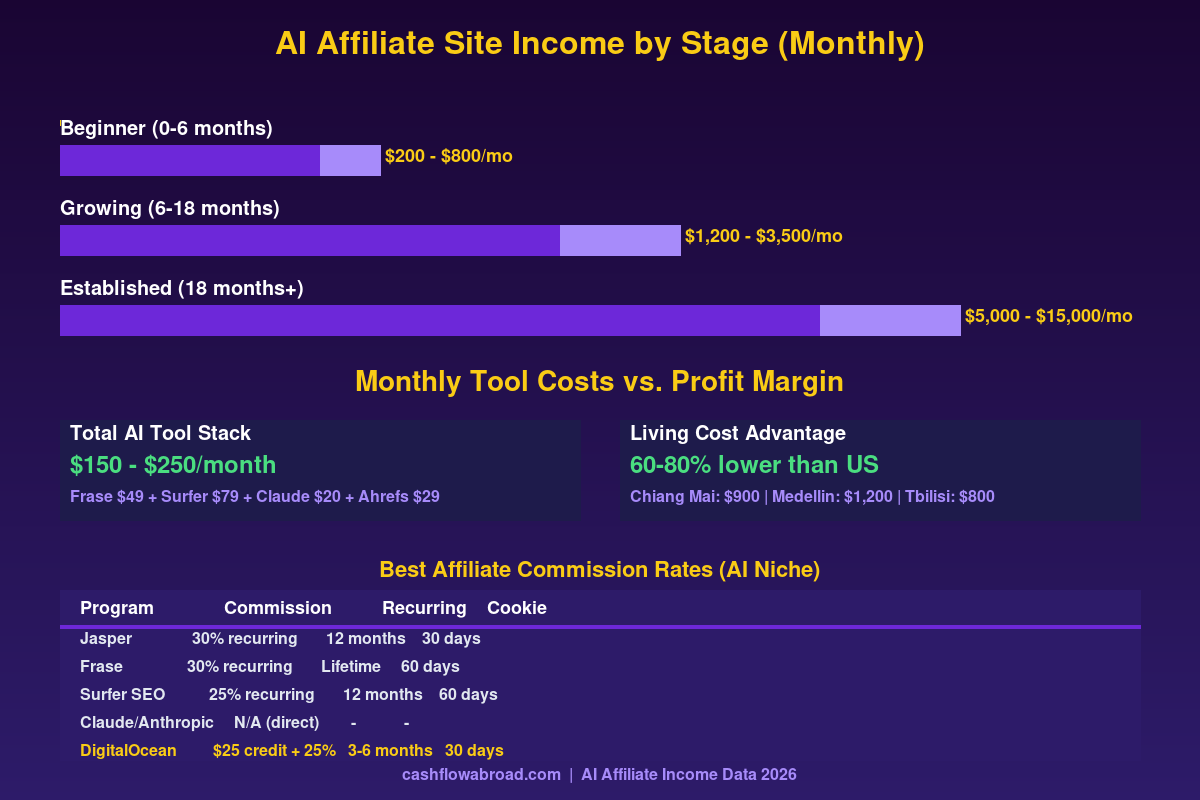
| Tool | Role | Price/Month | Free Tier? |
|---|---|---|---|
| Frase | Keyword research, content briefs, AI drafts | $49 (Solo) | 5 docs/mo free |
| Surfer SEO | On-page optimization, NLP keyword scoring | $79 (Essential) | No |
| Claude Pro | Research synthesis, content refinement, rewriting | $20 | Claude.ai free tier |
| Ahrefs Starter | Backlink analysis, keyword difficulty, competitor gaps | $29 | Free Webmaster Tools |
| DigitalOcean Hosting | Managed WordPress hosting (1GB droplet) | $12–$24 | $200 credit for new accounts |
| Total | $189–$201/mo |
For hosting, DigitalOcean's managed droplets are the expat-friendly choice — $200 in credits for new accounts, reliable global uptime, and no vendor lock-in. A $12/month droplet with 1GB RAM handles a lean WordPress affiliate site with no performance issues and straightforward SSH access from any café Wi-Fi.
One note on Claude vs. ChatGPT: Claude (Anthropic's model) consistently produces long-form content that doesn't read like marketing copy. The $20/month Pro plan gives you access to the full model with no usage caps that matter for a solo operation. Use it for research synthesis, paragraph rewrites, and turning your content brief into structured prose. Don't use it — or any AI — to publish raw, unedited drafts. The output needs your editorial layer.
The Content Workflow: From Keyword to Published
This is a repeatable process you can execute from any café with a 10 Mbps connection. Budget 3–5 hours per article including research, writing, and optimization.
Step 1: Keyword Research in Frase
Open Frase and run a topic research query for your niche. Focus on question-based keywords (how to, best, vs., review, alternative) with monthly search volumes between 500–8,000. Avoid anything over 10K — those are either dominated by major publications or too informational to convert.
Prioritize keywords with buyer-journey alignment. "Jasper vs. Writesonic for e-commerce product descriptions" is better than "what is Jasper AI" — the former signals someone 72 hours from subscribing, the latter is curiosity traffic with near-zero conversion.
Step 2: Build a Content Brief
Frase auto-generates briefs by scraping the top 10 ranking pages and extracting common topics, questions, headers, and NLP terms. Review the brief and add your own angles — specifics from your experience that the generic SERP doesn't cover. That differentiation is what earns rankings once Google's Helpful Content signals kick in.
Export the brief as a structured outline with H2s and H3s. This becomes your writing skeleton.
Step 3: Research Synthesis with Claude
Paste your content brief into Claude Pro with this prompt framework:
You are a [niche] expert writing for an audience of [target reader profile].
Using this content brief, help me write a [word count] article on [topic].

Requirements:
- Include specific pricing, features, and use cases for each tool mentioned
- Add one or two counterintuitive insights the typical listicle misses
- Write in an authoritative but conversational tone — no marketing fluff
- Flag anywhere you're uncertain so I can fact-check

Brief: [paste your Frase brief here]
Claude will produce a solid 70% draft. Your job is the remaining 30%: add your own experience, correct any hallucinated pricing or feature claims, and inject the specific details that make the piece feel written by someone who's actually used the tools — because it should be.
Step 4: Optimize in Surfer SEO
Paste the final draft into Surfer's Content Editor and target a score of 70+. Surfer shows you the exact NLP terms you're missing and where your word count falls short of competing pages. Don't chase 100 — over-optimization makes content read like a bot wrote it. 70–80 is the sweet spot.
Comparison pages (Tool A vs. Tool B) convert at 4.6% compared to 2.1% for general informational posts — more than double. Prioritize these in your content calendar once you've established topical authority in your niche.
Step 5: Publish and Interlink
WordPress with Rank Math SEO handles the technical publishing layer. For each article: write a custom meta title (55–60 chars), meta description (under 155 chars), set the focus keyword, and add 3–5 internal links to related articles already on your site. Build a hub-and-spoke content architecture — topic clusters around your 5–6 main keyword groups, with each spoke article linking back to the pillar piece.
Publishing pace: aim for 4–6 articles per week in months 1–3, then settle into 2–3 per week once you hit 60+ indexed pieces. Consistency matters more than raw volume.

Which Affiliate Programs Actually Pay Well
Not all affiliate programs are created equal. The best ones for AI content sites pay recurring commissions — meaning you earn every month a referred customer stays subscribed, not just on the initial signup.
| Program | Commission | Cookie Duration | Recurring? | Est. Monthly/Referral |
|---|---|---|---|---|
| Jasper | 30% | 30 days | Yes, 12 months | ~$25/mo |
| Frase | 30% | 60 days | Lifetime recurring | ~$15/mo |
| Surfer SEO | 25% | 60 days | Yes, 12 months | ~$20/mo |
| Semrush | $200 flat + 10% recurring | 120 days | Partial | $200 upfront |
| GetResponse | 33% recurring | 120 days | Lifetime | ~$18/mo |
| DigitalOcean | $25 credit + 25% | 30 days | Yes, 3–6 months | ~$30 per referral |
The math on recurring commissions compounds quickly. Refer 20 Jasper customers in month 3 at $49/month plans and that's $294/month in passive commission income. Stack Frase, Surfer, and GetResponse referrals on top and you reach $1,200–$1,800/month from 60–80 total active referrals. Keep publishing and the number grows without proportional labor.
Apply to programs via their direct affiliate portals rather than through aggregators like ShareASale or CJ when possible — direct relationships pay faster and often have higher commission tiers for high-volume publishers.
The Geographic Arbitrage Advantage: In Numbers
Running an affiliate site from abroad isn't just a lifestyle choice — it's a structural financial advantage that compounds. Consider two operators both clearing $5,000/month in affiliate commissions by month 18:
Scenario A: Austin, TX
Rent $1,800 | Food $700 | Transport $400 | Misc $400 | Monthly surplus: $1,700
Scenario B: Medellín, Colombia
Rent $700 | Food $350 | Transport $80 | Co-working $100 | Misc $200 | Monthly surplus: $3,570
The Medellín operator accumulates $22,920 more per year from identical revenue. Over three years, that's $68,760 compounding into investments, an emergency buffer, or seed capital for the next income stream.
For US citizens, the Foreign Earned Income Exclusion (FEIE) can shelter up to $126,500 of foreign-earned income from federal income tax if you qualify. Self-employment taxes still apply to US citizens regardless of residency, but the combined effect significantly reduces your effective rate. Combine with a territorial tax country like Georgia ($800/month cost of living, 1% tax on IT services), Colombia, or Panama, and your overall tax position on affiliate income can drop below 10%.
If you're maintaining a US LLC while living abroad, a virtual mailbox service like Traveling Mailbox keeps your US address active for banking, LLC registrations, and affiliate program applications that require a domestic address. Cost: $15–$25/month — easily one of the highest-ROI expenses in your stack.
US Banking and Receiving Affiliate Payments from Abroad
Most affiliate networks pay via direct deposit or wire transfer to a US bank account. Keeping that account functional as an expat requires a US address, a US phone number, and a bank that doesn't close accounts for extended international usage.
Mercury is the cleanest solution for this — a US business bank account built for remote founders, with no monthly fees, no minimum balance, and a web interface that works reliably from anywhere. Most affiliate networks can direct deposit to Mercury via ACH. Pair it with a Charles Schwab International brokerage account for fee-free ATM withdrawals in any currency, anywhere.
For international currency conversion, Remitly offers competitive rates for moving USD into local currencies across Southeast Asia and Latin America, typically with tighter spreads than bank wire transfers.
What to Avoid: Common Mistakes That Kill Sites Early
Publishing unedited AI drafts. Raw Claude or ChatGPT output is detectable and, more importantly, it reads generic. Google's Helpful Content system has been aggressively demoting thin AI content since late 2024. Every article needs your editorial pass — add specific examples, correct hallucinated product details, and make it read like a person who has actually used the tools wrote it.
Targeting high-volume keywords too early. A new site with no domain authority will not rank for "best AI writing tool." Spend the first 6–8 months going long-tail. Build authority in a specific corner of your niche first, then expand to broader terms.
Promoting too many programs at once. Pick 3–5 affiliate programs and go deep on them. Review every plan tier. Build a reputation as the go-to resource for those specific tools rather than a scattershot directory of everything.
Skipping VPN security. Working from foreign Wi-Fi without a VPN exposes your affiliate accounts, banking sessions, and site admin credentials. NordVPN at $3.39–$4.99/month is the minimum security overhead for remote digital operations — non-negotiable when you're logging into affiliate networks from café networks in Bangkok or Tbilisi.
Realistic Income Timeline
This is a disciplined-execution median — not a best case. Assumes 4–5 articles per week, consistent publishing, and active backlink building from month 6 onward:
- Months 1–2: Site setup, initial 20–30 articles. Revenue: $0–$50. Focus entirely on content volume and internal linking architecture.
- Months 3–4: First pages enter top-20 rankings. Early affiliate clicks. Revenue: $100–$400/month. Add comparison articles and "best X for Y audience" content.
- Months 5–6: 50–80 indexed articles, a handful ranking top-10. Revenue: $400–$1,200/month. Begin building 2–3 backlinks per month via digital PR or niche guest posts.
- Months 7–12: Site authority compounds. Comparison pages start converting at scale. Revenue: $1,500–$4,000/month. Reinvest 20% of gross into link building.
- Month 18+: Established authority in your niche. Revenue: $5,000–$15,000/month for a tightly scoped site with 100+ indexed articles and a real backlink profile.
The variance is significant. A bad niche selection, a Google core update, or 3 months of inconsistent publishing can set you back a full quarter. That's why the geographic arbitrage foundation matters: if your expenses are $1,200/month and you have 6 months of savings, you can weather turbulence without panicking and pivoting too early.
Getting Started
The barrier to entry is genuinely low: $200/month in tools, a $15 domain, and a consistent publishing schedule. The real competitive moat is staying in the game long enough for your site to accumulate topical authority while competitors burn out and quit.
For more on structuring the business side of remote operations, see running a US business while living abroad and building passive income streams from any country. If you're deciding where to base your operation, the geographic arbitrage playbook covers 10 countries with the best combination of low cost, fast internet, and expat infrastructure.
Conclusion
AI affiliate sites are one of the most accessible asymmetric income strategies available to expats right now. The AI tools cut content production time by 70%. Recurring commissions mean revenue grows even when you're offline. And the geographic arbitrage foundation — running everything from a $1,200/month cost base instead of a $4,500/month one — transforms a modest $5K/month gross into a genuine wealth-building engine.
The constraint isn't capital or technical skill. It's patience and consistency across the first 12 months. If you're already living abroad or planning to, you have the built-in financial runway to outlast the competition and reach the income threshold where the compounding takes over.
Financial disclaimer: Affiliate income projections are illustrative and based on aggregated industry data, not guaranteed outcomes. Individual results vary based on niche selection, content quality, backlink profile, and search algorithm changes. This post contains affiliate links — we may earn a commission if you purchase through them, at no extra cost to you. Nothing in this post constitutes financial or tax advice. Consult a licensed tax professional regarding your specific residency and income situation.
This guide is general information, not personalized tax, legal, or investment advice. Rules change; verify current thresholds with official sources or a qualified professional before acting.
Related guides
 AI Income & Cash FlowMay 27, 2026
Sell AI Digital Products: $5K/Month From Anywhere
Build a $3K–$8K/month passive income stream selling AI templates, prompt packs, and mini-courses on Etsy, Gumroad, and Payhip from abroad.
 AI Income & Cash FlowApril 30, 2026
Geographic Arbitrage + AI: Earn $8K/Month Abroad
Earn $75-$150/hr with AI skills while living on $1,500/month abroad. Real tools, rates, cities, and a 60-day client-landing plan.
 AI Income & Cash FlowMay 21, 2026
Sell AI Services on Upwork: $5K/Month From Abroad
Demand for AI skills on Upwork grew 109% in 2026. Use this step-by-step guide to sell AI services and earn $5K–$10K/month while living abroad.