AI Automation Agency: Earn $15K/Month Abroad
A solo AI automation agency charging five clients $3K/month generates $15K MRR — with a tool stack that costs under $300/month and zero employees required.
Learn how to run a one-person AI automation agency from abroad, charging $3K–$5K/month retainers while keeping overhead under $300/month.
A single client paying a $3,000/month automation retainer covers two full months of living expenses in Medellín, Chiang Mai, or Tbilisi — and most solo agency owners carry five of them. That's the entire pitch. You're not building a startup, hiring a team, or raising capital. You're building a small, tight roster of US and EU businesses that pay you recurring money every month to keep their operations running on autopilot while you sit in a $600/month apartment with fast Wi-Fi and a view of something better than a parking garage. This isn't a fantasy. It's a leverage arbitrage play that works because geography is still real, automation tooling is now cheap enough for one person to wield, and most small businesses are drowning in repetitive manual work they haven't touched in years.
What an AI Automation Agency Actually Does (and What It Doesn't)
Let's cut the buzzword fog. An AI automation agency does not build large language models, train neural networks, or require a computer science degree. What you're actually doing is connecting software systems that don't talk to each other, replacing manual copy-paste work with triggered workflows, and layering AI responses (usually via Claude or GPT-4o) into those workflows where a human used to have to make a judgment call.
A dentist's office gets a new lead from a Facebook ad. Right now, their front desk person checks the ad dashboard every few hours, copies the name and number into a spreadsheet, and texts the lead manually — usually four to six hours later. You build a workflow: lead comes in, it's automatically added to their CRM, a personalized SMS fires within two minutes, and if they don't respond in 24 hours, a follow-up sequence kicks off. Total setup time: three to eight hours. Monthly value to the client: they're booking 30% more consultations from the same ad spend. Monthly retainer you charge to maintain, monitor, and iterate: $3,000.
What this is not: AI strategy consulting at $300/hour, ML engineering, or anything requiring you to write Python from scratch. The tools do the heavy lifting. You're the architect who knows which tools to connect and why.
Core deliverable categories that fill most retainers:
- Lead capture and nurturing automation — ad leads, form fills, inbound emails routed and responded to instantly
- CRM and pipeline automation — deal stage triggers, task creation, sales rep notifications
- Client onboarding flows — intake forms, contract sends, welcome sequences, Slack channel creation
- AI-powered support and FAQ bots — trained on the client's knowledge base, embedded in their site or Slack
- Reporting and data aggregation — pulling numbers from five places and pushing a weekly summary to the founder's inbox every Monday at 8am
- E-commerce and ops triggers — inventory alerts, order status updates, chargeback notifications to Slack
Each of these is a workflow someone had to do manually. Once you automate it, it runs without you — which is why retainers work. The client pays you to maintain, improve, and expand the system, not to rebuild it from scratch every month.
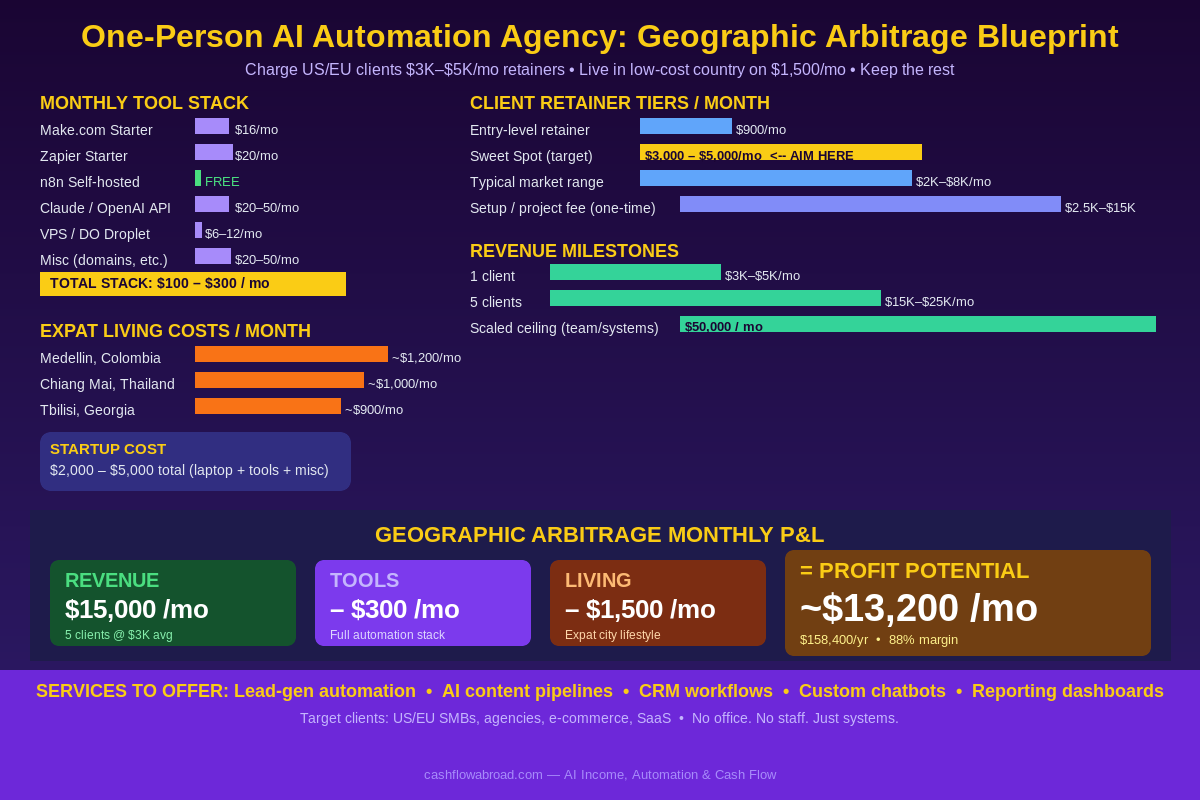
The Geographic Arbitrage Math: Why Location Is Your Biggest Lever
Most agency owners in the US or UK who do this work charge the same rates — but they also pay $2,500/month in rent, $700/month in health insurance, and $400/month eating out. Their effective hourly rate after expenses is a fraction of what it looks like on paper. You're not competing on price. You're competing on margin.
Here's what $1,500/month gets you in three cities where remote workers are well-established:
| City | Monthly Rent (1BR, good area) | Food & Coffee | Transport | Co-working / Wi-Fi | Total Comfortable Budget |
|---|---|---|---|---|---|
| Medellín, Colombia | $500–$700 | $300–$400 | $50–$80 | $80–$150 | $1,100–$1,400/mo |
| Chiang Mai, Thailand | $400–$600 | $250–$350 | $60–$100 | $60–$120 | $900–$1,200/mo |
| Tbilisi, Georgia | $450–$650 | $280–$400 | $40–$70 | $60–$100 | $950–$1,300/mo |
| Austin, TX (comparison) | $1,600–$2,200 | $600–$900 | $200–$400 | $200–$400 | $2,800–$4,000/mo |
At five clients paying $3,500/month each, you're grossing $17,500/month. With a $1,300/month cost of living and a $300/month tech stack, your margin is roughly 88%. A US-based equivalent doing the same work, living in Austin, has a margin of maybe 55–60% after expenses — and they're probably charging less because their market is more saturated with local competition.
The math also changes your risk tolerance. In Austin, losing one client means a genuine financial problem. In Medellín, losing one client means you're still profitable. That stability lets you take better clients, fire bad ones faster, and negotiate from a position of calm instead of desperation.
For structuring the business side — banking, entity, taxes — a US LLC while living in Colombia is a legitimate and common setup. You keep US banking, invoice in dollars, and pay yourself as a foreign owner of a pass-through entity. Mercury is the default banking choice for this structure — it opens 100% online, works with non-resident owners, and integrates cleanly with Stripe and Wise. Open a Mercury account here before you land your first client so you're ready to receive wire transfers from day one.
If you need a US mailing address for your LLC registration, IRS correspondence, and banking verification, Traveling Mailbox gives you a real street address with scanned mail for around $15/month. Non-negotiable if you're running a legit US entity from abroad.
For a broader look at how the numbers compare across different countries, the geographic arbitrage playbook breaks down ten destinations with cost-of-living data, visa options, and banking friction.
Your $300/Month Tech Stack: Make, n8n, and When to Use Each
You don't need much. Here's what a lean, functional AI automation agency runs on:
| Tool | Use Case | Monthly Cost | Notes |
|---|---|---|---|
| Make.com (Core plan) | Client workflow automation | $16–$29/mo per workspace | Visual, fast to build, great for client-facing flows |
| n8n (self-hosted) | Complex/high-volume workflows | ~$6/mo (VPS) or free | Per-execution billing, open source, no vendor lock-in |
| Claude API (Haiku) | AI responses in workflows | $1.00/$5.00 per 1M tokens | Use for classification, summaries, drafting responses |
| Airtable or Notion | Client ops dashboard | $0–$20/mo | Track workflow status, client notes, SOPs |
| Slack + Zapier (light) | Internal alerts + simple triggers | $0–$25/mo | For fast prototypes before moving to Make/n8n |
| DigitalOcean Droplet | Host n8n + custom webhooks | $6–$12/mo | 1-click n8n deploy, reliable uptime |
| NordVPN | Secure client access, stable IP | ~$4/mo (annual) | Consistent IP for OAuth and API whitelists from abroad |
Make vs n8n is not a religious debate — it's a job-fit question. Make is faster to build and easier to show clients during scope calls. n8n is better when you need complex branching logic, custom code nodes, or you're running hundreds of executions per day where Zapier's per-task billing would destroy your margin.
A practical rule: use Make for new client onboarding (it's visual and you can screen-share it), then migrate high-volume workflows to a self-hosted n8n instance on DigitalOcean once the workflow is stable and you know it'll run thousands of times a month.
Here's what a basic n8n workflow for a lead capture automation looks like in JSON structure — useful to understand when you're scoping a client project:
{
  "nodes": [
    {
      "name": "Webhook Trigger",
      "type": "n8n-nodes-base.webhook",
      "parameters": {
        "path": "new-lead",
        "responseMode": "onReceived"
      }
    },
    {
      "name": "Add to CRM",
      "type": "n8n-nodes-base.hubspot",
      "parameters": {
        "operation": "create",
        "resource": "contact"
      }
    },
    {
      "name": "AI Response Draft",
      "type": "n8n-nodes-base.anthropic",
      "parameters": {
        "model": "claude-haiku-4-5",
        "prompt": "Draft a personalized first-touch SMS for: {{$json.first_name}} interested in {{$json.service}}"
      }
    },
    {
      "name": "Send SMS",
      "type": "n8n-nodes-base.twilio",
      "parameters": {
        "to": "={{$json.phone}}",
        "message": "={{$node['AI Response Draft'].json.text}}"
      }
    }
  ]
}
On the AI side: Claude Haiku at $1.00 per million input tokens is your workhorse for classification, tagging, and short-form responses inside automations. Reserve Claude Sonnet ($3.00/$15.00 per million tokens) for longer drafts or anything client-facing that needs actual quality. The batch API gives you a 50% discount on async workloads — use it for anything that doesn't need a real-time response, like nightly report generation or weekly digest emails.
For security when you're connecting to client APIs from a coffee shop in Tbilisi or a co-working space in Chiang Mai, NordVPN keeps your IP consistent and your connections encrypted. Many client CRMs and admin panels will flag logins from new countries — a static IP via VPN prevents that headache.

The Five Client Types That Pay $3K–$5K/Month Without Blinking
Not every business is worth pursuing. You want clients who have real revenue (so the retainer isn't a stretch), clear repetitive workflows (so you can show fast results), and high customer lifetime value (so the automation ROI is obvious). Here are the five that fit that profile consistently:
1. Local Service Businesses with High Ticket Prices
Dental practices, med spas, cosmetic surgeons, law firms. These businesses charge $500–$5,000 per appointment or case. Missing a single follow-up is a $2,000 loss. If you automate their lead response and cut their response time from four hours to two minutes, you can point to booked appointments as direct revenue impact. They don't need to understand what Make.com is. They need to know you made the phone ring more.
2. Coaching and Consulting Businesses
Online coaches doing $500K–$2M/year are almost universally overwhelmed with onboarding admin. Application forms, discovery call scheduling, payment confirmations, welcome kit delivery, Slack onboarding — none of it is hard to automate, all of it is currently manual. A $3,500/month retainer to handle this is a no-brainer when it frees up 15 hours/week of their time or their VA's time.
3. Real Estate Teams and Brokerages
Lead qualification, follow-up sequences, and showing scheduling are high-volume and repetitive. A team closing 20 deals/month with $8,000 average commission per deal is not going to blink at $4,000/month if you can show that your lead nurturing workflow converts 10% more inquiries to appointments.
4. E-Commerce Brands ($1M–$10M Revenue)
Order notifications, abandoned cart flows, support ticket routing, inventory alerts, and supplier communication are all automatable. These brands usually have a Shopify back-end and an understaffed ops team. They understand ROI and they have the budget. Stay away from the micro-stores doing $10K/month — they can't afford you comfortably.
5. SMBs with Sales Teams
Any company with five or more salespeople who manually log calls, update CRM fields, send follow-up emails, and build pipeline reports is hemorrhaging time. Automate their CRM hygiene, their post-call follow-up sequences, and their weekly pipeline summaries, and you're saving the equivalent of one full-time employee's effort. Pricing your retainer at $4,000/month against $6,000/month in saved labor is an easy conversation.
How to Land Your First Retainer Client in 60 Days
The biggest mistake people make here is starting with a website and a service menu before they have a single conversation with a real prospect. Do it backwards.
Week 1–2: Identify 20 target businesses. Pick one vertical from the five above. Find 20 specific businesses in that vertical in the US or UK — not categories, actual named companies with actual owners you can find on LinkedIn. Look for businesses with 5–50 employees, active social media (means they're generating leads they need to handle), and a website that looks like it hasn't been touched since 2019 (means they're not technical and probably doing everything manually).
Week 3–4: Outreach with a specific hypothesis. Don't send "I help businesses with AI automation." Send this instead:
Subject: [Business name] — your Facebook lead follow-up

Hi [Name],

I looked at your Facebook page — you're running ads for [service].
Most [industry] businesses I talk to take 4–6 hours to follow up
with those leads. At that point, 60% have already called a competitor.

I build automations that respond within 90 seconds, personalized
by what the lead clicked on. Takes about a week to set up.

Worth a 20-minute call to see if the numbers make sense for you?

[Your name]
This works because it shows you looked at their specific situation, names the specific problem, and offers a specific outcome. The call request is low-stakes. You're not selling a retainer in the first email — you're selling a conversation.
Week 5–6: Run a paid pilot. Don't give away free work. Offer a $750–$1,500 fixed-price pilot to build one workflow and prove the ROI. This does two things: it filters out people who aren't serious, and it gives you a working example inside their actual business. After two to four weeks of the pilot running, you have a case for the retainer — "here's what we built, here's what it did, here's what maintaining and expanding it looks like at $3,000/month."
Week 7–8: Convert the pilot to a retainer. The conversation isn't a hard sell. You show them the workflow metrics, name two or three adjacent automations that would compound the results, and propose a 3-month minimum retainer. Most clients who had a good pilot experience will convert. The ones who don't weren't worth the retainer anyway.
For a deeper framework on building a location-independent income stream structured around service retainers, the $100K online business playbook covers client acquisition, positioning, and revenue model decisions in more depth.
Pricing, Scope, and Protecting Your Time Across Time Zones
The retainer model only works if scope creep doesn't turn a $3,000/month engagement into a 60-hour/month job. Here's how to prevent that.
Define deliverables, not hours. Your retainer agreement should list what's included: X active workflows maintained, Y new automation builds per month, a monthly strategy call, and a response SLA (24-hour response to issues, 48-hour for non-urgent requests). Do not sell "up to 20 hours/month." You'll spend those 20 hours and the client will still feel like they're getting less than they paid for.
Set expectations about time zones upfront. Most US clients are fine with a four to eight hour response window. State it explicitly: "I operate on [timezone], my standard response window is within 24 business hours." Clients who need real-time availability are the wrong clients. Your systems should handle urgency — a well-built automation doesn't need you to be awake at 3am.
Charge setup fees separately. Initial builds are $2,500–$5,000 depending on complexity, paid before you start. This covers your time to scope, build, test, and document the workflow. The retainer covers ongoing maintenance, improvements, and support. Never roll the build into the first month's retainer — it creates a misaligned expectation about what "retainer work" means going forward.
Monthly retainer breakdown by service level:
| Tier | Monthly Price | What's Included | Best For |
|---|---|---|---|
| Maintenance | $1,500–$2,000 | Monitor existing workflows, fix breaks, monthly check-in call | Clients with stable systems who just need uptime assurance |
| Growth | $3,000–$4,000 | Maintenance + 2 new automation builds/month + strategy session | Active businesses expanding their automation footprint |
| Scale | $5,000–$7,500 | Growth + custom AI integrations, full ops audit, priority SLA | Larger SMBs or multiple departments/workflows |
Most of your clients will land in the Growth tier. Two to three new workflow builds per month, once you've done the setup, take four to eight hours each. At $3,500/month, you're effectively billing $175–$250/hour for skilled technical work — competitive with AI consulting rates that Upwork reports averaging $80–$300/hour for strategy work.
Scaling from One Client to Five Without Hiring Anyone
The trap most agency owners fall into is hiring a team the moment they feel busy. Resist this until you're consistently over $20,000/month and the constraint is actually time, not systems. Most "I need help" moments at the one-to-three client stage are actually "I need better documentation and reusable templates" moments.
Build a workflow library, not custom solutions every time. Every automation you build for a client is a template for the next client in the same vertical. Your dental practice lead-response workflow, properly documented, becomes a one-day deployment for the next dental practice. By client number three in a vertical, you should be deploying their initial setup in under a week. This is where hourly economics collapse in your favor.
Use documentation as leverage. Every workflow you build should have a one-page doc: what it does, what triggers it, what systems it touches, and what breaks it. This makes maintenance faster, makes you look professional to clients, and means you can hand off monitoring to a $15/hour virtual assistant if volume eventually demands it — without that VA needing to understand the whole system.
Standardize your client communication. Use a shared Notion or Airtable for each client: their workflow status, known issues, upcoming builds, and a monthly reporting template. This turns the monthly check-in call from a free-form conversation into a 20-minute structured review where you show value with data. Clients who see clear metrics renew. Clients who feel vague about what they're getting churn.
Your revenue target at full capacity:
| Clients | Avg Retainer | Gross Monthly Revenue | Est. Hours/Month | Effective Hourly Rate |
|---|---|---|---|---|
| 1 | $3,500 | $3,500 | 15–20 hrs | $175–$230/hr |
| 3 | $3,500 | $10,500 | 40–55 hrs | $190–$260/hr |
| 5 | $3,800 | $19,000 | 60–80 hrs | $237–$316/hr |
Five clients at $3,800/month is $19,000/month gross. At 70 hours of actual work, that's $271/hour. With a $1,500/month cost of living and $300/month in tools, you're netting roughly $17,200/month — a number that would require a senior software engineering salary at a US tech company, without the 9-to-5, the commute, or the cold.
The inflection point where you genuinely need help isn't capacity — it's when client complexity starts requiring specialized knowledge you don't have (advanced ML, custom integrations, enterprise security requirements). At that point, you hire contractors per project, not employees per month. Keep your fixed costs as close to zero as possible and your geographic flexibility intact.
For context on how the broader income model compares across different digital business types, the online business at any location guide is worth reading alongside this one — the automation agency model stacks well with productized services and eventually SaaS if you want to build something with an exit value.
The Bottom Line
An AI automation agency is one of the few business models where the core skill set — understanding software integrations, workflow logic, and basic AI prompting — can be learned to a functional level in 60 to 90 days, and where the geographic arbitrage advantage is permanent rather than temporary. The tools are cheap, the market is massive (every SMB in the English-speaking world is behind on automation), and the retainer model creates income stability that hourly freelancing never does. You don't need a team, a VC, or even a particularly sophisticated technical background. You need to know how to connect systems that don't talk to each other and explain the result in terms of dollars recovered or hours saved. Five clients, a $300/month tech stack, and a $1,200/month apartment in a city with good coffee: that's the whole equation.
This post contains affiliate links and general income information for educational purposes. Individual results vary. Nothing here constitutes financial or legal advice.
This guide is general information, not personalized tax, legal, or investment advice. Rules change; verify current thresholds with official sources or a qualified professional before acting.
Next step
Package the service before chasing tools
A portable AI business works when one buyer, one painful workflow, one price, and one proof metric are clear.
Related guides
 AI Income & Cash FlowMay 28, 2026
AI Phone Bots Pay $2K/Month Retainers — No Coding Needed
Learn how to build an AI voice agent agency earning $5K–$10K/month. Exact platforms, pricing math, client scripts, and how to run it from anywhere.
 AI Income & Cash FlowMay 27, 2026
Sell AI Digital Products: $5K/Month From Anywhere
Build a $3K–$8K/month passive income stream selling AI templates, prompt packs, and mini-courses on Etsy, Gumroad, and Payhip from abroad.
 AI Income & Cash FlowMay 21, 2026
Sell AI Services on Upwork: $5K/Month From Abroad
Demand for AI skills on Upwork grew 109% in 2026. Use this step-by-step guide to sell AI services and earn $5K–$10K/month while living abroad.