Sell AI Chatbots to Local Businesses: $5K/Month Abroad
How to build a no-code AI chatbot agency targeting local businesses — dental, law, restaurants — and earn $5K/month from a low-cost country.
Build a no-code AI chatbot agency serving local businesses from abroad. Step-by-step guide to $5K/month with Botpress, Voiceflow, and direct outreach.
Disclosure: this article contains affiliate links. If you open an account through one of them, Cashflow Abroad may earn a referral commission at no extra cost to you.
A dental practice in Phoenix pays $2,500 a month for someone in Medellín to manage a chatbot that handles appointment bookings, FAQ responses, and after-hours inquiries. The bot cost $400 to build, runs on $30/month in API calls, and requires about three hours of monthly maintenance. That's one client generating $30,000 a year from a relationship that started with a two-minute Loom video.
Most people looking at the AI gold rush assume the money is in building sophisticated models or getting a CS degree. The actual opportunity — the one that's quietly making location-independent income achievable in 2026 — is far more mundane: building chatbots for local businesses that are still fielding the same repetitive phone calls they were fielding in 2019.
AI chatbot development landed in the top 20 most-searched categories on Upwork in 2026. Demand for AI skills on the platform more than doubled — a 109% jump — year over year. Freelancers with AI specializations earn 44% more than their non-AI counterparts. These numbers point at a real market gap, not hype.
This guide covers exactly how to build a chatbot agency from a low-cost country, which tools to use, what to charge, and how to get to $5,000/month without a single line of code written from scratch.
Why Local Businesses, Not Startups
The counterintuitive part of this business model is the target market. Startups have in-house developers. Tech companies build their own tools. The businesses that are actively underserved — and willing to pay recurring fees for a managed solution — are the ones that answer their own phones.
Think about a dental practice with three providers. The front desk handles scheduling, insurance verification calls, appointment reminders, and the endless loop of "do you accept my insurance?" A chatbot handles all of that. The cost savings aren't theoretical: human-agent conversations run $12–$25 each. Chatbot conversations cost $0.10–$0.50. A practice taking 80 calls a day that converts even half to chatbot interactions saves $400–$900 daily. That makes a $2,500/month retainer look like a rounding error.
Average first-year ROI from chatbot implementation is reported at 340%, with businesses citing up to $8 returned per $1 invested. Real estate leads the vertical rankings with a 28% profitability rate, followed by travel (16%) and education (14%). Law firms and dental practices don't make those lists because they don't publish their numbers — but anyone who's tried to book a dentist on a Saturday afternoon understands the problem.
The 60% chatbot pilot stall rate is your market opportunity. Most businesses have heard of chatbots, tried a DIY SaaS tool, got confused, and abandoned it. They're not skeptical of the technology — they're skeptical of their own ability to implement it. You're selling execution, not software.
Pick Your Niche Before Anything Else
The biggest mistake new chatbot sellers make is building a generic "AI chatbot for any business" offer. Niching down isn't just a marketing tactic — it directly affects your sales conversion rate, your build time, and your retainer stability.
Here's how the three strongest niches compare on the metrics that matter for a solo operator:
| Niche | Setup Fee Range | Monthly Retainer | Avg. Client LTV | Difficulty to Close |
|---|---|---|---|---|
| Dental Practices | $2,000–$3,500 | $1,500–$2,500/mo | 18+ months | Medium (office manager gatekeeper) |
| Law Firms | $3,500–$7,500 | $2,500–$5,000/mo | 24+ months | Hard (slow decisions, compliance concerns) |
| Restaurants | $500–$1,500 | $300–$800/mo | 6–12 months | Easy (owner answers DMs directly) |
| Real Estate Agents | $2,000–$5,000 | $1,000–$3,000/mo | 12–18 months | Medium (ROI story is obvious) |
For someone starting out, restaurants offer the fastest path to first revenue. For someone who wants to reach $5K/month with three clients instead of ten, dental practices are the play. Law firms pay the most but require patience — they're not going to sign a contract after one Loom video.
The Tool Stack: What to Use and What to Avoid
The no-code chatbot builder market has matured enough that choosing the wrong platform at the start is a real cost. Here's what you need to know before signing up for anything.
| Platform | Agency Plan Price | White-Label | Multi-Client Mgmt | Best For |
|---|---|---|---|---|
| Botpress Team | $495/mo | Yes | Yes | Agencies with 5+ clients |
| Voiceflow Pro | $60/editor/mo | Enterprise only | Yes | Complex conversation flows |
| Chatbase Standard | $150/mo + $398 for white-label | Yes (+$199/mo) | Limited | Quick deploys, solo freelancers |
| ManyChat Pro | From $15/mo | No | Per-client accounts | Restaurants, social/WhatsApp bots |
| Tidio + Lyro AI | $59–$749/mo | Plus tier only | Limited | Ecommerce, hybrid live chat |
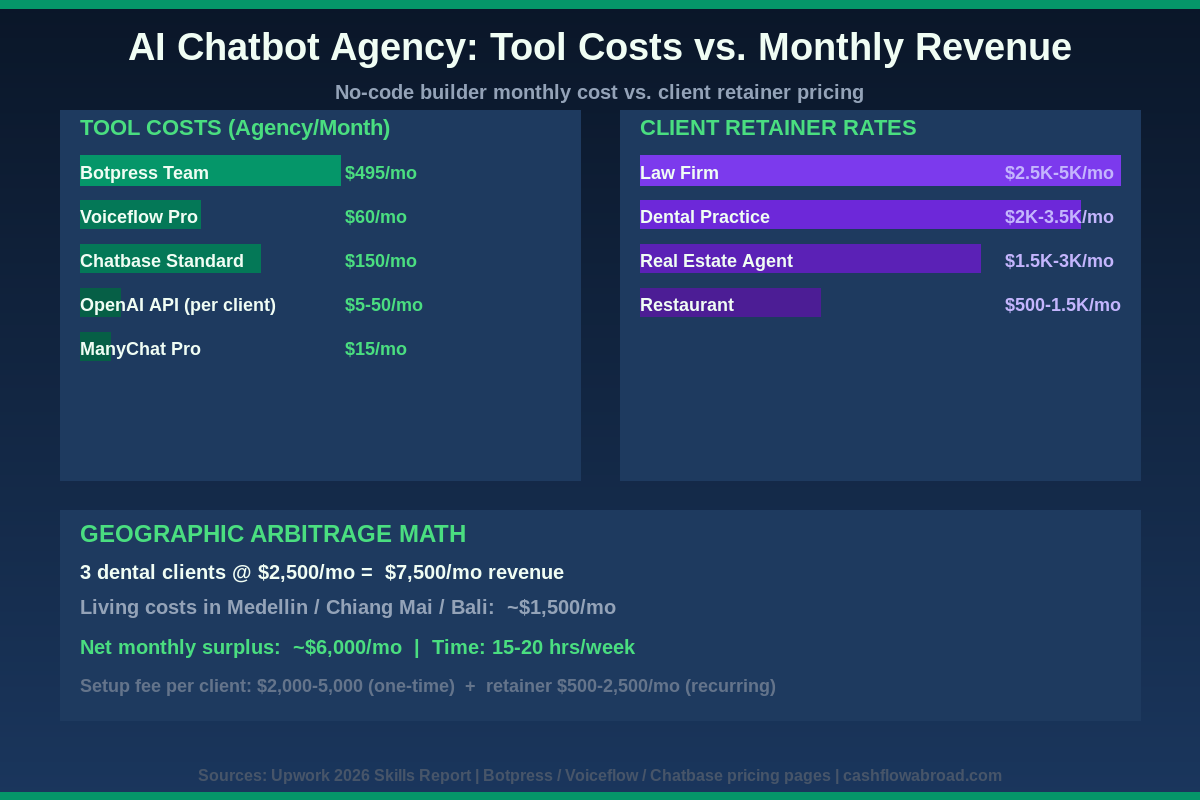
The highest-margin approach bypasses these platforms entirely for the backend. You wrap the Claude API or OpenAI API directly with a Voiceflow or custom widget frontend. Per-client API costs drop to $5–$50/month for typical SMB conversation volumes, while you charge $1,500–$5,000/month. At six clients, your tool costs across the entire operation are under $500/month. If you're hosting any supporting infrastructure, DigitalOcean runs a simple Node or Python webhook server for $6–$12/month per client — the margin math gets aggressive fast.
Start with Botpress Team ($495/mo) if you're planning to scale to five or more clients quickly. Start with Voiceflow Pro ($60/editor/mo) if you're in discovery mode and want to learn conversation design properly. Avoid Chatbase as your primary agency tool — the white-label add-on costs ($199/mo for custom domain, $199/mo for branding removal) eat your margin before you've signed client two.
The Outreach System That Actually Converts
Standard cold email in 2026 converts at about 1–2%. A Loom video showing a working prototype built on the prospect's own website converts at 6–10%. That gap is your entire sales strategy.
Here's the exact sequence:
Week 1: Build Your Prospecting List
Search "[niche] + [city]" on Google Maps. Filter for businesses with: a phone number on the website (high call volume), no visible chat widget, and at least 20 reviews (established, not about to close). Build a list of 50 prospects in a spreadsheet. For dental and law, LinkedIn gives you direct access to practice managers and partners — bypass the front desk entirely. For restaurants, Instagram DM outreach works better than email because owners check it constantly.
Week 2: Build the Demo Before You Pitch
Pick five prospects from your list. Go to their website. Using Botpress or Chatbase, spend 30–60 minutes building a bot trained on their publicly available content — their FAQ page, their "About" page, their service menu. Connect it to a test widget. Record a 90-second to 2-minute Loom video:
- Start with their actual website on screen
- Show the bot answering three common questions specific to their business
- End with one slide: your name, what you're offering, a calendar link
Your outreach message (email or DM) is five sentences max:
"Hey [Name], I noticed [Business] doesn't have a chatbot handling scheduling and FAQs. I spent an hour building one using your website — costs less than one missed appointment per month to run. Here's a 2-minute demo: [Loom link]. Happy to walk you through it — [calendar link]."
Expected conversion for 50 outreach messages: 8–12 replies, 4–6 meetings booked, 1–3 clients closed. That's cold, no relationship, no existing reputation. With a few testimonials and case studies, the numbers improve significantly.
The 30-Minute Sales Meeting
Don't pitch features. The meeting has one job: make the ROI calculation obvious.
"Your front desk handles how many calls a day? At roughly 5–7 minutes per call, that's [X] hours. At $18/hour for a part-time admin, that's $[Y]/month in labor on repetitive questions. This bot handles those questions for $500/month. The math isn't complicated."
Offer a 90-day trial agreement instead of a long-term contract. This removes the commitment objection entirely. After 90 days, every client who's seen the bot work will renew — and you'll have three months of conversation data to show them how many leads it captured or calls it deflected.
Price anchoring: present two tiers. Starter ($2,000 setup + $500/mo) and Professional ($5,000 setup + $2,500/mo). Most will take the middle ground. Don't offer a third tier in the first meeting — it creates decision paralysis.
Building and Deploying the Actual Bot
A mid-complexity chatbot for a dental practice takes 15–25 hours from discovery to launch. Here's how that time breaks down:
Days 1–2 (Discovery, 3–4 hours): Send a structured onboarding form asking for FAQs, service descriptions, pricing (if public), brand guidelines, calendar system (most dental offices use Dentrix or OpenDental, which have API access), and escalation preferences (when does the bot hand off to a human?).
Days 3–7 (Build, 8–12 hours): Configure the bot, upload the knowledge base, set up integrations. A simple Google Calendar integration via Voiceflow looks like this:
// Voiceflow API Block — Google Calendar availability check
{
  "method": "GET",
  "url": "https://www.googleapis.com/calendar/v3/freeBusy",
  "headers": {
    "Authorization": "Bearer {oauth_token}"
  },
  "body": {
    "timeMin": "{next_monday_iso}",
    "timeMax": "{next_friday_iso}",
    "items": [{"id": "practice@gmail.com"}]
  }
}
For practices using a scheduling platform that doesn't have a public API, you can use Zapier or Make (formerly Integromat) as a middleware layer — no custom code required.
Days 8–10 (Testing, 2–3 hours): Run 50 test conversations covering edge cases — insurance questions, emergency scenarios, "are you a real person?", requests outside the bot's scope. Document every failure mode and fix it before client review.
Days 11–14 (Launch, 2–3 hours): Embed the widget, monitor the first week of live conversations, optimize based on real user behavior. The first week always surfaces three to five questions you didn't anticipate.

The Income Math at Different Scales
This is where geographic arbitrage turns a decent freelance income into actual financial independence. The pricing is anchored to US market rates. Your costs are anchored to wherever you live.
| Client Count | Avg. Retainer | Monthly Revenue | Tool Costs | Net Profit | Hours/Week |
|---|---|---|---|---|---|
| 3 clients | $1,500/mo | $4,500 | ~$300 | $4,200 | 10–15 hrs |
| 6 clients | $2,500/mo | $15,000 | ~$500 | $14,500 | 25–30 hrs |
| 15 clients | $2,500/mo | $37,500 | ~$6,000 | $31,500 | 40+ hrs (need help) |
The $4,500–$5,000/month threshold is the number that unlocks the lifestyle most cashflowabroad.com readers are after. It covers comfortable living in Medellín ($1,200–$1,600/month), Chiang Mai ($1,000–$1,500/month), or Mexico City ($1,500–$2,000/month) with significant runway left over. That's three dental practice clients at entry-level pricing. Read the geographic arbitrage breakdown if you want specific cost-of-living numbers by city.
Using Platforms vs. Direct Outreach: The Fee Reality
If you're starting with zero reputation, platforms accelerate credibility-building. Here's the real cost structure:
Upwork: 0–15% service fee (most active sellers pay 10% after reaching $500 with a client). Client pays an additional 3–5% on top. Best for $5,000–$15,000 project contracts. Proposals cost $0.60–$2.40 in Connects (you get 10 free/month). The platform works for high-ticket, complex projects where clients want vetting protection.
Fiverr: Flat 20% commission on every transaction — no exceptions. Payments hold for 14 days (new sellers) or 7 days (Level 1+). Chatbot setup gigs range $75–$1,500 per project. Specialized sellers who niche down hit $3,000–$10,000/month. Generic "AI chatbot" gigs plateau at $500–$800/month. Fiverr works for standardized, repeatable deliverables at lower price points.
Direct outreach: 0% fees. Steeper ramp time. But every client is fully owned. This is where the business lives long-term — the Upwork and Fiverr income is how you get case studies to make direct outreach work faster.
The Business Infrastructure Abroad
Running a US-facing service business from abroad has one practical requirement that most guides gloss over: you need a real US banking setup. US clients want to pay a US entity. Wire transfers to foreign accounts create friction and, for some clients, compliance concerns.
The cleanest setup for a solo operator: form a Wyoming or Delaware LLC (remote, no physical presence required), open a Mercury bank account — it's built for remote-first businesses, has no minimum balance requirements, and makes ACH, wire, and card transactions straightforward. For your US mailing address (required for LLC formation and banking), a service like Traveling Mailbox gives you a scannable virtual mailbox without needing a physical presence.
For health coverage while abroad, SafetyWing runs around $45–$80/month for nomad-style coverage — not comprehensive, but adequate for most expat situations when combined with local insurance. See the full breakdown on running a US business from Colombia for the entity + banking details, or the FEIE guide for what this income setup means for your US tax situation.
Getting Your First Client in 30 Days: The Actual Timeline
Week 1: Choose your niche. Set up your agency workspace on Botpress or Voiceflow. Build one demo bot from scratch (pick a local business near you as a hypothetical). Get comfortable with the build process.
Week 2: Build your prospect list of 50 businesses. Record Loom demos for the top five. Send 20 outreach messages.
Week 3: Follow up, take meetings, send 20 more outreach messages. At this point you should have at least two to three conversations happening.
Week 4: Close your first client. Collect the setup fee. Start discovery. Send the remaining outreach messages while you're in the build phase.
Most people stall at the outreach step because they're waiting until the bot is "perfect" before pitching. The demo doesn't need to be perfect — it needs to be their bot, with their logo and their FAQs, answering questions a real customer would ask. That specificity does more than any polished template.
Conclusion
The chatbot agency model works because it sits at the intersection of a real business pain (repetitive calls, missed inquiries, after-hours dead zones) and a technology that's now genuinely accessible to non-developers. The no-code tools have caught up to the sales opportunity. What's left is execution: picking a niche, building a repeatable outreach process, and pricing the retainer high enough that three clients changes your monthly math.
For someone operating from a low-cost country, $5,000/month isn't a ceiling — it's the floor where serious geographic arbitrage begins. Six clients at mid-tier pricing gets you to $15,000/month. At that point you're looking at either building out a small team or raising prices and cutting clients. Both are good problems. The path to $100K from anywhere almost always runs through the first $5K, and this is one of the cleaner routes there right now.
If you're evaluating which city to base yourself in while building this out, the 2026 digital nomad visa rankings cover the practical visa and banking considerations by country.
Financial disclaimer: Income figures cited in this article are drawn from publicly available platform data, freelancer surveys, and reported case studies as of 2026. Individual results will vary based on niche, outreach quality, pricing strategy, client retention, and market conditions. This article does not constitute financial, legal, or tax advice. All tool pricing reflects publicly listed rates and is subject to change. Consult a qualified professional before making business or financial decisions.
This guide is general information, not personalized tax, legal, or investment advice. Rules change; verify current thresholds with official sources or a qualified professional before acting.
Next step
Make the chatbot offer specific
The buyer does not want a chatbot. They want faster lead capture, fewer missed replies, cleaner bookings, or cheaper support.
Related guides
 AI Income & Cash FlowJuly 21, 2026
FTC Review Rules for AI Retainers
Build a compliant AI review retainer with FTC rules, Google policy, scripts, pricing, and safeguards for local business clients.
 AI Income & Cash FlowJuly 3, 2026
AI SaaS Localization Service: Earn $3K–$8K/Month Abroad
Build an AI-assisted SaaS localization retainer using DeepL, Claude, and Crowdin for under $200/month and earn $3,000–$10,000 per month while living
 AI Income & Cash FlowJune 29, 2026
Build an n8n Automation Service From Abroad
Run an n8n workflow automation service from a low-cost country. Self-host for $24/month, charge clients $2,500+ and keep the arbitrage.