AI SaaS Localization Service: Earn $3K–$8K/Month Abroad
Build an AI-assisted SaaS localization retainer using DeepL, Claude, and Crowdin. Earn $3,000–$10,000/month while living on $2,000 abroad.
- AI-assisted SaaS localization costs $130–$200/month in tools (DeepL, Claude Haiku, Crowdin, n8n) vs. $22,000+ for a traditional agency project.
- Translation memory in Crowdin compounds your margin — by month three, 30–50% of a client's monthly strings are exact or fuzzy matches that cost nothing to re-translate.
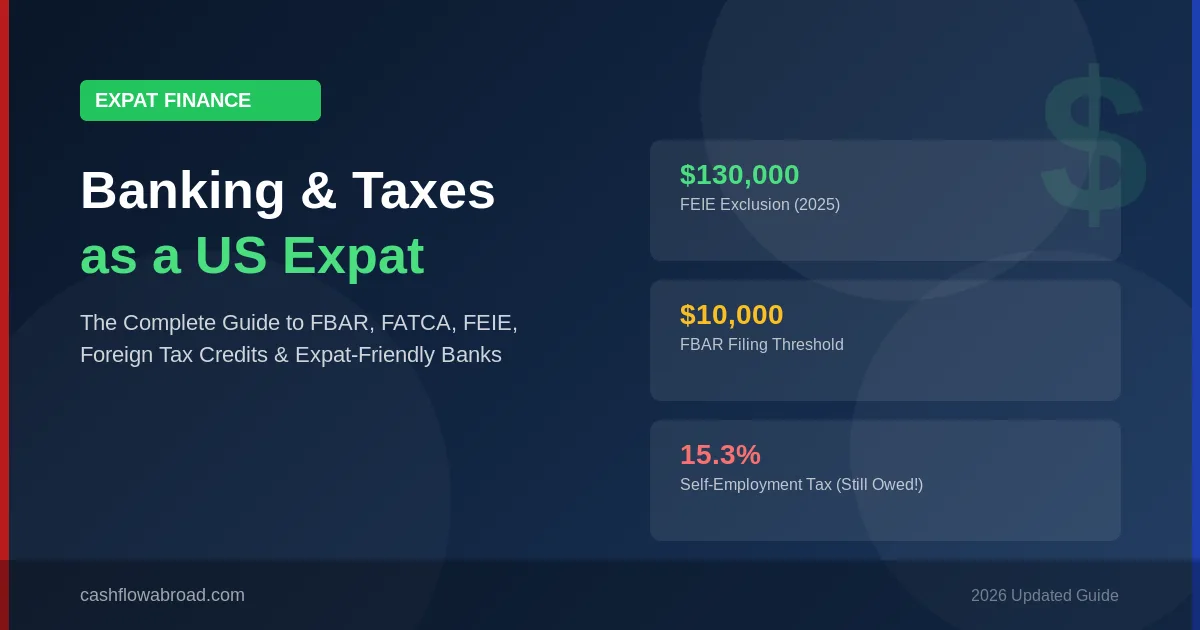
- Self-employment (SE) tax is 15.3% on net income up to $176,100 in 2025 — FEIE does not eliminate SE tax, so budget ~$17,000/year if earning $120,000.
- Spanish, German, French, and Brazilian Portuguese are the four first-wave languages US SaaS companies localize into — covering these four covers roughly 80% of the initial demand.
- DeepL Pro API charges $25 per million characters, with a free tier of 500,000 characters/month — enough to test a first client pipeline at zero cost.
- A Wyoming LLC costs $62/year in annual report fees with no state income tax — the simplest US legal entity for a solo operator running a digital service from abroad.
Disclosure: this article contains affiliate links. If you open an account through one of them, Cashflow Abroad may earn a referral commission at no extra cost to you.
A bootstrapped SaaS founder recently paid $22,000 to localize his 40,000-word app into Spanish and Brazilian Portuguese. The project took four months, required three rounds of back-and-forth with a translation agency, and broke a quarter's budget. An AI-assisted operator running a lean tool stack — DeepL, Crowdin, Claude, and n8n — can deliver the same scope for $2,500 to $4,500 per month on a rolling retainer, with a gross margin above 75% and a monthly tool cost under $200. If you live in Colombia, Mexico, Portugal, or anywhere your $2,500 in monthly income covers your bills, this is one of the cleanest AI arbitrage plays available today.
Who Buys SaaS Localization Services
The sweet spot is US software companies between 10 and 150 employees that have started seeing international signups but haven't yet built an in-house localization function. These companies know they need Spanish, German, French, or Brazilian Portuguese — they have users actively asking for it — but they cannot justify hiring a full-time localization manager or paying a large agency's project overhead.
The specific trigger points that make a company ready to buy:
- International signups exceed 15% of new accounts but churn faster than domestic users
- Support tickets from non-English speakers are climbing
- A new sales region or country partnership requires localized materials
- A competitor just launched in Spanish or German and is gaining ground
First-wave languages US SaaS companies prioritize
According to industry surveys, the sequence most US companies follow is: Spanish (covers Mexico and Latin America in one push), German (Germany, Austria, Switzerland), French (France plus francophone Africa and Canada), and Brazilian Portuguese. Japanese and Simplified Chinese come later, require more specialized work, and command a 30–60% price premium per word. Starting with European and Latin American languages is where most founders start, and it's where the easiest client acquisition happens for a solo operator.

The Tool Stack and What It Costs
The AI localization stack has three layers: a raw translation API that handles volume, a language model that polishes brand voice and handles edge cases, and a project management platform that keeps files, reviewers, and client handoffs organized.
| Tool | Purpose | Monthly Cost | Free Tier |
|---|---|---|---|
| DeepL Pro API | High-volume base translation (EU language pairs) | $5.49 base + $25/million chars overage | 500,000 chars/month |
| Claude API (Haiku 4.5) | Brand voice refinement, idiomatic polish, glossary enforcement | ~$1 input / $5 output per million tokens | No free tier — usage-based |
| Crowdin Pro | Translation management, glossary, translation memory, client portal | $59/month | Free for open-source |
| n8n Cloud Starter | Workflow automation: GitHub → DeepL → Crowdin → PR | €24/month (~$20 USD) | Community self-hosted (free) |
| GitHub Actions | Triggers on new string commits, pushes translated files | Free (2,000 minutes/month) | 2,000 minutes/month |
Monthly tool costs: DeepL ($30) + Claude API ($20 for typical 3-client volume) + Crowdin ($59) + n8n ($20) = ~$130/month
Revenue from 4 clients at $2,500/month each: $10,000/month
Gross margin: ($10,000 - $130) / $10,000 = 98.7% before your own time
Factor in 20–30 hours/month of review and QA work at an implied rate of $80/hour: all-in margin still exceeds 70%. Living in Medellín on $2,000/month, that net cash flow covers three months of expenses per month.
How translation memory compounds your margin
Every segment you translate is stored in Crowdin's translation memory (TM). On the second month with a client, repeated UI strings — button labels, nav items, error messages — match at 100% and cost nothing to re-translate. Partial matches (75–99%) get discounted rates. In practice, by month three, a mature product's monthly string volume is 30–50% net-new content, and your DeepL and Claude costs drop accordingly while the retainer price stays flat.
The Delivery Workflow, Step by Step
A professional AI-assisted localization service runs as a continuous pipeline, not a one-time project. Here is the operational sequence for a new client onboarding and ongoing delivery.
Client onboarding steps
| Step | What You Do | Tool Used | Time Required |
|---|---|---|---|
| 1. Audit existing strings | Clone repo, count translatable strings, identify i18n file format (.json, .po, .xliff) | GitHub CLI + local scripts | 2–4 hours |
| 2. Build glossary | Interview client for brand terms, product names, off-limits words, tone guide | Crowdin Glossary + Notion doc | 1–2 hours |
| 3. Connect repo to Crowdin | Install Crowdin GitHub app, configure crowdin.yml file in repo root | Crowdin + GitHub App | 1 hour |
| 4. Configure n8n workflow | Webhook on GitHub push → extract new strings → DeepL translate → Claude refine → Crowdin upload | n8n Cloud | 2–3 hours setup |
| 5. First full translation run | Run all existing strings through pipeline, human review 10% sample, fix errors | DeepL + Claude + Crowdin | 4–8 hours |
| 6. Deliver and review | Export localized files as PR, client merges, QA review in staging | GitHub PR | 1–2 hours |
After onboarding, the ongoing monthly cycle is lightweight: the n8n workflow catches new string commits automatically, runs them through DeepL and Claude, and creates a translation PR. Your monthly work is reviewing edge cases, updating the glossary when new product features ship, and responding to client questions. A well-configured client takes 5–10 hours of your time per month.
Why DeepL plus Claude beats either alone
DeepL produces exceptional literal accuracy for European language pairs — particularly Spanish, German, and French. Where it underperforms is brand voice consistency, idiomatic tone, and product-specific terminology. Claude Haiku, given a system prompt that contains the client's glossary and brand voice guidelines, catches and corrects those gaps efficiently and at low cost per token. A typical workflow: send the DeepL output to Claude Haiku with a system prompt that says "You are a brand editor. Enforce these glossary terms and ensure the tone matches our brand guide: [paste guide]. Fix any awkward phrasing while preserving the meaning." The combination produces output that is 90–95% publication-ready with minimal human review.

Pricing Your Localization Retainer
Professional human translation charges $0.10–$0.15 per source word for Tier 1 languages (Spanish, French, German) according to Alconost's 2025 benchmark of 3,200+ projects. A 40,000-word SaaS application localized into three languages would cost a company $12,000–$18,000 for the initial translation at those rates, plus ongoing charges for new content every release cycle.
Your AI-assisted service undercuts that by 50–60% while delivering equivalent or better consistency because of the translation memory and automated glossary enforcement. Structure your pricing in three tiers:
| Package | Languages | Monthly Price | New Words/Month | Deliverables |
|---|---|---|---|---|
| Starter | 1–2 | $1,200 – $1,800 | Up to 5,000 new words | Monthly translation PR, glossary updates, QA review |
| Growth | 3–5 | $3,000 – $5,000 | Up to 15,000 new words | Monthly PRs per language, priority turnaround (48 hrs), dedicated Slack channel |
| Scale | 6–8 | $6,000 – $10,000 | Up to 30,000 new words | All above + in-context screenshot review, human linguist review layer, monthly reporting |
Charge a one-time onboarding fee of $1,500–$3,000 for the initial setup: auditing the repo, building the glossary, configuring the pipeline, and running the first full translation pass. This covers your 10–15 hours of setup time and filters out clients who aren't serious.
Handling languages outside DeepL's strength zones
DeepL's coverage is strong for 31 European languages. For Japanese, Korean, and Simplified Chinese — which companies eventually need — switch to Google Cloud Translation API at approximately $10 per million characters for standard neural machine translation. Japanese and Korean also require a native-speaker review step, which you can outsource to verified translators on Workana or ProZ for $0.05–$0.08 per word as a pass-through cost. Price those language pairs at a 40–60% premium over your European rates to preserve margin.
Getting Your First Three Clients
The fastest path to a first client is not cold email. It is targeting software companies that are already building for an international audience but have not yet formalized localization.
Three reliable acquisition channels:
- Product Hunt comments and "coming soon" pages. When a US SaaS product launches on Product Hunt with an "international expansion coming soon" note or gets comments in French/Spanish from users asking "when will this be available in [country]?", that company has a problem you can solve. DM the founder within 48 hours.
- Indie Hackers and startup forums. Post a case study showing the cost math — $22,000 traditional agency vs. $3,000/month AI-assisted — and answer localization questions in threads. Founders who are at the "should we localize?" stage become buyers within weeks.
- LinkedIn search for "Head of Growth" at Series A SaaS companies with 25–75 employees. Filter for companies with international users mentioned in their About page. Send a one-paragraph pitch with one specific data point about how localization affects churn rates for international users.
Operating from Abroad: Entity, Banking, and Tax
Running a US-facing service business from abroad as a US citizen requires a US legal entity, a US business bank account, and an understanding of how the Foreign Earned Income Exclusion (FEIE) interacts with self-employment income.
US entity and banking
A Wyoming LLC is the most common choice for solo operators: the annual report fee is $62 per year, there is no state income tax, and Wyoming does not require a resident agent's physical address. Register as a single-member LLC, obtain an EIN from the IRS online, and open a Mercury Bank business checking account remotely. Mercury requires no minimum balance, has no monthly fees, and supports ACH and wire transfers to pay tool vendors and receive client payments electronically. US clients will pay by ACH or card, and all revenue lands in your US account before you decide how to move funds for living expenses.
FEIE and self-employment tax
The Foreign Earned Income Exclusion (Form 2555) lets qualifying US citizens exclude up to $130,000 of foreign-earned income from federal income tax in 2025. However, FEIE does not eliminate self-employment (SE) tax. The IRS SE tax rate is 15.3% on net self-employment income up to $176,100 (2025 limit), dropping to 2.9% above that. For a service business earning $120,000/year, SE tax alone is approximately $16,956 — budget for this regardless of which country you live in. If your business is structured as an S-Corp and you pay yourself a reasonable salary, SE tax applies only to the salary, not to distributions, which can meaningfully reduce this burden at higher income levels. Consult a US expat tax specialist — SE tax planning for LLC operators abroad has important setup steps.
See IRS Publication 54 for the full rules on foreign-earned income exclusions for US citizens abroad.
Five Pitfalls That Sink Localization Businesses
- Translating marketing copy with a UI-grade tool. DeepL is excellent for product strings; it misses tone and cultural resonance in conversion copy. Use Claude with a detailed brand voice prompt for landing pages, email campaigns, and anything customer-facing outside the product.
- Ignoring text expansion. German text is approximately 35% longer than English. A button that reads "Submit" in English becomes "Absenden" in German — same meaning, but a UI button that fits a 6-character string will not accommodate 9. Warn clients about this during onboarding and price UI review into the contract.
- Not having a termination clause. A three-month minimum notice period protects you if a client's funding falls through. With a pipeline that takes 10 hours/month to run, losing a client without notice means losing a month of income.
- Conflating machine translation quality with AI-assisted quality. Do not promise human-translation quality and deliver raw DeepL output. Always run a 10% sample review on each delivery and document your QA steps in the monthly report. Clients who spot an error and don't hear an explanation become churned clients.
- Skipping the compliance check on recording and data handling. EU clients operating under GDPR may require a Data Processing Agreement (DPA) before you can store their source strings in a third-party platform like Crowdin. Under EU GDPR Article 28, any processor that handles personal data on behalf of a controller must sign a DPA. Check whether Crowdin meets the client's DPA requirements, or offer a self-hosted Crowdin alternative.
Realistic Income Trajectory
Month 1–2: Setup, first client at $1,500/month Starter plan. Learning curve on n8n workflows, Crowdin config, and client communication.
Month 3–4: Second client. Revenue $3,000–$4,000/month. Workflow running smoothly; second client onboarding takes half the time of the first.
Month 6: Three to four clients at mixed tiers. Revenue $8,000–$12,000/month. Time commitment: 40–60 hours/month. Geographic arbitrage fully active if living in a sub-$2,500/month city.
Month 12: Four to six clients. Revenue $12,000–$18,000/month. Consider adding one contract reviewer for the Scale-tier clients to reduce your personal QA hours and protect quality.
These figures are realistic for a competent operator who invests in client relationships and maintains quality. They are not guaranteed. Revenue depends on your ability to close and retain clients, the specific SaaS market segment you target, and how quickly the localization pipeline matures for each client's codebase.
Start with One Client, One Language
The typical mistake is trying to build a six-language pipeline for an enterprise client before you've shipped one delivery. Start with one client, one language pair, a free Crowdin account, and DeepL's free 500,000-character monthly tier. Deliver two monthly PRs, document the QA process, then use that case study to land the next client at a higher tier. The economics scale cleanly: every new client adds less than $50/month in marginal tool costs and incremental workflow setup time. The geographic arbitrage is real — this is a business you can run from a $1,200/month apartment in Medellín and bill in USD to clients who think nothing of $3,500/month if it replaces a $25,000 agency project.
Disclaimer: This article is for informational purposes only and does not constitute legal, tax, or financial advice. Self-employment tax, FEIE eligibility, entity structure, and international income rules vary by individual situation. Consult a qualified US expat tax professional before making decisions based on this content.
Data Notes / Sources Checked
Pricing and thresholds were checked in July 2026 and may change. Tool pricing in particular updates frequently — verify directly with each vendor before committing.
- DeepL API pricing and plans — official DeepL Help Center
- Crowdin pricing tiers — official Crowdin pricing page
- How Much Does Translation and Localization Cost — Alconost, 3,200+ project dataset (2025)
- How to plan localization for your first 5 languages — SimpleLocalize
- IRS Topic 554: Self-Employment Tax
- IRS Publication 54: Tax Guide for US Citizens Abroad
- n8n Cloud pricing — official n8n.io pricing page
Frequently asked questions
Do I need to speak Spanish or German to sell SaaS localization services?
No. The AI handles the translation; your job is managing the pipeline, the client relationship, and quality review. You should be able to recognize when output looks wrong (run a back-translation check with DeepL), but fluency is not required for European language pairs.
How long does it take to set up the n8n and Crowdin pipeline for a new client?
Expect 8–15 hours for the first client: auditing the codebase, building the glossary, connecting the Crowdin GitHub integration, and configuring the n8n workflow. Each subsequent client takes roughly half the time as you reuse the same workflow template.
What file formats do SaaS companies typically use for their translatable strings?
Modern web apps use JSON (React, Vue, Next.js), while older stacks use .po/Gettext (PHP, Django) or .xliff (enterprise tools). iOS uses .strings files. Crowdin handles all these formats natively with GitHub integration.
Can I use FEIE to eliminate all US taxes on my localization income?
FEIE excludes up to $130,000 of foreign-earned income from federal income tax in 2025, but it does not eliminate self-employment tax (15.3% up to $176,100). A US citizen earning $120,000 still owes approximately $17,000 in SE tax regardless of where they live.
How do I handle GDPR when my clients are EU-based SaaS companies?
Crowdin is GDPR-compliant and provides a Data Processing Agreement template. For EU clients, sign a DPA before storing their source strings in any third-party platform. If a client's legal team requires stricter controls, Crowdin offers a self-hosted option.
This guide is general information, not personalized tax, legal, or investment advice. Rules change; verify current thresholds with official sources or a qualified professional before acting.
Related guides
 AI Income & Cash FlowJuly 28, 2026
AI Release Note Localization Retainer
Sell a 48-hour AI localization retainer for SaaS release notes with exact tools, startup costs, pricing tiers, and QA workflow.
 AI Income & Cash FlowOctober 3, 2026
AI Receptionist for Insurance Agencies
Price an insurance-agency receptionist at $0.1078 a minute on Retell, plus a $2 number, and keep quotes with a licensed producer.
 AI Income & Cash FlowSeptember 28, 2026
AI Locksmith After-Hours Dispatch
Price a $1,200 after-hours dispatch retainer for US locksmith shops. See Twilio, Retell, and n8n costs, delivery steps, and license rules.