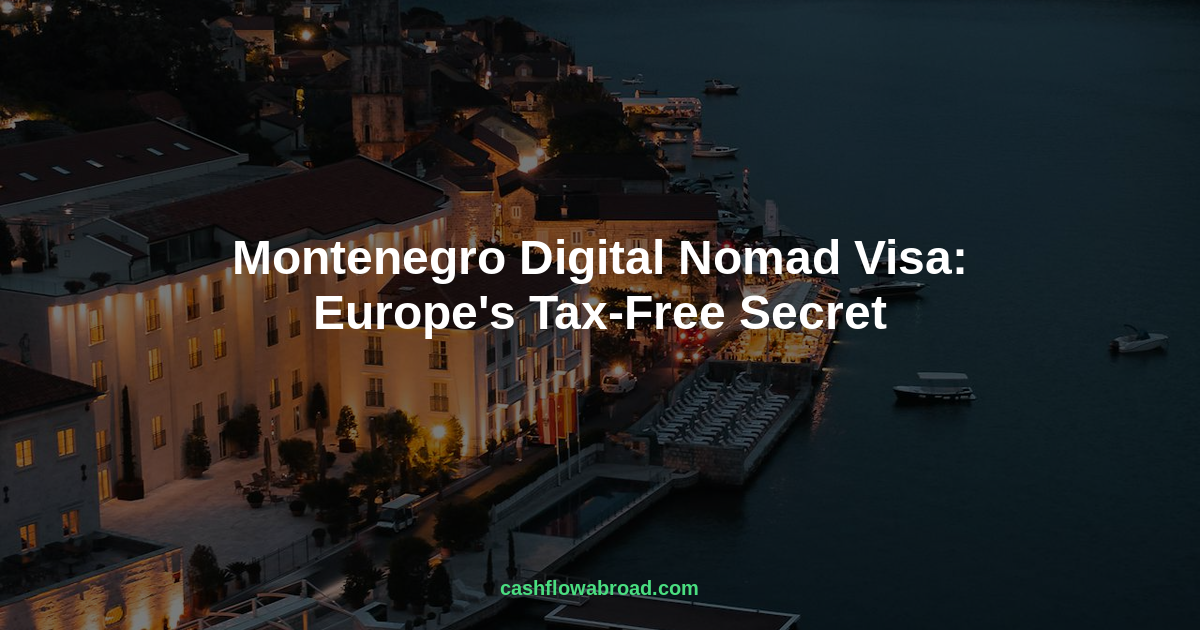
Montenegro Digital Nomad Visa: Europe’s Tax-Free Secret
8 min read · 1,897 words
Most digital nomads have heard of Bali’s visas, Portugal’s NHR, and Thailand’s LTR. Almost none of them have seriously considered Montenegro — a tiny Balkan country that offers four years of complete income tax exemption on foreign earnings, costs roughly $1,300 a month to live comfortably, and sits wedged between Croatia and Albania on the Adriatic coast. The official digital nomad residence permit launched in 2022 and still flies under the radar. That oversight is costing some remote workers tens of thousands of dollars annually.
To be specific: if you’re earning $80,000 remotely and paying 25% effective tax where you live now, moving to Montenegro under this visa could legally eliminate your local tax burden entirely — and leave you living in a walled medieval city 20 minutes from a turquoise sea.
Here’s exactly how it works.
What Is Montenegro’s Digital Nomad Visa?
Montenegro’s Digital Nomad Visa is technically a temporary residence permit issued under the country’s Law on Foreigners. It’s specifically designed for non-EU citizens who work remotely for foreign employers or foreign-registered companies. The key distinction from standard residency: you cannot work for a Montenegrin employer or generate income from local clients.
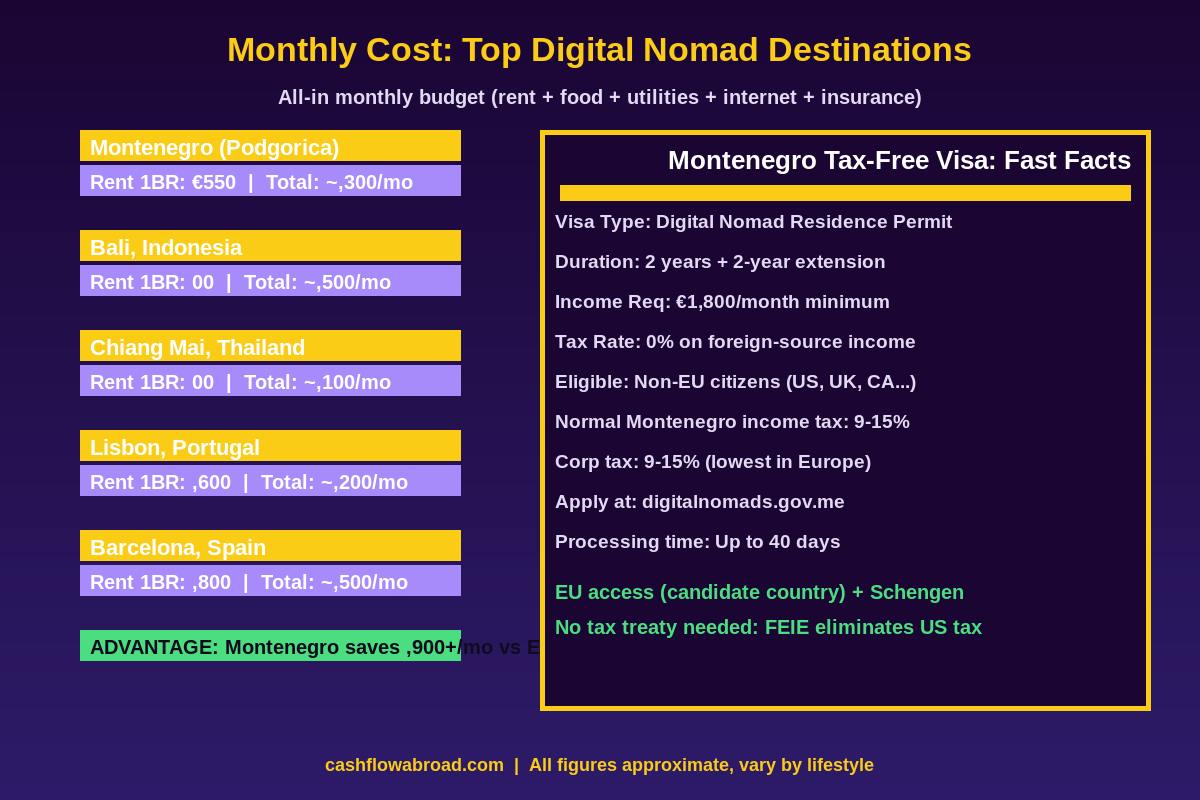
The visa is issued for two years and renewable once for an additional two years, giving you a maximum continuous stay of four years. After that, you must exit for six months before starting a fresh 2+2 cycle. During the entire four-year window, you pay zero income tax on your foreign-source earnings.
Montenegro is an EU accession candidate — it’s been in the formal accession process since 2012 and is widely considered one of the countries most likely to join in the coming years. It already uses the Euro. That combination of low cost, EU trajectory, and genuinely exceptional tax treatment makes it one of the more undervalued residency plays in Europe right now.
The Tax Exemption: What Zero Actually Means
Under Montenegro’s standard tax code, personal income is taxed on a progressive scale: 9% up to roughly €14,000/year, 15% above that. The first €700 of monthly salary is non-taxable. Corporate income tax runs 9-15% — among the lowest in Europe.
Digital nomad visa holders are exempt from paying any of that on income earned from foreign sources. The government’s stated rationale was to attract high-earning remote workers who contribute to the local economy through spending without competing for local jobs.
The exemption applies to the full duration of the visa. If you earn $120,000 from US clients over four years, you owe Montenegro nothing. Not 9%. Not 15%. Nothing. The only caveat: if you accidentally generate income from a Montenegrin source while on this visa, you lose the exemption on that income and risk jeopardizing your permit status.
The US Expat Angle: FEIE + Montenegro = Near-Zero Tax
Americans don’t get off the hook entirely — US citizens owe federal taxes on worldwide income regardless of where they live. But the Foreign Earned Income Exclusion (FEIE) dramatically changes the math. For 2026, the exclusion threshold sits around $130,000. If you earn under that and qualify by meeting either the bona fide residence or 330-day physical presence test, you exclude that entire amount from US federal taxable income.
Combined with Montenegro’s zero tax on foreign income, the effective tax rate for a US digital nomad earning under $130,000 is approximately zero at the federal level and zero locally. You’ll still owe self-employment taxes if you’re a freelancer rather than an employee, but even that can be structured with a properly-set-up foreign corporation.
There’s no US-Montenegro tax treaty, but none is needed here — the FEIE does the work. Read the full breakdown in our US Expat Banking and Taxes Guide.
Cost of Living: The Real Numbers
Montenegro splits into two distinct zones for expats: the capital Podgorica (inland, year-round stable pricing) and the coastal strip — Budva, Kotor, Tivat — which is dramatically cheaper off-season and spikes 20-40% in summer.
| Expense | Podgorica | Budva/Kotor (off-season) |
|---|---|---|
| 1BR apartment rent | €500–750/mo | €650–950/mo |
| Groceries (cooking most meals) | €200–270/mo | €220–295/mo |
| Utilities (electric, water, heat) | €100–130/mo | €110–140/mo |
| High-speed fiber internet | €25–35/mo | €25–35/mo |
| Private health insurance | €30–70/mo | €30–70/mo |
| Dining out (per person, avg meal) | €8–15 | €10–20 |
| Monthly total (solo, moderate lifestyle) | ~€1,100–1,350 | ~€1,250–1,600 |
At current EUR/USD rates, a comfortable solo lifestyle in Podgorica runs approximately $1,200–1,500/month. Coastal living off-season adds maybe $200-300. Compare that to Lisbon at roughly $3,200/month or Barcelona at $3,500/month — both of which also currently lack any blanket tax exemption for nomads. A couple living here on two remote incomes can do it extraordinarily well for $2,000–2,500/month combined.
Who Qualifies
The eligibility rules are clear but strict:
- Must be a non-EU citizen — US, UK, Canadian, Australian, and most non-European passport holders are eligible. EU citizens already have freedom of movement; this visa fills the gap for everyone else.
- Must work remotely for a foreign company or foreign-registered client — invoicing Montenegrin businesses disqualifies you.
- Minimum income: €1,800/month — roughly $1,980/month. If you hold a university degree, the bar rises to €2,400/month. This must be documented via bank statements plus employment letters or client contracts.
- Valid health insurance covering Montenegro for the full visa duration.
- Clean criminal record — certificate issued within the past 6 months, from your home country.
There’s no minimum physical presence requirement. You don’t need to be in Montenegro 183 days/year to maintain the permit. This makes it especially powerful as a tax base for nomads who travel extensively — you can spend time in Croatia, Serbia, or elsewhere without threatening your status. Note however that exceeding 183 days in Montenegro triggers standard tax residency rules; consult a local advisor if your schedule approaches that threshold.
Application Process: Step by Step
Montenegro doesn’t accept remote applications. You submit in person at the Ministry of Internal Affairs branch in the municipality where your accommodation is registered. Processing takes up to 40 days from receipt of a complete application.
Required Documents
- Valid passport — must remain valid at least 3 months beyond the visa’s end date
- Completed application form — available at digitalnomads.gov.me (Montenegro’s official nomad portal)
- Proof of remote income — employment contract or freelance agreements showing consistent foreign-source income of €1,800+/month
- 12 months of bank statements confirming €21,600+ received over the prior year
- Health insurance valid 2 years in Montenegro — SafetyWing Nomad Insurance starts at approximately $56/month and is accepted for this visa; get the 2-year policy or consecutive renewals documented in advance
- Notarized rental agreement + property deed from your landlord proving secured accommodation
- Criminal background check from your home country, apostilled, dated within the last 6 months
- Tourist registration — you must register with the local tourist organization within 24 hours of entering Montenegro (your landlord typically handles this)
Most applicants hire a local lawyer or relocation agency for €300–600 to manage notarizations and submission logistics. Not required, but it cuts down on the most common rejection causes — missing apostilles, incorrectly formatted accommodation documents, and similar paperwork technicalities.
Bringing Family
Dependents (spouse, children) can apply under your primary permit. No separate income requirement applies to them, but you’ll need to show additional financial capacity — typically €600–800/month per family member in additional income or a savings balance of €16,200+ in your accounts.
Banking and Finances Setup
Montenegro is a euro-economy with a functional banking sector. Once you have your residence permit, opening a local account is free and takes about an hour. You’ll want a “national” account for local payments and an “international” account for receiving foreign transfers. Monthly maintenance fees run €1–3.
Critically: keep your US banking intact before you leave. Mercury is ideal for freelancers and US LLC owners — no fees, no minimums, works for international payments. Charles Schwab’s International Account reimburses all ATM fees worldwide, which matters if you’re traveling across the Balkans.
For recurring EUR transfers to your Montenegrin account, Remitly delivers competitive rates without the €20–35 bank wire charges. Don’t use your US bank’s international wire service for routine transfers — it adds up fast.
Maintain a US mailing address. Once your US accounts see a foreign address on file, some institutions will restrict access or close accounts. Traveling Mailbox provides a real US street address with mail scanning for $15/month — covers the IRS, brokerage accounts, and state domicile. It’s one of the most overlooked tools in the expat setup. Full breakdown in our virtual mailbox guide.
Also file your FBAR if your Montenegrin account holds $10,000+ at any point during the year. Montenegro is not a tax haven under US reporting rules — it’s a reportable jurisdiction. The penalty for a willful failure to file is $100,000 or 50% of the account balance, whichever is larger.
Montenegro vs. Other Digital Nomad Visas
| Country | Tax Exemption on Foreign Income | Min Income Req | Est. Monthly Cost | Max Duration |
|---|---|---|---|---|
| Montenegro | Yes — 100% exempt | €1,800/mo | $1,200–1,500 | 4 years (2+2) |
| Indonesia (E33G) | Yes — 5-year tax holiday | ~$2,000/mo | $1,500–1,800 (Bali) | 5 years |
| Japan Digital Nomad | No | ~¥10M/yr ($67K+) | $2,800–3,500 | 6 months |
| Portugal D7 | No (NHR ended for new applicants) | €760/mo | $2,800–3,500 | Renewable indefinitely |
| Costa Rica Rentista | Territorial (foreign income untaxed) | $2,500/mo | $1,500–2,000 | 2 years (renewable) |
| Albania | No (15% flat on all income) | None stated | $800–1,100 | 1 year (renewable) |
Montenegro’s strongest competition is Indonesia’s E33G — longer duration (5 vs 4 years) and a slightly lower effective cost in Bali. But Montenegro has a more transparent application process, a euro-based economy with no currency risk, and a European lifestyle without Western Europe costs. Indonesia also comes with an 8-hour flight from the US and complex banking access for Americans.
See the full ranked breakdown in our Digital Nomad Visas Ranked guide.
Practical Tips
Best starting city: Podgorica. Kotor and Budva are more scenic, but Podgorica has the Ministry offices for your application, stable year-round pricing, and the growing expat infrastructure. Plan to start there for the first 2–3 months, then relocate to the coast once permits are sorted.
Internet quality: genuinely solid. Fiber is available across cities at 100–300 Mbps for €25–35/month. Co-working spaces in both Podgorica and Budva run €80–150/month for a dedicated desk.
Connectivity on arrival: Use a Saily eSIM before touching down — you’ll have data instantly while sorting a physical SIM from local carriers MTEL or m:tel. Saily covers Europe including the Balkans with pay-as-you-go data plans.
Get a VPN: Use NordVPN on any public or co-working WiFi, and to access US region-locked financial accounts. Several US brokerages block logins from non-US IPs without explanation.
Health insurance must be legitimate: The visa requires documentation of multi-year coverage. Short-term travel policies won’t satisfy the requirement. SafetyWing is purpose-built for this scenario. Full comparison in our Expat Health Insurance Guide.
Bottom Line
Montenegro’s Digital Nomad Visa is one of a handful of European programs that combines a complete tax exemption on foreign-source income, sub-$1,500/month living costs, and an income threshold low enough that most remote workers clear it without creative accounting. The 4-year window (2+2), euro economy, EU accession trajectory, and medieval coastal cities make it a serious medium-term base that deserves far more attention than it currently gets.
US citizens layering FEIE on top arrive at near-zero effective taxation during their stay — legally, with proper structure and annual review from a qualified expat tax professional. That’s a combination almost nowhere else in Europe offers simultaneously.
For the complete strategic framework, see our Geographic Arbitrage Playbook and the Expat Investor’s Playbook — the tax savings only compound if you’re deploying them into the right accounts.
Financial Disclaimer: This article is for informational purposes only and does not constitute tax, legal, or financial advice. Montenegro’s digital nomad visa program terms, income thresholds, and tax treatment are subject to legislative change. US citizens living abroad should consult a qualified expat CPA before making residency, tax, or investment decisions. FEIE eligibility depends on meeting specific IRS criteria. Nothing in this article creates an advisor-client relationship.
Liked this article?
Get the next one delivered straight to your inbox — plus a free Expat Tax Cheat Sheet.
Join our subscribers. No spam — just expat finance intel and new post notifications.