
Most expats spend more time picking their carry-on luggage than choosing health insurance. That's a mistake that can cost $80,000 on a single hospitalization abroad. The right plan costs as little as $56 a month. The wrong one leaves you personally liable for bills your US domestic plan categorically refuses to cover once you're outside the country.
There are three names that dominate expat health insurance: SafetyWing, Cigna Global, and Allianz Care. They serve completely different buyers, at completely different price points, with completely different coverage philosophies. Picking the wrong one is painfully common — nomads overinsure with expensive plans they don't need, or retirees underinsure with travel-grade products that leave chronic conditions uncovered.
Here's a direct comparison so you can stop guessing.
Who Each Plan Is Actually For
Before diving into premiums, understand what category each provider falls into. SafetyWing is a travel insurance company that has extended its product toward long-term nomads. Cigna Global and Allianz Care are true international private medical insurance (IPMI) companies — structured, underwritten, and priced for people living abroad indefinitely.
That distinction matters enormously. Travel insurance products have aggregate caps per trip or per incident. IPMI products have annual limits that reset, cover chronic conditions after a waiting period, and often include direct-billing hospital networks rather than requiring you to pay upfront and claim later.
If you're moving abroad permanently, you should be comparing IPMI products. If you're testing locations for 6–12 months, SafetyWing may be the right starting point — but you need to understand its limits before you find yourself standing in a foreign hospital.
SafetyWing: What You Get for $56/Month
SafetyWing offers two products: Nomad Insurance Essential and Nomad Insurance Complete.
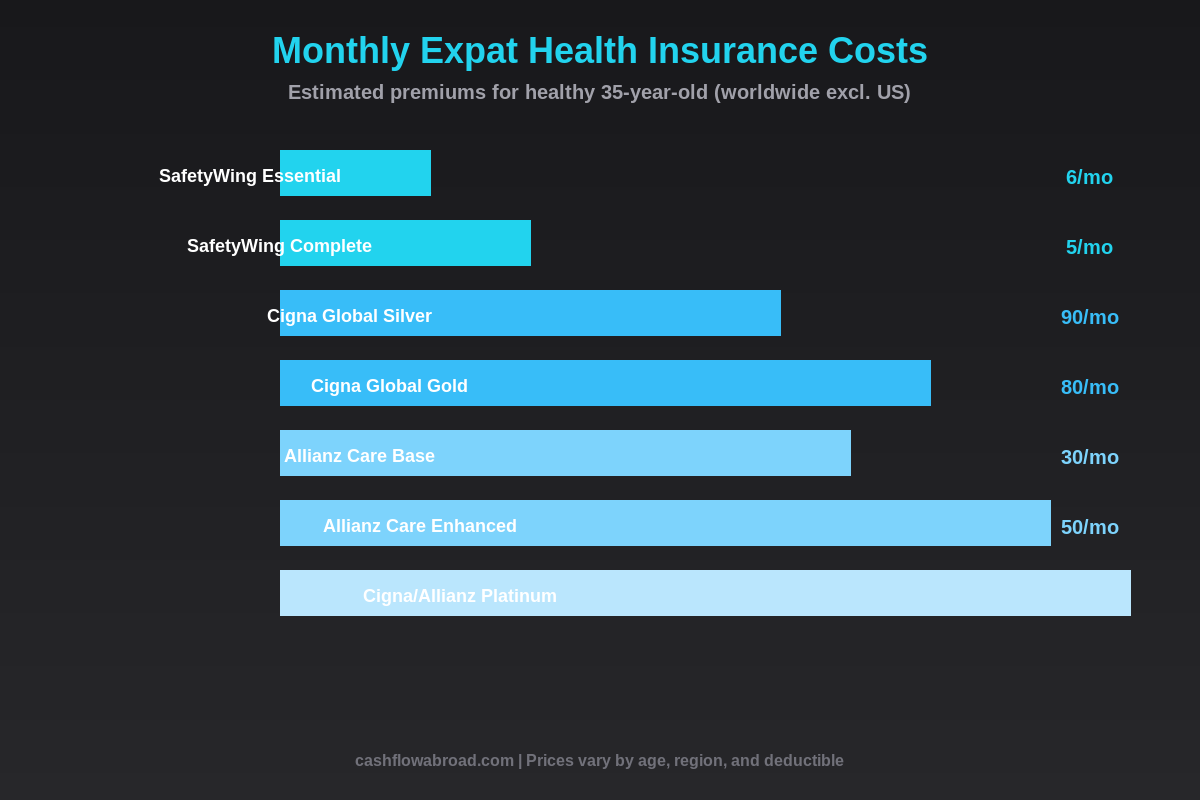
Essential runs $56.28 per 4-week period (~$61/month) for ages 10–39. It's a travel insurance product with a $100,000 medical evacuation cap and limited outpatient coverage. Pre-existing conditions are fully excluded. There's a $250 deductible per incident. It also covers 30 days of home-country visits per 90-day period — useful if you travel back to the US occasionally.
Complete is SafetyWing's more serious health insurance product, with up to $1.5 million in maximum coverage. It covers cancer treatment, chemotherapy, prescriptions, and pre-existing conditions that develop after your coverage starts. Pricing scales sharply with age — travelers aged 60–69 pay upwards of $218/month on the Essential plan alone, and Complete pricing climbs faster. Enrollment closes at 65, but existing coverage can continue indefinitely as long as you enrolled before that birthday with no coverage gaps.
The key limitations: SafetyWing doesn't cover the US unless you add a rider (which significantly increases premiums), doesn't cover pre-existing conditions on the Essential plan at all, and isn't accepted by most hospital billing departments directly — you pay out of pocket and claim reimbursement. That last point becomes genuinely stressful at 2 a.m. in a Bangkok private hospital.
For a 30-year-old nomad bouncing between Southeast Asia, Latin America, and Europe, SafetyWing Complete makes sense as a starting point. For a 55-year-old retiring abroad with managed hypertension or type-2 diabetes, it's inadequate by design.
Check SafetyWing's current pricing for your age bracket.
Cigna Global: The Mid-Tier Workhorse
Cigna Global operates on a modular model. You start with a core inpatient plan and add coverage modules: outpatient, dental, vision, evacuation. The four tiers are Close Care, Silver, Gold, and Platinum.
Silver is where most long-term expats land. Expect to pay roughly $150–190/month for a healthy 35-year-old on Silver (worldwide excluding the US). Gold runs $250–280/month for the same profile. Add outpatient coverage and premiums jump another 30–40% on top of the base rate.
What Cigna gets right is the network. Cigna's direct-billing hospital network spans 40,000+ facilities in over 200 countries. In most major expat hubs — Bangkok, Medellín, Dubai, Lisbon — you can walk into a private hospital, hand them your Cigna card, and leave without touching your credit card. That's a practical advantage that compounds over time, especially in emergencies when the last thing you want to do is calculate how much cash you have available.
Cigna also covers pre-existing conditions, with a standard waiting period and potential premium loading depending on your medical history. For any expat with ongoing prescriptions or managed conditions, this is non-negotiable. SafetyWing Essential simply won't pay for those claims.
Annual costs for Cigna Global range from roughly $4,000 to $6,000 for comprehensive individual coverage excluding the US. Include the US in your coverage zone and prices roughly double — which is exactly why most expats who don't plan significant time in the US explicitly exclude it and add a separate short-term travel supplement for visits home.
Allianz Care: The Premium Tier
Allianz Care is the most comprehensive option and the most expensive. Plans run across three tiers — Base, Enhanced, and Signature — with annual coverage limits of $1.35 million, £1.66 million, and £3.1 million respectively.
Base coverage starts around $230/month for a 35-year-old (worldwide excluding the US). Enhanced runs $350+/month. Signature is for people with legitimate reasons to want £3 million in annual coverage — executives on assignment, high-net-worth retirees in countries with expensive private care, families who want absolutely no compromises.
Allianz's strength is its direct-billing network across the EMEA region and its claims processing reputation. In markets like the UAE, Germany, France, and Southeast Asia, Allianz has deeply integrated hospital partnerships. The plan also lets you add optional modules — outpatient, dental, maternity — and choose a deductible to manage premiums. Annual payment saves 5% versus monthly billing.
Allianz covers mental health treatment, cancer diagnostics, and rehabilitation at a level that makes it genuinely usable as a sole primary insurance product for someone not maintaining a US-side plan at all. For a retiree or family unit settling permanently in Europe, the premium difference between Allianz and a cheaper IPMI plan is often smaller than a single serious outpatient claim.
Direct Comparison
| Feature | SafetyWing Essential | SafetyWing Complete | Cigna Global Silver | Allianz Care Base |
|---|---|---|---|---|
| Monthly cost (healthy 35-yr-old, excl. US) | ~$61 | ~$85–120 | ~$150–190 | ~$230 |
| Max annual coverage | $100K (evacuation) | $1.5M | $1–5M (by tier) | $1.35M |
| Pre-existing conditions | Excluded entirely | Post-enrollment only | Covered after waiting period | Covered after waiting period |
| Direct billing network | No | Limited | 40,000+ facilities | Strong (EMEA focus) |
| Outpatient coverage | Limited | Yes | Add-on module | Add-on module |
| Dental & vision | Emergency only | Limited | Add-on module | Add-on module |
| Maternity | No | No | Higher tiers only | Enhanced+ only |
| Cancer treatment | No | Yes | Yes | Yes |
| Mental health coverage | No | Limited | Yes | Yes |
| US coverage option | Rider (extra cost) | Rider (extra cost) | Yes (major premium jump) | Yes (major premium jump) |
| Max enrollment age | 64 | 64 | No fixed cutoff | No fixed cutoff |
The US Coverage Trap
Including the United States in your coverage area is the single biggest premium lever in international health insurance. Medical care in the US is 3–5x more expensive than equivalent care in Europe or Southeast Asia, and insurers price for it accordingly. A "worldwide including US" policy typically costs 60–80% more than the same plan "worldwide excluding US."
Most expats don't need US coverage in their primary international plan. If you're in the US for family visits a few weeks per year, a separate short-term travel policy for that window costs $20–40 total. If you're splitting time substantially between the US and abroad, that math changes — but the majority of full-time expats are better off with the worldwide-excluding-US rate and a travel supplement for stateside trips.
This single adjustment can save $1,500–3,000/year on a Cigna or Allianz premium. That's not a rounding error.

Matching Plan to Situation
| Your Situation | Best Fit |
|---|---|
| Under 40, healthy, testing nomad life under 12 months | SafetyWing Essential (reasonable starting point) |
| Under 40, committing to expat life long-term | SafetyWing Complete or Cigna Silver |
| 35–55, any managed conditions (BP, diabetes, etc.) | Cigna Global Silver or Gold |
| 55+, retiring abroad permanently | Cigna Gold or Allianz Base/Enhanced |
| Family with kids abroad | Cigna Gold+ or Allianz Enhanced (pediatric and maternity) |
| Long-term EU or EMEA resident | Allianz Care (deepest regional network) |
| Budget traveler, under 30, perfect health | SafetyWing Essential — but know exactly what it doesn't cover |
What Brokers Don't Tell You
Age-banded pricing accelerates fast. SafetyWing's Essential plan costs $218/month for ages 60–69 — nearly four times the under-40 rate. Cigna and Allianz scale more gradually, but still climb significantly past 50. If you're in your late 40s and considering the move, locking into an IPMI plan before your next decade of birthday saves real money on underwriting. Insurance bought at 48 is dramatically cheaper than insurance shopped at 55 with a few new diagnoses on your chart.
Pre-existing conditions reset your options. Once you're diagnosed with anything ongoing — hypertension, depression, anything requiring regular prescriptions — insurers can exclude that condition via rider, apply premium loading, or decline coverage entirely. Shopping for insurance before you have documented conditions is substantially easier. Every year you delay while healthy is a year you're leaving better options on the table.
The deductible is a premium lever almost nobody uses intelligently. Most expats take the lowest-deductible plan because it feels like the safe choice. But a $2,500 annual deductible can reduce your Cigna or Allianz premium by 20–30%. If you're healthy and using the plan primarily for catastrophic protection rather than routine outpatient visits, the higher deductible is almost always the rational move. Run the 3-year total cost math: premium savings typically exceed the deductible difference unless you're filing multiple claims per year.
Your US domestic health insurance stops working abroad immediately. Medicare, Medicaid, and most employer-sponsored plans have zero coverage outside the US. Some PPO plans offer emergency-only international reimbursement with a separate claims process and out-of-network rates. Don't assume you're covered — confirm in writing before you leave.
The Financial Setup That Goes With It
Health insurance is one layer of the expat financial stack. You also need banking that works internationally. Charles Schwab's International Account reimburses all ATM fees worldwide — genuinely useful when you're pulling local currency from ATMs across multiple countries. For business banking or freelance operations, Mercury provides a free US business checking account that operates seamlessly while you're abroad.
Keep a US mailing address. Once banks see a foreign address on file, some will restrict access or close accounts without warning. Traveling Mailbox gives you a real US street address with mail scanning for $15/month — covers the IRS, brokerages, and state domicile. It's one of the most overlooked tools in the expat setup. Full breakdown in our virtual mailbox guide.
For the full IRS and FBAR compliance picture, the US Expat Banking & Taxes Guide covers what you need to file, what you need to report, and what genuinely triggers audits.
The Bottom Line
SafetyWing is entry-level and fine for what it is. If you're starting out, under 40, and healthy, it's a reasonable way to avoid being completely uninsured while you test expat life. But don't confuse "affordable" with "sufficient." A single hospitalization in a Southeast Asian private hospital runs $8,000–25,000. A serious diagnosis abroad without real IPMI coverage becomes a financial emergency stacked on top of a medical one.
Cigna Global is the practical choice for most long-term expats — broad network, solid underwriting, modular pricing, and real pre-existing condition coverage after the waiting period. For the majority of people comparing these three, it's where the math lands.
Allianz is for people who want the premium product without compromise. The network depth in Europe and the EMEA region is genuinely differentiated, and for families or retirees who've committed to a specific region long-term, the extra cost is defensible.
Whatever you choose: get covered before you need it, exclude the US unless you genuinely need it, and size your deductible based on math rather than anxiety. The expats who get this right pay $100–300/month and sleep well. The ones who get it wrong negotiate payment plans with hospital billing departments.
Get a SafetyWing quote for your age and destination.
Also see: The Complete Expat Health Insurance Guide and Geographic Arbitrage Playbook: 10 Countries.
This article is for informational purposes only and does not constitute professional insurance or financial advice. Insurance products, coverage details, and pricing change frequently — always verify current figures directly with the insurer. The author may receive compensation for referrals through affiliate links in this article. Consult a licensed insurance broker before purchasing any health insurance plan.