Albania: Europe’s Cheapest Digital Nomad Tax Play
8 min read · 2,007 words
While digital nomads pile into Lisbon paying €1,400/month for a one-bedroom and Bali chasing a $60K income requirement for a remote worker visa, Albania is sitting there quietly offering the most underrated tax-residency deal in Europe. Twelve months of complete income tax exemption on arrival. Then a flat 15% rate — forever. All in a country where $1,200/month buys a genuinely comfortable life. The total nomad population calling Albania home is still small enough that you can walk into a coworking space without a waitlist.
Most people don’t consider Albania because they don’t know it exists as a destination. That’s going to change. Foreign resident permits rose 6% year-over-year in 2025, and the EU candidacy process is moving. The window where this is still uncrowded is closing.
The Tax Setup: Year One Is Tax-Free
Albania’s Unique Permit (the official name for its digital nomad visa) carries a provision that most other nomad visas don’t: for the first 12 months after your permit is issued, you are explicitly exempt from Albanian income tax, regardless of how many days you spend in the country. You could hit 200 days and owe nothing domestically.
After that first year, if you stay and establish tax residency (183+ days in a 12-month period), Albanian income tax kicks in at a flat 15% on all income. That’s the same rate for everyone — no brackets, no phase-outs. Self-employed individuals pay 15% as well. For comparison, Portugal’s NHR regime (now effectively dead for new applicants) charged 20% on qualified income, and the Czech Republic, often cited as a nomad-friendly spot, tops out at 23%.
What this means practically: your first year is essentially a trial run at zero domestic tax cost. If you’re a US citizen, you’re still filing with the IRS regardless — but the Foreign Earned Income Exclusion can shelter up to $126,500 of earned income from federal tax, making the combination genuinely powerful.
Albania has double taxation treaties with roughly 40 countries. The US is not currently one of them, which is the main asterisk for American expats — though the FEIE largely covers this gap for most earned-income situations.
The Real Monthly Numbers
Tirana is the main hub, and the numbers here are legitimately compelling. According to Numbeo’s March 2026 data, a single person’s estimated monthly costs sit around $1,200 all-in — and that includes rent. For a one-bedroom in the city center (specifically in Blloku, the neighborhood most expats and nomads gravitate toward), you’re looking at €400–€600/month. Outside the center, that drops to €250–€400.
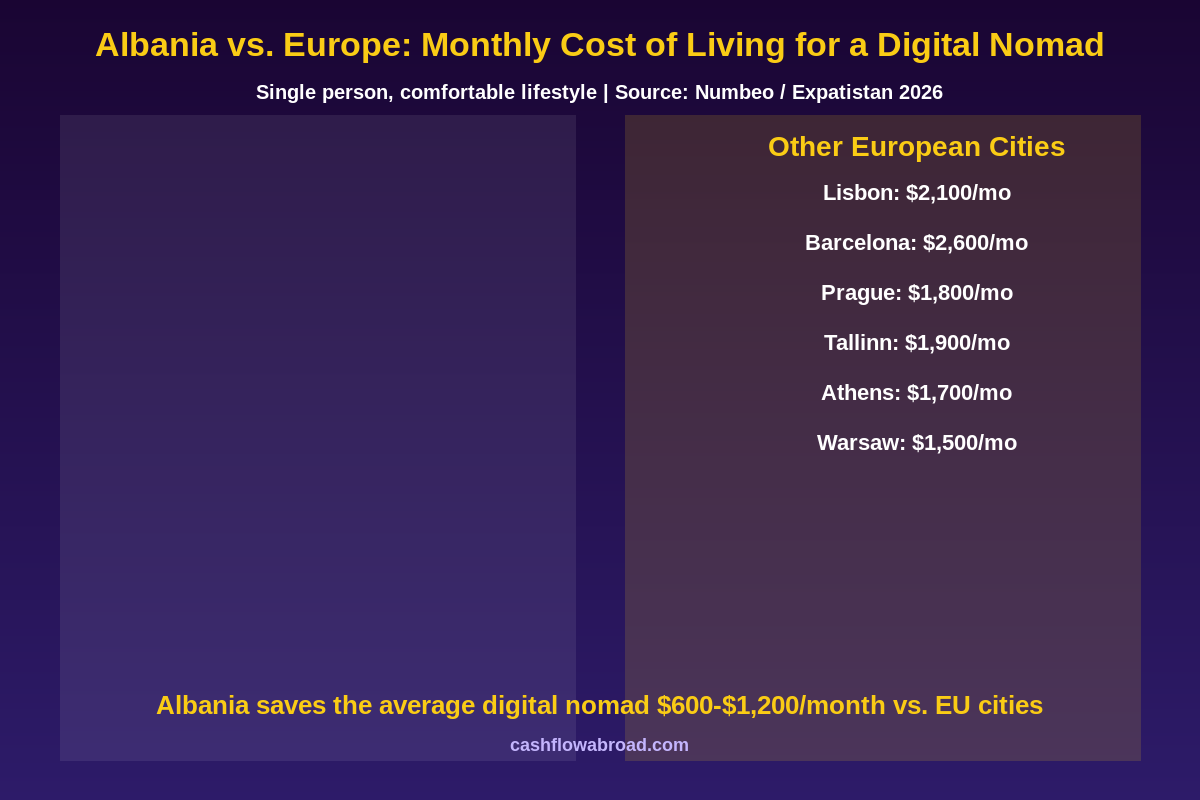
Here’s a realistic monthly budget breakdown for a single digital nomad in Tirana:
| Expense | Monthly Cost (USD) | Notes |
|---|---|---|
| Rent (1BR, city center) | $430–$650 | Blloku / Komuna e Parisit areas |
| Groceries | $120–$160 | Local markets significantly cheaper |
| Coworking | $142 | Coolab monthly membership, no fixed desk |
| Utilities (electricity, water, internet) | $60–$100 | High-speed internet averages 48 Mbps in Tirana |
| Local transport | $20–$30 | Bus passes, occasional rides |
| Dining out (3–4x per week) | $80–$130 | Mid-range restaurant meal: $8–$15 |
| Health insurance | $45–$120 | Required: minimum €30K coverage |
| Total | $897–$1,332 | Conservative to comfortable |
The Albanian Riviera — Saranda, Himara, Ksamil — runs slightly higher in summer due to tourism demand (costs can double July–August) but is extraordinary value from September through June. Saranda averages around $891/month for a single person year-round. If your workflow is flexible, you can work from a hillside terrace overlooking the Ionian Sea at half the price of any comparable Mediterranean alternative.
How the Unique Permit Actually Works
Albania doesn’t call this a “digital nomad visa” in its official documentation. The pathway combines a Type D Long-Stay Visa with the Unique Permit for Digital Mobile Workers, introduced under Law 79/2021 “On Foreigners.” The minimum income requirement is $9,800/year — among the lowest bars for any legitimate European nomad program. The entire application is submitted online through Albania’s e-visa portal, and processing takes up to 12 weeks (each reviewing institution gets up to 2 weeks for their part). Once approved, you receive an electronic stamp and permit delivered digitally.
Documents you’ll need:
- Valid passport (at least 3 months beyond the visa period, 2 blank pages)
- Passport-size photo taken within the last 6 months
- Employment contract with an overseas employer — or service contracts showing 3+ months of paid work if self-employed
- Proof of accommodation in Albania (rental agreement or hotel booking)
- Health insurance valid in Albania with minimum €30,000 coverage
- Clean criminal record from all countries of residence in the past 5 years
- Apostille certification on government-issued documents
- Proof of an active bank account in a recognized Albanian bank
That last requirement — an Albanian bank account — is the one that catches people off guard. You’ll need to open this after arriving and before your permit application is complete. Credins Bank and Raiffeisen Albania are the most accessible for foreigners; Raiffeisen has more English-speaking staff in its Tirana branches.
For your primary US banking needs abroad, Charles Schwab’s international checking account remains the standard: no foreign transaction fees, worldwide ATM fee reimbursement — which matters in a country that’s still heavily cash-based outside the capital.
The initial permit runs 1 year and is renewable. After 5 years of continuous legal residence, you can apply for permanent residency. The path to Albanian citizenship requires 5 more years of permanent residency on top of that — a long road, but it exists and it’s fully codified in law.
Meeting the €30K Health Insurance Requirement
The Unique Permit requires a minimum €30,000 in health coverage valid in Albania. Standard international health plans clear this bar easily, but cost varies significantly. SafetyWing’s Nomad Insurance starts around $45–$56/month for people under 40, covers 185+ countries with a $250 deductible per period, and has been used successfully for the Albanian Unique Permit application. Their Remote Health plan provides comprehensive coverage with a formal policy document that explicitly states coverage amounts — what you want to hand to immigration officials.
For a full breakdown of international health plan options at different price points, the expat health insurance guide compares the main providers, including what’s worth paying more for and what’s negotiable based on your risk tolerance.
Internet, Coworking, and the Working Reality
Tirana’s average internet speed clocks in at 48 Mbps, with fiber available in most central apartments for €20–€30/month. Mobile data is cheap — a local SIM with generous data runs under €10/month. For travel days and the coastal stretches where fixed internet is spottier, an eSIM from Saily keeps you connected across the Balkans without roaming charges.
The coworking scene in Tirana is small but functional. Coolab is the most popular with the expat community: day passes start at $9.50, monthly memberships without a fixed desk run $142. Dutch Hub and InnoSpace are solid alternatives. Outside the capital, coworking options drop off sharply — if you’re working from the Riviera, you’re in your apartment or a café with solid WiFi, not a dedicated space.
The honest picture: Tirana is a capital mid-transformation. Infrastructure is functional but not seamless. Power outages in the center are rare but not unheard of. New construction is constant, international flights are multiplying, and the Blloku neighborhood — once the sealed residential compound for Albania’s Communist Party elite, off-limits to ordinary citizens until 1991 — is now the city’s best café-and-bar district. An espresso costs $0.80. A solid dinner is $12. The arbitrage is real and not subtle.
Albania vs. Other European Nomad Visas
| Country | Min. Income | Tax Rate | Monthly Cost (Single) | Visa Term |
|---|---|---|---|---|
| Albania | $9,800/yr | Year 1 exempt, then 15% flat | $897–$1,332 | 1 yr → 5 yr renewable |
| Georgia | None (tourist track) | 20% flat (if tax resident) | $800–$1,200 | 1 yr remotely renewable |
| Portugal D7 | ~$1,130/mo | 28% standard (NHR mostly closed) | $1,800–$2,400 | 2 yr, renewable |
| Estonia DNV | €4,500/mo net | 22% personal income tax | $1,600–$2,200 | 1 yr, not renewable |
| Greece DNV | $3,500/mo | 50% exemption on foreign income (7 yrs) | $1,400–$2,000 | 2 yr, renewable |
| Spain Beckham Law | None (for remote workers) | 24% flat (6 yrs) | $2,200–$3,200 | 1 yr → 5 yr |
On pure tax efficiency combined with cost of living, Albania wins the table. Georgia is comparable on cost and has zero income requirement, but the legal framework for remote work status is murkier and EU integration is a distant prospect at best. Estonia’s income threshold (€4,500/mo net) screens out most freelancers entirely. The trade-off with Albania is the infrastructure gap and the learning curve of a genuinely unfamiliar system — but that’s also why the arbitrage hasn’t been priced away yet.
The US Expat Tax Layer
American citizens file with the IRS regardless of residence. The Albania playbook works like this:
Year one: Albania grants a tax exemption. You pay US taxes only. After applying the FEIE (which shelters up to $126,500 in foreign earned income for 2025), most digital nomads earning under $150K end up with minimal US federal tax liability. Pair that with the full FBAR and FATCA compliance routine and you’ve got a clean setup.
Year two and beyond: Albania charges 15%. If you claim the Foreign Tax Credit instead of the FEIE, that 15% offsets a portion of your US liability dollar-for-dollar. The FEIE vs. Foreign Tax Credit comparison covers when each strategy wins — the stakes are real, and the wrong choice can cost thousands per year.
FBAR filing is still required for your Albanian bank account if the balance exceeds $10,000 at any point during the year. Don’t skip this — the penalties are disproportionate.
One logistical piece most expats underestimate: maintaining a US address for IRS correspondence, banking, and state domicile documentation. A virtual mailbox through Traveling Mailbox costs $15/month and provides a real US street address with digital mail scanning and check deposit capability. If you’re terminating state tax residency before you leave — which you should, since some states pursue former residents aggressively — having a documented forwarding address in a no-income-tax state is step one of that process. See the full virtual mailbox guide for how to set this up before you go.
Moving Money In and Out of Albania
Albania’s banking system supports SWIFT, but fees at local banks stack up on international transfers. For regular income transfers (freelance payments, client invoices), Remitly covers Albania as a recipient country with competitive rates. For larger transfers, the expat money transfer guide is worth reading first — the cost differences between methods at $10K+ are significant.
Albania operates in Albanian Lek (ALL), though most central Tirana businesses and landlords quote prices in EUR. ATMs are plentiful in the capital; bring cash when leaving the city for the coast or mountains.
The EU Candidacy Factor
Albania has been an EU candidate since 2014 and formally entered accession negotiations in 2022. Full membership isn’t imminent — the process typically spans a decade-plus — but it has two practical effects now. First, it’s driving rapid regulatory modernization: the fully online Unique Permit application, relatively transparent processing timelines, and improving legal clarity all trace back to EU alignment requirements. Second, if Albania eventually joins, the cost-of-living arbitrage disappears, real estate prices compress upward, and permanent residency secured today becomes dramatically more valuable.
That’s a bonus scenario, not a thesis. But it’s a dimension that purely territorial-tax countries like Georgia or Paraguay don’t offer, and it’s worth factoring in if you’re thinking beyond a 1–2 year stint.
Bottom Line
Albania’s Unique Permit is the best-kept secret in European digital nomad visas. The combination of a 12-month income tax exemption, a 15% flat rate after that, and the lowest cost of living of any EU candidate country in Europe makes the financial case hard to argue with. The minimum income bar clears easily for most remote workers. The application is fully online. And the number of people who’ve figured this out is still small enough that you’re not competing for apartments or fighting waitlists at coworking spaces.
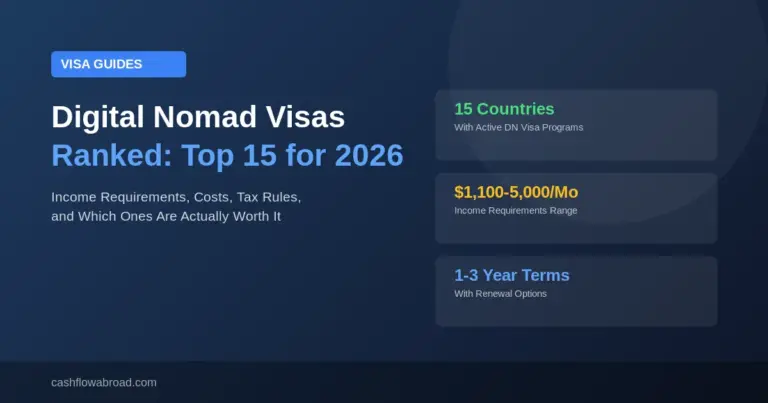
The infrastructure isn’t perfect and the banking setup requires patience. You’ll spend time explaining your destination to people who’ve never heard of Tirana. But the math works, the country is safe, the internet is fast enough, and the Riviera in October looks exactly like the photos. For the full ranked comparison of 15 digital nomad visa programs — including the ones that look better on paper than they perform in practice — that guide covers the real costs and red flags for each.
Financial Disclaimer: This post is for informational and educational purposes only and does not constitute tax, legal, or financial advice. Tax laws, visa requirements, and income thresholds change frequently and vary by individual circumstances. Consult a qualified tax professional, immigration attorney, or licensed financial advisor before making any residency, tax, or financial decisions. All costs and figures reflect publicly available data as of early 2026 and may have changed.
Liked this article?
Get the next one delivered straight to your inbox — plus a free Expat Tax Cheat Sheet.
Join our subscribers. No spam — just expat finance intel and new post notifications.