Thailand LTR Visa: The Expat Wealth Visa Most Americans Miss
By the end of 2025 — three years in — they'd issued roughly 7,000 visas . That's 0.7% of target. You can read that two ways.
By the end of 2025 — three years in — they'd issued roughly 7,000 visas . That's 0.7% of target. You can read that two ways.
Thailand's government set a goal of attracting 1 million wealthy and talented foreign residents through its Long Term Resident (LTR) visa program within five years of launch. By the end of 2025 — three years in — they'd issued roughly 7,000 visas. That's 0.7% of target.
You can read that two ways. Either the program is a bureaucratic failure nobody wants, or it's a wildly underutilized opportunity sitting in plain sight — and the few thousands of expats who've figured it out are living a very different financial life than the tens of thousands still cycling 90-day tourist visas while overpaying taxes in Bangkok cafes.
We lean toward the second interpretation, and the math backs it up. A 10-year multiple-entry residency visa with 0% Thai personal income tax on your foreign earnings, access to world-class private hospitals, no 90-day reporting, and a cost of living that lets you bank more than half your income — all for a one-time fee of roughly $1,400. By any rational standard, that's an extraordinary deal. Here's everything you need to know before applying.
Related: digital nomad visa rankings
What Is the Thailand LTR Visa?
Thailand launched the Long Term Resident visa program on September 1, 2022, administered through the Board of Investment (BOI). Unlike traditional Thai visas — which required frequent renewal, 90-day immigration check-ins, and offered no path to permanent residency — the LTR was explicitly designed to attract a different kind of foreigner: wealthy retirees, remote workers employed by foreign companies, investors, and highly skilled professionals working in targeted industries.
The program exists because Thailand looked at what's happened with digital nomad and expat migration globally and decided it wanted a larger piece of that economic pie. More affluent foreigners means more spending, more investment, more economic activity without straining the labor market. The LTR visa is their play to capture that.
The core features that set it apart from every other Thai long-stay option:
- 10-year duration (renewable), multiple entry — no annual renewals at the immigration office
- Annual reporting rather than the standard 90-day check-in requirement
- 0% Thai personal income tax on foreign-sourced income for most categories
- Immigration fast-track lanes at Suvarnabhumi and Don Mueang airports
- Unlimited dependents (as of a 2025 update, now including parents, not just spouses and minor children)
- Cost: 50,000 THB (~$1,400) — cut in half from the original 100,000 THB in 2025
What it does not offer: a path to permanent residency or Thai citizenship. You can live here for 10 years, renew, and live here 10 more — but you will never hold a Thai passport or own land outright. That's a genuine limitation worth knowing upfront.
The Four LTR Categories: Which One Are You?
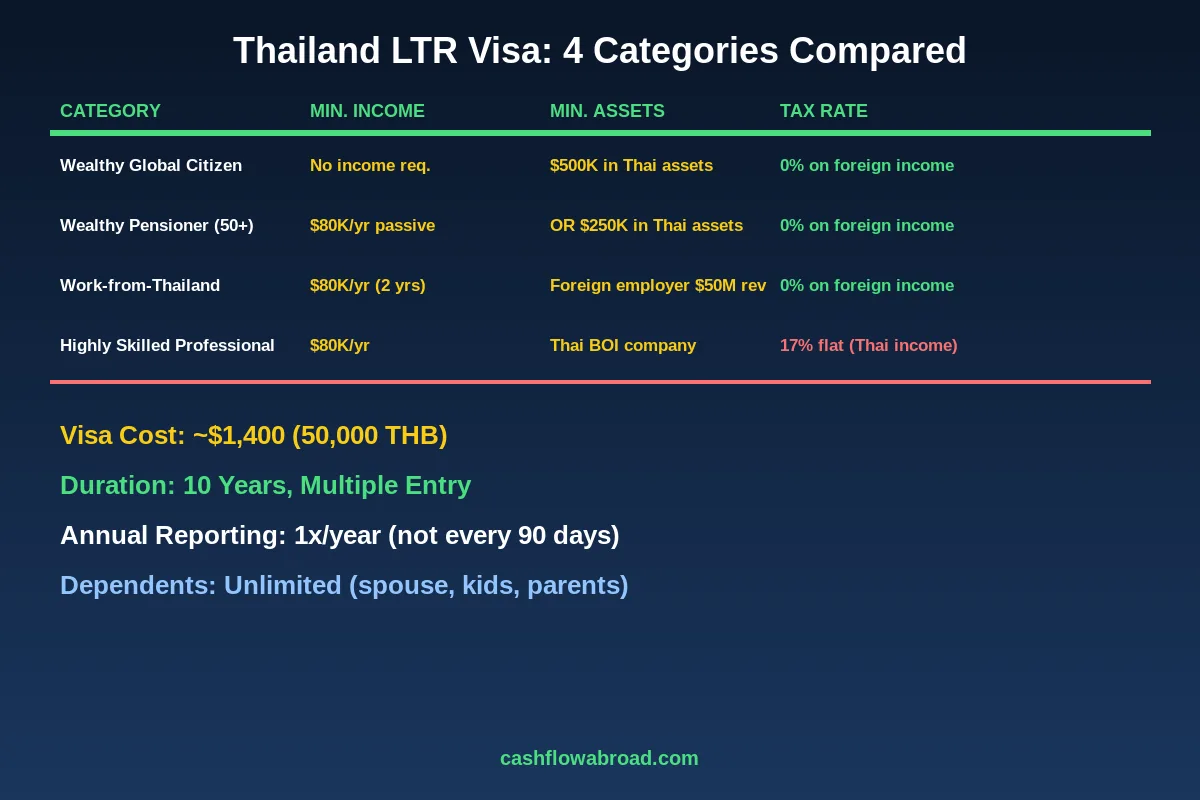
The LTR visa has four distinct tracks, each with different income, asset, and employment requirements. Understanding which category applies to you is the critical first step — and the most common source of confusion online.
1. Wealthy Global Citizen
This is the investor track. The January 2025 revision eliminated the previous USD 80,000/year income requirement for this category and simplified it to an asset requirement: you must hold at least USD 1,000,000 in total assets, of which at least USD 500,000 must be invested in specific Thai assets — government bonds, shares in BOI-promoted companies, or Thai real estate (held via a leasehold or through a Thai company).
The Thai investment requirement is actually the dealbreaker for most applicants. It's not that USD 1M is unreachable for the target audience — it's that requiring USD 500K deployed into Thai-specific assets asks for a very specific kind of commitment that most mobile high-net-worth individuals aren't ready to make on the strength of a visa application alone.
2. Wealthy Pensioner
Age 50 or older. Two options to qualify:
- Option A: At least USD 80,000/year in passive income — pension, dividends, rental income. This explicitly excludes salary or director fees. You must demonstrate genuinely passive income streams.
- Option B: At least USD 40,000/year in passive income plus at least USD 250,000 invested in qualifying Thai assets
Health insurance is required: minimum USD 40,000 in Thai coverage. The passive income definition is strict — a remote salary does not qualify for this track. If you're 58 and living off a US pension, dividends, and rental income, this is your path.
3. Work-from-Thailand Professional
The remote worker track — and the category most digital nomads are eyeing. Requirements:
- At least USD 80,000/year in employment income for the past 2 consecutive years
- Employer must be a foreign-based company with minimum revenue of USD 50,000,000 over the past 3 years (dramatically reduced from the original USD 150 million in the 2025 update)
- Subsidiaries of qualifying parent companies now eligible — a key change that opened the door for employees of international subsidiaries operating in smaller markets
- Health insurance required
The income threshold is the real filter. USD 80K/year is the floor, not the average profile. If you're a software engineer, product manager, consultant, or senior professional at a mid-to-large company earning at or above that figure, you're in scope. Freelancers and solo business owners are not — you need a single foreign employer.
One nuance that trips people up: Work-from-Thailand holders do not receive a traditional Thai work permit. They cannot work for Thai companies or serve Thai clients. The visa authorizes remote work for your existing foreign employer only — hence the category name.
4. Highly Skilled Professional
The talent acquisition track. This category requires working for a Thai BOI-promoted company or government/international organization in a targeted industry: biotech, automation, digital economy, aviation, defense, and others on the BOI priority list. Income requirement: generally USD 80,000+/year in Thai-sourced employment.
This is the category that gets all the press for its 17% flat personal income tax rate. We'll come back to this because there's enormous confusion about who actually benefits from it.
The Tax Picture: 0% vs. 17% and the American Problem
Let's clear up the biggest point of confusion in every article written about the LTR visa.
The 0% Rate (Most LTR Holders)
Thailand taxes residents — anyone spending 180+ days per year in the country — on income sourced in Thailand. As of January 1, 2024, Thailand's Revenue Department updated its rules significantly: all foreign-sourced income remitted into Thailand by tax residents is now taxable, regardless of when it was earned. This was a major policy shift that created real liability for long-term expats who'd previously moved money into Thailand freely without considering tax consequences.
LTR visa holders in the Wealthy Global Citizen, Wealthy Pensioner, and Work-from-Thailand categories are explicitly exempt from this rule. Their foreign-sourced income remitted to Thailand is taxed at 0%. This carve-out is arguably the single most valuable feature of the LTR visa in the post-2024 environment — it functions as a legal shield against the new remittance tax that now catches ordinary long-stay expats.
Related: golden visa guide
For most LTR applicants, this is the entire Thai tax story. You pay zero to Thailand on your foreign earnings.
The 17% Rate (Highly Skilled Professionals Only)
The 17% flat rate applies exclusively to Highly Skilled Professionals — people employed by Thai BOI companies in targeted industries. Their Thai-sourced employment income is taxed at a flat 17% instead of the progressive scale (which runs from 5% on lower brackets up to 35% on income above 5 million THB). For a senior engineer at a Thai semiconductor or biotech firm earning USD 200K, this is a substantial discount. For everyone else on the LTR — paying 0% on foreign income — the 17% rate is simply irrelevant to their situation.
Most of the articles conflating "LTR visa = 17% tax rate" are referring exclusively to this one category. Don't let it confuse your analysis.
The American Double-Tax Problem
Here's the part most LTR visa guides skip, and it matters enormously for US citizens: the 0% Thai tax benefit is worth less than it looks for Americans.
The United States taxes its citizens on worldwide income regardless of where they live. A US passport holder earning USD 120,000 remotely while living in Chiang Mai still owes the IRS on that income. In high-tax countries — France, Germany, Australia — expats normally offset their US bill with the Foreign Tax Credit: pay 30% to France, offset your US liability by that 30%.
With the LTR visa, Thailand takes 0% on foreign income. No foreign tax credit. Your US bill stands essentially unreduced.
The primary tool US citizens in Thailand use is the Foreign Earned Income Exclusion (FEIE), which allows qualifying expats to exclude approximately $126,500 (2024 figure, indexed annually) of foreign-earned income from US taxable income. This eliminates US federal tax on income up to that threshold. Earnings above the exclusion are taxable at regular US rates. For a complete breakdown of how to structure this, see the FEIE guide for US expats.
The bottom line: if you're American, the LTR visa is still an outstanding deal — you live extremely well, save aggressively, and pay only US taxes significantly reduced by FEIE. But don't assume you've escaped the tax system. Thailand just isn't adding on top of your existing US obligation.
How to Apply: Step-by-Step
Applications are processed by Thailand's BOI. You can apply at a Royal Thai Embassy or Consulate in your home country, or domestically at the BOI office in Bangkok if you're already in Thailand on another valid visa.
Core Documents (All Categories)
- Valid passport with at least 12 months remaining
- Completed LTR visa application form (available at BOI offices and select embassies)
- Recent passport photographs
- Health insurance policy showing minimum USD 40,000 coverage in Thailand
- Criminal background check from your home country, apostilled
- Medical certificate from a licensed physician
- Category-specific financial documentation (see below)
Category-Specific Financial Documentation
Work-from-Thailand: Two years of payslips or equivalent income documentation, a letter from your employer confirming remote work authorization, and the company's financial documentation demonstrating USD 50M+ in annual revenue (annual reports, auditor letters, or certified financial statements). Foreign companies with subsidiaries may need to provide parent company documentation.
Wealthy Pensioner: Bank statements and documentation of passive income sources — pension statements, dividend records, rental income agreements. If applying under Option B, confirmation of qualifying Thai-based investments from a licensed Thai financial institution.
Wealthy Global Citizen: Total asset valuation evidence plus proof of qualifying Thai investments: Thai government bond certificates, BOI company shareholding certificates, or real estate leasehold documentation.
Timeline and Costs
| Cost Item | Amount |
|---|---|
| Official LTR visa fee | 50,000 THB (~USD 1,400) |
| Legal/immigration agent fees | USD 1,000–3,000 |
| Document apostilles and translations | USD 200–500 |
| Health insurance (annual) | USD 2,400–6,000/year |
| Total first-year realistic cost | USD 5,000–11,000 |
| Annualized visa cost over 10 years | USD 140–240/year |
Processing time through BOI is approximately 20 business days. Applying with a qualified immigration attorney or BOI-registered agent significantly reduces rejection risk from documentation errors — the most common reason for delays. Spread over the 10-year visa duration, the bureaucratic investment is trivial relative to the benefit.
How the LTR Stacks Up Against Other SE Asia Visas
Thailand isn't the only country in the region competing for affluent expats. Here's an honest comparison of the main programs:
| Feature | Thailand LTR | Malaysia MM2H | Indonesia 2nd Home | Philippines SRRV |
|---|---|---|---|---|
| Duration | 10 years | 10 years | 5 years | Permanent |
| Min. Financial Bar | $80K/yr income or $500K Thai assets | RM 1.5M (~$320K) liquid assets | ~$130K deposit in Indonesian bank | $10K–$75K deposit (age-dependent) |
| Tax Benefit on Foreign Income | 0% (most categories) | None | None | None |
| Remote Work Rights | Yes (foreign employer) | No | No | No |
| Reporting Requirement | Annual (1x/year) | 60 days/year min. stay | Annual | Annual |
| Dependents Covered | Unlimited (incl. parents) | Spouse + children | Spouse + children | Spouse + dependents |
| Private Healthcare Quality | Excellent (Bangkok) | Very Good | Developing | Variable |
| Visa Fee | ~$1,400 | ~$2,700 | Moderate | ~$1,400 |
Malaysia MM2H is the main regional competitor. After a 2021 overhaul that drastically raised requirements, it now demands RM 1.5 million in liquid assets (~USD 320,000) — which prices out many remote workers who are income-rich but asset-light. Malaysia offers proximity to Singapore's financial ecosystem and excellent English-language infrastructure, but there's no special tax benefit on foreign income.
Indonesia's Second Home Visa requires roughly USD 130,000 deposited in an Indonesian bank for the 5-year version. Bali's appeal is obvious, but infrastructure limitations, developing healthcare, and the lack of any tax structure make it a pure lifestyle play rather than a financial optimization strategy.
Philippines SRRV wins on entry cost — deposits as low as USD 10,000 for retirees with a foreign pension. But the Philippines' infrastructure challenges, crime statistics in Metro Manila, and variable healthcare quality keep it off many affluent expat shortlists, even though Cebu and the Visayas offer genuinely beautiful and affordable living for the right profile.
Related: cheapest countries guide
Vietnam has no real long-stay program. Expats cycle tourist and business visas, which creates perpetual bureaucratic overhead without the stability of a proper residency visa.
The verdict: For qualified remote workers and retirees, Thailand's LTR is the strongest package in Southeast Asia on the dimensions that matter most: tax treatment, healthcare quality, visa duration, and administrative simplicity. The Philippines SRRV remains the most accessible entry point. Malaysia MM2H is the logical choice if your business life requires proximity to Singapore.
The Cost of Living Equation
A visa is only as valuable as the lifestyle it enables. Here's an honest breakdown of what comfortable living actually costs in Thailand's two most popular expat cities.
Bangkok
Bangkok delivers a quality of life that would cost three to four times as much in New York, London, or Sydney. World-class hospitals — Bumrungrad International charges roughly 20–30% of equivalent US procedure costs. A BTS Skytrain system that makes car ownership optional in most expat-friendly neighborhoods. And food options that genuinely run the full spectrum from USD 1.50 street noodles to USD 200 tasting menus, all within Grab ride distance of each other.
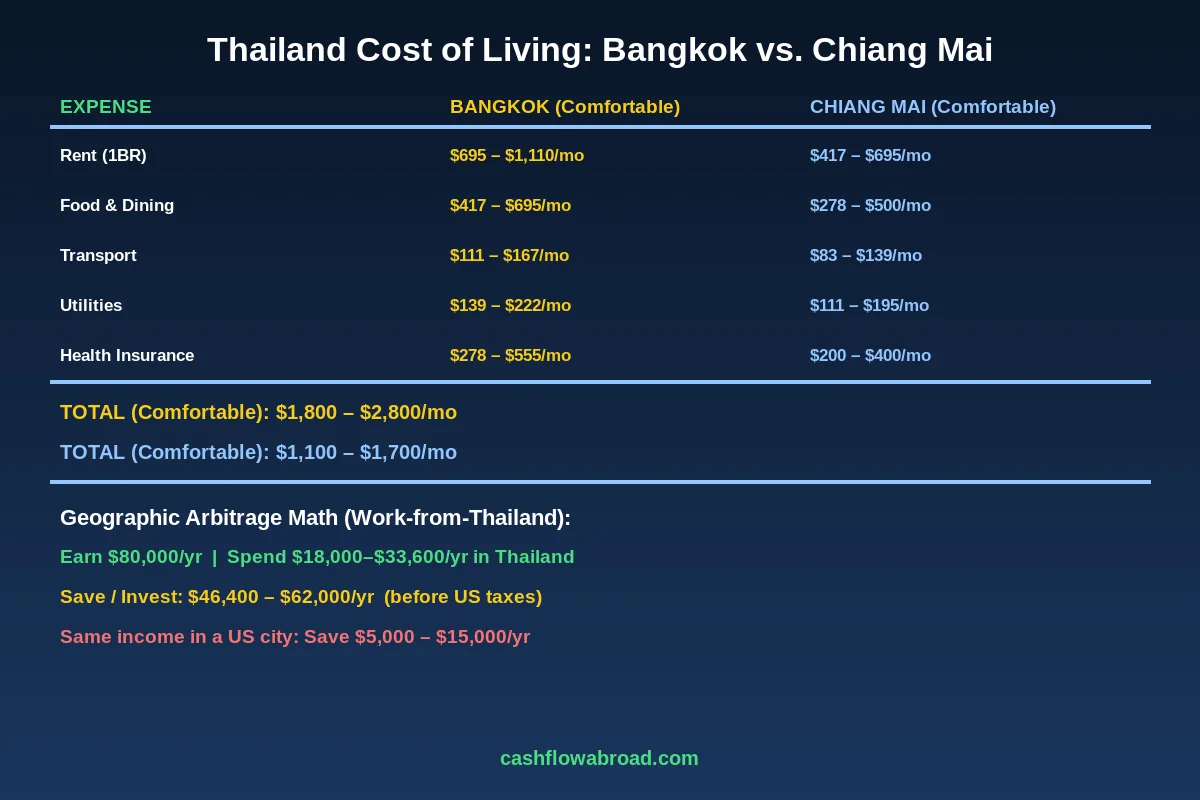
For a single person living comfortably — a quality 1BR apartment in Phrom Phong, Ari, or Thonglor, eating out most nights, occasional weekend travel, health insurance included — expect USD 1,800–2,800/month. A couple at similar quality runs USD 2,800–4,000/month. Families with children at international schools should budget meaningfully more: top-tier international schools run USD 15,000–30,000/year per child.
Chiang Mai
About 31% less expensive than Bangkok for equivalent quality, and beloved by the slower-pace, long-stay crowd. The digital nomad infrastructure here is mature — dozens of dedicated coworking spaces, an established expat community, excellent coffee shop culture, and a night market scene that never gets old. Climate: genuinely pleasant November through February (15–25°C); hot season March–May; rainy June–October.
Comfortable single living in Chiang Mai runs USD 1,100–1,700/month all-in. A nice 1BR in the Nimman or Old City area goes for USD 417–695/month. The tradeoff: Chiang Mai's hospital infrastructure is solid for routine care but limited for complex procedures. For anything serious, you're looking at Bangkok Hospital Chiang Mai as the best local option, with Bangkok proper as the gold standard for complicated cases.
The Geographic Arbitrage Math
This is where the LTR visa becomes transformative rather than merely convenient. An American earning USD 80,000/year — the Work-from-Thailand minimum — living in a mid-tier US city might spend USD 55,000–70,000/year on housing, food, transport, healthcare, and taxes, leaving perhaps USD 10,000–25,000 to save or invest annually.
The same USD 80,000 in Chiang Mai: spend roughly USD 18,000/year (USD 1,500/month), and the remaining USD 62,000 before US taxes is available to invest. Even in Bangkok at USD 2,500/month, that's USD 30,000/year in expenses versus USD 80,000 in income — a USD 50,000 annual savings advantage over a typical US scenario, compounded over the 10-year visa duration.
This is the geographic arbitrage core thesis in action. For a comprehensive framework on applying this logic across multiple countries and income scenarios, the Geographic Arbitrage Playbook breaks it down in detail.
Banking and Money Management in Thailand
The LTR visa addresses residency — you still need to deliberately structure your banking to avoid losing money to fees and poor exchange rates.
US-Side Banking
Keep your US financial infrastructure fully intact before you move. Charles Schwab's Investor Checking account remains the standard recommendation for expats in Thailand: no foreign transaction fees, and they reimburse all ATM fees worldwide at month-end — including Thai ATM surcharges that run 200–220 THB (~USD 6) per withdrawal at every machine in the country. If you're making 10 ATM withdrawals a month in Bangkok, that's USD 60 per month in fees you're avoiding.
For moving money from your US paycheck or US brokerage to your Thai bank account, Remitly consistently delivers competitive USD-to-THB exchange rates with transparent fees and reliable transfer speed. Thai bank wire rates on the receiving end are typically worse — use a dedicated transfer service and compare rates before sending large amounts.
Thai-Side Banking
Opening a Thai bank account as an LTR visa holder is considerably smoother than for tourist-visa holders, who often face roadblocks. Bangkok Bank, Kasikorn (KBank), and SCB (Siam Commercial Bank) are the primary options for foreigners. You'll need a local account for recurring charges — rent, utilities, many Thai app-based payments — that don't reliably process on foreign-issued Visa or Mastercard.
Connectivity and VPN
Thailand has solid 4G/5G coverage in Bangkok and most urban centers, expanding into rural areas. That said, geo-restrictions on streaming services and occasional content filtering make a reliable VPN standard practice for expats. NordVPN works consistently on Thai networks. If you're in transit between Thailand and other countries while in the process of relocating, a Saily eSIM lets you activate local data plans by country without swapping physical SIMs or dealing with Thai SIM cards before you've landed your permanent setup.
Health Insurance: Meeting the Requirement and Going Beyond It
The LTR visa mandates a minimum USD 40,000 in Thai health coverage. Treat this as a floor, not a target. If you're planning years in Thailand, you want coverage that includes inpatient care at the facilities you'd actually want: Bangkok Hospital Group, Bumrungrad International, or Samitivej if you're in Bangkok; Bangkok Hospital Chiang Mai if you're in the north.
International health insurance from providers like SafetyWing is built around expat and digital nomad needs — flexible international coverage that travels with you, with options to include or exclude US coverage depending on whether you ever return for care. For a comprehensive guide to structuring expat health coverage across different budgets and risk profiles, see the Expat Health Insurance Guide.
Related: expat health insurance guide
One practical logistics note: Bangkok's top private hospitals require insurance verification or a cash deposit at admission. Arrive with your insurance policy number and insurer contact readily accessible — not buried in email.
Investing While Living in Thailand
Thailand's investment environment for foreigners has an accidental advantage for US expats: the country's strict capital controls and complex local financial product structures make it effectively unattractive to buy Thai mutual funds, ETFs, or most locally-domiciled investment products. Which means American LTR visa holders are naturally pushed toward continuing to invest through their US brokerage accounts — in US-listed ETFs and securities — which is precisely what you'd want anyway.
This sidesteps the PFIC (Passive Foreign Investment Company) trap that ensnares expats who buy locally-domiciled funds in the country where they live — a US tax nightmare involving mark-to-market elections and punitive interest charges that you want absolutely no part of. Thailand's foreigners-stay-out investment environment is inadvertently expat-tax-friendly. For a full breakdown of the PFIC rules and how to structure expat investing to avoid them, see the Expat Investor's Playbook.
Who Should Apply — and Who Should Skip It
The LTR visa is genuinely excellent, but it's not for everyone. An honest assessment by profile:
Strong Fit
Senior remote workers at established companies earning USD 80K+: This is the Work-from-Thailand sweet spot. You meet the income and employer size thresholds, you're already working for a foreign company, and the geographic arbitrage math means saving USD 40K–60K more annually than you would in a Western city. Combine with FEIE and you've meaningfully reduced your total tax burden while living extremely well.
Retirees with solid passive income above USD 80K: The Wealthy Pensioner track is purpose-built for this profile. Thailand's private healthcare delivers quality care at a fraction of Western prices, and the 0% tax on remitted foreign income means your pension and dividend income arrives intact.
Families seeking long-term Asian base: The 10-year duration, unlimited dependent coverage (now including parents), and Bangkok's established international school ecosystem make this viable as a genuine long-term family relocation, not just a nomad stopover. Just budget realistically for international school fees.
Not a Strong Fit
Freelancers and independent contractors: If your income comes from multiple clients rather than a single foreign employer, the Work-from-Thailand category doesn't apply. You'd need to explore other Thai visa structures — or a different country.
Anyone whose primary goal is cutting US federal taxes: The LTR doesn't directly reduce US tax exposure. FEIE helps significantly on earned income below ~$126,500, but above that threshold — or on passive income like dividends and capital gains — US taxes apply regardless of Thailand's 0% rate. If minimizing total tax burden is the dominant priority, look at our overview of the full digital nomad visa landscape alongside territorial tax countries.
Those who want permanent residency or citizenship: Thailand is one of the most restrictive countries in the world for permanent residency and naturalization. The LTR is a very good long-stay visa — not a pathway to becoming Thai.
Why 7,000 Visas, Not 1 Million
The program's dramatic underperformance against its stated target is worth understanding — both to explain who hasn't been coming, and to read the tea leaves on where requirements will continue to loosen.
The income thresholds filter out a majority of location-independent workers. USD 80,000/year in documented employment income from a single foreign employer with USD 50M+ in revenue is a narrow slice of the remote work universe. It excludes freelancers, early-career remote workers, and anyone whose employer is below the revenue threshold. The 2025 reduction from USD 150M to USD 50M in required employer revenue was significant — but a USD 50M company is still a fairly large organization.
The Wealthy Global Citizen Thai asset requirement is a committed ask. Requiring USD 500K specifically in Thai-domiciled assets asks for a level of conviction in Thailand as a long-term base that most mobile high-net-worth individuals haven't yet formed. Most evaluate several countries simultaneously, and committing half a million dollars to one before living there feels backward.
The program is genuinely undermarketed. Thailand receives tens of millions of tourists annually, many of whom are exactly the profile the LTR targets. Yet awareness of the program among that audience is surprisingly low. The applications that do come in skew European and Japanese — not because those nationalities are more eligible, but because expat communities in those regions have more effectively spread awareness.
What this means for you: A program sitting at 0.7% of its goal is a program that will continue adjusting to attract more takers. The 2025 changes (halved fee, expanded dependent coverage, reduced employer revenue threshold) show the Thai government is responsive to feedback and willing to compete. If you're on the edge of qualifying today, the trend is working in your favor.
Bottom Line: Is the Thailand LTR Visa Worth It?
For the right person, the Thailand LTR visa is one of the most cost-effective residency arrangements available to English-speaking remote workers and retirees globally. Ten years of legal residency, 0% Thai income tax on foreign earnings, access to genuinely excellent private hospitals, a city infrastructure that's surprisingly functional, and a cost of living that makes aggressive saving possible — all for a one-time visa investment of roughly USD 1,400.
The catches are real and worth naming plainly: it doesn't eliminate US tax obligations for American citizens, it doesn't lead to permanent residency or citizenship, and the income and asset thresholds exclude a large portion of remote workers who might otherwise be interested. Freelancers and independent business owners need a different structure.
But for a senior remote employee, a pensioner with solid passive income, or an investor prepared to place capital in Thailand, the program is dramatically underutilized relative to its actual value. The 7,000 people who've figured that out are living the geographic arbitrage thesis in practice — earning in dollars, spending in baht, saving at rates that would be impossible back home. The other 993,000 spots on Thailand's target list remain unclaimed.
Financial Disclaimer: This article is for informational purposes only and does not constitute legal, tax, immigration, or financial advice. Visa requirements, tax rules, income thresholds, and program conditions change frequently — always verify current requirements directly with Thailand's Board of Investment (ltr.boi.go.th). US citizens should consult a qualified expat tax professional (a CPA or EA with international specialization) and a licensed Thai immigration attorney before making any relocation or visa decisions. Affiliate links in this article may earn the site a commission at no additional cost to you.
This guide is general information, not personalized tax, legal, or investment advice. Rules change; verify current thresholds with official sources or a qualified professional before acting.
Related guides
 Digital Nomad & Visa GuidesSeptember 22, 2026
Thailand DTV Visa: Fee and Stay Limit
See the $400 DTV fee, 500,000 baht month-end bank proof, and 180-day stay limit before you apply from the United States.
 Digital Nomad & Visa GuidesMay 25, 2026
Bali's $130K Visa and the Tax Trap Most Nomads Miss
Indonesia's $130K Second Home Visa sounds ideal — but the 183-day tax rule could expose your worldwide income. Here's what nomads need to know.
 Digital Nomad & Visa GuidesMay 15, 2026
Taiwan Gold Card: Asia's Overlooked Expat Tax Break
How Taiwan’s Gold Card gives foreign professionals a 50% income tax cut + tax-free overseas income for 5 years. Step-by-step application guide.