Taiwan Gold Card: The $310 Visa With a 50% Tax Break
10 min read · 2,460 words
Most digital nomads spend months debating Bali versus Chiang Mai. Meanwhile, 14,907 professionals from 101 countries have quietly secured one of Asia’s most powerful residency visas — a document that halves their Taiwan income tax for five years, costs between $100 and $310, and can be approved in 30 days. It’s called the Taiwan Employment Gold Card, and if you earn above $92,000 a year and work in a qualifying field, ignoring it might be the most expensive mistake of your expat career.
This isn’t a fringe digital nomad trick. The US, India, and UK are the top three source countries. Tech workers, finance professionals, architects, and academics are using it to park themselves in a city that costs 30–40% less than Tokyo or Singapore while extracting a tax deal most Western governments would never offer.
What Is the Taiwan Employment Gold Card?
The Gold Card is a single document that bundles four things most expats have to get separately: a resident visa, a work permit, an Alien Resident Certificate (ARC), and a re-entry permit. Launched in February 2018 under Taiwan’s Act for the Recruitment and Employment of Foreign Professionals, it lets you live, work, change jobs freely, leave and re-enter Taiwan without restriction, and eventually apply for permanent residency — all without being tied to a specific employer.
It’s valid for one, two, or three years, and renewable. The application is done entirely online through the government’s official portal. No job offer required, no local sponsor, no visa agent needed.
As of October 2025, 14,907 cards have been approved since launch. The program hit 13,000 approved cards in May 2025, and the pace has been accelerating as Taiwan competes with Singapore and Japan for international talent.
The Tax Math That Actually Matters
Here’s the part everyone focuses on — and understandably so. Taiwan’s regular personal income tax runs on a progressive scale from 5% to 40%. For a high earner, that’s not trivial. But Gold Card holders who qualify for the tax incentive get a deal the official tax code literally carves out for them.
The rule: For the first five consecutive years in which you reside in Taiwan for at least 183 days and your annual salary exceeds NT$3 million (approximately $92,500 USD), 50% of everything you earn above NT$3 million is excluded from taxable income.
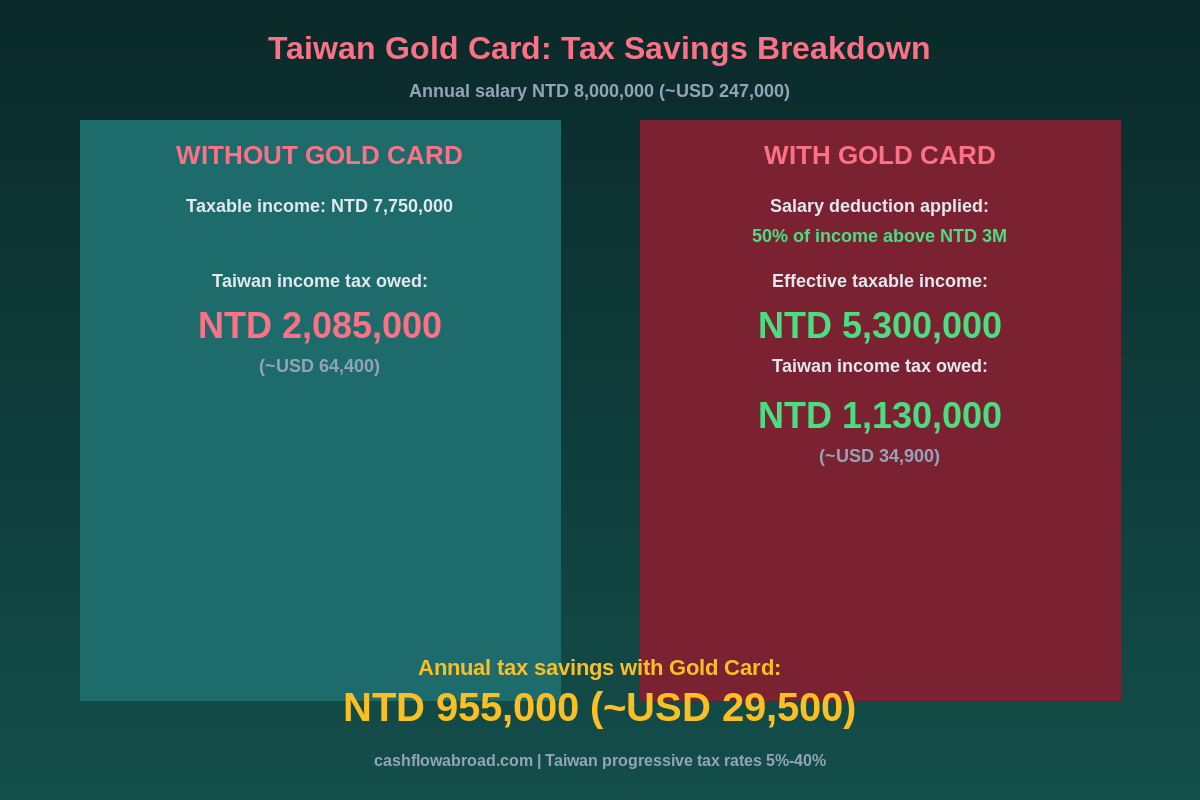
Let’s run the numbers on a $247,000 annual salary (NT$8 million):
| Scenario | Taxable Income (NTD) | Estimated Taiwan Tax | USD Equivalent |
|---|---|---|---|
| Without Gold Card benefit | NT$7,750,000 | NT$2,085,000 | ~$64,400 |
| With Gold Card 50% exemption | NT$5,300,000 | NT$1,130,000 | ~$34,900 |
| Annual Tax Savings | — | NT$955,000 | ~$29,500 |
At $29,500 in annual savings, you’re recovering the cost of the visa in roughly 36 hours of work. Over five years, that’s nearly $150,000 in tax savings on Taiwan-side income alone — before touching the overseas income exemption.
The 183-day threshold resets annually. If you fail to spend 183 days in Taiwan in a given year, you lose the benefit for that year — but the five-year clock doesn’t move. You can pause mid-stream and return later to restart. This gives Gold Card holders unusual flexibility to travel or spend time in a second country without permanently forfeiting the benefit.
The Overseas Income Bonus
This is where it gets truly interesting for high earners with global income streams. Under Taiwan’s Basic Income Tax Act, overseas income is normally included in your income calculation once it exceeds NT$1 million in a year. For Gold Card holders who meet the tax incentive criteria, all overseas income is exempt from being included in that calculation during the qualifying years.
Practically: if you’re earning $120,000 from a US client and another $80,000 from a UK contract while living in Taipei, Taiwan doesn’t tax the overseas portion at all during your incentive window. That’s a territorial-style tax treatment without having to renounce citizenship or sever US ties.
How US Expats Layer the FEIE
US citizens are taxed on worldwide income regardless of where they live. The Gold Card doesn’t change that. But it changes the local tax math dramatically — which matters because of how the Foreign Tax Credit works.
If you’re earning entirely from a Taiwanese employer while residing in Taipei for 183+ days, you likely qualify for the Foreign Earned Income Exclusion — which lets you exclude approximately $130,000 of foreign-earned income from US federal tax for 2026. Income above that threshold can be offset by the Foreign Tax Credit, where Taiwan taxes already paid reduce US taxes owed dollar-for-dollar.
The combination works like this for a $200,000 salary from a Taiwan employer:
- First ~$130,000: excluded from US federal tax via FEIE
- Remaining ~$70,000: Taiwan tax on this portion (reduced by the 50% Gold Card exemption) offsets remaining US federal tax via Foreign Tax Credit
- Net result: potentially zero or near-zero combined US + Taiwan tax on the bulk of your income
This isn’t guaranteed — it depends on income composition, filing status, and whether income qualifies as “earned” versus passive. Run the numbers with a CPA who specializes in expat taxation before assuming total elimination. But the structural overlap between the FEIE and Taiwan’s Gold Card exemption is genuinely favorable.
One key nuance: the FEIE requires you to use either the Physical Presence Test (330 days outside the US in a 12-month period) or the Bona Fide Residence Test. Both are achievable for most Gold Card holders who make Taiwan their primary base. See our complete expat banking and tax guide for the full mechanics.
Who Qualifies: Fields and Salary Thresholds
The Gold Card program covers 8 professional fields, each with its own qualification criteria. You typically need to meet one of two standards: a salary threshold or a recognized credential or achievement in the field.
| Field | Salary Route (Monthly) | Alternative Credential Route |
|---|---|---|
| Science & Technology | NT$160,000+ (~$4,950) | Published research, patents, academic credentials |
| Economy | NT$160,000+ | Senior executive roles, notable business achievements |
| Finance | NT$160,000+ | Professional certifications (CFA, CPA), fund management experience |
| Culture & Arts | NT$160,000+ | Awards, exhibitions, recognized artistic achievements |
| Education | NT$160,000+ | University teaching positions, distinguished academic work |
| Sport | NT$160,000+ | Professional league experience, coaching credentials |
| Architecture & Engineering | NT$160,000+ | Licensed professional engineer status abroad |
| Law | NT$160,000+ | Barred attorney experience in a foreign jurisdiction |
NT$160,000 per month is approximately $4,950. You don’t need to earn NT$160,000 from a Taiwanese company. Foreign payroll qualifies if you can document the income via a tax return or salary certificate from your home country. A W-2, UK P60, or Australian PAYG summary all work.
Important: the tax benefit activates when your Taiwan-sourced salary exceeds NT$3 million annually in a qualifying year. If you earn most income from a US employer remotely, the exemption on Taiwan salary income is less impactful — though the overseas income exemption still applies in qualifying years.
If you’re comparing residency programs across the region, our ranked guide to digital nomad visas covers Taiwan alongside Portugal, Japan, Indonesia, and 12 other programs.
Application Process: Step by Step
The entire application happens online through goldcard.nat.gov.tw. No local presence required to apply. Here’s the realistic timeline:
- Check your field qualification — confirm which ministry reviews your field (NDC, FSC, Ministry of Education, etc.) and that your credentials match the listed criteria.
- Prepare documents — passport copy, proof of salary (last annual tax return or salary certificate), professional credentials (degree, license, or work history), passport-style photo. No Chinese translation required at the application stage.
- Submit online application — takes about 15 minutes if everything is organized. Pay the government fee at submission.
- NIA initial review — 1–2 weeks. They confirm your documents are complete and forward to the relevant ministry.
- Ministry qualification review — 1–2 months. Finance applications go to the FSC, tech to the NSTC, and so on. This is the variable step.
- Passport inspection (overseas applicants only) — visit a Taiwan representative office in your country for biometric checks. About one week.
- Card issued — physical card mailed to your address or collected in Taiwan. Clean applications finish in 30 days; complex cases run 50–60 days.
What Does It Cost?
| Card Duration | Fee (Non-US Passport) | Fee (US Passport, approx.) |
|---|---|---|
| 1 year | NT$3,700 (~$114) | ~$100 |
| 2 years | NT$4,700 (~$145) | ~$200 |
| 3 years | NT$5,700 (~$176) | ~$310 |
Most people apply for 3 years on the first application. The fee is negligible relative to the tax savings. Renewals follow the same structure. There is no income requirement to renew — only to activate the annual tax benefit.
Cost of Living in Taipei
Taipei doesn’t feel like a budget city. Xinyi District has gleaming towers, Michelin-starred restaurants, and a nightlife scene that rivals Hong Kong. But the underlying cost structure sits significantly below other first-world Asian cities — roughly 30–40% cheaper than Tokyo or Singapore.

| Expense | Budget (USD/mo) | Mid-Range (USD/mo) | Comfortable (USD/mo) |
|---|---|---|---|
| Rent — 1BR apartment | $650–$800 | $900–$1,300 | $1,300–$1,600 |
| Food (groceries + eating out) | $250–$350 | $400–$600 | $700–$1,000 |
| Transport (MRT + Uber) | $40–$60 | $80–$120 | $150–$250 |
| Utilities (electric, internet, water) | $60–$80 | $80–$120 | $120–$180 |
| Leisure & miscellaneous | $150–$200 | $300–$500 | $600–$1,000 |
| Monthly Total | $1,150–$1,490 | $1,760–$2,640 | $2,870–$4,030 |
A single professional lives comfortably in Taipei on $1,800–$2,500/month. Taipei’s MRT is among the cleanest and most reliable rail systems in the world, which eliminates car ownership as a cost for most expats. Night market food runs $2–$6 per meal and is genuinely exceptional.
Healthcare is worth addressing separately. Taiwan’s National Health Insurance (NHI) program covers Gold Card holders after six months of continuous residence. Before that, you need private expat health coverage. SafetyWing offers reliable nomad medical coverage from around $56–$80/month depending on age, with no long-term commitment. Once enrolled in NHI, your monthly premium runs roughly NT$749 (~$23) — one of the best healthcare deals in Asia for the level of coverage.
For connectivity on arrival, a Saily eSIM gets you online before you leave your home airport. Taiwan has excellent 5G coverage across Taipei, and setup takes two minutes from your phone.
What Gold Card Holders Often Miss
The tax benefit reads cleanly on paper. In practice, several traps catch applicants off guard.
The “First Time” Rule
The 50% exemption is only available to foreign professionals working in Taiwan for the first time. If you’ve previously been a tax resident of Taiwan — held an ARC and filed local taxes years ago — you likely don’t qualify, regardless of the Gold Card program. This has caught professionals who took short contracts in Taiwan earlier in their career and returned later expecting the exemption.
Your Stated Field Must Match Your Work
If the work you engage in while in Taiwan doesn’t match the Field on your Gold Card, you’re ineligible for the tax benefits that year. A tech Gold Card holder who accepts a role formally classified under finance could inadvertently disqualify their exemption. This matters if you freelance across categories or pivot your work mid-program.
The 183-Day Hard Stop
There’s no partial credit. Spend 182 days in Taiwan in a calendar year and you get zero benefit for that year — and one of your five windows is gone. Plan travel carefully. Extended visits to family, US tax filing trips, and client site work abroad all chip away at the 183-day threshold faster than people expect.
Maintaining Your US Financial Footprint
Moving to Taiwan doesn’t make your US financial infrastructure evaporate — but it needs active management. A Traveling Mailbox (real US street address, mail scanning, check deposit capability, $15/month) handles IRS correspondence, brokerage statements, and any account that requires a US mailing address. It’s one of the cheapest insurance policies in an expat financial stack.
For banking, Mercury works well for internationally-mobile founders and freelancers, and Charles Schwab’s international account provides fee-free ATM withdrawals anywhere in the world — including Taiwan’s 7-Eleven ATMs, which dispense NT dollars 24 hours a day.
FBAR and FATCA Still Apply
Gold Card or not, you’re still a US person with full reporting obligations. If your Taiwanese bank accounts exceed $10,000 at any point in the year, file the FBAR. If aggregate foreign financial assets exceed $200,000 as a single filer living abroad, file Form 8938. Taiwan’s banks report under CRS, and FATCA cross-referencing is routine. There are no Taiwan blind spots at the IRS.
Privacy and Security
Taiwan’s internet is fast and largely unrestricted, but working from co-working spaces or cafes with US client data warrants basic protection. NordVPN adds an encrypted tunnel on public networks without noticeable speed loss on Taiwan’s high-speed infrastructure.
The Path to Permanent Residency
The Gold Card’s benefits extend well past the five-year tax window. After five consecutive years of legal residency — counting time on the Gold Card — you’re eligible to apply for Permanent Resident status. Taiwan’s permanent residents can own property, access NHI indefinitely, and live without annual visa renewals.
A 2026 policy update expanded family provisions: parents and grandparents of Gold Card holders can now stay for up to one year per visit with extendable duration, significantly improving the program’s appeal for professionals with family care obligations back home.
Taiwan doesn’t offer a citizenship-by-investment pathway, but naturalization is available after five years of continuous residence plus a Chinese language and civics test. Dual citizenship with the US is technically possible but involves navigating both countries’ rules carefully.
Who Should Skip the Gold Card
This program isn’t the right move for everyone. Skip it if:
- Your Taiwan-sourced income falls below NT$3 million annually. The 50% exemption only activates above that threshold. The residency rights still have value, but the tax benefit is minimal if most of your income originates outside Taiwan.
- You’ve previously worked as a tax resident in Taiwan. The “first time” rule very likely disqualifies you.
- You’re targeting zero-tax jurisdictions. If the goal is complete income tax elimination, Dubai’s 0% rate, Paraguay’s territorial tax structure, or Uruguay’s 11-year foreign income exemption are structurally more powerful. Our visa comparison guide maps out the full competitive field.
- You need multi-country flexibility. The 183-day requirement ties you to Taiwan. If your life requires splitting time across three or four countries, the benefit window rarely activates cleanly.
Bottom Line
The Taiwan Gold Card occupies a rare category: a government program that openly, explicitly, and legally rewards high-earning foreign professionals with a five-year tax discount, wrapped in a four-in-one residency document that costs $310. It’s not exotic tax planning — it’s a statutory benefit written directly into Taiwan’s tax code, available to anyone who qualifies and shows up for 183 days a year.
The math is stark. Earn above $92,000 in Taiwan-sourced salary, spend 183 days in Taipei, and you’re looking at $20,000–$30,000 in annual tax savings for five years running — while living in one of Asia’s most livable, well-connected, and affordable major cities. The visa pays for itself in the first day or two of the first year.
The window to use the program as a “first timer” is finite by definition. Every year you wait is a year of the five-year benefit clock that doesn’t come back.
For health coverage while you establish Taiwan NHI eligibility, see our complete expat health insurance guide. For understanding how the FEIE interacts with your Taiwan salary, our FEIE guide walks through the full exclusion mechanics step by step.
Financial Disclaimer: This article is for informational purposes only and does not constitute tax, legal, or financial advice. Tax rules change and vary by individual circumstances. Consult a qualified CPA or international tax attorney before making residency or tax-related decisions. US citizens living abroad must comply fully with IRS obligations including FBAR, FATCA, and applicable treaty provisions regardless of their country of residence.
Liked this article?
Get the next one delivered straight to your inbox — plus a free Expat Tax Cheat Sheet.
Join our subscribers. No spam — just expat finance intel and new post notifications.