Indonesia’s E33G: The $430 Bali Visa With a Tax Holiday
9 min read · 2,342 words
Indonesia collected exactly zero dollars in income tax from the roughly 60,000 foreign remote workers living in Bali last year. That’s not a loophole or a gray area — it’s by design. Indonesia’s territorial tax system, combined with a 4-year exemption for skilled expatriates, means most digital nomads on the E33G visa never owe Indonesian tax on the income they earn from foreign clients. The visa itself costs about $430. The math is hard to argue with.
Most nomads treat Bali as a place you visit, not a place you structure around. The E33G Remote Worker Visa changed that. Launched in 2023 and increasingly popular through 2025–2026, it’s one of the cheapest, most straightforward legal residency paths in Asia — and it comes with a surprisingly clean tax profile for Americans who know how to use the Foreign Earned Income Exclusion alongside it.
What Is the E33G Visa?
The E33G is Indonesia’s official Remote Worker Visa, technically classified as a KITAS (Kartu Izin Tinggal Terbatas, or Temporary Residence Permit). Unlike a tourist visa or the B211A social visa that nomads used to game by doing “visa runs” to Singapore every 60 days, the E33G is a proper legal status that lets you live and work remotely in Indonesia for one full year.
Key facts upfront:
- Duration: 12 months, renewable once for a second year (2 years total)
- Cost: ~7,000,000 IDR (approximately $430–600 USD at current exchange rates)
- Who qualifies: Remote workers and freelancers employed by or contracting with a company registered outside Indonesia
- Work restriction: You cannot work for Indonesian companies or serve Indonesian clients
- Family: Dependents can be included on the same application
Processing typically takes 1–2 weeks once you submit a complete application. You can apply from inside Indonesia or in advance from your home country through an Indonesian consulate.
Requirements: Who Qualifies
The E33G has three hard gates that filter out casual applicants. If you clear these, the rest is paperwork:
Income threshold: $60,000/year minimum
You need to demonstrate a salary or freelance income of at least $60,000 per year ($5,000/month) from an employer or clients based outside Indonesia. This is verified via pay stubs, employment contract, tax returns, or signed client agreements. Freelancers can use a portfolio of contracts that collectively show sufficient income — you don’t need a single employer.
Bank balance: $2,000 minimum
Bank statements showing an ending balance of at least $2,000 USD equivalent for the prior 3 months. Note: this is a minimum floor, not a strict average. Having $2,000 sitting in your account on statement day generally satisfies the requirement. Immigration officers are checking that you won’t be destitute in Bali, not that you’re wealthy.
Health insurance: required coverage
You must have valid health insurance covering your entire stay. SafetyWing’s Nomad Insurance is widely accepted and runs about $45–80/month depending on your age — considerably cheaper than what you’d pay in the US. Save your policy documentation as a PDF for your application packet.
Employment/contract documentation
A signed employment contract showing your role, employer’s foreign registration details, and compensation — or, for freelancers, signed contracts with clients that reference your services and rates. The contract must make clear that the employer/client is domiciled outside Indonesia.
Full Document Checklist
| Document | Requirement |
|---|---|
| Passport | Valid 6+ months from entry date, blank pages available |
| Passport photo | Recent, white background, 4×6 cm |
| Bank statements | Last 3 months, showing ≥$2,000 ending balance |
| Proof of income | Pay stubs, tax return, or client contracts showing ≥$60K/year |
| Employment/freelance contract | Signed, with foreign employer registration details |
| Health insurance | Policy valid for full 12-month duration |
| CV/resume | Professional background demonstrating role |
| Travel itinerary | Planned entry date, initial accommodation address |
Many applicants use a local Bali visa agent (cost: $100–200 USD) to handle document formatting and submission, which significantly reduces rejection risk. The Indonesian immigration system is notoriously particular about document formatting, so having a guide helps — especially for freelancers assembling multiple client contracts.
How to Apply: Step-by-Step
Option 1: Apply before arriving — Submit your application through an Indonesian consulate in your home country. You’ll receive a single-entry visa to enter Indonesia, and then convert it to a KITAS once you arrive. This is the cleaner path but requires 2–3 weeks lead time.
Option 2: Apply from inside Indonesia — Enter on a tourist visa (30 days free on arrival for most nationalities) or B211A social visa, then apply for the E33G from inside the country. You’ll work with a local visa agent or directly with the Directorate General of Immigration (Ditjen Imigrasi). Processing time is 1–2 weeks once your full document packet is submitted.
The online application portal is evisa.imigrasi.go.id. Create an account, upload your documents, pay the ~7,000,000 IDR fee online, and wait for approval notification. After approval, you’ll need to biometrically register at your local immigration office to receive your physical KITAS card.
The Tax Situation: What You Actually Owe
This is where it gets interesting — and where most nomads leave money on the table by not understanding the rules.
Indonesian Tax: The 4-Year Exemption
Indonesia uses a residence-based tax system: if you spend more than 183 days in a 12-month period in Indonesia, you technically become an Indonesian tax resident and should register for a NPWP (tax ID). However, Indonesia explicitly provides for a 4-year exemption under PMK No. 18/PMK.03/2021 for qualifying expatriates.
Under this regulation, skilled foreign workers who become Indonesian tax residents can apply to be taxed only on Indonesia-sourced income for their first four fiscal years. Since E33G holders are prohibited from working for Indonesian employers or clients, they typically have zero Indonesian-source income. The practical result: during your first four years as an Indonesian tax resident, you owe Indonesia nothing on your foreign remote work income.
After the 4-year window closes, you’d be taxed like an ordinary Indonesian resident on worldwide income — but by then, most E33G holders have either moved on to other locations or structured their affairs differently (offshore company, different visa category, different country).
US Tax: The FEIE Still Applies
American expats remain liable for US federal taxes regardless of where they live — Indonesia is no exception. The saving grace is the Foreign Earned Income Exclusion (FEIE), which lets you exclude up to $126,500 (2024 threshold, indexed annually) of foreign-earned income from US federal tax. If you’re living in Bali on the E33G and earning $90,000/year from a US client, the FEIE can zero out your federal tax liability entirely.
For a deep breakdown of how the FEIE works alongside territorial tax systems, see our complete guide to paying zero federal income tax as a US expat. You’ll also want to file FinCEN 114 (FBAR) if you hold foreign bank accounts with aggregate balances over $10,000 — even accounts opened in Indonesia count. See our US expat banking and FBAR guide for the full compliance picture.
One critical note: the FEIE requires you to pass either the Bona Fide Residence Test (resident in a foreign country for a full tax year) or the Physical Presence Test (330 days outside the US in any 12-month period). The E33G makes the Physical Presence Test trivially easy to satisfy — you’re living in Bali for 12 months. More on this in our guide to the top-ranked digital nomad visa destinations.
Cost of Living: Real Numbers
Bali is not the cheapest country in Southeast Asia — Thailand’s Chiang Mai and Vietnam’s Da Nang will undercut it on rent. But Bali’s combination of infrastructure (fast fiber, thriving coworking scene), weather, and lifestyle makes it one of the highest-value nomad bases in the world relative to quality of life.
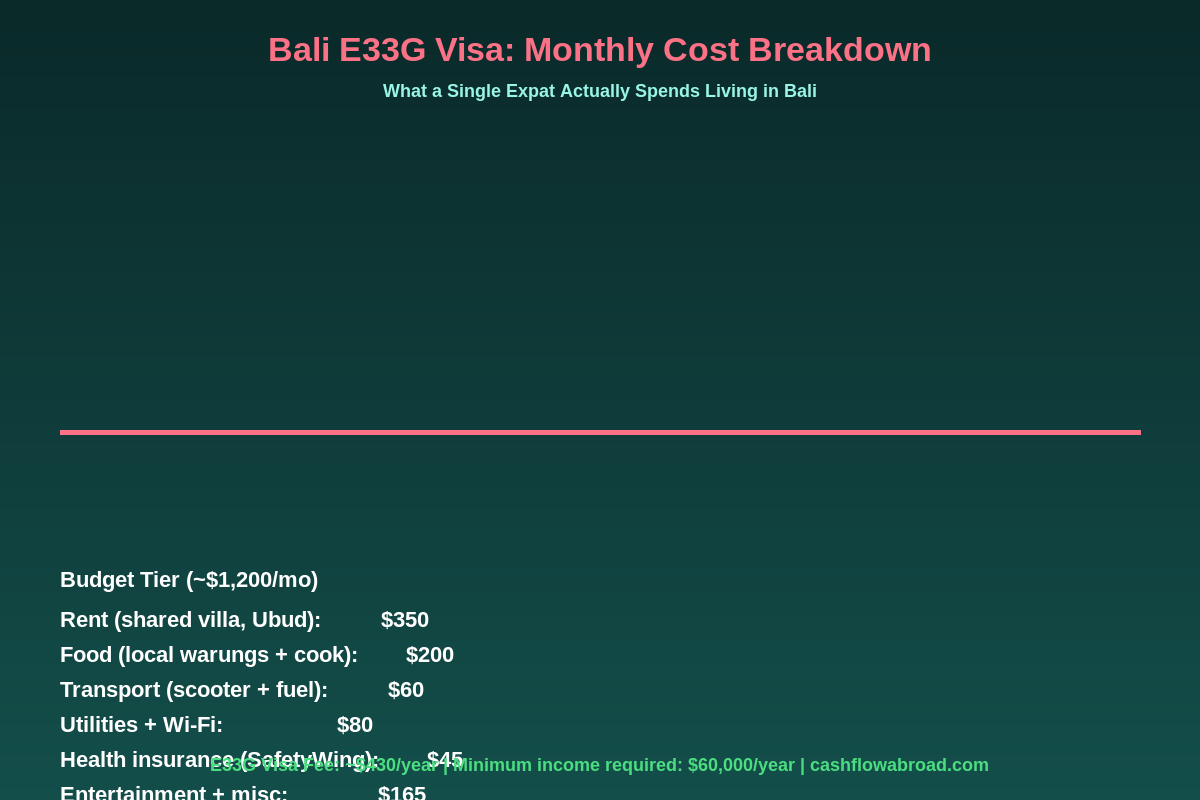
| Expense Category | Budget (~$1,200/mo) | Comfortable (~$2,200/mo) |
|---|---|---|
| Rent (1BR/villa) | $350 (shared villa, Ubud) | $900 (private villa, Canggu) |
| Food | $200 (local warungs) | $450 (mix of cafés + restaurants) |
| Transport | $60 (scooter rental + fuel) | $100 (scooter + Gojek/Grab) |
| Utilities + WiFi | $80 | $100 |
| Health insurance | $45 (SafetyWing basic) | $150 (premium plan + gym) |
| Entertainment + coworking | $165 (café-based work) | $350 (coworking + social) |
| Monthly total | ~$1,200 | ~$2,250 |
Location matters enormously. Canggu is the nomad epicenter — fast WiFi, abundant coworking, great coffee, $700–1,200/month for a decent private space. Ubud is quieter, cheaper by 30–40%, and increasingly popular with remote workers who want focus over nightlife. Uluwatu has the surf culture; Seminyak is more expensive and tourist-heavy.
Genuinely budget-conscious nomads can do Bali on $1,000–1,200/month if they eat local, rent in quieter neighborhoods, and move on a scooter. The “budget” experience here is still quite good — local warungs serve full meals for $1–3, a bowl of bakso (meatball soup) costs under $1, and fresh fruit from the pasar (traditional market) is nearly free.
Banking and Financial Setup
You have two banking layers to manage on the E33G: your home country accounts (where your income lands) and optionally a local Indonesian account.
Keep your US accounts functional
The most common mistake new nomads make is letting their US banking relationship lapse after moving abroad. Banks have been increasingly closing accounts of customers who list foreign addresses. The fix: use a US virtual mailbox like Traveling Mailbox ($15/month) to maintain a real US street address. This keeps your US banking, IRS correspondence, and state domicile intact without needing to stay at a relative’s house. We use it personally and it works exactly as advertised. Full breakdown in our virtual mailbox for expats guide.
For investing, Charles Schwab International is the gold standard for expat accounts — they don’t close accounts based on foreign residency, they rebate all ATM fees worldwide (massive in Bali where ATMs charge $3–5/withdrawal), and the brokerage is as full-featured as anything in the US. For business banking, Mercury is worth having for freelancers and remote business owners — it’s FDIC-insured, free, and widely compatible with international ACH and wire transfers.
Indonesian banking (optional but useful)
E33G KITAS holders can open a local Indonesian bank account, which is useful for paying rent, utilities, and local vendors who don’t accept international cards. Bank BCA and Bank Mandiri are the most foreigner-friendly — bring your KITAS card, passport, and local phone number. Account opening takes under an hour at a branch. For transfers back home or paying international invoices, Remitly is reliable and significantly cheaper than wire transfers through Indonesian banks.
SIM and connectivity
Bali’s mobile infrastructure is solid in populated areas. Buy a local Telkomsel or XL Axiata SIM on arrival for ~$5–10 with a data plan. If you want data coverage before landing or need a backup eSIM for travel, Saily eSIM covers Indonesia and you can activate it before boarding. A VPN is practically essential in Bali — NordVPN handles geoblocking for US banking apps and streaming services that restrict foreign IPs.

E33G vs. Other Options
The E33G isn’t your only legal path to staying in Bali long-term. Here’s how it stacks up against alternatives:
| Visa Type | Duration | Cost | Income Req. | Best For |
|---|---|---|---|---|
| E33G (Remote Worker KITAS) | 1 year (×2) | ~$430–600 | $60K/year | Remote workers, employed nomads |
| B211A (Social/Cultural) | 60–180 days | ~$300 total | None | Short-term stays, testing the waters |
| Second Home Visa | 5–10 years | $130K savings proof | None formal | Long-term residents, retirees |
| Investor KITAS (PT PMA) | 1–2 years | $5,000–15,000+ | Investment required | Business owners, entrepreneurs |
For pure digital nomads — employed remotely or freelancing — the E33G is the most efficient route. The B211A is fine for a 2–6 month stint, but if you’re building a life in Bali rather than just visiting, the E33G’s legal clarity and KITAS status (which lets you open bank accounts, get a local SIM on contract, and sign leases properly) is worth the extra $430.
What To Watch Out For
The 4-year tax exemption requires active application. The PMK 18/2021 exemption isn’t automatic — once you’ve stayed 183+ days and technically become an Indonesian tax resident, you should proactively apply through the local KPP (tax office) to register for NPWP and declare foreign-source exemption status. Most E33G holders either don’t know about this or assume they’re exempt by default. The grey area exists, but for anyone building a serious financial structure around Bali, getting proper documentation is worth the one-time effort. Budget $200–400 for a local tax advisor to handle this correctly.
You can’t serve Indonesian clients. The E33G explicitly prohibits working for Indonesian companies or earning income from Indonesian sources. This is rarely enforced against foreign remote workers, but if you’re growing a business that starts serving the Indonesian market, you need a different structure (PT PMA company registration).
The E33G is capped at 2 years. After two consecutive years, you can’t renew — you must exit and reapply, or switch to another visa category. In practice, most nomads are naturally ready to move after two years in Bali, or they’ve structured something through a local company by then.
ATM fees and currency risk. Indonesian ATMs typically charge $3–5 per withdrawal plus an exchange rate margin. The solution: Schwab’s ATM rebate program for US-based cash access, or a local Bank BCA account funded via peer-to-peer transfers. The IDR has been reasonably stable at ~15,000–16,000 per USD, but holding a large IDR cash balance long-term isn’t advisable for US-dollar earners.
Bottom Line
The E33G is the rare visa that’s genuinely affordable ($430), legally clean, and comes with a surprisingly favorable tax profile for foreign-income earners during the first 4 years of Indonesian residency. The income bar ($60K/year) is within reach for most employed software developers, marketers, consultants, and freelancers who make up the bulk of the Bali nomad community. The cost of living — $1,200 to $2,200/month depending on lifestyle — is hard to match anywhere with comparable infrastructure and quality of life.
Set up a Traveling Mailbox to keep your US address intact, grab a Schwab International account for fee-free ATM withdrawals, lock in SafetyWing for health coverage, and file your FEIE through a qualified expat tax preparer. The logistics are manageable. The lifestyle is exceptional. And 59 cents a day in visa fees is the cheapest rent you’ll ever pay for legal residency anywhere.
Financial disclaimer: This article is for informational purposes only and does not constitute tax, legal, or financial advice. Tax obligations vary based on individual circumstances, nationality, and residency status. Consult a qualified international tax professional before making decisions based on residency or visa changes. The 4-year Indonesian tax exemption described here applies under specific regulatory conditions and requires active registration — it is not automatic. US citizens and permanent residents remain subject to US federal tax obligations regardless of foreign residency.
Liked this article?
Get the next one delivered straight to your inbox — plus a free Expat Tax Cheat Sheet.
Join our subscribers. No spam — just expat finance intel and new post notifications.