Build an AI Chatbot Business for Under $200/Month
10 min read · 2,482 words
A 27-year-old from Ohio built a $4,800/month recurring business in under six months. He has 16 clients. His total tool costs: $147/month. His location: Medellín, Colombia, where his overhead runs about $900/month. That spread — Silicon Valley-priced services delivered from a South American café — is exactly why building an AI chatbot business is one of the sharpest geographic arbitrage plays available right now.
The global chatbot market crossed $12 billion in 2025 and is on track to hit $15.5 billion by end of 2026. More importantly: 64% of small businesses plan to adopt AI chatbots by 2026, but most have no idea how to build one. That knowledge gap is your business. You don’t need to be a developer. You don’t need to hire a team. You need a laptop, $100–$200/month in tools, and a clear process for signing and serving clients.
This post walks through exactly how to build that business — the tools, the pricing, the client acquisition playbook, and how to run it profitably from anywhere with a reliable internet connection.
Why AI Chatbots Are the Perfect Expat Income Stream
Most online income streams require you to either trade time for money (freelancing) or build a massive audience first (blogging, YouTube). Chatbot agencies break that pattern because the work is front-loaded. You spend a few days building a bot, charge a setup fee, then collect a monthly retainer for hosting, updates, and support. That retainer income stacks as you add clients.
Here’s the arbitrage angle: a dental clinic in Austin, Texas doesn’t care whether you’re sitting in their waiting room or a café in Tbilisi when you update their booking bot. They care that it works and that someone answers their WhatsApp when something breaks. That’s worth $200–$400/month to them — and it might be your entire housing cost in Georgia.
The businesses that buy chatbots are almost all local, service-based companies: dentists, real estate agents, law firms, restaurants, med spas, gyms. They’re not looking for someone in their city. They’re looking for someone competent who answers their messages. You can be that person from anywhere.
For the broader framework on how geographic arbitrage compounds this kind of income, the Geographic Arbitrage Playbook breaks down exactly which countries give you the best leverage on US-priced work.
The Tool Stack: What to Actually Use
The chatbot builder ecosystem is crowded, but you only need to master four or five tools to run this business profitably. Here’s the honest breakdown:
| Tool | Use Case | Free Tier | Paid Plan | Best For |
|---|---|---|---|---|
| Botpress | Custom chatbot builder with AI | Yes (5 bots, 2K messages/mo) | $49–$495/mo | Technical builds, complex flows |
| Voiceflow | Visual conversation design | Yes (2 editors) | $60/editor/mo | Multi-channel, voice + chat |
| Tidio | Live chat + AI hybrid | Yes (50 conversations) | $29–$749/mo | E-commerce, Shopify stores |
| ManyChat | Instagram/Facebook/WhatsApp bots | Yes (1,000 contacts) | From $15/mo | Social media lead gen |
| Chatbase | Train a bot on your documents | Yes (1 chatbot) | $19–$399/mo | FAQ bots from PDFs/URLs |
| OpenAI API | GPT-4o mini backend for smart replies | No (pay-per-token) | ~$0.00015/1K tokens (mini) | Any build needing real AI reasoning |
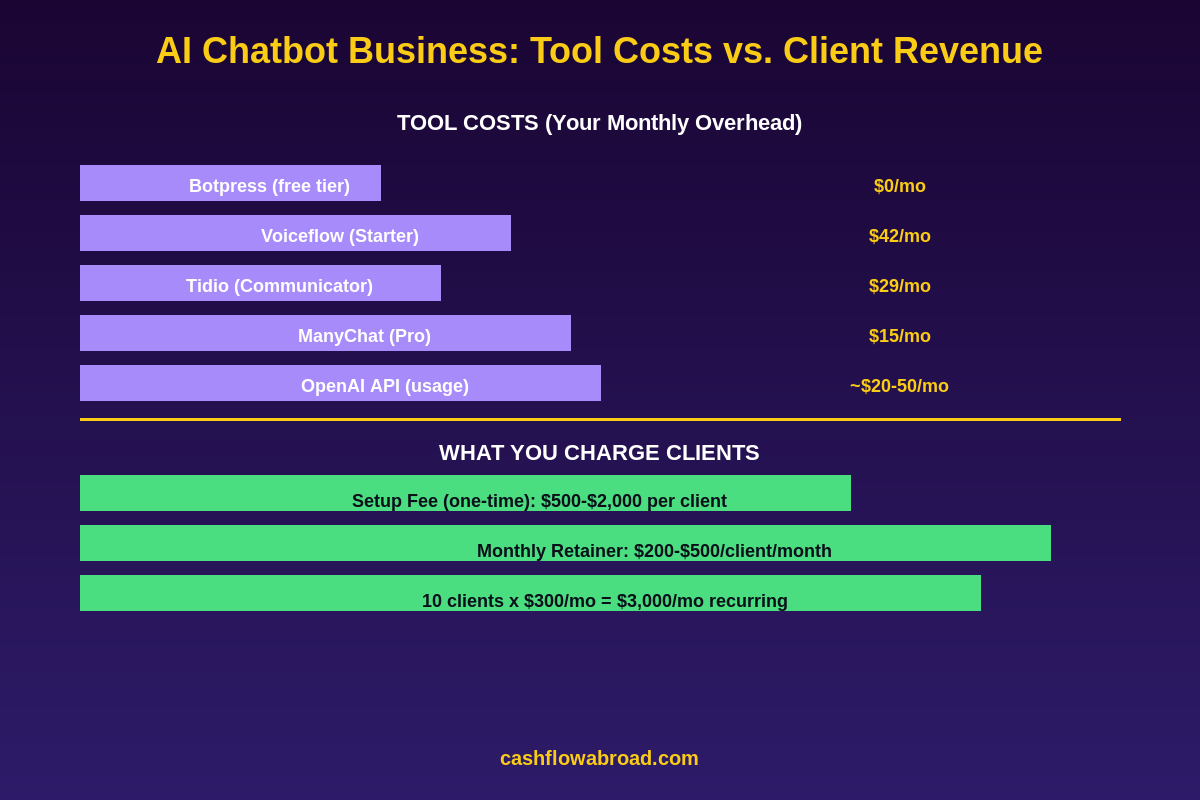
Recommended starting stack: Botpress (free tier for your first 3–5 clients) + OpenAI API (GPT-4o mini, roughly $20–50/month at scale) + a $12/month DigitalOcean droplet if you need to self-host any custom webhook logic. Total overhead: under $100/month while you’re getting started.
Once you have 5+ paying clients, consider moving to Botpress’s Team plan ($495/month), which gives you unlimited bots and white-label options — at that point you’re billing $2,500–$5,000/month in retainers, so the tool cost is a rounding error.
Which Industries to Target (And What to Charge)
Not all small businesses are equal chatbot buyers. The ones with the highest lifetime value and lowest sales resistance share a few traits: they’re drowning in repetitive customer questions, they’re losing leads outside business hours, and they already pay for monthly software subscriptions — so a SaaS fee isn’t a foreign concept.
Dental and Medical Practices
The single best niche for beginners. Dental practices field the same eight questions every day: office hours, insurance networks, appointment availability, procedure costs, emergency contact. A trained chatbot handles 80% of that volume instantly. Typical pricing: $800–$1,200 setup, $200–$300/month recurring. A practice with 3 front-desk staff saving 2 hours/day sees ROI immediately. Target practices with 2–5 operatories — large enough to value automation, small enough that they’re not already using enterprise software with built-in chat.
Real Estate Agents and Brokerages
Real estate agents lose leads constantly to slow response times. A buyer who clicks on a listing at 10pm and gets an instant reply with property details, availability, and a calendar booking link converts dramatically better than one who waits for a callback. Build a lead-qualification bot that asks: budget range, timeline, neighborhood preference, bedrooms needed — then syncs responses to their CRM (HubSpot, Follow Up Boss, or KVCore). Charge $1,000–$1,500 setup, $250–$400/month. Individual top-producing agents pay this without negotiation.
Restaurants and Hospitality
Restaurant bots handle reservations, answer menu questions, push daily specials via WhatsApp broadcast, and automate post-visit review requests. ManyChat is the right tool here — it integrates natively with Instagram DMs, Facebook Messenger, and WhatsApp Business. Most restaurant owners understand Instagram, so the demo sells itself. Pricing: $500–$800 setup, $150–$250/month. Volume game — sign 8–10 restaurants and you have a solid income base.
Law Firms and Legal Services
Lawyers don’t want to pay paralegals to answer “do you handle DUIs?” for the 40th time. An intake bot qualifies leads by practice area, collects basic case information, and books consultations. Always include a “not legal advice” disclaimer in the bot’s responses — this is non-negotiable. Premium niche: a mid-size personal injury firm will pay $1,500 setup and $400–$600/month without pushback. One good law firm client is worth more than five restaurant clients.
Pricing by Industry
| Industry | Setup Fee | Monthly Retainer | Annual Client Value |
|---|---|---|---|
| Dental / Medical | $800–$1,200 | $200–$300/mo | $3,200–$4,800 |
| Real Estate | $1,000–$1,500 | $250–$400/mo | $4,000–$6,300 |
| Restaurant / Hospitality | $500–$800 | $150–$250/mo | $2,300–$3,800 |
| Law Firm | $1,200–$2,000 | $400–$600/mo | $6,000–$9,200 |
| Gym / Fitness Studio | $600–$1,000 | $150–$250/mo | $2,400–$4,000 |
How to Build a Client Chatbot: The Exact Workflow
Here’s the step-by-step process for building a dental clinic chatbot in Botpress — your most replicable template:
Step 1: Run a Discovery Call
Before touching Botpress, spend 20 minutes with the clinic’s front desk and ask what questions they get most. You want 8–12 specific Q&A pairs. Also get: their booking system (Calendly, Jane App, or phone-only), office hours, insurance accepted, and their emergency protocol. This call is what separates a $150 Fiverr bot from a $1,000 professional build — the difference is specificity, and specificity comes from asking questions.
Step 2: Build the Knowledge Base in Botpress
Create a new bot in Botpress. Under “Knowledge Bases,” upload a document with your FAQ pairs, business hours, and services list. Botpress uses this to generate natural-language answers via OpenAI under the hood. This alone handles 70–80% of inbound questions without any custom flow logic. No code required for this step.
Step 3: Build the Appointment Flow
Create a simple conversation flow: “Would you like to book an appointment?” → Collect name + phone number → Send a confirmation or link to their booking page. If the clinic uses Calendly, embed the direct link. If they’re phone-only, the bot collects contact info and fires an email notification to the front desk via a webhook. Here’s what a basic Botpress webhook action looks like:
// Botpress custom action — sends collected data to Make.com webhook
// Trigger: user submits contact info in appointment flow
// Payload example:
{
  "name": "{{user.name}}",
  "phone": "{{user.phone}}",
  "requested_time": "{{user.requestedTime}}",
  "source": "website_chatbot"
}
// Make.com scenario then sends an email or Slack notification to front desk
The actual coding involved here is minimal. If you can follow a tutorial and read JSON, you can build this flow in 3–4 hours on your first attempt, faster afterward.
Step 4: Test and Deploy
Test 50+ conversation paths before handing the bot to the client. Use Botpress’s built-in chat simulator. Deploy via the webchat embed code — it’s a 2-line JavaScript snippet the clinic pastes into their website header. For WhatsApp integration, use Botpress’s native WhatsApp Cloud API connector; the client needs a Meta Business account, which takes about 30 minutes to set up. Record a Loom video walkthrough of the setup process so you can send it asynchronously across any timezone.
Step 5: Ongoing Maintenance (What Justifies the Monthly Fee)
Monthly retainer deliverables: review conversation logs for unanswered questions (15–20 minutes), update the knowledge base when services or prices change, monitor uptime, and send a one-page monthly report. That’s roughly 2 hours per client per month. At $250/month for 10 clients, you’re earning $2,500/month for about 20 hours of work — from an apartment that costs $600 to rent.

How to Sign Your First 5 Clients
The business stalls if you can’t acquire clients. Here are the four channels that actually work, ranked by effort-to-conversion ratio:
1. Targeted Cold Email
Build a list of dental practices or real estate agents in a specific US metro using Google Maps + a scraping tool like Outscraper ($20 one-time, exports name/email/phone/website for any business category). Write a short email: “I built a chatbot for [similar business in your area] that handles their 12 most common patient questions automatically. Could I show you a 5-minute demo?” Attach a Loom video demonstrating the bot on a fake practice. Response rate: 3–8%. Book 30 calls, close 3–5 clients. That’s $2,400–$6,000 in setup fees plus $750–$2,000/month recurring from a single outreach campaign.
2. LinkedIn Direct Outreach
Search “dental office manager” or “real estate broker” in your target city. Connect with a personalized note referencing something specific about their practice. After acceptance, send a short message offering the demo. LinkedIn’s inbox has far less noise than email, and business owners actually read it. Lower volume than cold email but higher quality conversations — these people have already accepted a connection from you.
3. Upwork for Case Studies
Search “AI chatbot” on Upwork — hundreds of open jobs post monthly from businesses that have already decided they want a bot. Most proposals are generic. A focused proposal (“I specialize in chatbots for dental and medical practices — here’s a live example”) converts reliably. Rates: $500–$1,500 for one-off builds. Use Upwork to generate case studies and testimonials, then transition clients to direct relationships off-platform for ongoing retainers.
4. Partner With Web Designers
Find freelance web designers who build sites for local businesses. Offer 10–15% referral fee on any client who purchases a chatbot. A web designer with 20 local clients is a business development engine — they already have trust, they’re already being asked about AI tools, and they’re happy to earn passive income on client upsells. This channel takes 4–6 weeks to warm up but has the highest lifetime value per referral once it’s running.
Setting Up the US Business Infrastructure From Abroad
You want US clients comfortable paying you. That means a US entity, a US bank account, and a US mailing address. Here’s how to assemble all three remotely:
LLC formation: Wyoming and Delaware LLCs cost $50–$100/year in state fees. Use Stripe Atlas ($500 one-time) or a registered agent service like Northwest Registered Agent (~$125/year). Your LLC provides liability protection and gives you a professional name to invoice under.
Business banking: Mercury is the go-to for expat founders. It’s a US business checking account you open entirely online — no branch visit required — with zero monthly fees, free domestic and international wires, and a clean API for payment automation. US clients pay invoices to your Mercury account; you transfer to your local account via Remitly at competitive rates.
Virtual mailing address: A real US street address (not a PO box) is required for your LLC registered agent and looks more professional on contracts. Traveling Mailbox gives you a real US address, scans incoming mail, and forwards anything important digitally. About $15/month — essential infrastructure. See the full guide to expat virtual mailboxes for setup instructions.
For protecting client data on public WiFi in coworking spaces, NordVPN runs about $4/month on an annual plan and is one fewer security risk when you’re building bots that handle client customer data.
The Income Math at Three Milestones
Months 1–3: Getting to First $2K/Month
Close 3 clients at $800 average setup fee = $2,400 one-time. Set monthly retainers at $200 each = $600/month recurring. Tool costs are essentially zero (Botpress free tier covers this). By month 3, you have $600/month in recurring income stacking while new setup fees come in from the next round of outreach. If you’re living somewhere like Colombia or Georgia where $1,200/month covers everything comfortably, you’re near break-even on living costs within 90 days while building an asset base.
Months 4–6: $3K–$5K Recurring
You now have 10–15 clients. Setup fees start arriving regularly from referrals and Upwork. Move to Botpress Pro ($49/month). Monthly overhead: around $150 total. Recurring income: $200–$300 × 12 clients = $2,400–$3,600/month. Add 2–3 new setup fees monthly ($1,600–$2,400). Total: $4,000–$6,000/month. Your effective hourly rate: $80–$120 — on par with a mid-level developer in the US, earned from Chiang Mai or Lisbon.
Month 12+: Scaling or Productizing
At 25–30 clients, you either hire a VA to handle maintenance (a Philippines-based virtual assistant runs $500–$800/month, handles all routine log reviews and monthly client reports) or you productize by building industry-specific templates you sell for $199–$499 as self-service installs. Build a dental bot once, sell it 50 times. Use Gumroad or Lemon Squeezy as the storefront, no extra infrastructure needed.
For more frameworks on building scalable online income from abroad, see the guide to building a $100K online business from anywhere.
Tax Considerations for Chatbot Income Earned Abroad
US citizens owe tax on worldwide income regardless of where they live — but the Foreign Earned Income Exclusion (FEIE) lets you exclude up to $126,500 in 2024 earned income if you pass the physical presence test (330 days outside the US). Chatbot agency income qualifies as earned income under FEIE as long as you’re actively working. Pure passive income doesn’t qualify, but running client chatbots does.
Self-employment tax (15.3%) still applies on your first ~$160,000 in net profit even when FEIE eliminates federal income tax. Build this into your pricing. The full breakdown is in How to Pay Zero Federal Tax as a US Expat. Once you’re consistently clearing $5K/month, talk to a CPA about structuring your LLC as an S-Corp to reduce SE tax exposure.
Start Small, Stack Clients, Compound the Arbitrage
The AI chatbot business isn’t complicated. Local service businesses have repetitive customer questions. They’re losing leads outside business hours. They’ll pay $200–$500/month for a solution that reliably works. You can build that solution with $0–$100 in tools, sign your first client within 30 days of starting, and run the entire operation from anywhere with a 50Mbps connection.
The geographic arbitrage piece is what makes it exceptional. You’re charging US market rates for a service with minimal overhead, zero commute, and no hard dependency on where you’re physically located. That’s the combination that turns a side project into a business with real, compounding leverage.
Pick one industry. Build one template bot. Sign one client. Everything else follows from that first proof of concept.
Financial disclaimer: Income figures cited in this post are based on publicly available reports, case studies, and market data. Individual results will vary based on experience, effort, client mix, and market conditions. This post contains affiliate links — if you make a purchase through one, we may earn a commission at no extra cost to you. Nothing in this post constitutes financial or legal advice.
Liked this article?
Get the next one delivered straight to your inbox — plus a free Expat Tax Cheat Sheet.
Join our subscribers. No spam — just expat finance intel and new post notifications.