AI Voice Agents: Build Phone Bots That Pay Monthly
9 min read · 2,251 words
A developer in Chiang Mai is pocketing $8,400 a month in recurring revenue. He manages 21 dental clinics across the US, none of which he’s ever visited. His product: an AI phone receptionist that answers every inbound call, books appointments, handles cancellations, and answers FAQs — 24 hours a day, at a cost his clients can’t replicate with a human for three times the price.
He built the whole thing in a weekend using Vapi AI, a $12/month Twilio number, and a prompt he spent two hours refining. His monthly infrastructure cost for all 21 clients: under $600. His monthly revenue: $8,400. That’s a 93% gross margin business, run entirely from a laptop in a city where rent costs $350.
That’s not an outlier. That’s the AI voice agent business model — and it’s one of the most overlooked cash flow opportunities for expats and digital nomads right now.
What Are AI Voice Agents (And Why Businesses Are Desperate for Them)
An AI voice agent is a software system that makes and receives phone calls, holds natural conversations, and takes actions — booking appointments, updating CRMs, sending confirmation texts — without a human ever picking up. Not a robocall from 2009. Modern voice agents built on GPT-4o or Claude sound indistinguishable from a person on a good connection.
The inflection happened fast. In 2023, these systems still sounded robotic. By 2025, ElevenLabs, Cartesia, and PlayHT pushed voice synthesis to the point where test calls routinely fool people. Today, businesses that used to employ part-time receptionists are realizing they can run the same operation for $200/month — with better performance: no sick days, no accent barriers, no “can I put you on hold for 10 minutes.”
74% of small and medium businesses plan to invest in automated customer communication tools. The vast majority haven’t done it yet because they don’t know how, and enterprise vendors are charging $2,000–$5,000/month for packaged solutions. That gap is your opening.
The Three Platforms That Actually Matter
The AI voice space has exploded with options, but 90% of builders use one of three platforms. Here’s what you actually pay:
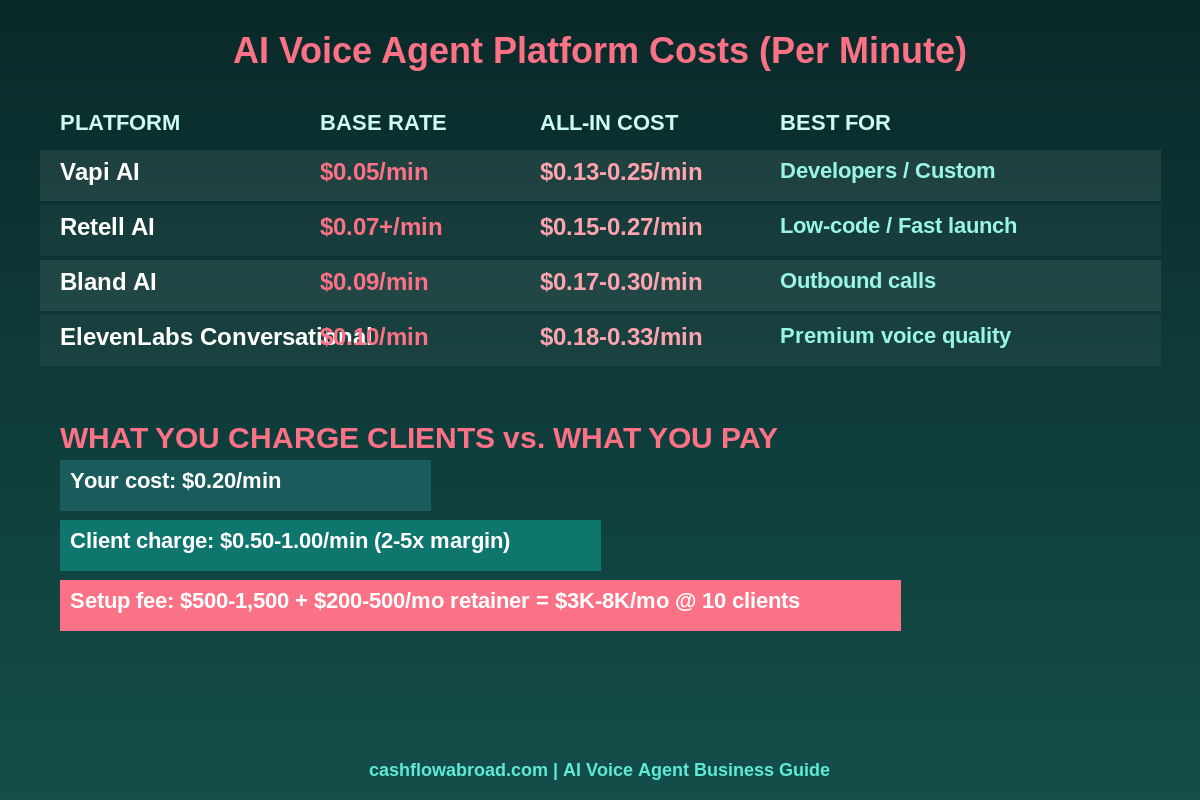
| Platform | Base Rate | All-In Cost/Min | Best For | Free Tier |
|---|---|---|---|---|
| Vapi AI | $0.05/min | $0.13–$0.25/min | Developers, maximum customization | $10 credit on signup |
| Retell AI | $0.07+/min | $0.15–$0.27/min | Low-code builds, fast deployment | Free trial available |
| Bland AI | $0.09/min | $0.17–$0.30/min | High-volume outbound campaigns | No paid minimum |
| ElevenLabs Conversational | $0.10/min | $0.18–$0.33/min | Premium voice quality requirements | 10K chars/month free |
The important caveat: “base rate” is marketing. Every platform’s advertised per-minute price covers only their orchestration layer. Add telephony (Twilio: ~$0.014/min inbound), speech-to-text (Deepgram: ~$0.006/min), an LLM call (GPT-4o-mini: ~$0.03–$0.05 per call), and text-to-speech ($0.03–$0.06/min), and your real cost runs 2–4x the headline rate. Plan for $0.15–$0.25/minute all-in on moderate-complexity builds.
That’s not a problem — it’s the margin you price into client packages. At $0.20/min all-in, billing clients $0.50–$1.00/min or structuring a flat monthly fee gives you significant spread.
Which to start with: Vapi if you’re comfortable with APIs and want full control. Retell AI if you want something live in 24 hours without writing backend code — their dashboard is genuinely fast. Bland is the choice when clients need high-volume outbound calling campaigns.
How to Build Your First Agent in 48 Hours
Here’s the actual technical process using Vapi, the most widely used platform for builders.
Step 1: Set Up Your Accounts
You need four things: a Vapi account (vapi.ai), a Twilio account for phone numbers, an OpenAI API key, and an ElevenLabs or PlayHT account for voice synthesis. Total monthly cost if you’re testing light: under $30.
In Vapi’s dashboard, create a new assistant. You’ll configure four key fields:
- System prompt: The instructions that define behavior, knowledge, and boundaries
- First message: What the agent says when it answers (“Thanks for calling Downtown Dental, this is Maya — how can I help you today?”)
- Voice: Select from ElevenLabs or PlayHT voices via API key integration
- Functions: What actions the agent can trigger mid-call (book to calendar, send SMS confirmation, update CRM)
Step 2: Write a Tight System Prompt
Most beginners write vague prompts and get vague agents. A prompt that actually works for a dental receptionist:
You are Maya, the virtual receptionist for Downtown Dental, a family dentistry practice in Austin, TX.

Your role:
- Greet callers warmly and professionally
- Book, reschedule, or cancel appointments using the booking function
- Answer questions about services, hours, and accepted insurance
- Collect name, DOB, and insurance provider for new patient appointments

Rules:
- Never make up information. If you don't know, say: "Let me have someone from our team follow up with you."
- Always confirm appointment details before ending the call
- If a caller describes pain or dental emergency, prioritize urgent care slot booking
- Do not discuss pricing — direct billing questions to the front desk

Hours: Mon–Fri 8am–6pm, Sat 9am–2pm. Closed Sundays.
Insurance: Delta Dental, Cigna, Aetna, most PPO plans. No Medicaid.
For booking integration, connect a function call to a scheduling API. Calendly’s API works well for simple setups. Most dental software (Dentrix, Curve Dental) has Zapier connectors that can receive appointment requests without direct API access. Google Calendar API is free and handles most small practice needs.
Step 3: Connect a Phone Number
Buy a local US number on Twilio ($1.15/month). In Vapi’s dashboard under Phone Numbers, link your Twilio credentials and assign the number to your assistant. Call it from your own phone within 10 minutes — your agent answers.
For client deployments, you can port their existing business number to Twilio (takes 3–7 days) or provision them a new local number. Most clients prefer to keep their original number and point overflow or after-hours calls to the AI line.
Step 4: Break It Before Your Client Does
Call your agent 20 times with different scenarios: angry caller, heavy accent, asks an impossible question, tries to book outside operating hours, asks for a refund. Vapi gives you full call transcripts and latency metrics — review them and refine the prompt after each failure mode.
Target under 1.5 seconds response latency. Above 1.8 seconds the conversation feels noticeably awkward. If your latency is high, switch to GPT-4o-mini instead of GPT-4o (dramatically faster, negligibly worse quality for receptionist use cases), or try Groq for LLM inference — they offer Llama 3.3 70B at near-zero latency for about $0.09/1M input tokens.
Where the Money Is: Best Verticals to Target
Generic “AI receptionist” pitches get ignored. Vertical specialization — and demonstrating you understand a specific industry’s pain — closes deals.
Dental Practices
A solo dental practice misses 15–30% of inbound calls during procedures. Each missed call represents a potential $500–$2,000 appointment. AI receptionists that answer 100% of calls, book new patients, and send appointment reminders are a direct revenue recovery story. Arini.ai has proven the market at scale — you can build equivalent functionality on Vapi for a fraction of their subscription cost and resell it at a lower price point with higher margin.
Pricing: $750 setup + $350/month retainer. At 12 clients: $4,200/month recurring.
HVAC, Plumbing, and Home Services
These businesses get overwhelmed with calls in peak season and lose jobs to competitors when calls go to voicemail. An AI agent that qualifies the service request, books a technician slot, and sends a confirmation text captures every lead automatically. ServiceAgent.ai has built a niche product on this exact model — same opportunity, different entry point.
Pricing: $1,000 setup + $400/month. These clients see ROI within the first week and have extremely low churn once the agent is handling their calls reliably.
Real Estate Agents and Property Management
Agents spend 40% of their time fielding calls for lead qualification and showing requests — work that an AI agent can handle completely. Property management firms benefit from automated maintenance request intake. Multi-agent packages (covering a team of 5 agents) sell well at $600–$900/month.
Pricing: $500 setup + $250/month per agent or package deals for teams.
Medical Clinics
HIPAA compliance is mandatory. Vapi charges $1,000/month for their HIPAA-compliant tier — pass this cost to clients as an infrastructure fee and target larger multi-location practices where the math still works at $1,500+/month retainers.

The Geographic Arbitrage Multiplier
A voice agent business serving US clients generates US dollars. You’re billing $300–$500/month per client — a competitive rate for American SMBs. Your cost of living might be $1,000–$1,800/month in Vietnam, Colombia, or Georgia (the country).
| Location | Monthly Living Cost | Clients to Cover Life | Clients to Hit $5K Profit |
|---|---|---|---|
| New York, USA | $4,500+ | 15 | 32 |
| Lisbon, Portugal | $2,400 | 8 | 22 |
| Medellín, Colombia | $1,400 | 5 | 17 |
| Chiang Mai, Thailand | $900 | 3 | 15 |
| Tbilisi, Georgia | $1,100 | 4 | 16 |
Three clients covering your life expenses in Chiang Mai means you can experiment aggressively — lower your pitch price to close faster, take on harder builds, test new verticals without financial pressure. The US developer trying to launch this same business needs 15 clients just to break even on rent. That asymmetry is the whole point.
For receiving US client payments, Mercury is the cleanest option — free US business checking, no minimum balance, works without a US address or physical presence, and integrates with Stripe for subscription billing. Pair it with a virtual US mailbox for any postal correspondence that comes with maintaining a US business entity.
If you’re operating out of Colombia, the Digital Nomad Visa provides legal residency while you earn entirely from foreign-sourced income — and Colombia’s territorial tax system means that income stays untaxed locally. For the broader tax strategy, our FEIE deep-dive and the geographic arbitrage playbook map out how to structure this properly.
Getting Your First Paying Client
The most common mistake: building the perfect product before talking to anyone who might pay for it. Flip that sequence.
Week 1 — Build a demo, not a product. Pick one vertical. Dental is easiest. Build a single agent for a fictional clinic. Give it a realistic name, real hours, and a working booking flow (even if it just logs to a Google Sheet). Test it on 20 call scenarios until it handles them all cleanly.
Week 2 — Cold pitch real businesses. Find 20–30 dental clinics in a specific US city using Google Maps. Check their reviews for complaints about missed calls or phone responsiveness. Call them — yes, call — and ask to speak with the owner or office manager. Your opener: “I’m piloting an AI receptionist for dental practices in [city]. It answers every call 24/7 and books appointments automatically. Can I show you a 5-minute demo?” You need one yes out of 30 calls. One.
On the demo, dial your agent from your phone and have them listen to a simulated appointment booking. Let them try calling it themselves. Offer a 30-day free pilot at the end. Your cost for a 30-day pilot on a moderate-call-volume dental practice: $40–$80 in platform fees. Your potential monthly revenue if they convert: $350. Reasonable bet.
After the pilot, send a simple invoice. If the agent handled their calls well — and it will — they’ll pay it. That first client is your proof of concept, your case study, and your reference for every pitch that follows.
For server infrastructure — if you’re building custom backend integrations connecting Vapi to client CRMs or calendar systems — DigitalOcean‘s $6/month droplet handles it. Their managed databases cover call log storage without needing to manage your own Postgres instance.
Scaling the Unit Economics
At 10 clients, you manage everything manually. At 25, that breaks. Here’s what you build to scale:
Prompt templates by vertical. A dental template, an HVAC template, a real estate template. Every new client gets a customized version — not a ground-up build. Reduces setup from 8 hours to 90 minutes per client.
Automated call monitoring. Vapi’s API lets you pull transcripts and error events. A simple Python script that pings you on Slack when a call fails handles 90% of incident detection:
import requests

VAPI_KEY = "your_key"
SLACK_WEBHOOK = "your_webhook"

def check_failed_calls():
    r = requests.get(
        "https://api.vapi.ai/call",
        headers={"Authorization": f"Bearer {VAPI_KEY}"},
        params={"status": "failed", "limit": 50}
    )
    failed = r.json()
    if failed:
        msg = f"⚠️ {len(failed)} failed calls detected. Review required."
        requests.post(SLACK_WEBHOOK, json={"text": msg})

check_failed_calls()
Subcontract the setup work. Once templates exist, initial build work can be handled by a junior developer on Upwork ($15–$25/hour, Philippines or Eastern Europe). You become the architect and account manager. Your hours-per-client drops from 8 to under 2 as the business scales.
The unit economics at 30 clients, worked out honestly:
- Average client: 800 minutes AI call time/month
- Your all-in platform cost: ~$0.20/min = $160/client/month
- Your client charge: $400/month flat (includes 1,200 min, $0.30/min overage)
- Gross margin per client: $240/month
- At 30 clients: $7,200/month margin before your own time
- Plus setup fees ($750 avg): add $1,500–$3,000/month for new client onboarding
That’s a $8,700–$10,200/month gross margin business running on $6/month infrastructure and 10–15 hours/week of management time. From anywhere with a WiFi connection and a laptop.
The Asymmetric Bet
AI voice agents represent one of the clearest high-margin, recurring revenue opportunities for technically inclined expats available right now. The market demand is real and growing — SMBs need this, can’t afford enterprise solutions, and are actively looking for alternatives. The tooling has matured enough that a non-expert can build a production-quality agent in a weekend. Switching costs are high once a business relies on your agent to handle their phones. And the geographic arbitrage angle means you’re competing with US-based vendors at half their cost structure while charging identical prices.
The developer in Chiang Mai isn’t exceptional. He’s early. That window is closing as more people figure this out — but it’s still open.
Financial disclaimer: Income figures cited in this article are based on publicly reported cases and community data. Individual results vary significantly based on execution quality, market conditions, client acquisition skills, and technical ability. This article is for informational purposes only and does not constitute financial, legal, or tax advice. Consult qualified professionals before starting any business or making investment decisions.
Liked this article?
Get the next one delivered straight to your inbox — plus a free Expat Tax Cheat Sheet.
Join our subscribers. No spam — just expat finance intel and new post notifications.