AI Freelancing Abroad: The $5K/Month Expat Formula
10 min read · 2,440 words
A freelancer in Medellín, Colombia is clearing $8,400/month building AI automation workflows — and spending $1,200/month to live better than most Americans earning $150,000 a year. The same skills pay the same rates whether you’re in San Francisco or Chiang Mai. The cost of living doesn’t.
That’s the arbitrage nobody’s fully running the numbers on: AI skills now command Silicon Valley-tier rates on global platforms like Upwork and Fiverr — and there’s zero geographic lock-in on the income side. Meanwhile, your cost of living can be 60–80% lower than in the US. The spread between what you earn and what you spend is where real wealth gets built.
This post covers the exact formula: specific niches, specific tools with real pricing, actual workflow breakdowns, and what it takes to earn $5K–$15K/month in AI services while your rent is $600.
Why AI Freelancing Pays More Than Regular Freelancing
Upwork’s 2025 annual report contained one stat that should get your attention: freelancers working on AI-related projects earn 44% more per hour than those on non-AI projects. AI freelance rates on the platform jumped 60% in a single year. AI-related gigs grew 109% year-over-year. For context, traditional copywriting and design rates have been flat or declining.
The gap exists because supply and demand haven’t equalized. Most businesses know they need AI — they’ve been told constantly — but have no idea how to actually implement it. They need someone who can wire ChatGPT to their CRM, build a custom chatbot for their support queue, or automate their content pipeline. That person is you, and you can be anywhere.
The geographic component matters for a specific reason: AI tool costs are fixed globally, but your living costs aren’t. The $200/month you spend on AI subscriptions costs the same in Austin or Bangkok. The rest of your overhead doesn’t.
Six AI Freelance Niches That Actually Pay
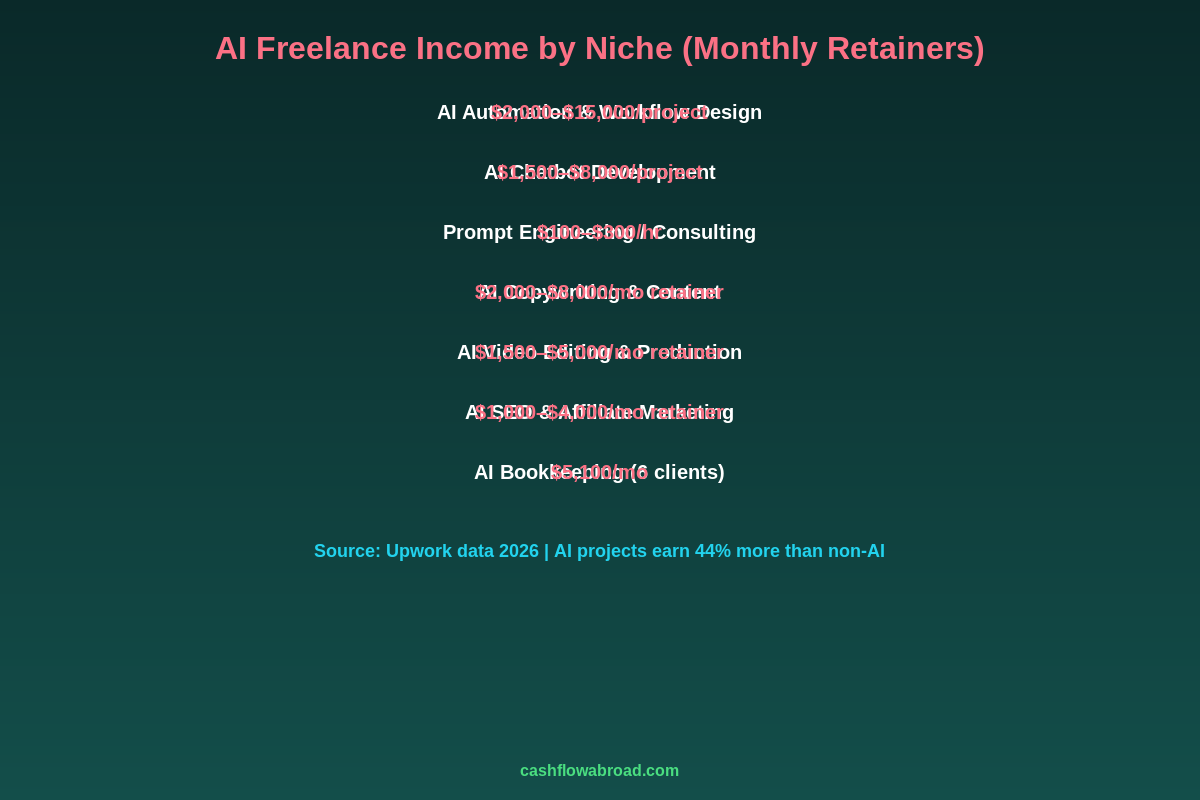
Not all AI freelancing is equal. Here are the six niches with the clearest path to $5K/month, ranked by income ceiling and barrier to entry:
1. AI Automation & Workflow Design ($2,000–$15,000/project)
This is the highest-paying niche with the lowest technical barrier. You’re connecting tools — AI models to business apps — using platforms like n8n, Make.com, or Zapier. A typical project: a law firm wants to automatically summarize incoming contracts using GPT-4o and route them to the right attorney based on content type. Setup time: 6–8 hours. Fee: $2,400–$4,000.
Real rate data: Straightforward Zapier/Make workflows with AI integrations sell for $200–$700 each at the entry level. Complex multi-step AI pipelines — lead enrichment + scoring + CRM update + personalized email draft — go for $1,500–$5,000. Advanced AI consulting and custom workflow architecture hits $2,000–$5,000/day.
To hit $5K/month in this niche, you need roughly 3–4 mid-tier projects. The work is repeatable — once you’ve built a document summarization pipeline, you can replicate it for ten clients with minor customization.
2. AI Chatbot Development ($1,500–$8,000/project)
Businesses pay well for chatbots that handle customer support, qualify leads, or book appointments. The tools have made this accessible: Voiceflow (no-code), Botpress (open-source, self-hostable), Lindy.ai (AI agent platform), or building directly on OpenAI’s Assistants API. A basic customer support chatbot trained on a company’s docs goes for $1,500–$3,000. A sophisticated lead qualification bot with CRM integration and human handoff: $4,000–$8,000.
The maintenance retainer is where recurring revenue lives. Clients typically pay $200–$800/month to keep their chatbot updated and monitored. Six clients at $500/month = $3,000/month in pure retainer income on top of project fees.
3. AI-Enhanced Copywriting & Content ($2,000–$8,000/month retainer)
This isn’t “use ChatGPT and ship generic content.” Clients paying $2K–$8K/month want a strategist who uses AI to produce high-volume, high-quality output — blog posts, email sequences, ad copy, LinkedIn content — that converts. The AI handles first drafts and research; you handle strategy, editing, brand voice, and performance analysis.
The niche is crowded at the low end but wide open at the strategic level. An AI content strategist running a full content funnel for a B2B SaaS company — mapping buyer journey stages, producing content at each stage, tracking what converts — commands $3,000–$8,000/month.
4. Prompt Engineering & AI Consulting ($100–$300/hour)
The median prompt engineering rate is $70.61/hour according to ZipRecruiter — but that’s across all experience levels. On Upwork and Toptal, specialized prompt engineers working on production systems command $100–$300/hour. This isn’t just writing clever prompts. It’s designing and testing prompt architectures for enterprise use cases: retrieval-augmented generation (RAG) systems, fine-tuning pipelines, and multi-agent workflows.
AI consulting — helping companies audit their workflows, identify automation opportunities, and build AI roadmaps — sits in the same rate range. A 10-hour consulting engagement at $150/hour is $1,500. Four of those per month hits $6,000.
5. AI Video Editing & Production ($1,500–$5,000/month retainer)
Fiverr reported demand for AI video creation services surged 66% in six months. Searches for “faceless YouTube video creators” spiked 488%. AI video tools like Runway ML, HeyGen, ElevenLabs (voice), and CapCut have made it possible to produce high-quality video content at 5x the speed. Short-form clips pay $30–$100 each; retainers for ongoing YouTube or social video production run $1,500–$5,000/month.
6. AI-Assisted Bookkeeping ($700–$1,000/month per client)
Unglamorous, but the math is undeniable: six clients at $850/month = $5,100/month, and the actual work is reviewing AI-categorized transactions rather than doing the categorization manually. Tools like Botkeeper and Pilot handle the AI layer; you handle client relationships, edge cases, and tax prep coordination. In a low-cost country, this income is genuinely life-changing.
The Tool Stack (What It Actually Costs)
You don’t need expensive software to run a $5K/month AI freelancing business. Here’s the full operational stack, priced out:
| Tool | Purpose | Cost/Month |
|---|---|---|
| n8n Cloud | Workflow automation (AI pipelines, integrations) | $20 (2,500 executions) |
| Make.com Starter | No-code automation (simpler workflows) | $9 (10,000 ops) |
| OpenAI API | GPT-4o, Embeddings, Whisper | $20–$100 (usage-based) |
| Anthropic API | Claude Sonnet/Haiku (often better for reasoning) | $20–$80 (usage-based) |
| Cursor Pro | AI-powered code editor | $20 |
| Voiceflow Pro | Chatbot builder (no-code to code) | $50 |
| ElevenLabs Starter | AI voice generation | $22 |
| Runway ML Standard | AI video generation | $15 |
| DigitalOcean | Host self-managed n8n, Botpress, or APIs | $12–$24 (droplet) |
Total for a fully operational AI freelancing stack: roughly $190–$300/month. If you’re earning $5,000/month, you’re spending 4–6% on tools. That margin is why this model works — especially from a country where fixed costs are already low.
The practical rule: keep AI subscriptions under 10% of monthly revenue. When you’re at $3,000/month, budget under $300 for tools. Don’t tool-stack before you have clients.
The Coding Shortcut: Cursor + Claude
If you’re building AI automation workflows or chatbots, you don’t need a CS degree. Cursor (the AI code editor) combined with Claude or GPT-4o has made it possible to build production-quality integrations with minimal prior coding experience. You describe what you want, Cursor generates the code, you test it, iterate.
A concrete example: generating a complete n8n workflow in JSON format using Claude takes minutes. The workflow imports directly into n8n. What once required a backend developer now requires someone who can write clear specs and knows enough to test the output.
# Prompt to Claude for workflow generation:
"Build an n8n workflow that:
1. Triggers on new Typeform submission
2. Extracts the submitted email and company name
3. Sends to OpenAI API to score lead intent (0-10)
4. If score >= 7, adds to HubSpot as qualified lead
5. Sends personalized Slack notification to sales team"
Claude outputs the JSON. You import it into n8n, configure API keys, test. Done in 2–3 hours. Bill $1,200–$1,800. This is the workflow that unlocks AI freelancing for non-developers.
The Geographic Arbitrage Math
Here’s what the numbers actually look like when you combine AI income with a low cost-of-living country:
| Location | Monthly Income | Monthly Costs | Monthly Savings | Annual Savings |
|---|---|---|---|---|
| US (major city) | $6,000 | $4,500 | $1,500 | $18,000 |
| Colombia (Medellín) | $6,000 | $1,400 | $4,600 | $55,200 |
| Thailand (Chiang Mai) | $6,000 | $1,200 | $4,800 | $57,600 |
| Georgia (Tbilisi) | $6,000 | $1,000 | $5,000 | $60,000 |
| Mexico (Oaxaca/Mérida) | $6,000 | $1,500 | $4,500 | $54,000 |
The US freelancer saves $18K/year. The expat on the same income saves $55K–$60K. Same work, same rates, radically different financial outcome. This is the core of geographic arbitrage — and AI income is uniquely suited to it because the rates are set by global markets, not local economies.
Layer in the Foreign Earned Income Exclusion: US citizens abroad for 330+ days can exclude up to $126,500 of foreign earned income from US federal taxes. If you’re using the FEIE, your effective federal rate on that income drops to near zero. The combination of low local costs, reduced federal taxes, and high AI rates is one of the most powerful wealth-building setups available to Americans right now.

Where to Sell: Platform Fees and Strategy
Platform choice matters because the fee structure directly affects your take-home. Here’s the current landscape:
| Platform | Fee Structure | Best For |
|---|---|---|
| Upwork | 0–15% variable (since May 2025) | Automation, chatbots, consulting |
| Fiverr | Flat 20% | AI video, content, templates |
| Toptal | Markup on client rate (variable) | Senior AI engineers, $100+/hr |
| Contra | 0% | Growing US freelance market |
| Direct clients | 0% | $3K+ projects via LinkedIn/referral |
Upwork’s variable fee structure (introduced May 2025) means high-demand AI specializations can qualify for 0% platform fees, while saturated categories pay 15%. Prompt engineers and AI automation specialists consistently land in the lower-fee tier. Fiverr’s flat 20% is steep — build your reputation there, then move repeat clients to direct invoicing where you keep everything.
The 2026 freelancer data shows 56% of new projects now come through professional networks — up from 30% in 2024. Platforms are for getting your first clients and reviews. Your goal is to collect enough case studies to justify direct client relationships, where your effective rate immediately jumps 15–25%.
How to Start in 30 Days
Week 1: Pick one niche and build a sample project
Don’t offer everything on day one. AI automation workflows are the highest-value entry point with the lowest technical barrier. Build a real sample: an AI customer inquiry classifier that routes emails by topic, or a lead scoring workflow that enriches data and scores intent with GPT-4o. Document it with screenshots and a short video walkthrough. This is your portfolio piece.
Week 2: Set up your Upwork profile and first listings
Lead your profile with a specific result, not a generic bio: “I build AI automation workflows that cut manual data entry by 80%.” Attach your sample project. Your first proposals should be hyper-targeted to businesses that clearly need automation — e-commerce stores with repetitive order handling, service businesses with bottlenecked client onboarding.
Week 3: Price at $65–$80/hr and land your first client
Don’t start at $150/hr with zero reviews — and don’t race to the bottom at $15/hr. The sweet spot for a first AI automation engagement is $65–$80/hr, or a fixed project fee of $800–$1,500. Deliver excellent work, ask for a detailed review, then raise your rate by $20–$30/hr for the next engagement.
Week 4: Build toward retainers
The path to $5K+/month isn’t ten one-off projects — it’s 3–4 monthly retainers. After delivering a project, pitch a maintenance and expansion retainer: “I can monitor this workflow, add two new automations per month, and handle any issues for $400/month.” Most satisfied clients will say yes. Three clients at $400/month = $1,200/month in baseline income before any new projects.
Banking and Getting Paid from Abroad
Running this business as a US person abroad requires solid financial infrastructure. Mercury is the go-to for US-based business banking — no monthly fees, API access, works internationally, and straightforward to open for an LLC. Upwork and Fiverr both pay directly to a US bank account. Mercury handles it without the foreign transaction fees or account closure risks that plague big retail banks for expat customers.
For maintaining a US address — required for LLC registration, IRS correspondence, and most banking — a virtual mailbox like Traveling Mailbox provides a real street address (not a P.O. Box) with mail scanning for around $15–$25/month. Essential for keeping your business legally grounded in the US while you work from anywhere.
On the security side, accessing client systems and sensitive APIs over café or co-working WiFi without a VPN is a liability. NordVPN runs $3–$4/month on annual plans. Clients in regulated industries (finance, healthcare) often explicitly require contractors to document security practices — having a VPN policy is the minimum.
Realistic Income Timeline
Here’s what a realistic ramp looks like, assuming some familiarity with tech tools but no prior development background:
- Month 1–2: $500–$1,500. First clients are the hardest. Two small projects or one mid-tier project. Focus entirely on delivery and getting reviews.
- Month 3–4: $2,000–$3,500. First retainer client, two project clients, Upwork profile with 3–5 reviews. Inbound interest starting.
- Month 5–6: $3,500–$5,500. Three retainers plus project work. Inbound proposals starting to outweigh outbound hustle.
- Month 9–12: $5,000–$10,000+. Full retainer roster, direct clients, selective about new project intake.
For context: the median full-time Upwork freelancer earns $85,000/year. AI specialists clear that figure significantly faster. The combination of high-value niche, platform reviews, and geographic arbitrage is a legitimate path to financial independence in 2–3 years rather than 10–15.
The Structural Advantage Nobody Talks About
Beyond the income math, there’s an asymmetry to running an AI freelancing business from abroad that doesn’t get enough attention: your client base is global, your costs are local, and the two are entirely disconnected. A recession in your host country doesn’t touch your income. Currency crises — common in places with the cheapest costs of living — don’t hit your earnings because you invoice in dollars or euros.
You capture the cost benefits of a developing economy without the economic fragility that normally comes with it. If Medellín gets expensive or the digital nomad crowd inflates Chiang Mai rents, you move. Your clients don’t notice.
That portability extends to taxes. The $100K online business model built on AI services is one of the cleanest implementations of the US-while-living-abroad structure — particularly when paired with proper expat tax planning. You’re earning in dollars, living on local currency, and building in a market where the skills gap still heavily favors the freelancer.
Start With One Niche, One Tool, One Client
The most common trap in AI freelancing is tool paralysis — spending three weeks evaluating software and zero weeks billing clients. Pick one niche. Build one sample project with n8n or Voiceflow. Write one Upwork profile. Send ten targeted proposals. Everything else is optimization that happens after revenue exists.
The geographic arbitrage component accelerates everything. When your monthly runway is $1,200 instead of $4,500, the early grind of building a client base is far less stressful. You can afford to underprice your first few clients to build reviews. You have the time to build the right portfolio piece. The math actively works in your favor.
The AI skills gap between what businesses need and what they can staff internally won’t close for years. The freelancers who built portfolios and client relationships early will be the ones with full retainer rosters and direct clients by the time the broader market catches up. The income is real. The geographic arbitrage is real. The question is whether you act on it before the window narrows.
Disclaimer: Income figures cited are based on publicly available platform data from Upwork, Fiverr, ZipRecruiter, and third-party freelancer surveys. Individual results vary based on experience, niche, time invested, and market conditions. This is not financial, tax, or legal advice. Consult a qualified CPA regarding tax obligations as a US person working abroad.
Liked this article?
Get the next one delivered straight to your inbox — plus a free Expat Tax Cheat Sheet.
Join our subscribers. No spam — just expat finance intel and new post notifications.