Vietnam Expat Guide: $1,200/Month, Zero Foreign Tax
Vietnam offers a comfortable expat life for $1,200/month with zero foreign income tax below 183 days. The least-hyped value in Southeast Asia.
Vietnam costs ~$1,200/month for a comfortable expat life and taxes foreign income at 0% if you stay under 183 days. Complete guide for US expats.
Disclosure: this article contains affiliate links. If you open an account through one of them, Cashflow Abroad may earn a referral commission at no extra cost to you.
While tens of thousands of Americans relocate to Portugal (€2,000/month minimum) or Thailand ($1,500/month with visa headaches), Vietnam sits quietly offering a comfortable expat life for $1,200–$1,500/month — with zero Vietnamese tax on your foreign income if you structure your stay correctly. The country gets a fraction of the expat press it deserves, partly because the tax math isn't obvious and partly because the visa situation sounds messier than it actually is.
Here's what's actually true: an American living in Vietnam on remote income, staying under 183 days in any calendar year, owes Vietnam exactly $0 on that income. No tax treaty needed. That's not a loophole — it's the base rule for non-residents. Cross the 183-day threshold and you trigger worldwide income taxation at progressive rates up to 35%. The entire Vietnam expat strategy is built around that single number.
The Tax Math First
Vietnam's personal income tax system creates two completely different realities depending on how long you stay:
| Residency Status | Trigger | Foreign Income Tax | Rate |
|---|---|---|---|
| Non-tax resident | Under 183 days/year | None (foreign-sourced) | 0% |
| Tax resident | 183+ days/year | Worldwide income taxed | 5%–35% progressive |
| Non-resident on VN income | Any duration | Vietnamese-sourced only | 20% flat |
The critical detail: the 183 days don't have to be consecutive. Vietnam counts total days present in the calendar year. So if you spend February through July in Hanoi (roughly 181 days), you're fine. Add one more week and your entire year's worldwide income becomes taxable in Vietnam at rates that top out at 35%.
It gets worse: the US and Vietnam have no comprehensive income tax treaty. If you become a Vietnamese tax resident and your US income is also taxable under the Foreign Tax Credit framework, you're doing math between two tax systems with no bilateral safety net. The Foreign Earned Income Exclusion can shelter up to $130,000 in earned income from US tax, but it doesn't solve the Vietnam side of the equation.
The practical fix most nomads use: spend 3–4 months in Vietnam, then rotate to Thailand, Malaysia, or the Philippines before crossing the 183-day mark. This keeps your Vietnamese income at $0 while pocketing the low cost of living. If you want a permanent base in Vietnam and plan to stay over 183 days, you'll need to run proper compliance on both sides — which is still often worth it given the costs involved. See our FEIE guide for how to layer these exclusions correctly.
The Visa Reality (Not As Complicated As It Sounds)
Americans can enter Vietnam visa-free for 45 days. For longer stays, the 90-day multiple-entry e-visa costs $50 and is processed entirely online in 3 business days. That's your primary tool.
What happens when 90 days runs out: most expats do a "border run" — a day trip to Cambodia, Laos, or a neighboring country — then re-enter on a fresh 90-day e-visa. A Cambodia border run costs about $80–$150 total including a budget flight or minibus. Some expats stack visa-free entry with the e-visa to stretch stays to 135 days before needing to exit.
For longer-term arrangements beyond quarterly exits:
- Business/investor visa (DT4): A 1-year renewable business visa requiring company registration or investment. Setup costs run $2,000–5,000 depending on the agency. Eliminates quarterly exits but pushes you toward the 183-day threshold — plan your counting carefully.
- Vietnam's "Golden Visa" proposal: A 10-year visa was proposed in April 2025 but remains unenacted as of mid-2026. Worth monitoring but not bookable yet.
- Remote work legal status: Working for foreign clients on a tourist e-visa sits in a legal gray zone under Vietnamese law. In practice, Vietnam has never prosecuted a foreigner for remote laptop work. It remains "tolerated but not officially permitted" — identical to the status most digital nomads operate under across Southeast Asia.
The Real Cost of Living Numbers
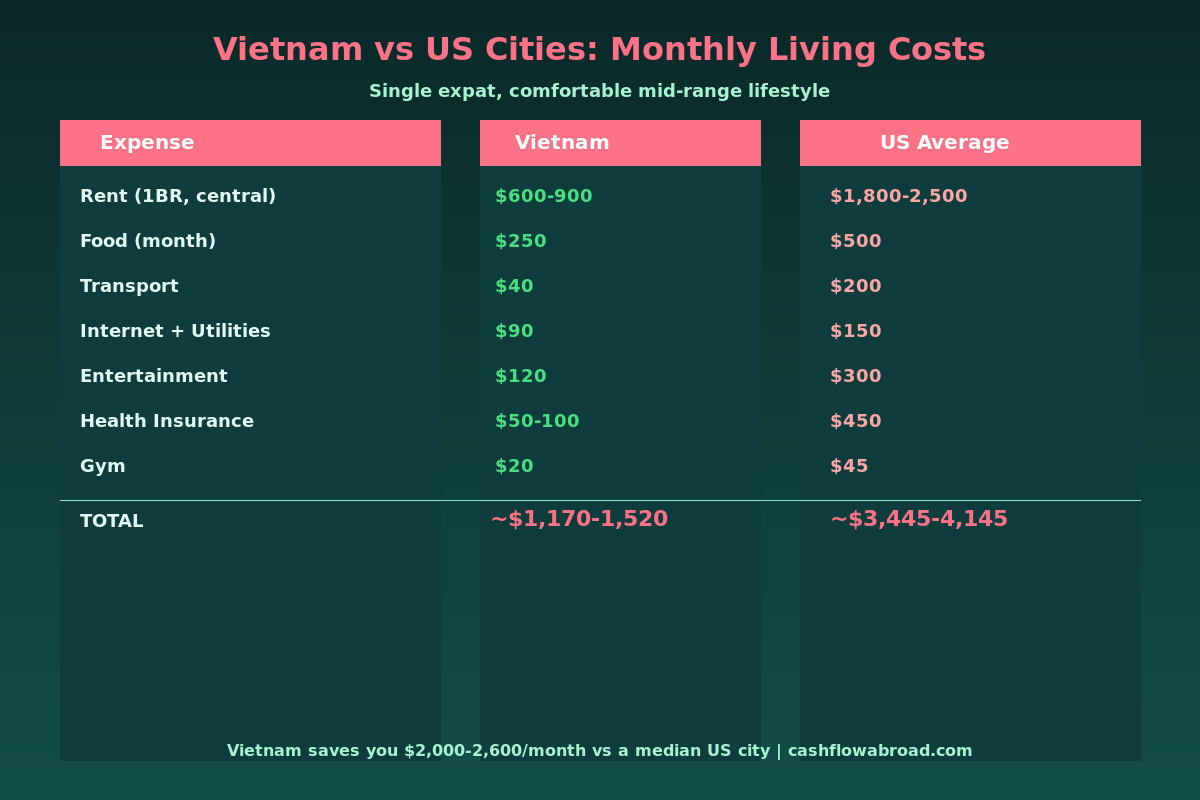
Vietnam is genuinely cheap — not "cheap for Southeast Asia" cheap, but cheap relative to almost anywhere a Westerner might choose to live. Here's what a comfortable single expat actually spends monthly:
| Expense | Ho Chi Minh City | Hanoi | Da Nang |
|---|---|---|---|
| Rent (1BR, central) | $700–$900 | $550–$750 | $400–$600 |
| Groceries + dining | $250–$350 | $200–$300 | $180–$280 |
| Transport (Grab + scooter) | $50–$80 | $40–$70 | $30–$60 |
| Internet + utilities | $80–$110 | $70–$100 | $65–$95 |
| Entertainment, gym, misc | $150–$250 | $120–$200 | $100–$180 |
| Total (comfortable) | $1,230–$1,690 | $980–$1,420 | $775–$1,215 |
A few specifics: mobile data with a local SIM (Viettel, Vinaphone) runs $3/month for unlimited. Fiber internet at home is $11/month. Two people can eat a full street food meal for under $5. If you opt for Western-style dining and serviced apartments with a rooftop pool in HCMC's District 1, you can spend $4,000+/month with ease — Vietnam scales both ways.
Health Insurance: Don't Rely on Public Coverage
Vietnamese public hospitals are functional for locals but not calibrated for foreign patients — language barriers, different clinical standards, and outdated equipment outside major cities create real risk. International hospitals (FV Hospital in HCMC, Vinmec in Hanoi) are excellent but expensive without coverage. A single emergency room visit at an international hospital can run $500–$2,000 without insurance.
International expat health insurance is the standard solution. SafetyWing's Nomad Insurance starts at around $56/month for travelers under 39 and covers emergency medical care in Vietnam including evacuation. For longer-term residents who want broader coverage including routine care, their Remote Health plan runs $150–$300/month depending on age and deductible. For a full comparison of plans across price points, see our expat health insurance guide.
Banking in Vietnam: What Actually Works
Opening a Vietnamese bank account without a work permit is genuinely difficult. Vietcombank, Techcombank, and HSBC all require a work permit or temporary residence card — tourist visa holders get turned away. For quarterly-rotation expats, the solution is foreign cards that work globally.
The practical expat banking stack for Vietnam:
- Charles Schwab International account: Zero foreign transaction fees, full ATM fee reimbursement worldwide. The standard recommendation for any expat destination. Open before you leave the US.
- Local bank (if you have a TRC): Techcombank has the best mobile app; Vietcombank is most reliable for salary payments and international wires.
- International transfers: Remitly offers competitive rates for USD-to-VND transfers with direct deposit to Vietnamese bank accounts — far cheaper than US bank international wires.
Vietnam is primarily a cash economy outside major urban centers. Even in HCMC and Hanoi, many landlords, smaller restaurants, and market vendors want VND cash. With Schwab's full ATM reimbursement, withdrawing locally costs you nothing.
If you're maintaining US banking, IRS correspondence, and brokerage accounts while living in Vietnam, a Traveling Mailbox gives you a real US street address for $15/month — essential for preserving your US financial infrastructure from overseas.
Which City Fits Your Life

Ho Chi Minh City (Saigon)
Vietnam's economic engine and home to the largest foreign community — Koreans, Japanese, Taiwanese, and a growing cohort of Western expats concentrate here. The Thao Dien neighborhood in District 2 is the unofficial expat village: international schools, reliable-WiFi cafes, and modern apartments. HCMC is the most expensive Vietnam city but still 60–70% cheaper than comparable US metros. Landmark 81 — the country's tallest building — and a skyline that now rivals a mid-size US city illustrate how fast this place has moved.
Hanoi
Vietnam's capital is more traditional, more chaotic, and roughly 20% cheaper than HCMC. The Old Quarter works well for short stays. The Tay Ho (West Lake) district is where long-term expats prefer to settle — wider streets, lakeside paths, and a calmer pace. Hanoi is better if you want more cultural immersion and lower costs; HCMC wins for infrastructure and the larger international community.
Da Nang
The best lifestyle-to-cost ratio in Vietnam. Beach access, mountains 30 minutes away, a growing coworking scene, and rents 30–40% below HCMC. The expat community is deliberately smaller — mostly remote workers who specifically chose Da Nang over the more crowded hubs. Best city in Vietnam for anyone who wants sun, surf, and reliable broadband without Ho Chi Minh City prices.
Hoi An
The boutique option — a UNESCO-listed ancient town with lantern-lit streets, exceptional Vietnamese cuisine, and a tight-knit small expat community. Limited coworking infrastructure, rents of $400–$600/month for a good apartment, and a pace that suits writers, designers, or anyone who can work without a large professional network immediately around them.
The Geographic Arbitrage Math
On a $60,000/year remote income, the comparison that matters most: what does living in Vietnam versus staying in a US city actually save you? A remote worker applying the geographic arbitrage playbook gets concrete numbers here.
Assumptions: $60,000 earned income, single filer, FEIE applied (zeroing out US federal income tax on earned income). Social Security/Medicare self-employment tax (~14.1%) still applies: roughly $8,460/year regardless of country.
- Chicago living costs: ~$3,800/month = $45,600/year
- HCMC living costs: ~$1,400/month = $16,800/year
- Annual savings from the move: $28,800
- 5-year compounded (8% return): ~$211,000
That $211,000 gap is the cost of not moving. And it understates the case: most people who move to HCMC report their quality of life improves — better food, warmer weather, more interesting daily life, and a city that visibly rewards curiosity.
First 30 Days: Setup Checklist
- Get the e-visa before you fly. Apply at evisa.gov.vn at least 5 days out. $50, 3-day processing, 90-day multiple-entry.
- Arrive with USD cash. ATMs dispense VND; US dollars are accepted for large transactions and exchanged at better rates at local gold shops (tiệm vàng) than bank counters.
- Get a local SIM at the airport. Viettel and Vinaphone both have airport kiosks. $5 gets unlimited data immediately and activates your Grab account.
- Book short-term housing first. Spend 2–4 weeks in a serviced apartment or Airbnb while scouting neighborhoods before signing any lease.
- Join a coworking space. Toong and Toong Premium are reliable Vietnam-wide chains. Hot desks run $80–$150/month with stable internet and a professional community.
- Track your days from day one. If you're doing the under-183-day strategy, keep a spreadsheet. Vietnam immigration records every entry and exit date. A miscalculation shifts your entire tax position for the year.
The Honest Caveats
Vietnam is not a retirement visa destination. There's no formal long-stay retirement visa here — unlike Malaysia's MM2H or Panama's Pensionado program. The setup requires ongoing visa management. For retirees who want permanent legal status with minimal bureaucracy, other destinations rank higher. See our retirement abroad guide for the full comparison.
Air quality in major cities is a real factor. HCMC and Hanoi regularly hit AQI levels of 100–160 during dry season months. Da Nang is meaningfully cleaner. If you have respiratory conditions, this matters before you choose a city.
Language barrier requires patience. Outside tourist areas and expat neighborhoods, English is limited. Google Translate solves most daily situations, but lease disputes, medical visits, and bureaucratic tasks are dramatically easier with a Vietnamese-speaking contact.
No digital nomad visa exists yet. You're operating on tourist infrastructure. The enforcement posture has been consistently tolerant, but it's worth monitoring Vietnamese immigration policy annually if you're basing a major financial decision on remote work here.
The Bottom Line
Vietnam is the least-hyped value in Southeast Asian expat living. The cost numbers beat Thailand at comparable lifestyle levels. The food is genuinely exceptional. The internet infrastructure rivals developed countries at $11/month. The sub-183-day zero-tax strategy requires some logistical discipline but no exotic structures or expensive advisors. The expat community of roughly 100,000 foreign nationals is large enough to feel supported without having been fully priced into the local cost of living yet.
If you're running the numbers on geographic arbitrage, Vietnam belongs on the shortlist — particularly if you find Bali overrun, Chiang Mai too slow, or Lisbon too expensive. The window where it's this affordable won't stay open indefinitely.
Financial disclaimer: This article is for informational and educational purposes only and does not constitute tax, legal, or financial advice. Vietnamese tax law, US expatriate tax rules, and immigration regulations are complex and subject to change. Consult a qualified professional familiar with both US expatriate taxation and Vietnamese tax law before making residency or financial decisions.
This guide is general information, not personalized tax, legal, or investment advice. Rules change; verify current thresholds with official sources or a qualified professional before acting.
Related guides
 Geographic ArbitrageMay 27, 2026
Cambodia Expat Guide: Dollar Economy, $800/Month, No Foreign Tax
Cambodia uses US dollars, costs under $1,200/month, and exempts foreign income from local tax. Full guide for US expats with real numbers and IRS
 Geographic ArbitrageJune 3, 2026
Retire in the Philippines: SRRV, Costs, and Setup
SRRV deposit from $15K, Cebu life from $1,200 monthly, Philippine law exempts foreign pension remittances from local tax. Full relocation setup guide.
 Geographic ArbitrageMay 15, 2026
Andorra's 10% Flat Tax: Europe's Best-Kept Expat Secret
Andorra offers a 10% max income tax, 4.5% VAT, and zero inheritance tax. Full guide: residency types, costs, and the US expat catch.