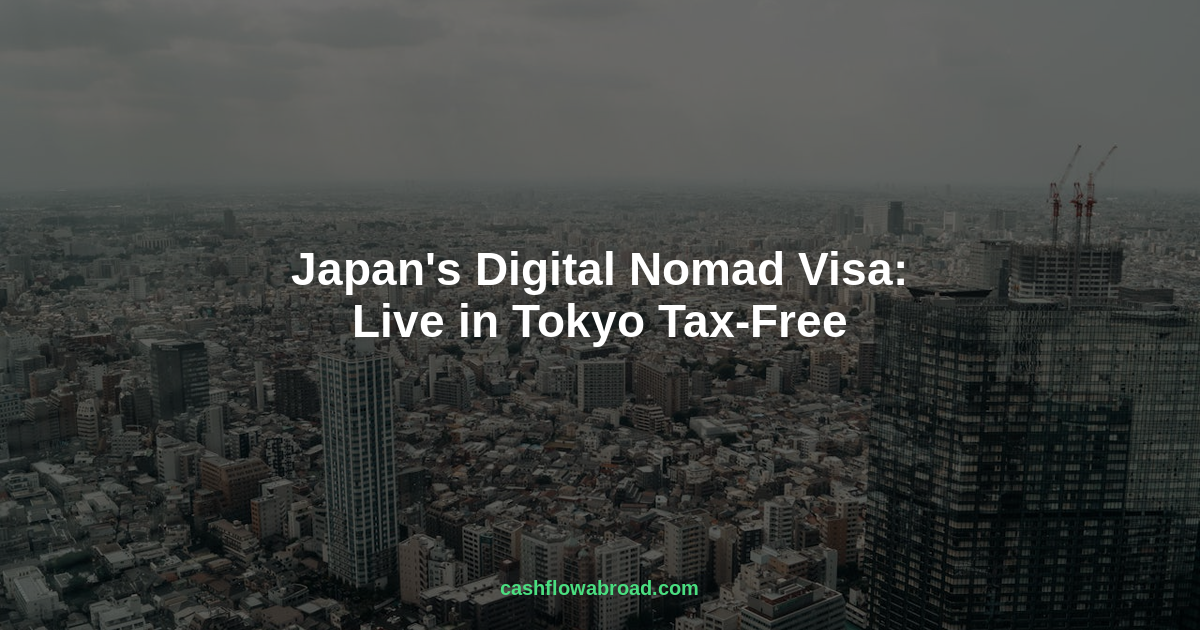
Japan’s Digital Nomad Visa: Live in Tokyo Tax-Free
9 min read · 2,127 words
At 159 yen to the dollar — the weakest the yen has been in three decades — a comfortable life in Tokyo now costs less per month than renting a one-bedroom apartment in Austin, Texas. That’s not a misprint. Japan, the country expats assumed would stay expensive forever, quietly became one of the best geographic arbitrage plays on the planet for remote workers earning in USD.
Japan launched its digital nomad visa in 2024. It requires $63,000 in annual income, a health insurance policy, and paperwork that takes 5–10 business days to process. You get 6 months in one of the world’s greatest cities, zero Japanese income tax on your foreign-sourced earnings, and a cost of living that undercuts most mid-tier American cities. Here’s exactly how it works and whether it’s worth it.
What Is Japan’s Digital Nomad Visa?
Japan’s “Specified Visa for Designated Activities (Digital Nomad)” launched in March 2024, targeting remote workers employed by or contracted with businesses outside Japan. It’s a 6-month, single-entry visa in the “Specified Visa” category — distinct from tourist visas and long-term resident status.
The key legal distinction: because your income originates from non-Japanese sources and your stay is under a year, Japan does not consider you a tax resident. You pay zero Japanese income tax. Compare that to actually moving to Japan on a standard work visa, where you’d face progressive income tax up to 45% plus a 10% inhabitant tax — a combined marginal rate of 55.945% on high earners. The digital nomad visa sidesteps all of that entirely.
For US citizens, the picture is more nuanced (it always is). The US taxes worldwide income regardless of where you live. But if you meet the Foreign Earned Income Exclusion requirements — specifically the Physical Presence Test of 330 days outside the US in any 12-month period — you can exclude up to $132,900 of earned income for 2026. Combined with Japan’s zero-tax stance on your income, the math can be very favorable.
Visa Requirements: The Full Checklist
Japan’s requirements are strict compared to most Southeast Asian nomad visas, but the process is remarkably fast:
| Requirement | Details |
|---|---|
| Income | ¥10 million/year (~$63,000 at April 2026 rates) |
| Nationality | Citizen of one of 50+ countries with a Japan tax treaty AND visa-exempt entry (US, Canada, UK, Australia, NZ, most of Europe) |
| Health insurance | Private policy covering minimum ¥10 million (~$63,000) for injury, illness, and death |
| Employer | Must work remotely for a company or clients entirely outside Japan |
| Passport validity | Valid for full duration of stay |
| Processing time | 5–10 business days |
| Visa fee | Approximately $16–31 USD depending on citizenship |
The income threshold is the primary filter. At ¥10 million/year, Japan is targeting established remote professionals — developers, designers, consultants, marketers, copywriters — not entry-level freelancers. If you gross $63K+ annually from non-Japanese sources, you’re in. That’s the bar for roughly 40% of full-time remote US workers in tech.
What You Cannot Do
The visa strictly prohibits working for Japanese companies, providing services to Japanese domestic clients, or any business activity that serves the Japanese market. This is a hard line. If your employer is US-based and your clients are in North America and Europe, you’re fine. If you take a side gig from a Tokyo startup you met at a coworking space, you’ve violated the visa terms. Japan’s immigration enforcement is not casual — this isn’t a risk worth taking.
Duration and the Re-Entry Strategy
The digital nomad visa is valid for 6 months maximum and is not renewable within Japan. Once it expires, you must leave. But here’s the strategic angle most guides miss: after spending 6 consecutive months outside Japan, you can reapply for a fresh 6-month visa. In practice, many nomads are building Japan into annual rotation strategies — 6 months in Tokyo, 6 months in Southeast Asia, repeat.
Family members can accompany you on dependent visas without any additional income proof. Unlike several European digital nomad programs that require extra income for each dependent, Japan asks for nothing beyond your existing proof of income. A meaningful advantage for nomads traveling with partners or children.
Cost of Living: What the Yen Actually Buys You
The received wisdom on Japan has always been: expensive. And for yen earners, that’s still partially true — Japan saw 20,609 food product price increases through 2025, 64.6% more than the prior year. Domestic inflation is real. But for dollar earners at ¥159/$1, the currency effect overwhelms the price increases by a wide margin.
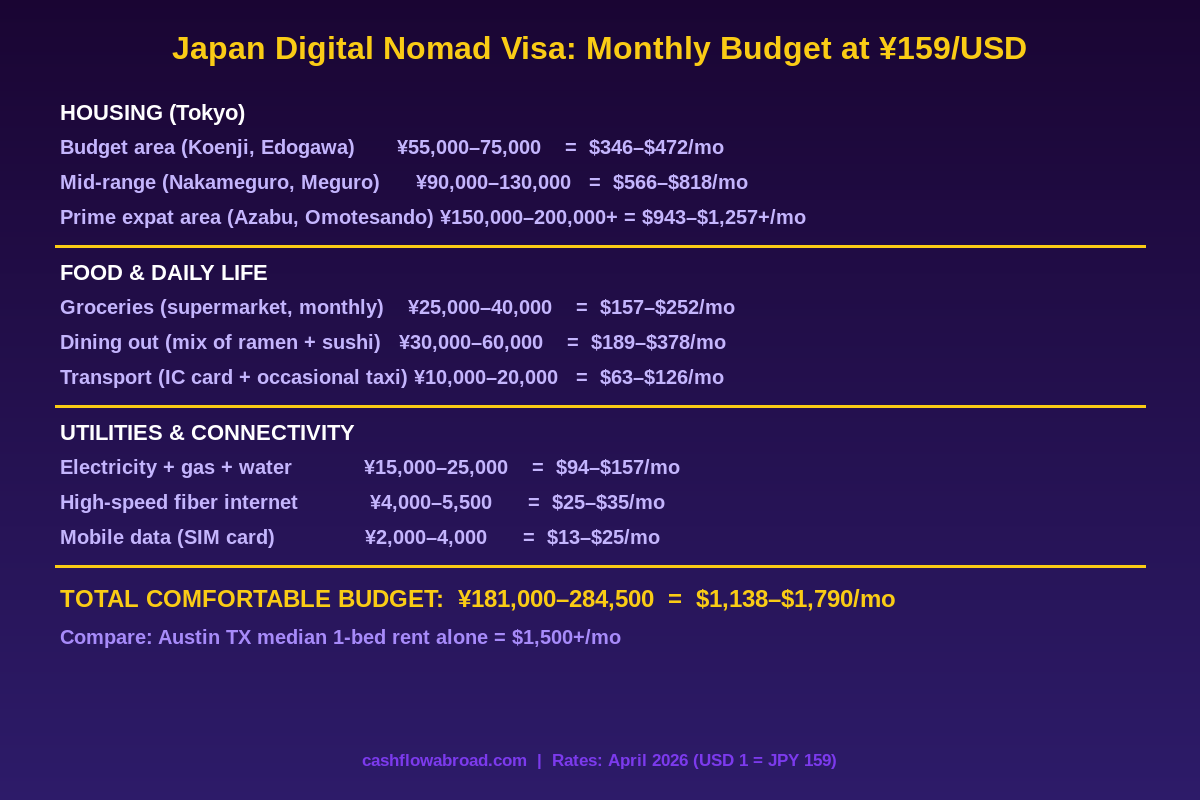
A studio apartment in Tokyo’s outer wards — Koenji, Shimokitazawa, Edogawa — runs ¥55,000–75,000/month, or $346–$472 at April 2026 rates. The median Austin studio is $1,300+. Mid-range neighborhoods like Nakameguro, Meguro, and Sangenjaya cost ¥90,000–130,000/month ($566–$818). Even the upscale expat enclave of Azabu runs ¥150,000–200,000/month ($943–$1,257) — competitive with equivalent-quality apartments in San Francisco or New York.
Full Monthly Budget
| Category | Monthly (JPY) | USD Equivalent |
|---|---|---|
| Rent (mid-range 1-bed) | ¥90,000–120,000 | $566–$755 |
| Groceries (supermarket) | ¥25,000–40,000 | $157–$252 |
| Dining out (ramen, sushi, izakaya mix) | ¥30,000–60,000 | $189–$378 |
| Transport (IC card + occasional trips) | ¥10,000–20,000 | $63–$126 |
| Utilities (electricity, gas, water) | ¥15,000–25,000 | $94–$157 |
| Fiber internet | ¥4,000–5,500 | $25–$35 |
| Mobile SIM | ¥2,000–4,000 | $13–$25 |
| Entertainment / misc | ¥15,000–30,000 | $94–$189 |
| Total | ¥191,000–304,500 | $1,201–$1,915 |
A comfortable solo life in mid-range Tokyo runs $1,200–$1,900/month. For someone earning $63K/year ($5,250/month gross), that’s a 64–77% savings rate — in Tokyo. For a developer or consultant at $150K, you’re looking at a 6-month stint where you barely touch your income.
Best Neighborhoods for Digital Nomads
Tokyo is enormous — 14 million people in the city proper, 37 million in Greater Tokyo. Where you live shapes your budget and daily rhythm dramatically.
Koenji / Shimokitazawa — Budget option with genuine local flavor. Record shops, vintage boutiques, cheap izakayas, late-night ramen. Rent runs ¥55,000–80,000/month. Shimokitazawa has built a reputation as Tokyo’s “Brooklyn” — if that means anything to you, it’s either a selling point or a red flag.
Nakameguro / Daikanyama / Sangenjaya — The mid-range sweet spot. Nakameguro’s canal becomes legendary during cherry blossom season. Excellent coworking infrastructure, boutique coffee that punches above most world cities, and good transit links to Shibuya and Ebisu without Shibuya pricing. Budget ¥90,000–130,000/month.
Minato / Azabu / Hiroo — The traditional expat enclave. Embassies, international supermarkets, English-language medical care, international schools. If you have a family or prioritize English services over cultural immersion, this is the zone. 1-beds run ¥150,000–300,000+.
Okinawa — A completely different Japan. Monthly costs for a single person run $1,100–$1,600, the pace is slower, and there’s more of a beach-adjacent digital nomad culture developing. Worth considering if density isn’t your thing.
The Housing Problem Nobody Warns You About
Japan’s traditional rental system involves “key money” (礼金, reikin) — a non-refundable gift to the landlord of 1–2 months’ rent — plus a security deposit of 2 months and an agency fee of 1 month. On a ¥100,000/month apartment, that’s ¥400,000–500,000 ($2,515–$3,145) just to get through the door, before you’ve paid a single month’s rent. On a 6-month stay, that dramatically changes the economics.
Practical workarounds:
- Sakura House / Leo Palace 21 — Foreigner-friendly, furnished, no reikin, English contracts. Higher per-month cost (¥70,000–120,000) but dramatically lower move-in friction. The right choice for most 6-month stints.
- Gaijin houses (share houses) — Shared housing built around foreign residents. ¥40,000–60,000/month all-in. Good for solo nomads; built-in social life.
- Monthly furnished apartments / Airbnb monthly rates — Legal monthly options exist. Budget ¥100,000–200,000/month for furnished studios. Easier than standard rentals but more expensive per square meter.
- Standard rentals via bilingual agent — Targeting “no reikin” (礼金0) listings on Suumo.jp or Homes.co.jp with a bilingual agent cuts move-in costs significantly and opens higher-quality inventory.
Satisfying the Health Insurance Requirement
Japan requires private health insurance covering a minimum of ¥10 million ($63,000) for medical expenses, injury, illness, and death during your stay. Japan’s national health insurance (kokumin kenko hoken) is not available to digital nomad visa holders — that’s for residents only.
SafetyWing Nomad Insurance is the simplest option. Coverage starts at $56.28/month for ages 18–39, with $250,000 in medical coverage — well above Japan’s ¥10 million floor. It covers you globally as you rotate countries, and signup is fully online. For a 6-month Japan stay, that’s roughly $338 total. Higher-limit options from Cigna Global or AXA International run $150–250/month if you want broader coverage. See the expat health insurance guide for a full comparison of what these policies actually cover in practice.
Banking and Getting Connected
Japan is less cash-dependent than its reputation suggests — IC cards (Suica, Pasmo) work for transit, convenience stores, vending machines, and increasingly for restaurants and shops. Contactless payment adoption accelerated significantly post-2024. That said, ATM access for foreign cards remains important for day-to-day withdrawals.
Charles Schwab’s international bank account is the standard recommendation for expats worldwide: unlimited ATM fee reimbursements globally, no foreign transaction fees, no monthly fees. Japan Post and 7-Eleven ATMs reliably accept foreign cards. On a 6-month stay, not paying $3–5 per withdrawal adds up to a few hundred dollars in savings.
For connectivity, Japan has exceptional LTE coverage. Local SIMs from providers like IIJmio or Mineo run ¥2,000–4,000/month for data. If you’re building a multi-country rotation and don’t want to hunt for SIMs on arrival, a Saily eSIM lets you activate Japan coverage before you land. Japan’s fiber internet is among the world’s best — 1 Gbps connections in apartments for ¥4,000–5,500/month ($25–35) are standard, not exceptional.
US Tax Strategy for Japan Nomads
The visa’s zero-Japan-tax status is clean and well-defined. US tax strategy takes more planning.
To qualify for the FEIE, most Japan nomads use the Physical Presence Test: 330 days outside the US in any 12-month period. This is flexible — the 12 months don’t need to align with the calendar year, and “outside the US” includes your entire time in Japan. For a 6-month Japan stay built into a larger international rotation, the 330-day test is achievable.
For 2026, the FEIE excludes up to $132,900 of earned income from US federal tax. A software developer earning $120,000 in salary who qualifies for the FEIE and spends 6 months in Tokyo could owe zero federal income tax on their earned income (self-employment tax still applies to the self-employed). The Foreign Housing Exclusion can layer on top to exclude housing costs above the base amount.
Two things to track obsessively: your exact day count for the 330-day test, and FBAR requirements. If your Japanese bank or investment accounts exceed $10,000 at any point, FinCEN 114 is due. Consult the US expat tax guide for the full FBAR/FATCA framework before you arrive.
How to Apply: Step-by-Step
Applications go through a Japanese consulate or embassy in your home country (not online, not on arrival). What you need:
- Visa application form — From the Ministry of Foreign Affairs website or your consulate. Sign in ink; pencil is rejected.
- Passport photo — Recent, white background, passport-sized.
- Valid passport — Covering your full intended stay.
- Proof of income — Most recent tax return (Form 1040 for US citizens), employment contract, or bank statements showing consistent deposits of ¥10M+/year.
- Proof of remote employment — Company letter confirming remote work for a non-Japanese entity, or signed freelance contracts with non-Japanese clients.
- Health insurance documentation — Policy letter confirming ¥10M+ coverage for injury, illness, and death during your stay dates.
- Planned activities statement — Brief description of what you’ll do (remote work + personal activities). One page is sufficient.
Submit at your nearest Japanese consulate. Processing: 5–10 business days. Visa fee: $16–31. For one of the world’s most in-demand travel destinations, it’s a surprisingly simple and fast process — far easier than EU golden visa programs or LATAM long-stay visas.
How Japan Stacks Up Against Competing Visas
| Visa | Income Requirement | Duration | Tax on Foreign Income | Visa Fee |
|---|---|---|---|---|
| Japan Digital Nomad | $63,000/yr | 6 months | Zero | $16–31 |
| Indonesia E33G (Bali) | $60,000/yr | 6 months | Zero | ~$150 |
| Portugal D7 | ~$1,400/mo | 2 years (renewable) | Taxed in Portugal | ~$250 |
| Thailand LTR Visa | $80,000/yr | 10 years | Partial exemption | ~$350 |
| Malaysia MM2H | $24,000/yr + liquid assets | 5 years | Zero (foreign income) | ~$500+ |
Japan’s limitation is duration — 6 months is hard to argue around. If you need a long-term base, the Thailand LTR or Malaysia MM2H is the better vehicle. But Japan wins on cultural and logistical quality-of-life by a wide margin. The closest comparable is Indonesia’s E33G for Bali — same 6-month duration, similar income threshold, similar tax treatment. The choice between them is largely personal preference and what you want out of the experience.
The Bottom Line
Japan’s digital nomad visa filters for income ($63K minimum), but what it delivers is exceptional: 6 months in one of the world’s safest, most livable, and most culinarily complex cities, with zero Japanese income tax, and a monthly cost of living that has become legitimately competitive with mid-tier US cities at the current yen rate. A comfortable life in Tokyo — mid-range apartment, eating well, transit pass included — runs $1,200–$1,900/month. That number would have been unthinkable five years ago.
The window may not stay open indefinitely. Yen weakness is historically cyclical, and Japan’s immigration liberalization is still cautious relative to Southeast Asian peers. For remote workers earning $80K+ who haven’t priced out a Japan stint, the calculation right now is unusually favorable. The infrastructure is world-class, the visa process is fast, and the geographic arbitrage math actually works. Run the numbers.
This post is for informational purposes only and does not constitute tax, legal, or financial advice. US expat tax rules are complex and change frequently. Consult a qualified expat CPA or immigration attorney before acting on any visa or tax strategy. Exchange rates cited are approximate as of April 2026 and fluctuate daily.
Liked this article?
Get the next one delivered straight to your inbox — plus a free Expat Tax Cheat Sheet.
Join our subscribers. No spam — just expat finance intel and new post notifications.