Social Security for Expats: Collect Full Benefits from Abroad
US expats can collect Social Security in 186+ countries. The 2025 WEP repeal restored hundreds per month for expats with foreign pensions. Here is how to set it up.
US expats can collect Social Security in 186+ countries. The 2025 WEP repeal restored hundreds per month for expats with foreign pensions.
Disclosure: this article contains affiliate links. If you open an account through one of them, Cashflow Abroad may earn a referral commission at no extra cost to you.
Here's the thing most people get wrong: Social Security doesn't evaporate the moment you board a one-way flight. The US government will happily deposit your monthly check directly into a bank account in Portugal, Mexico, Thailand, or Colombia — and the amount doesn't shrink because you moved. Of the world's 195 recognized countries, the Social Security Administration can send payments to all but nine. That's a 95%+ clearance rate most Americans have no idea about.
And it gets better. A law signed in January 2025 just handed back hundreds of dollars per month to thousands of expats who'd been quietly getting cheated for decades. If you've ever worked for a foreign government, contributed to a local pension, or held a public-sector job outside the US, your Social Security was probably docked — sometimes by as much as 50%. That ended. Retroactively.
Here's everything you need to know to collect every dollar you've earned, from wherever you've decided to live.
Who Qualifies to Collect Abroad
The eligibility rules don't change when you cross a border. To collect Social Security retirement benefits, you need 40 work credits — roughly 10 years of paying into the system. The amount you receive is based on your highest 35 earning years, and your decision about when to claim (between 62 and 70) affects your benefit amount, not your address.
One important nuance for non-citizens: if you're a non-US citizen living abroad, the SSA will stop payments after six consecutive months outside the United States — unless you're a citizen of a country with a totalization agreement or meet other specific exceptions. US citizens face no such restriction. You can live in Lisbon or Bangkok indefinitely without a single payment being paused.
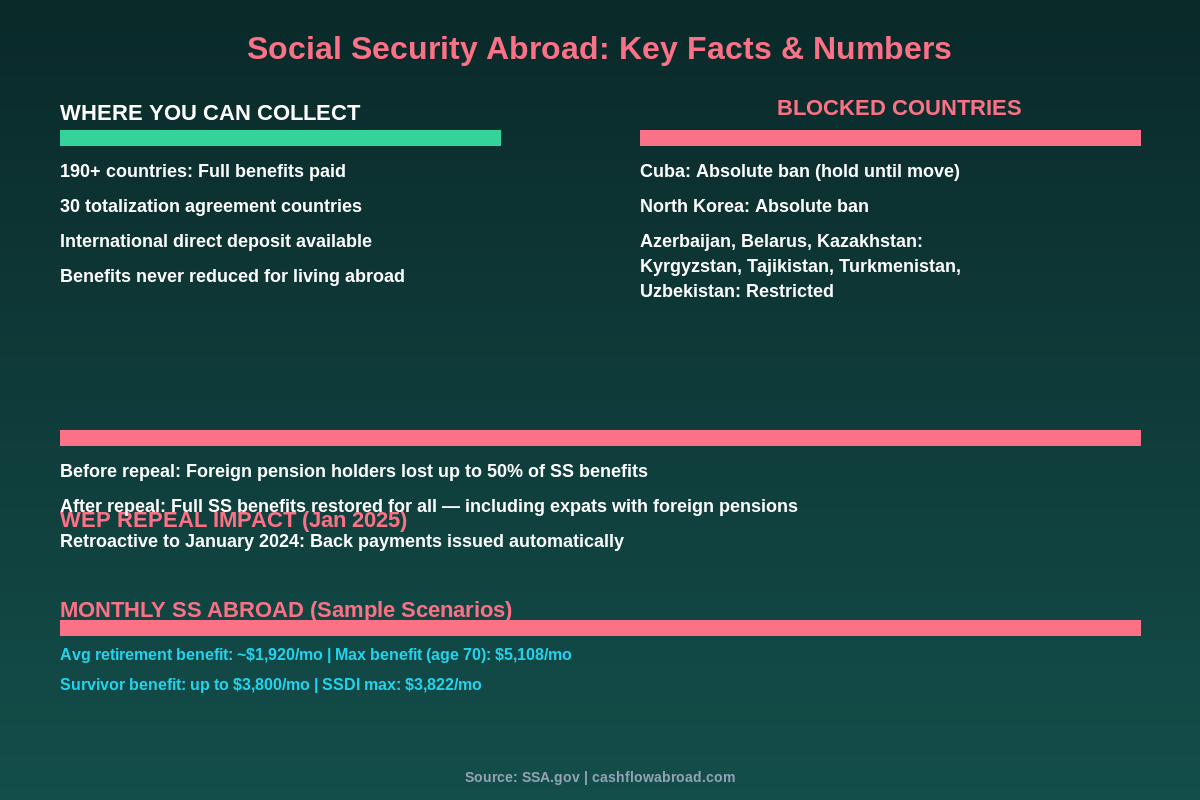
The current average retirement benefit is ~$1,920/month ($23,040/year). The maximum at full retirement age is around $4,018/month, and if you delay until 70, you can reach $5,108/month — the highest it's ever been.
The 9 Countries That Block or Restrict Payments
The SSA organizes countries into three categories. Most fall into a clean "you're good" bucket. A handful are blocked or restricted:
| Country | Status | What Happens If You Move There |
|---|---|---|
| Cuba | Absolute ban | Payments held; released once you move to an eligible country |
| North Korea | Absolute ban | Same as Cuba for US citizens; non-citizens lose those months permanently |
| Azerbaijan | Restricted | Limited exceptions available; requires agreement with SSA |
| Belarus | Restricted | Limited exceptions available |
| Kazakhstan | Restricted | Limited exceptions available |
| Kyrgyzstan | Restricted | Limited exceptions available |
| Tajikistan | Restricted | Limited exceptions available |
| Turkmenistan | Restricted | Limited exceptions available |
| Uzbekistan | Restricted | Limited exceptions available |
The restrictions on the Central Asian countries aren't political in the same way Cuba and North Korea are — they stem from Treasury Department regulations and the absence of qualifying financial infrastructure. If you retire in Tashkent, you're not out of luck forever; you just need to negotiate specific payment conditions with the SSA's Office of International Operations.
If you're in Cuba or North Korea as a US citizen and then move to an eligible country, every held payment gets released. The money doesn't disappear — it waits.
The WEP Repeal: Thousands of Expats Just Got a Raise
This is the part most expat publications haven't fully covered yet.
For decades, the Windfall Elimination Provision (WEP) and the Government Pension Offset (GPO) quietly slashed Social Security benefits for anyone who also received a pension from employment not covered by Social Security taxes. That included teachers, police, firefighters — and critically for expats — anyone who worked for a foreign government or contributed to a mandatory foreign pension system.
The WEP formula could reduce your Social Security by up to 50% of your foreign pension amount. If you spent ten years working for the German government contributing to Deutsche Rentenversicherung, your US Social Security benefit took a serious hit — even though you paid into both systems separately.
President Biden signed the Social Security Fairness Act into law on January 5, 2025. It eliminated both WEP and GPO completely. The repeal is retroactive to January 2024, which means:
- If you were already receiving reduced benefits, your monthly payment automatically increased
- You're owed back payments for every month since January 2024 that you received a docked amount
- The SSA is processing these retroactive payments automatically — if you haven't seen the increase, contact the Office of Earnings and International Operations at 410-965-0160
For some expats, the restoration is $300–$600/month. If you've been collecting for years with a foreign pension hitting your benefit, do the math: what was your pre-WEP benefit versus what you received? The difference multiplied by the months since January 2024 is what you're owed.
How to Actually Receive Payments Abroad
You have three practical options for receiving Social Security payments outside the US:
Option 1: Keep a US Bank Account (Recommended)
This is the cleanest setup for most expats. Social Security deposits into any US bank account, and you access the money with a debit card or wire to your local account. The key is finding a US bank that doesn't punish you for being abroad.
Charles Schwab's investor checking account is the standard recommendation in the expat community — no account fees, no foreign transaction fees, and unlimited worldwide ATM reimbursements. Your Social Security lands in Schwab, you withdraw in local currency at an ATM in Lisbon or Medellín, and you pay zero fees. It's how many of the expats in our retirement abroad guide are running their finances.
One practical note: even if you bank abroad, maintaining a US address matters. The SSA uses your address for correspondence, annual questionnaires, and Form SSA-1099 (your annual benefits statement for taxes). A virtual mailbox like Traveling Mailbox gives you a real US street address in 50+ cities — mail gets scanned and forwarded digitally, so you never miss SSA correspondence. At $15/month, it's cheap insurance against having your benefits paused due to an unresponsive address. See our full virtual mailbox guide for expats for setup details.
Option 2: International Direct Deposit
In countries that participate in the SSA's international direct deposit program, Social Security can send payments directly to a foreign bank account. This includes most of Western Europe, Canada, Australia, Japan, and dozens of other countries.
The catch: your foreign bank may charge fees on incoming international transfers, eating into your benefit. Check the SSA's Payments Abroad page for the current participating country list. For most expats in popular destinations (Portugal, Mexico, Thailand, Colombia), this works fine.
Option 3: Paper Check (Last Resort)
The SSA can mail a paper check to most countries. This is slower, involves currency conversion fees, and carries the risk of delays or loss. Only use this if the other options aren't available in your destination country.

How Social Security Gets Taxed When You Live Abroad
This is where a lot of expats get surprised — and not in a good way. Two common misconceptions need clearing up fast:
Misconception 1: "I'll exclude my SS from taxes using FEIE." No. The Foreign Earned Income Exclusion only applies to earned income — wages and self-employment income. Social Security is neither. Your benefits are fully subject to standard US taxation rules regardless of where you live. Full breakdown at our FEIE guide.
Misconception 2: "I won't owe US taxes because I live abroad." Also no. US citizens pay taxes on worldwide income regardless of residence. The question is how much of your SS is taxable — and whether any tax treaty changes that calculation.
Under standard IRS rules, up to 85% of your Social Security benefits are taxable if your "combined income" (adjusted gross income + nontaxable interest + half your SS benefit) exceeds $34,000 for single filers or $44,000 for married filing jointly. Below $25,000 single / $32,000 MFJ, none of it is taxable.
Countries Where Treaties Change the Rules
Certain US tax treaties give the country of residence the exclusive right to tax Social Security benefits — meaning zero US tax on those payments. This applies in a handful of countries:
| Country | SS Tax Treatment Under Treaty |
|---|---|
| Germany | Only Germany taxes US SS paid to German residents; US does not |
| Italy | Only Italy taxes US SS paid to Italian residents |
| Switzerland | Treaty limits US taxing rights on Social Security |
| Canada | Both countries have partial rights; treaty reduces but doesn't eliminate US tax |
| Most other countries | Standard IRS rules apply; up to 85% may be taxable in US |
Treaty benefits don't apply automatically — you have to claim them on your Form 1040 and reference the relevant treaty article. Missing this is a common and expensive mistake. If you're moving to Germany or Italy specifically to retire, the treaty election could save you thousands per year. The US tax treaties guide covers how to claim these elections properly.
The 30-Country Totalization Advantage
Separate from income tax, there's the question of Social Security contributions if you're still working while living abroad — freelance, remote, or self-employed. Without protection, you could theoretically owe Social Security taxes to both the US and your country of residence. Totalization agreements prevent this double hit.
The US has agreements with 30 countries, including the UK, Germany, France, Canada, Australia, Japan, South Korea, and most of Western Europe. Under these agreements, you contribute to one system only. Coverage periods from both countries can also be combined to meet eligibility thresholds — which matters if you split your career between two countries and don't hit the 40-credit minimum in either one alone.
The full list of countries and what each agreement covers is in our totalization agreements breakdown.
The Annual Questionnaire: Don't Ignore It
Once you start collecting Social Security abroad, the SSA sends a questionnaire every one to two years to verify continued eligibility. It asks whether you're still alive (yes, really), whether your marital status has changed, and whether you've returned to work. If you don't respond, benefits get suspended — and resuming them requires contacting the Office of Earnings and International Operations directly, which can take weeks.
Keep your US mailing address current with the SSA. If you're using a virtual mailbox service, make sure they forward physical mail promptly or set up online access at SSA.gov/myaccount, where you can respond to questionnaires digitally. This is the kind of admin task that feels trivial until it causes a three-month payment gap.
The Medicare Problem (and How Expats Handle It)
Here's the one genuine downside of retiring abroad on Social Security: Medicare doesn't travel with you. Medicare Parts A and B cover US-based care only. Use it abroad and you're paying out of pocket — Medicare won't reimburse foreign providers.
Expat retirees use two main approaches:
- Expat health insurance: SafetyWing offers comprehensive international coverage for seniors starting around $99/month. Cigna Global and Allianz Care handle more complex pre-existing conditions. Full comparison at our expat health insurance guide.
- Local national health systems: Many countries with retirement visa programs (Portugal D7, Costa Rica Rentista, Panama Friendly Nations) provide access to national health care for legal residents — often at a fraction of US private insurance costs.
Most expat retirees continue paying Part B premiums ($185/month in 2026) to preserve Medicare for US visits, then use expat insurance or local systems abroad. Annoying? Yes. But Medicare's late enrollment penalty — 10% per year you delay enrollment after becoming eligible — is more annoying. Pay the premium, keep the backup.
Where Your SS Benefit Goes Furthest
A $2,500/month Social Security benefit is a stretch in a US metro area. In many expat-popular cities, it's comfortable — even generous. Some rough benchmarks for a couple living on Social Security alone:
- Medellín, Colombia: $2,000/month covers rent, food, entertainment, and private health insurance with money left over
- Chiang Mai, Thailand: $1,500/month covers comfortable living; $2,500 puts you in the upper tier
- Lisbon, Portugal: $2,500-$3,000/month covers a decent lifestyle; significantly cheaper than similarly livable US cities
- Oaxaca, Mexico: $1,500-$2,000/month is fully sufficient; proximity to the US keeps travel costs manageable
For a full breakdown of monthly costs in the top retirement destinations — including actual rent, healthcare, and food numbers — see our guide to the best places to retire abroad on Social Security.
Seven Steps Before You Leave
- Verify your SS statement: Create an account at SSA.gov/myaccount. Check your estimated benefit at different claiming ages and review your earnings record for errors — errors happen, and correcting them after three years becomes much harder.
- Check your destination country: Use the SSA's Payments Abroad Screening Tool to confirm payments flow to your destination.
- Open a Schwab account: Schwab investor checking takes 2-3 weeks to process and requires a US address — set it up before you leave.
- Get a virtual mailbox: Traveling Mailbox gives you a real US street address for SSA correspondence and your annual SSA-1099.
- Check your WEP repeal status: If you have a foreign pension and were collecting SS before January 2025, verify your benefit was restored. Call SSA at 410-965-0160 if your payment hasn't increased.
- Review any applicable tax treaty: If you're moving to Germany or Italy, check whether the treaty shifts your SS taxation to your country of residence. Worth a conversation with an expat CPA — could save $2,000-$5,000/year.
- Plan your Medicare strategy: Decide whether to keep Part B or suspend it. Get expat health insurance lined up before you lose US-based coverage.
Bottom Line
Social Security doesn't stop at the border. The US government sends payments to 186+ countries without restriction, and the recent WEP/GPO repeal means that expats with foreign pensions are now getting their full entitlement for the first time in decades. Retroactively.
The logistics — a Schwab account, a virtual mailbox, annual questionnaire responses — are genuinely manageable. The tax piece requires some planning, but it's not complicated if you address it before you leave. The Medicare gap is real but solvable with expat insurance.
What you're left with is a monthly income stream that follows you anywhere on Earth, sized by your US earnings record, unaffected by where you choose to live it out. That's a more powerful setup than most people realize when they're still thinking Social Security is a US-only benefit.
Financial Disclaimer: This article is for informational and educational purposes only and does not constitute financial, tax, or legal advice. Social Security rules, international payment policies, tax treaties, and Medicare regulations change frequently. Consult a qualified expat tax professional and verify current rules directly with the SSA before making any retirement decisions. Benefit amounts referenced are based on SSA data current as of 2025-2026 and are subject to annual cost-of-living adjustments.
This guide is general information, not personalized tax, legal, or investment advice. Rules change; verify current thresholds with official sources or a qualified professional before acting.
Next step
Pair benefits with the full retirement stack
Social Security access matters, but the durable plan combines banking, healthcare, taxes, residency, and emergency return options.
Related guides
 Retirement AbroadMay 31, 2026
Greece's 7% Flat Tax: Pay Less Than Your US State
Greece's 7% flat tax on all foreign pension income lasts 15 years. A California retiree earning $60K saves up to $15,000/year by moving.
 Retirement AbroadOctober 5, 2026
Spain Non-Lucrative Visa Income Requirements
See if you clear the Spain non-lucrative visa income test: €28,800 for one person, €7,200 per dependent, and no remote work.
 Retirement AbroadSeptember 30, 2026
Is an SSA Benefit Taxable Living Abroad?
Check the $25,000 and $34,000 IRS bands, see which countries exempt a US citizen, and run the worksheet before you spend the check.